|
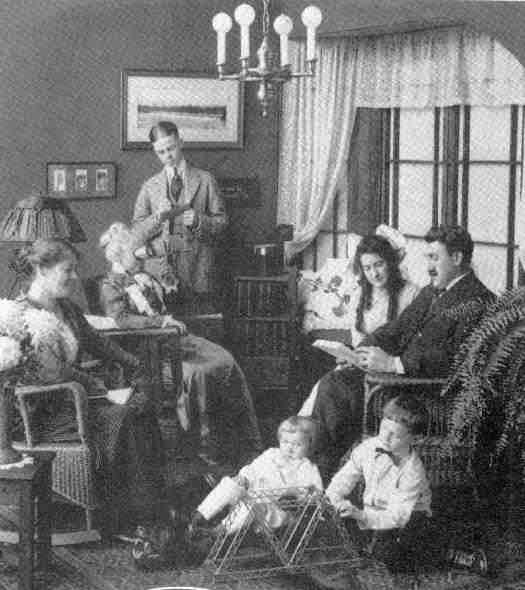
The parlor was a Victorian creation. Before the Victorians few individuals could afford a house with formalized rooms like parlors. The parlor is the creation of the middle class and it was the tremendous wealth generation of the Industrial Revolution that led to a hugely expanded middle class. The parlor to the Victorians was the most formal room of the house. But it was not the center of family life, in fact the children, especially the younger children, were often excluded from the parlor. Views of the Victorian parlor come to us through drawings and paintings. After the turn of the 20th century snap shots of home life begin to appear providing us many more glimpses into the parlor, including what it looked like and the activities conducted there. Many of these glimpses suggest rather formal dress until rather recently--but they also look rather staged. Of course since World War II, informal dress is worn in the modern living room--except for special occasions.
Parlors existed in the 18th century. But the number of persons wealthy enough to have a fine house with a parlor was a very small part of the population. The middle-class existed and was of some importance, but did not dominate society. Then in the English Midlands a phenomenal development began--the Industrial Revolution. This began to reorient society from agriculture and land ownership to industrial production (mid-18th century). The impact was a massive generation of wealth. And the huge expansion of the middle-class. What evolved was machinery and mechanical process. But that machinery was still dependent on human and animal power to drive it plus a measure of water driven inputs. (This is why even the most the most powerful and sophisticated engines today are measured in horse power.) Thus the extent of the Industrial Revolution and the expansion of the middle class was still limited. And this wa still a strictly British development.
Early in the 19th century, inventors added the key cog into the Industrial Revolution--coal driven steam power to drive the new machinery. Rail roads and col powered steam ships soon followed. Production and imaginable profits increased beyond any historical period. Producers has been limited to human and horse power. Now massive power inputs were available. The generation of wealth was amazing. One of the results is that the middle-class exploded. exploded. And the new rising middle class wanted fine possessions and a place to display them--thus the parlor appeared in the new homes they could afford. This is all associated with the Victorian Era, because Queen Victoria appeared at just the time all his came together to create modern Britain (1839). But by this time we see these delopments extending to the Cointinent and America. The parlor was often at the center of the 19th century home--but not necessarily of family life. Families varied on how the parlor was used. Most used it for company and the children often did not have free access to it--if any access t all. In a few families it was used more of a family room--but this was not very common.. In such cases the children were more welcome--but on their best behavior. But most Victorian families used the parlor to show off family wealth. We see displays of fine glass crystal, ceramics, porcelain, potted palms and depending on family circumstances art treasures. There were also mementos of treasured family members. Adding to the eventual clutter was photography (mid-19th century). Until photography, only the well-to-do could afford family portraits. Victorian mothers believed in filling up all available spaces places. The Victorians we hungry for images. (Remember there were no movies, television, or even magazines that could reproduce photographs.) Photography not only brought family portraits, but the stereoscope that allowed Victorians to investigate the world, especially the new expanding Empire. The parlor was where family, friends and various callers were received. Interesting features of many Victorian parlors were screens where 'scraps'" (cutouts), greening cards, and postcards might be used to decorate. There were also scrap books to share with visitors. The Victorians, both children and mothers also loved to keep scrapbooks in their parlors. A variety of items might be included in these scrapbooks, including photographs, 'scraps', letters, postcards, clippings. pressed flowers, and much more.
The Victorian and Edwardian parlor was changed for ever by modern technology. First it was the phonograph at the turn of the 20th century. Then in the 1920s with the development of the radio and after World War II the development of television. The parlor evolved into the modern living room. Some of the activity formerly conducted in the parlor has moved to an activity room in the modern home.

Navigate the Boys' Historical Clothing Web Site:
[Return to the Main parlor page]
[About Us]
[Introduction]
[Activities]
[Biographies]
[Chronology]
[Cloth and textiles]
[Countries]
[Garments]
[Girls]
[Photography]
[Topics]
[Bibliographies]
[Contributions]
[FAQs]
[Glossaries]
[Images]
[Links]
[Registration]
[Search]
[Tools]
[Boys' Clothing Home]