|
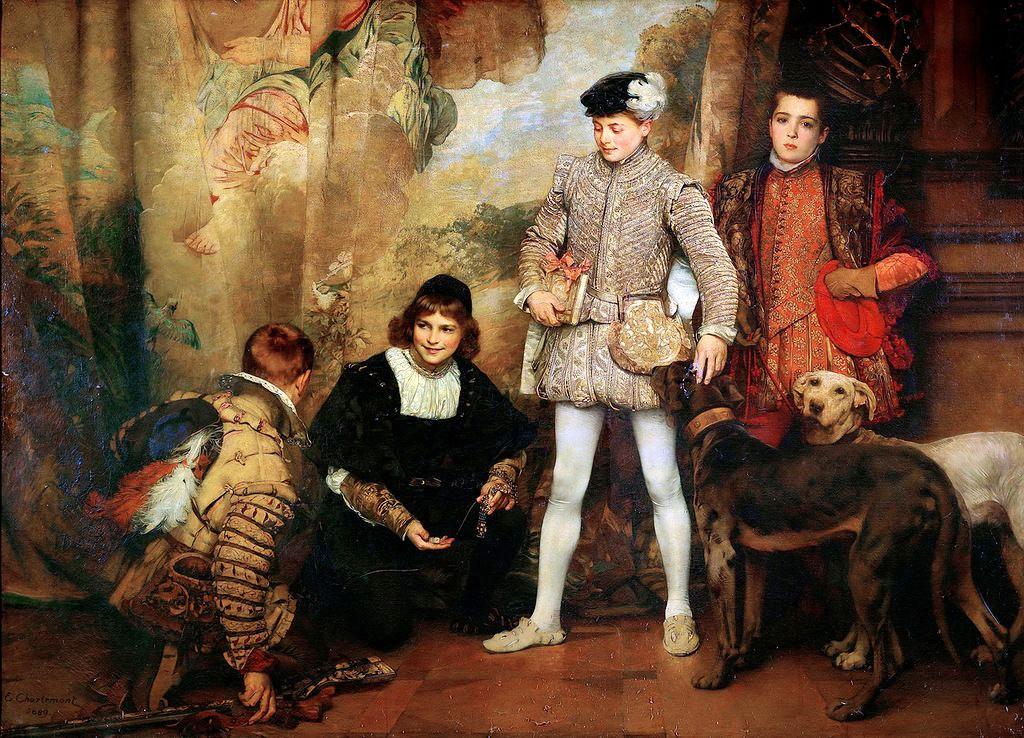
Eduard Charlemont was a classical, scademic artist born in Vienna (1848). He came from am artistic Family. His father, Matthias Adolf Charlemont, was an accomplished artist. He was known for his miniatures. Eduard's younger brother, Hugo Charlemont (1850–1939), also a well known painter, an impressionist. Eduard studied at the Academy of Fine Arts Vienna. He began exhibiting at a very early age--15 years old. His talent was so impressive that at the same age a girls' school in Vienna hired him to teach drawing. When he graduated, as was common, Charlemont traveled, especially throughout central Europe. This was primarily to view art work in other countries. He then settled in Paris to be part of the French art world and access to the French art market. Charlemont settled in Paris, where he lived for most of the rest of his life. Most of his productive years were spent in Pris. He won the prestigious first prize of the Paris Salon held by the French Academy of Fine Arts (Académie des Beaux-Arts) several times. His best known work is 'The Guardian of the Seraglio', better known as the 'The Moorish Chief'. Charlemont traveled widely in Europe, but we do not know if his travels took him to the Middle East. The French established colonies in North Africa which fed into the popular Orientalism of the time. He won the gold medal at the Exposition Universelle, a World's Fair held in Paris (1899). Like other 19tyhcentury asrtidts like Ramberg and Becker, Charlemont was influenced by the work the 17th-century Dutch master Johannes Vermeer. We note one work, 'The pages'. We see pages depicted on the periphery in many paintings, this one is just about the pages. We do not know what royal court the artist was trying o depict, but we wold gess the French court. Charlemont was also noted for murals, especially three of the murals of the Burgtheater (the Austrian National Theatre in Vienna). This was one of the most prestigious German language theaters). It was an amazing 55 meters in length. In his final years, Charlemont returned to Vienna

Navigate the Boys' Historical Clothing Web Site:
[Return to the Main Austrian artist page]
[Return to the Main French artist page]
[Return to the Main individual A-F artist alphabetical page]
[About Us]
[Introduction]
[Activities]
[Biographies]
[Chronology]
[Cloth and textiles]
[Garments]
[Countries]
[Topics]
[Bibliographies]
[Contributions]
[FAQs]
[Glossaries]
[Images]
[Links]
[Registration]
[Search]
[Tools]
[Boys' Clothing Home]