|
We note several Ender portraits from the 1830s showing boys outfits. His work reflects how boys from well-todo-famles were dressed. This included both fancy and rather plain outfits. We note tunics and a lot of jackets and open collars, although we do see some fancy collars. All boys after breaching wore long pants.
One Ender portrait was titled 'Mutter und sohn'--mother and son. The family is not identifid, but it looks like a very affluent family. It is not dated. We might guess it was painted about 1830--but at this time we are omly guessing. The mother dress with the elaborate slleces is the best way to date the image. Notice the boy's open ruffled collar. Notice the classical column and drapes. This popular convention also appared in early CDV portraits. (Earlier formats tended to have plain backgrounds.)
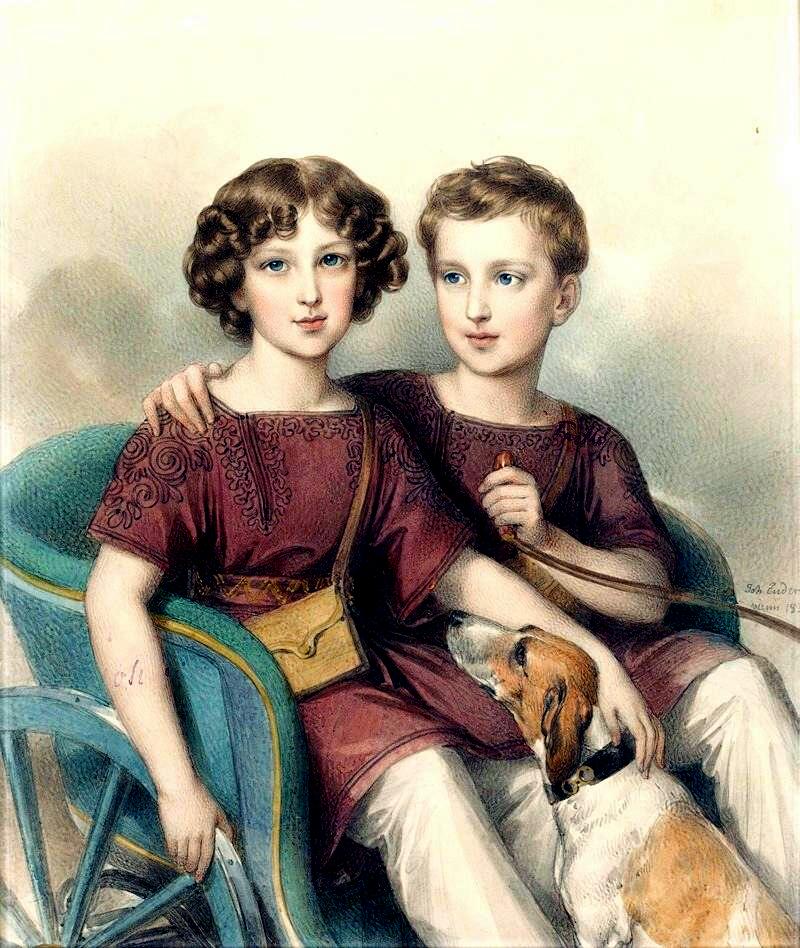
We notice a portrait of Alfred and Adam Potocki sitting in a carriage (1831) (figure 1). The Potockis were one of the wethiest and imprtant Polish arisocratic families. Poland had been partioned (18th century) and Audstria got va small slice--primarily Galici. The Potocki family played an important role in Austrian politics and society. Austria control continued until World War I with Polish independence (1918). The boys as was the custom of their mother were dressed alike. They wear square, opened necked maroon tunics with white pants and are pictured with a faithful pooch. Curiously for a mother who dressed them alike did their hair very differently. Amother earler portrat shows them wearing matching blue tunics.
We have found and Ender portrait dated 1837, but without any identification of the two boys. Google image reserach returned an incorrect reference. They look to be about 7-14 years old. The youngerr boy has a large ruffled collar, lrger than we often see in the 1830s. There are matching wrist ruffs. We do not think they were part of a blouse, but we are not sure. He has a blue top, but we are not sure what kind of garment it was. He has high-waisted long pants. They were normally button-on pants in the early-19th century, but we do no see any buttons. It is almost as if the pants waistbabd was ilasticed, but elastic did not yet exist. Could here be insude buttons? The child looks rather girlish, perhaps because of the hair, but girls did not wear pants. The musket he is holding further confirms that he is aoy. His older brother has an oopen Shiller collar, vest and long pants. There seems to be some kind of leather item on the rock by the older boy.

Navigate the Boys' Historical Clothing Web Site:
[Return to the Main individual A-F artist alphabetical page]
[Return to the Main Austrian artist page]
[Introduction]
[Activities]
[Biographies]
[Chronology]
[Clothing styles]
[Countries]
[Bibliographies]
[Contributions]
[FAQs]
[Glossaries]
[Images]
[Links]
[Registration]
[Tools]
[Boys' Clothing Home]