|
Edmund Blair Leighton was an important English artists known for historical genre scenes, specialising in medieval depictions and some Regency scenes. He associated with the pre-Raphaelite movement (late 19th-early 20th century). Edmund was the son of the artist Charles Blair Leighton (1823–1855) who died at an early age. His mother was Caroline Leighton (née Boosey). Edmund was educated at University College School. (College in Erope often means a secondary-level bschool.) He left, leaving at 15 to work for a tea merchant. (Presumably as his father had died, finance was an issue.) Edmund was intent on art studies. He took evening classes in South Kensington and then attended Heatherley School of Fine Art in London. He entered the Royal Academy Schools at 21 tears of age. He began making monochrome illustrations for Cassell's Magazine and their Book of British Ballads. His also did paintings. The first one to be exhibited at the Royal Academy was 'A Flaw in the Title' (1874). He got £200 fot it--a substantial sum at the time. As a result, he decided against prsuing 'black and white' illustrations. He pursued oil painting. He married Katherine Nash (1885- ), They had a son and daugter. Their son Eric John Blair Leighton also became a painter. Leighton painted in great detail. His work was highly finished historical paintings done completd to the smallest detail. We are not sure just how he studied to learn about period dress. His painigs are highly romanticised. He often depicted highly idealize medieval chivalry. Medieval women were a common focus. A few paintings involved children. His paintings were very popular and fond a ready market. Leighton did not keep a diary. He left a substantisl body of work and exhibited at the Royal Academy for over 40 years (until 1920). We have fond a few of his paintings in which children are depicted (figure 1). There are some in which children are the mainn subject. Others in which they are the main character:
The 'Boyhood of Alfred the Great' is one of Leighton's many medieval historical works, completed (1913). It a scene from the early life of Alfred the Great, the greatest of the Anglo-Saxon kings, King of Wessex. He is commonly the first monarch that can ve describbed an English king. Alfred is the only English monarch to be given the wll-deserved sobriquent 'Great'. The medieval era was a very long medieval era--basically an entire mellennium. Artists has contemporary paintings to go on the late medieval era. Much less is availble for the early medievl peioid. So the images produced or more based on imaginaton thn for later periods. Leighton 's clothing depictions are basically those commonly accepted in modern assessments. We see Alfred with a brother enjoying a story being read to them. Who the young woman is Leighton leaves up to the viewer. Alfred was the fifth son of King Aethelwulf and succeeded his brother Aethelred as King (871). Royalty commonly left such domestic duties to servnts.
The painting 'Farewell' (also known as 'The Fond Farewell' or 'Adieu'). The painting is a poignant depiction of a bother and son waving goodbye to a ship an man, presumasbly the husband and father. The imagev evokes a strong emotional narrative of parting. The depiction look to be from the early medieval era, probably about the time of Alfred based upon whhat we can see of the ship. The clothing is non-descript. We know nothing anout the scene he is depicting here. We do know that it was his detailed painting, done in 1922, the year that he died. It was also his last painting. We suspect his strenth was ebbing. We suspect that it was his way of saying good bye to his many admirers.
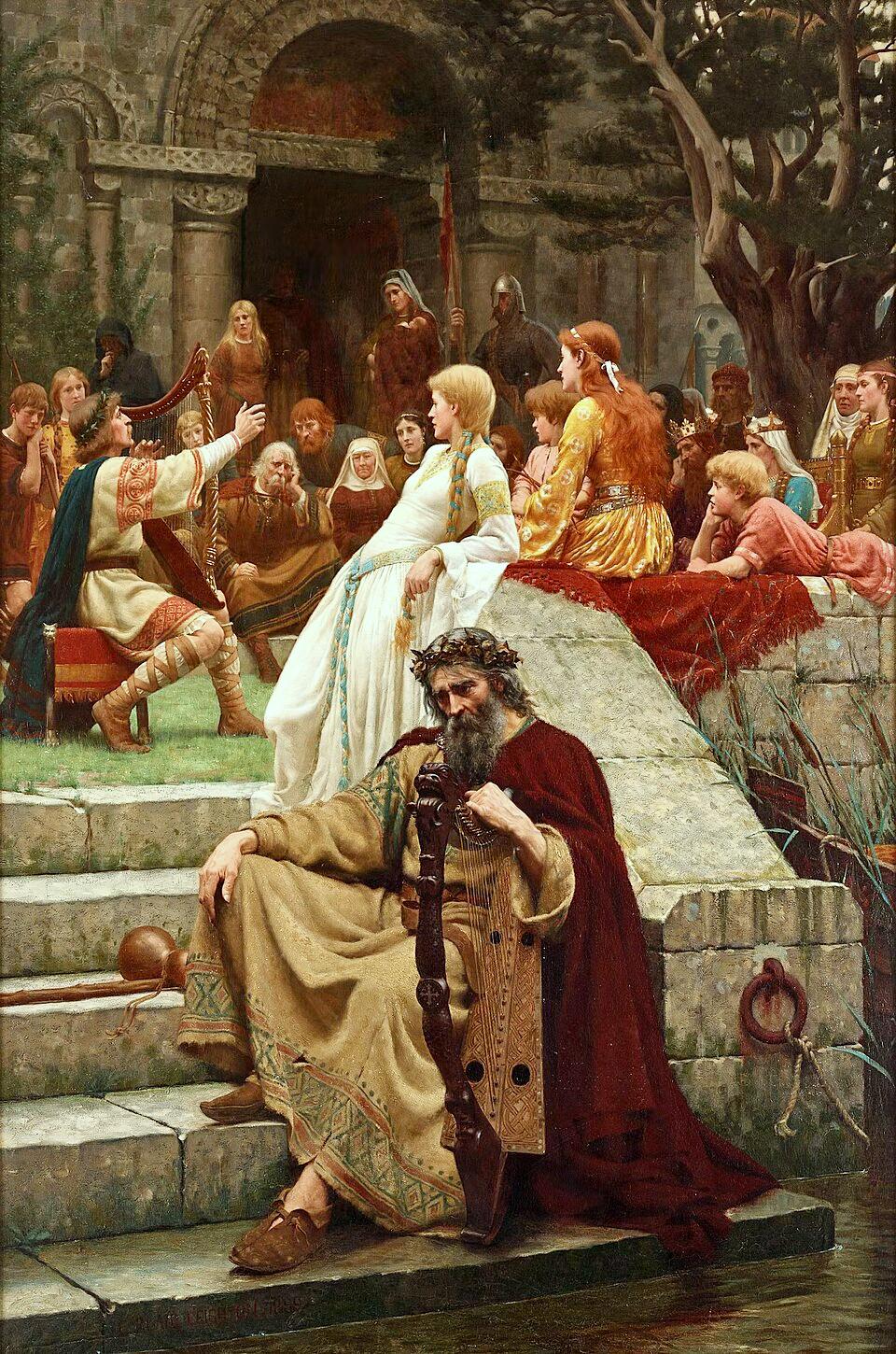
This Edmund Leighton work was another of his medieval paintings (figure 1). It was was titled 'Faded laurels'. It was painted (1889). It depicts an elderly bard during early medieval era whose time has come and gone. A younger bard is singing anf playing the lyre to the acclaim of the adults, presumablyh the court of a king given the crowns that we can see at the right. Perhaps this was meant to be ne of the Anglo Saxon kings. Children are watching from the top of a wall. We do not know a great deal about medieval music, but this is an interresting depiction.
This Leighton painting was inreviledf at the Royal Academy (1904). He titled it 'Vox Populi' (The Voice of the People). It is one of the artoist's actual historical scene. Most of his paintings were set bin historical mperiods with out referemce to any actual historican event or individual. Art experts believe that the inspiration here is Shakespearian. They note Henry VI, Part II: "This lad will prove our country's bliss / His looks are full of peaceful majesty"). This was all about a youthful prince that was posed to transform the the state of the realm. The painting is said to depict Magaret Beaufort (a Lacastertian) holding up her todler son, Henry Tudor (the future King Henry VII), on a stone balcony so the populace cans see him. Masrgaret had married Edmund Tudor, Earl of Richmond and half brother of King Henry VI. At the time England decended in the War of the Roses (1455–87)--a strugle between the Lacasters and the Yorks over the crown. Henry's father was killed in the fighting. The boy would grow up and become Henry VII. Henry's victoy at Bosworth Field (1485) and choice of Elizabeth of York ended decades of conflict, political instability, and bloodshed. The marriage united the two warring families. The scene is atisticlly revolutionary, picured from behind instead of the front. Leighton has given the paining a decidedly red orientation. The red rose was the emblem of the House of Lancaster, and the white rose represented the House of York, the two rival factions. The masrriage symbolically merged the red and white roses into the Tudor Rose, a heraldic emblem imprtantly combining both colors to visually represent peace and reconciliation. The Tudor Rose, usually depicted with a red outer layer and a white center, became a visual symbol of national unity.
Leighton focused on the medieval era, but he also dabbled in other eras. This one is set in the Napolenonic era, called the Regency era in Britain. That was another era that Leighton liked to paint. The British thought they had Napoleon defeated (1814). The Allies exciled him to Elba, a small island off of Italy. The locals to the surprise of many were happy to have him. But Elba was too small to contain Napoleon's vast ambitions. He esacped from exile (February 1815). French soldiers quickly flocked to his cause Which led to the finlly conclusive Battle of Waterloo in which the British and Prussians defeated him -- ending the Napoleonic Wars (June 1815). Other historical artists went for the gore or dramatic scenes of battle. Leighton went to the ordinary people in these periods, sometimes on the peifery of great events. The painting captures a moment in London as residents joyfully greet the returning soldiers return from the Continent after a long period of war. Leighton's pinting depicts a victory parade in London the following year--1816. The centerpiece is a British lancer catching the attention of a young lady waving her handkerchief. With her on the balcony are also older people of various ages and two children. The girl wears a long Empire dress. The boy wears a skeketon suit.

Navigate the Boys' Historical Clothing Web Site:
[Return to the Main individual English artist page]
[Return to the Main individual A-L artist alphabetical page]
[Return to the Main English page]
[About Us]
[Introduction]
[Activities]
[Biographies]
[Chronology]
[Clothing styles]
[Countries]
[Girls]
[Theatricals]
[Topics]
[Bibliographies]
[Contributions]
[FAQs]
[Glossaries]
[Images]
[Links]
[Registration]
[Tools]
[Boys' Clothing Home]