|
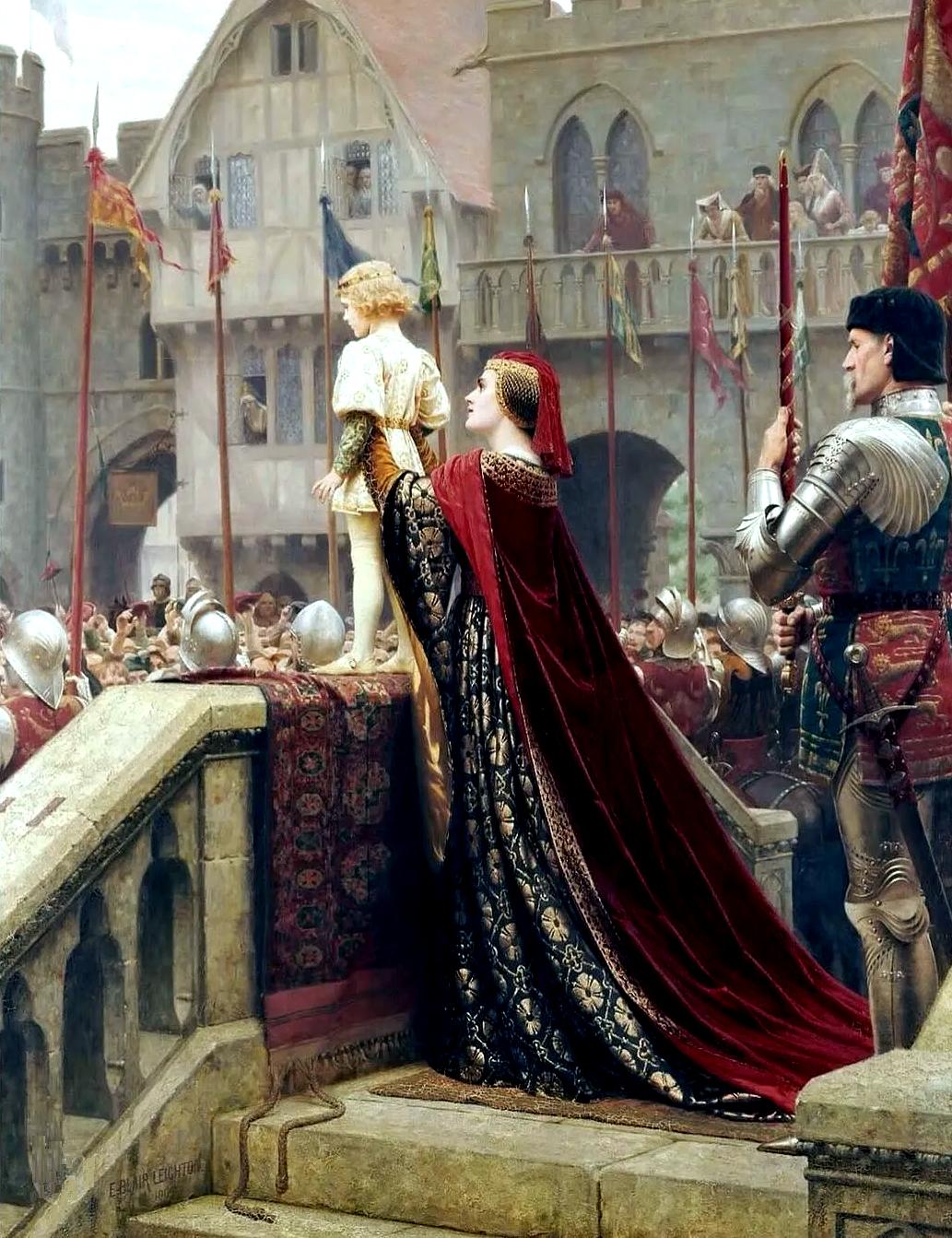
This Leighton painting was inreviledf at the Royal Academy (1904). He titled it 'Vox Populi' (The Voice of the People). It is one of the artoist's actual historical scene. Most of his paintings were set bin historical mperiods with out referemce to any actual historican event or individual. Art experts believe that the inspiration here is Shakespearian. They note Henry VI, Part II: "This lad will prove our country's bliss / His looks are full of peaceful majesty"). This was all about a youthful prince that was posed to transform the the state of the realm. The painting is said to depict Magaret Beaufort (a Lacastertian) holding up her todler son, Henry Tudor (the future King Henry VII), on a stone balcony so the populace cans see him. Masrgaret had married Edmund Tudor, Earl of Richmond and half brother of King Henry VI. At the time England decended in the War of the Roses (1455–87)--a strugle between the Lacasters and the Yorks over the crown. Henry's father was killed in the fighting. The boy would grow p and become Henry VII. Henry's victoy at Bosworth Field (1485) and choice of Elizabeth of York ended decades of conflict, political instability, and bloodshed. The mrriage united the two warring families. The scene is atisticlly revolutionary, picured from behind instead of the front. Leighton has given the paining a decidedly red orientation. The red rose was the emblem of the House of Lancaster, and the white rose represented the House of York, the two rival factions. The masrriage symbolically merged the red and white roses into the Tudor Rose, a heraldic emblem imprtantly combining both colors to visually represent peace and reconciliation. The Tudor Rose, usually depicted with a red outer layer and a white center, became a visual symbol of national unity.

Navigate the Boys' Historical Clothing Web Site:
[Return to the Main Edmund Blair Leighton page]
[Return to the Main individual English artist page]
[Return to the Main individual A-L artist alphabetical page]
[Return to the Main English page]
[About Us]
[Introduction]
[Activities]
[Biographies]
[Chronology]
[Clothing styles]
[Countries]
[Girls]
[Theatricals]
[Topics]
[Bibliographies]
[Contributions]
[FAQs]
[Glossaries]
[Images]
[Links]
[Registration]
[Tools]
[Boys' Clothing Home]