***
Portuguese boys' clothes in art: Domingos António de Sequeira
Domingos António de Sequeira (Portugal, 1768-1837)
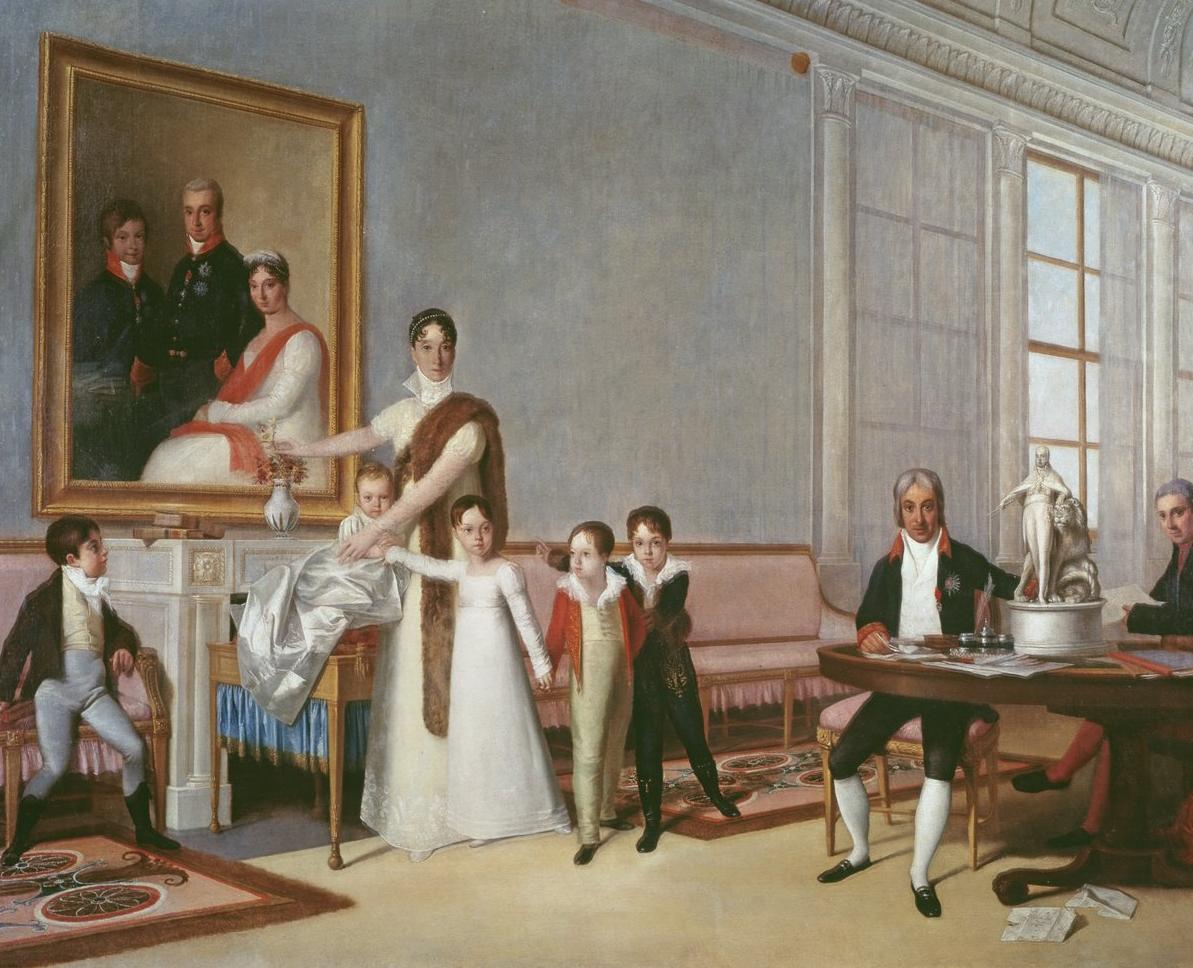
Figure 1.--Here is Sequeira's portrait of the First Viscount de Santerem and his family (1816). The the mother and daughter wear white Empire dresses. Note that the boys wear skeleton suit influenced long pamts while men were still wearing knee breeches.
Domingos António de Sequeira was an important Portuguese artist at the Royal Court of King John VI. He was born in Belém (1268). It was a family of modest circumstance. He would later change his family name from Espírito Santo to the more aristocratic sounding Sequeira.
As a boy, Domingos had exhibnited a real talent for drawing. At age 13 years, F. de Setubal employed him as an assistant in his work for the João Ferreiras Palace (1781). He began his art studies at the academy of Lisbon, before going to Rome to study uder Antonio Cavallucci. Sequeira lived in in Rome (1788-94). He was able to become an honorary member of the Academy of St Luke. After another 2 years and further study in Italy, he returned to Portugasl and his skill immedicate commanded admirtion. He was aearded commissions for churches and palaces. He did both large monumentl historical compositions as well as potrasits. The Duke of Braganza (future King John VI) due to his mother's mental illness appointed him first court painter (1802). He completed many works for the prince regent, for Dona Maria Teresa, and for members of the King John's court. This was during the Napoleonic Wars and French armies invded Potugal which was aided by Britain. The royal family took refuge in Brazil. After the War,
designed an ornate silver service presented by to Welingon on behalf of the grateful Portuguese nation. A monument dedicated to Wellington was erected (1820) in Lisbon's Rossio Square.
Sequeirawent to Paris where he woeked on lithography and etching (1823). One of his major works was the 'Death of Camões' (1825). Art historians consider it to be the first proto-romantic or romantic Portuguese painting. Another important works are the 'Miracle of Ourique', 'Prince John Reviewing the Troops at Azumbuja', and 'The Adoration of the Magi'. There were also many portraits, mostly of court perrsonalities and other aristocrats. The portrait here of Viscount de Santerem and his family (1816) is a good example. Sequeira's final years lived in Rome.
His paintings there were largely religious. He was head of the Portuguese Academy. He see,s to have been influenced by a Turner exposition (late-1820s). One such paintings is the 'Adoração dos Magos' (1828). He passed away in Rome (1837).