|
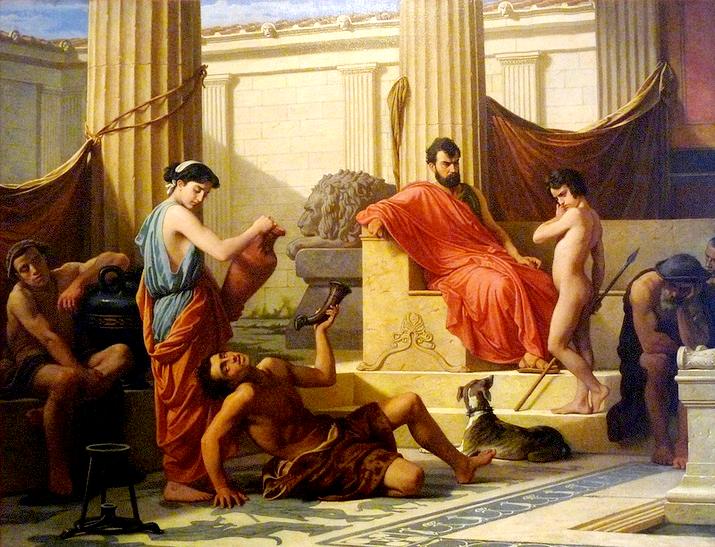
The most important outlier in ancient Greece was Sparta which developed a very different education system. The goal of education in Sparta was to produce superbly conditioned and trained soldier-citizens. The emphasize on philosophy and the arts which was a major part of education in other Greek city states were not a major part of Spartan education. The education system for boys and girls was very different. The focus was on the boys and the system was more one of training than educating. Interestingly, the Spar ans gave more attention to educating girls than any other Greek state. Children were trained to be members of a well-drilled, strictly-disciplined army capable of long, rapid forced marches. Girls were educated separately with a completely different program. Spartan boys left home at an early age. The lived and studied in severely disciplined groups and closely supervised by officers. Their education and training continued until age 18. The program was designed for boys at each age level and made increasingly strenuous physical demands. The boys of Sparta were obliged to leave home at the age of 7 to join sternly disciplined groups under the supervision of a hierarchy of officers. From age 7 to 18, they underwent an increasingly severe course of training. Sparta also had a very distinctive training program for girls. In fact, sharp contrast to other city states, Sparta provided training for girls and not just training in domestic skills a home. The girls at age 6-7 also began school. As for the boys, it was not an academic program. They received strenuous physical training, including running, jumping, throwing the javelin and discus, and wrestling as well as gymnastics. Much less is known about how the girls were trained. Apparently they lived, slept and trained in their sisterhood's barracks. No one knows for sure if the girls were subjected to as harsh a program as the boys.
The goal of education in Sparta was to produce superbly conditioned and trained soldier-citizens. The emphasize on philosophy and the arts which was a major part of education in other Greek city states were not a major part of Spartan education. Children were trained to be members of a well-drilled, strictly-disciplined society.
The Romans who venrated the Greeks and Sparans in particvular for their military skill seemed to think that Spartan educastion was uncvhasnged gfor centueies. Modern historians report that it varied over time. Simonides seem cto be the first author to mention any kind of specisalised Spartan education system, but only one word, an epithet -- δαμασίμβροτος. This meant,'tamer of mortals'. This meant that fron the final years of the Greek archaic era that Greek authors had bccome aware of a dectimnctive Spartan educational system and its role in Sparta's martial succes.
As in the rest of Greece, the education system for Spartan boys and girls was very different. The focus was on the boys and the system was more one of training than educating. Interestingly, the Spartans gave more attention to educating girls than any other Greek state which often largely ignored girls leaving their eduction up nto the parents. But it was the boys' educsation that was radically different. Spartan boys left home at an early age. The lived and studied in severely disciplined groups and closely supervised by officers. Their education and training continued until age 18. The program was designed for boys at each age level and made increasingly strenuous physical demands. The boys of Sparta were obliged to leave home at the age of 7 to join sternly disciplined groups under the supervision of a hierarchy of officers. From age 7 to 18, they underwent an increasingly severe course of training. Spartan boys left their mothers were sent to military school at age 6 or 7 years. They lived, trained and slept in the barracks of the brotherhood that they were assigned to a birth. The boys began a program of physical conditioning. They were taught skills that would be helpful when they began actual military training like survival skills. Sparta also had a very distinctive training program for girls. In fact, sharp contrast to other city states, Sparta provided training for girls and not just training in domestic skills at home. The girls at age 6-7 also began school. As for the boys, it was not an academic program. They received strenuous physical training, including running, jumping, throwing the javelin and discus, and wrestling as well as gymnastics. Much less is known about how the girls were trained. Apparently they lived, slept and trained in their sisterhood's barracks. No one knows for sure if the girls were subjected to as harsh a program as the boys, but this was unlikely even for Sparta.
Young Spartiates as part of their educsation were obligated to take part in state festivals. The role in hese festivkls was an important part of their educsation. In most cases, other psrts of the population also took part in these festivals, but in a less organized amnner.
【Ducat, pp. 249-80.】 The major divinity associuted with the education of boys was the godess Artemis Orthia. And the youth playd a key role in the festivals associated with Orthia. Artemis Orthia was a lesser-known Grek god, but primarily worshipped in Sparta.
Plutarch, the eminent Greek historian and essayist who became a Roman citizen has left us an account of the part legendary Spartan law giver--Lycurgus (9th century BC). Plutarch was nearly a millennium removed, si\o his account has to be taken with some reservation. It seems, however, one of the better accounts from antiquity. He tells us,
"Lycurgus would not put the sons of Spartans in charge of purchased or hired tutors, nor was it lawful for every father to rear or train his son as he pleased, but as soon as they were seven years old, Lycurgus ordered them all to be taken by the state and enrolled in companies, where they were put under the same discipline and nurture, and so became accustomed to share one another's sports and studies. The boy who excelled in judgment and was most courageous in fighting, was made captain of his company; on him the rest all kept their eyes, obeying his orders, and submitting to his punishments, so that their boyish training was a practice of obedience.
Of reading and writing, they learned only enough to serve their turn; all the rest of their training was calculated to make them obey commands well, endure hardships, and conquer in battle. Therefore, as they grew in age, their bodily exercise was increased; their heads were close-clipped, and they were accustomed to going bare-foot, and to playing for the most part without clothes. When they were twelve years old, they no longer had tunics to wear, received one cloak a year, had hard, dry flesh, and knew little of baths and ointments; only on certain days of the year, and few at that, did they indulge in such amenities. They slept together, in troops and companies, on pallet-beds which they collected for themselves, breaking off with their hands (no knives allowed) the tops of the rushes which grew along the river Eurotas. In the winter-time, they added to the stuff of these pallets the so-called lycophon, or thistle-down, which was thought to have warmth in it." 【Plutarch.】
Ducat, Jean. Spartan Education: Youth and Society in the Classical Period (Classical Press of Wales, 2006), 350p.
Plutarch Life of Lycurgus (about 75 AD).
Simonides (the end of the 6th century and beginning of the 5th).

Navigate the Historic Boys' Clothing Web Site:
[Return to the Main ancient Greek education page]
[Return to the Main ancient Sparta page]
[Return to the Main ancient Greek page]
[Return to the Main Greek chronology page]
[Introduction]
[Activities]
[Art chronologies]
[Biographies]
[Chronology]
[Countries]
[Photography]
[Style Index]
[Bibliographies]
[Contributions]
[FAQs]
[Glossaries]
[Images]
[Links]
[Registration]
[Tools]
[Boys' Clothing Home]
Navigate the HBC School Section:
[About Us]
[Activities]
[Chronology]
[Clothing styles]
[Countries]
[Debate]
[Economics]
[Garment]
[Gender]
[Hair]
[History]
[Home trends]
[Literary characters]
[School types]
[Significance]
[Transport and travel
[Uniform regulations]
[Year level]
[Other topics]
[Images]
[Links]
[Registration]
[Tools]
[Return to the Historic Boys' School Home]