|
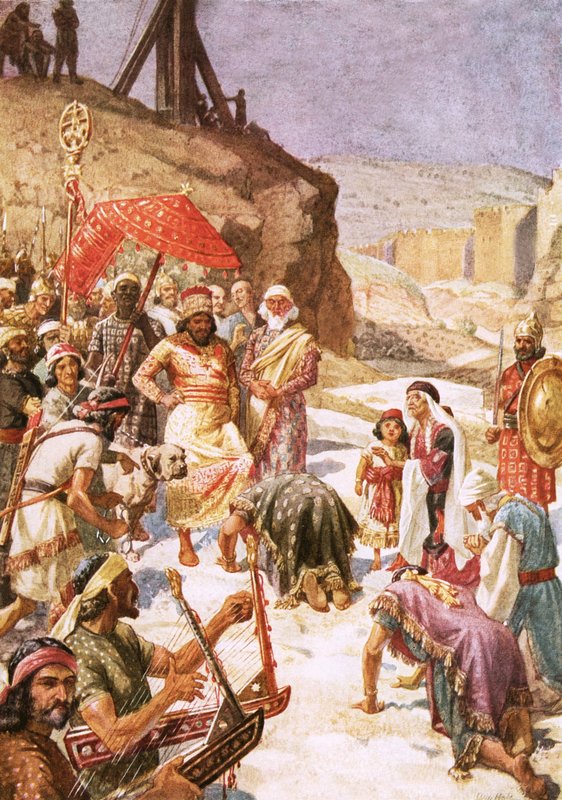
The Babylonians with the defeat of the Assyrians took over most of Western Asia. Judah without a powerful ally (Eother Assyria or Egypt) could not by itself resist the large Babylonian amies. Babylonian king, Nebuchadnezzar, raised a large force to punish Judah for defecting to the Egyptians (598 BC). When the massive Babylonian Army appeared at the walls of Jerusalem, the new king of Judah, Jehoiachin, realizing that resistance was futile, handed the city over to Nebuchadnezzar (597BC). This coided the city being sacked. The conquerer than appointed a new king for Judah, Zedekiah. As was the practice of the time, Nebuchadnezzar deported about 10,000 Jews to his capital in Babylon. This was a strategy to weaken resistance to foreign rule by eliminating the cultural elite. The deportees were carefully selected. They were the Jewish elite and drawn from professionals, the wealthy, and craftsmen. The peasant class and other ordinary people were permitted to stay in Judah. The deportation of the Jewiosh elite is now known as the Babylonian Exile. Further resistance and Baylonian actions followed. The Babylonians destroyed Solomon's great Temple, often called the First Temple (586 BC). The great prohets (Isaiah, Jeremiah, and Ezekiel) wrote pitiful lamentations about the destruction of Jerusalem and the Temple. 【Book of Prophets】 The Jewish Prophets tried to understand why God had forsaken them and allowed pemitted the Babylonians to conquer and exile the Jewish people. They concluded that the Jews had not adequately observed the Law (the Ten Commandments). Essentially the Jewish people had not kept up their side of the Covenant, so God had not kept up his side. Ironically in our modern world, this is the same argument Islamicists use. They claim that the poverty and weakness of the Arab people is due to an inadequate commitment to Islam.
The Hebrew not yet Jewih kingdom, started with such optimisy and glory by David, ended. And at it not appear ovr vfoirst centuriesand then millennia, it seemed as if it would never appear. TYhere was a brief sprle in the second century BC, but to the exiled Jews forced to relocate and the Jews left in Palestine to eke out a living in their once proud land, it seemed as if a Jewish nation was lost for good. It was as if theCobenent was broken for ever-- the special bond that Yahweh had promised to the Hebrews that they wre the chosen people that would shasce place in history. It seemed broken and forgotten by their god.
Book of Prophets

Navigate the Historic Boys' Clothing Web Site:
[Return to the Rise of the Neo-Babylonian Empire]
[Return to the Old Testament history]
[Return to the Main Ancient Hebrew history]
[Introduction]
[Activities]
[Art chronologies]
[Biographies]
[Chronologies]
[Countries]
[Style Index]
[Bibliographies]
[Contributions]
[FAQs]
[Glossaries]
[Images]
[Links]
[Registration]
[Tools]
[Boys' Clothing Home]