|
The story of the Hebrew people, in fact all of humanity, is depicted in the Old Testament. This of course begins in Genesis and is largely mythological. As the Old Testament unfolds, however, we gradually get into real historical figures and events that can be confirmed even dated by archeologists and historians. DNA work will certainly provide further evidence. There is considerable debate as to who is real and who is mythological. And dating is often disputed. The existence of David, a key Old Testament figure, in particular is contested.
Almost from the beginning of Christianity, Old Testament chronology has has been attempted by biblical scholars. At first these scholars primarily used information in the Old Testament such as ages of the patriarchs to create a chronology. The work of Bishop Ussher (1581-1656) was widely accepted as definitive as Europeans entered the modern era. Sir Issac Newton even entered the discussion. Only in the 20th century did scholars begin to use new disciplines and expanding historical knowledge to create a more realistic chronology, including accurate concepts of when earth was formed and life developed. Biblical scholars differ as to how to delineate the main events of the biblical chronology. A reasonable outline is: Creation, the Great Flood and Noah, Abraham, Egypt and the Exodus, Solomon and the First Temple, the Babylonian Captivity and Cyrus the Great, and the Maccabeeam period during which the Temple was rededicated. [Thompson, pp.14-15.] This is a gradual procession from mythological cosmology to known and datable historical events.
The Biblical account of the creation drew upon the cosmology and mythology prevalent in the Middle East after the dawn of civilization in Mesopotamia (about 10,000 BP). The uniqueness of the Biblical account is the monotheistic element. Just when this became part of the Hebrew tradition we do not know. The creation account is often used by atheists to 'debunk' the Bible. But this is a futile exercise. The Biblical account can simply beseen as God describing creation in terms a stone age people could understand. But at any rate, the Bible is not a scientific work. It should be judged on the basis of its ethical and spiritual message.
Noah and his Ark is largely seen as a mythological figure. A great flood in the eastern Mediterranean and Levant/Mesopotamia, however, may have been an actual event. There are so many accounts of a massive flood in ancient Middle Eastern mythology, that an actual flood seems to be a distinct possibility. An ancient Babylonian flood myth seems particularly important to the Biblical account--the Epic of Gilgamesh. This is an account very similar to that of Noah and his ark. A man named Utnapishtim builds a ship to save his family and animals from floods caused by a wrathful god. After 7 days, Utnapishtim's ship with his family come to rest safely on a mountaintop. At the end of the last Ice Age, the receding ice shelf meant large volumes of melting water increased sea levels and presumably causing flooding (about 10,000 BP). The resulting widespread flooding may explain why there are so many flood events in the mythology of so many civilizations. There is evidence of a great flood in more recent times. The fresh water Black Sea was below the level of the Mediterranean. Waters from the Mediterranean broke through a narrow land dam causing a huge flood (about 5,000 BP). There is evidence of a residual fresh water lake at the bottom of the Black Sea that never mixed with the influx of Mediterranean salt water. And researchers are looking for evidence of now under water settlements that were living along the ancient lake.
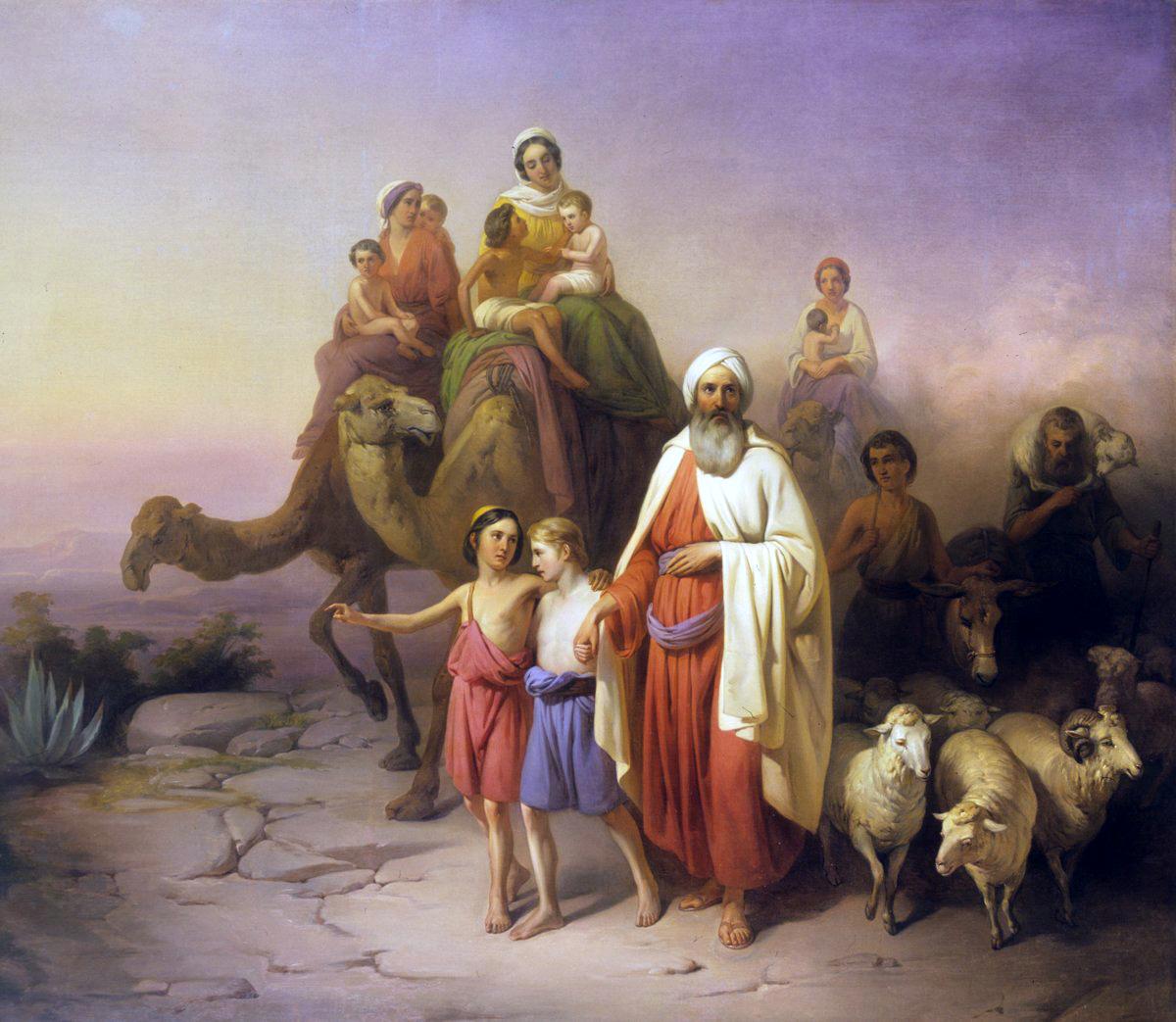
Abraham is generally seen as the great patriarch and founder of the Hebrew people. It is with Abraham that God concluded the Covenant. The basic story told in Genesis is that Abraham was son of Terah (son of Nahor, son of Serug, etc. -- Genesis 11). Abraham's story is essentially the history of the establishment of the covenant between Abraham and God. This of course is the central tenant of Judaism. God called Abraham to leave his land, family and household in Mesopotamia in return for a new land, family and inheritance in Canaan. This can be interpreted as the ancient Hebrews developing their claim to Canaan (modern Palestine). As the story is mythological it can not be dated, but more interesting is just when it became part of the Jewish tradition. It is not clear when this tenant was developed because there surely was an oral tradition before the Torah was actually enshrined in writing. The stories in Genesis, including Abraham, cannot be related to any known history. As a result most modern biblical histories no longer begin with the patriarchal era. Whether the story conveys any insight into early migratory pattern is unknown. His first born son Ishmael was by his Egyptian maidservant/slave Hagar (Genesis 16). While Ishmael was still very young; Abraham's wife Sara mistreated Hagar and she fled into the wilderness. Hagar almost died. God (or an angel of God) helped her find water. Her Biblical scholars are confused. There are similar accounts in Genesis 16 while Hagar was pregnant with Ishmael and Genesis 21 after Ishmael was weaned. Later Sarah became pregnant and had a son that was named Isaac. So Sarah asked Abraham to drive out the slave and her son, because Ishmael would claim a share of the inheritance with the legitimate son (Genesis 21:10). Abraham gave Hagar bread and water and drove her and the child into the desert (Genesis 21:14). The text tells that, saved by an angel, Ishmael became the founder of a great people, the Ishmaelites-- i.e. the Arabs. This story is also an ancient evidence of the difficult relation between Hebrews and Arabs, dating before the Muslim era. The confusing Biblical text has led people to debate whether these are the same account recorded twice, or two different events. When Abraham died, Isaac and Ishmael buried him beside Isaac's mother Sarah (Genesis 25). Ishmael had 12 sons: Nebaioth, Kedar, Adbeel, Mibsam, Mishma, Dumah, Massa, Hadad, Tema, Jedur, Naphish, and Kedemah (Genesis 25).
The Jacob saga is an important part of the Old Testament story. The Bible is the only source for the migrations of Jacob and the age of the Patriarchs. Thus it must be treated as legend without any other historical evidence. While legend the historical existence of Jacob and the Patriarchs can not be dismissed. The Bible provides an account of an Israelite conquest of the Promised Land (generally dated about the 15th century BC).
Some scholars associate the Hebrews with the word "Hiberu". It first appears in writing sent to Egypt from one of the small client states which the Egyptians left after withdrawing from Canaan in the 1300s BC. These client states faced waves of nomadic tribes. The Egyptian word "Hiberu" meant "outsider" and originally was probably used to describe migrants in general and not one specific people. Other scholars refer to the Hapiru. These appear to be Bedouin people who attacked caravans and isolated settlements. The Egyptians also used the term for war captives used as laborers and slaves as well as people of undetermined ethnicity who wandered the area of modern Syria and Palestine engaging in brigandage and mercenary service. They might be hired by the rulers of the petty states of the area to assist in their dynastic disputes. [Aldred, p. 37.] The general popular view is that the Hebrws/Jews were a tribe of relatively narrow origins. Some of the work on this period suggests that that the Hebrew people were formed in Egypt from people of more varied origins. The Exodus has not been documented outside of the Bible, although Egyptian scholars have found some tantalizing clues. Biblical scholars tend to date the Exodus to the reign of Ramses II (1292-1225), although there are alternative assessments. God did not allow Moses to enter the Promised Land as he had blood on his hands.
The heart of Judaism is the Covenant and the Law and the basic concept influences the other Abrahamic religions. These are among the most important passages in the Torah (Pentateuch). The Covenant is the agreement (essentially a contract) that God concluded with the Old Testament Abraham (Genisus Ch 15 verse 17/ Ch 17 verse 2,7). It created a special relationship between God and not only Abraham, but also all of his descendants for all time. As a sign of this Covenant he required the rite of Circumcision. The Abrahamitic Covenant was the core of the religious that the descendants of Abraham would develop--Judaism. The people of Yahweh accepted him as the one and only God. Thus Judaism became the first monotheistic religion. The next step in the development if Judaism was the giving of the Law. This according to the Torah was done on Mount Sinai--thus the Sinaitic covenant. It was essentially a renewal of the original Abrahamic Covenant. God presented the Ten Commandments to Moses. And the people of Israel pledged themselves to keep His covenant (Exodus Ch 19 verse 8). Moses went up and down Mt. Sinai to make sure the people understood and agreed. And the Law in more detailed followed Exodus 20-23). After the giving of the Law, Moses sprinkled 'the blood of the covenant sacrifice' half upon the people and half upon the altar of the Lord (Exodus 24, verses 6-8). And to signify this mystical union of Israel and Yahweh, the 'everlasting' Sinaitic covenant between God and Israel became the keeping of the the Sabbath (Exodus Ch 31, verses 13-17). The tables of the Law upon which the pledge was made became known as 'the book of the covenant' (Exodus 24, verse 7). The Ten Commandments became known as the 'the words of the covenant' (Exodus 34, verse 28). The tables containing the Ten Commandments and Law became 'the tables of the Covenant' (Deuteronomy Ch. 9 verse 9, 15). The Israelis during their wanderings in the wilderness and then after settling in Palestine carried the Ark of the Covenant (Numbers 10, verse 33 and Deuteronomy Ch. 8 verse 31 and Chapter 31 verse 26). And then constantly through out Joshua, Samuel, and Kings) the Ark was regarded as 'testimony' to the presence of the Yahweh and the Covenant in their midst. Notice it was not a graven image (idol), but the Covenant and Law.
The era of the Judges is commonly dated to the 12th century BC.
The Levant was a dangerous place. Tribes competed for scarce resources. The Israelites battled the Philistines, generally believed to be the Phoenicians (11th century).
These struggles gave rise to strong charismatic leaders who could organize armies and successfully wage war. Samuel and Saul were important figures in the formation of the Israeli state. King Saul from the tribe of Benjamin became king (about 1000 BC). He was defeated and killed by Philistines (Phoneticians). David (1000-960 BC) succeeded him. David a millennium after Abraham's encounter on Mount Moriah, made Jerusalem his capital. He called Jerusalem a 'vista of beauty, joy of the land". He dreamed of rebuilding a great temple. God allowed him to make the preparations, but not to actually build the temple. David chose the location--where Abraham was said by legend to be ready to sacrifice his son. David was succeeded by his son Solomon (960-22). And under Solomon the Great Temple was built (964 BC). There is a description in the Bible, but that is all that is known about the First Temple. Under David and Solomon, the united Hebrew people were the major power in the Levant.
When Solomon died (922 BC), his two sons disputed the succession and the kingdom was divided . The northern kingdom was Israel. The southern kingdom was Judah. Religious differences developed in the two kingdoms. The prophet Elijah describes this era. The two kingdoms existed between Assyria to the West and Egypt to the east. For a time the Assyrians were content to receive tribute from the Jews. Egypt was ruled by the southern Saites dynasty and was absorbed in internal affairs. Assyrian power varied over time. The Jews instead of joining forces against the Assyrians quarreled with each other. There were wars between Israel and Judah. And there were civil wars within the two states over the kingship. There were also wars with neighboring peoples like the Canaanites. Both states had commercial, military, and diplomatic contacts with the other peoples of the Levant. Of particular importance were the Phoenicians (coat of Lebanon) and the Aramaeans (Damascus and Hamath).
Assyria began expanding south (9th century BC). Israel joined with the kingdoms of Hamath and Damascus (modern Syria) to resist the Assyrians (mid-9th century). The Assyrian had far greater resources and steadily moved south. One of the most important Assyrian kings was Tiglathpileser III ( -728 BC). He appears to have been the Biblical Pul (2 Kings 15.19). His conquests included the Aramaean tribes in Babylonia and his armies campaigned against the Medes and reached as far north as the Caspian Sea. Tiglathpileser defeated King Urartu in Hamath thus gaining control of the north of modern Syria. The two Hebrew states instead of joining against Assyria saw each other as the major enemy. King Ahaz of Judah appealed to King Tiglathpileser for military aid King Pekah of Israel and King Resin of Damascus. Tiglathpileser conquered Damascus. He then suppressed a revolt in Babylonia.
Stripped of its northern allies, Israel had to face Assyria alone with a hostile Judah to the south. Tiglathpileser conquered northern areas of Israel and exiled the tribes of Zebulun and Naphtali. Shalmanaser V (727-22) took Luli in Tyre. He then conquered Samaria, the capital of Israel, in the same year he died (722 BC). [2 Kings 17.] This was the territory of tribes of Reuben, Gad and Manasseh, Shalmanaser exiled the tribes. Sargan II (721-05 BC), one of the greatest Assyria kings conquered the rest of Israel, completing the conquest. Sargon is Biblical Sharru-kin. [Isaiah 20:1.] The exiled Jews were replaced with other peoples. It is unclear who they were, but because because they were living in Shomron or Samaria -- are called Samaritans in the Bible. The Samaritans accepted some aspects of Judaism, but not the religion fully. They were thus not accepted by the Jewish people and were in turn resentful.
The Levant is the area between the first two great river valley civilizations--Mesopotamia and Egypt. Thus is was inevitable that the Levant and the trade routes which passed through would become a contested area, both diplomatically and militarily. With the rise of the Hittites in Anatolia to the north, a third power pole would arise to contest the Levant. And of course square in the middle of the Levant was Israel and Judah. The 7th century BC proved to be the most tumultuous century in the struggle for the Levant. It would be here that the first recorded military (Megiddo and Qadesh) battles of history would be fought. The Assyrian conquest of Israel was a traumatic event for Judah. They realized that it could have just as easily been them. And the Assyrian menace still existed. The Assyrian Emperor Sennacherib annexed territory from Judah (701 BC). The Jews in Judah presumably would have suffered the same fate as the Israelites at the hand of the Assyrians. This did not occur, primarily because of the rise of Babylon. The Babylonians, under Nabopolassar, reassert control over Mesopotamia (625 BC). This was a direct threat to Assyria which was then distracted from the conquest of Judah and the wider Levant. The Judah King Josiah responded to the ensuing power vacuum in the Levant Judah did not, however, have the resources of the Assyrians, Babylonians, and Egyptians. Jehoahaz secedes his father. the Egyptian Pharoah Necho (placed in power by the Assyrians), launched an army into Judah and deposed Jehoahaz. Judah thus became an Egyptian tributary state. The Babylonians next defeated the Egyptians (605 BC). This made Judah a Babylonian tributary. The Babylonians suffered a defeat at the hands of the Egyptians (601 BC). King Jehoiakim decided to defect to the Egyptians. This put him and Judah on the Babylonian hit list.
With the conquest of Israel the Assyrians began to target the southern kingdom of Judah. This proved more difficult and before it was accomplished, the Assyrians were conquered by the Babylonians. It would thus be Babylon that would conquer Judah. Babylon was new empire arose in western Asia centered on the ancient city with the decline of the Assyrian Empire, The Babylonian Empire gradually expanded and defeated the Assyrians. The Jews under their king Josiah were Assyrian allies. The Egyptians dispatched troops to assist the Babylonians, but Josiah and the Jews at the battle of Megiddo blocked the Egyptian column (609). The Babylonians even without Egyptian assistance defeated the Assyrians . Babylonian became the dominant power in western Asia. With the conquest of Israel the Assyrians extended their influence over the southern kingdom of Judah. The Assyrians never conquered Israel. They faced a new power--the Babylonians. A new empire arose in western Asia with the decline of the Assyrian Empire. The Neo-Babylonian Empire gradually expanded and threatened the Assyrians. Judah as an Assyrian client state fought Babylon. The Jews under their king Josiah were Assyrian allies. The Egyptians who were allied with the Babylonians dispatched troops to assist the Babylonians. Josiah and the Jews at the battle of Megiddo blocked the Egyptian column. The Babylonians even without Egyptian assistance, however, defeated the Assyrians. The Babylonian became the dominant power in western Asia. Nebuhadnezzar II rebuilt Babylon as the world's most beautiful and advanced city. It was the site of the Hanging Gardens and Tower of Babel. It was Babylon that would conquer Judah and exile the Jewish people.
The Babylonians in turn were conquered by Persia. Cyrus the Great introduced new concepts of imperial rule. He conquered Babylon (539 BC). Cyrus was a more tolerant ruler than the Babylonians and permitted the Jews to worship once more in Jerusalem (538 BC). Many Jews returned to Palestine. More than 40,000 are believed to have done so. The Assyrians had taken the northern tribes into captivity and are lost to history. The Babylonian exile were what remained of the Children of Israel. Cyrus had am innovative imperial outlook. The Persians allowed a degree of autonomy, permitting local notables to govern their own people. Other exiled Jews remained in Babylon. The relatively open policies of the Persians allowed Jews to spread throughout their Empire. This was the origin of the Jewish population in Iran as well as many other western Asian countries that were part of the Persian Empire. The Jews asked themselves while God had allowed this terrible tragedy occur. Ezra and Nehemiah preached that the Jews themselves were at fault. They had not properly observed the Law. In other words, the Jews had not adhered to their side of the Covenant. Ezra and Nehemiah successfully convinced many exiled Jews to observe the Law more rigorously. The prophesied 70 years of captivity were fulfilled with the completion of the New or Second Temple (516 BC). Cyrus did not interfere in the religious life of his subjects as long as they did not challenge his rule.
The Jews returning home from Babylon encountered the Samaritans in their former homeland. These were people that the Assyrians had help settle. This was a time in which the returning Jews establish a restored Jewish states which might be called a theocracy. The returning Jews encountered the Samaritans. The Bible describes the Samaritans as a foreign people, but who who had partially adopted the Israelite religion. Historians debate the origins of the Samaritans. Some believe that the Jews were not exiled but had mixed with non-Jews. The Samaritans still practiced Judaism, but there were religious differences. This may be the result of an extended separation as well as the beliefs that the non-Jews had. There are other theories. The Samaritans describe themselves as the repository of the ancient Hebrew faith at is was the returnees from the Babylon captivity that had changed. It seems likely that the Jews in captivity had been more committed and strict. Conflict developed between the Jews and Samaritans. Iran has one of the oldest Jewish communities outside Israel. Jews first appeared in Iran at the time of the destruction of the First Temple (6th century BC). The Jews had been conquered by the Babylonians and many were taken to Babylon as slaves. Cyrus the Great who founded the Archemid dynasty, conquered Babylon (539 BC). Cyrus allowed the enslaved Jews to return to Israel. Jews raised the Second Temple (516 BC). Not all the Jews returned. Scattered Jewish colonies were established in Babylon and various Persian provinces as well as Hamadan and Susa.
Some of the final books of the Old Testament are not like the early books, a kind of mythological/historical account of the Jewish people. Much of the final books are what might be called either 1) wisdom literature or 2) apocalyptic literature.
After centuries of Persian rule, the fabled Persian Empire was destroyed by Alexander. After Alexander's death (323 BC), his generals (the Diadochi) divided his vast empire. Palestine was on a fault line between rival Greek kingdoms. Ptolemy invaded Palestine (320). The Battle of Ipsus fought to the north of Palestine was a major encounter between the the Diadochi settling the fate of Alexander's empire. (301 BC). Ipsus was a small village in Phrygia. Antigonus I Monophthalmus and his son Demetrius I of Macedon fought a coalition of three other companions of Alexander: Cassander (Macedon), Lysimachus (Thrace), and Seleucus I Nicator (Babylonia and Persia).
This was the last effort to unite Alexander's empire. Antigonus had been the only general able to consistently defeat the other Successors. His death meant the end of Alexander's empire. Ptolemy held Egypt, Seleucus receiving the bulk of Antigonus' lands in the east and eastern Asia Minor, and Lysimachus receiving the remainder of Asia Minor. Seleucus would eventually defeat Cassander and Lysimachus (281 BC), but died shortly afterward. This began a period of conflict between the Ptolemic and Seleculid empires and Palestine was on the fault line between the two empires. For many years the Jews were controlled by the Ptolemies in Egypt. They were defeated by the Seleucids under Antiochus III who the Jews joined (199 BC). The Jews helped Antiochus drive the Ptolemies from Jerusalem.
Judas Maccabeus launched a revolt that sought to overthrow the Greek rulers (167 BC). The Greek Seleucids had ruled Palestine since the collapse of Alexander's empire. Jerusalem and Judea was thus returned to Jewish rule (164 BC). This is the victory celebrated in Hanukkah festival. The Maccabees ruled or had some authority in Judea until (37 BC). Differences soon developed between the traditionalists and those who seized control of the new state. Tensions thus developed in Judea even under Jewish rule. Sects appeared about the time of the Maccabeean revolt began (167 BC), perhaps a few decades later authored by the inhabitants of Qumran. It is not entirely clear what caused increasing religious unrest among the Jews at the time. Some such as the Essences are fairly well known to history. Others less so. They were pious Jews that resented Greek rule, but after the Maccabee, against the elders in their own Jewish leadership. Most believed that the elders were not being faithful to the strict traditions of the faith. They reacted in various ways. The Essenes convinced that Judea was not following God's strict instructions decided to forego temple rituals. Rather they lived in widely scattered communities where they sought to lead simple pious lives governed by strict rules. The Essenes in addition the the laws set forth in the Torah took ritual baths and rejected the idea of private property. Instead they lived a communal monastic life. The authors of the Dead Sea Scrolls seem to have been one of these dissenting sects. Some two centuries after they were written, Qumran was overun by the Roman Legions at the time of The Jewish revolt, The Scrolls seem to have been put into protective jars and hidden in caves at this time to keep them from falling into Roman hands.

Navigate the Children in History Website:
[Return to the Main Ancient Hebrew history]
[Return to the Main ancient civilization page]
[Introduction]
[Animals]
[Biographies]
[Chronology]
[Climatology]
[Clothing]
[Disease and Health]
[Economics]
[Geography]
[History]
[Human Nature]
[Law]
[Nationalism]
[Presidents]
[Religion]
[Royalty]
[Science]
[Social Class]
[Bibliographies]
[Contributions]
[FAQs]
[Glossaries]
[Images]
[Links]
[Registration]
[Tools]
[Children in History Home]