|
Judas Maccabeus launched a revolt that sought to overthrow the Greek rulers (167 BC). The Greek Seleucids had ruled Palestine since the collapse of Alexander's empire. Jerusalem and Judea was thus returned to Jewish rule (164 BC). This is the victory celebrated in Hanukkah festival. The Maccabees ruled or had some authority in Judea until (37 BC). Differences soon developed between the traditionalists and those who seized control of the new state. Tensions thus developed in Judea even under Jewish rule. Sects appeared about the time of the Maccabeean revolt began (167 BC), perhaps a few decades later authored by the inhabitants of Qumran. It is not entirely clear what caused increasing religious unrest among the Jews at the time. Some such as the Essences are fairly well known to history. Others less so. They were pious Jews that resented Greek rule, but after the Maccabee, against the elders in their own Jewish leadership. Most believed that the elders were not being faithful to the strict traditions of the faith. They reacted in various ways. The Essenes convinced that Judea was not following God's strict instructions decided to forego temple rituals. Rather they lived in widely scattered communities where they sought to lead simple pious lives governed by strict rules. The Essenes in addition the the laws set forth in the Torah took ritual baths and rejected the idea of private property. Instead they lived a communal monastic life. The authors of the Dead Sea Scrolls seem to have been one of these dissenting sects. Some two centuries after they were written, Qumran was overrun by the Roman Legions at the time of The Jewish revolt, The Scrolls seem to have been put into protective jars and hidden in caves at this time to keep them from falling into Roman hands.
After centuries of Persian rule, the fabled Persian Empire was destroyed by Alexander. After Alexander's death (323 BC), his generals (the Diadochi) divided his vast empire. Palestine was on a fault line between rival Greek kingdoms. Ptolemy invaded Palestine (320). The Battle of Ipsus fought to the north of Palestine was a major encounter between the the Diadochi settling the fate of Alexander's empire. (301 BC). Ipsus was a small village in Phrygia. Antigonus I Monophthalmus and his son Demetrius I of Macedon fought a coalition of three other companions of Alexander: Cassander (Macedon), Lysimachus (Thrace), and Seleucus I Nicator (Babylonia and Persia).
This was the last effort to unite Alexander's empire. Antigonus had been the only general able to consistently defeat the other Successors. His death meant the end of Alexander's empire. Ptolemy held Egypt, Seleucus receiving the bulk of Antigonus' lands in the east and eastern Asia Minor, and Lysimachus receiving the remainder of Asia Minor. Seleucus would eventually defeat Cassander and Lysimachus (281 BC), but died shortly afterward. This began a period of conflict between the Ptolemic and Seleculid empires and Palestine was on the fault line between the two empires. For many years the Jews were controlled by the Ptolemies in Egypt. They were defeated by the Seleucids under Antiochus III who the Jews joined (199 BC). The Jews helped Antiochus drive the Ptolemies from Jerusalem.
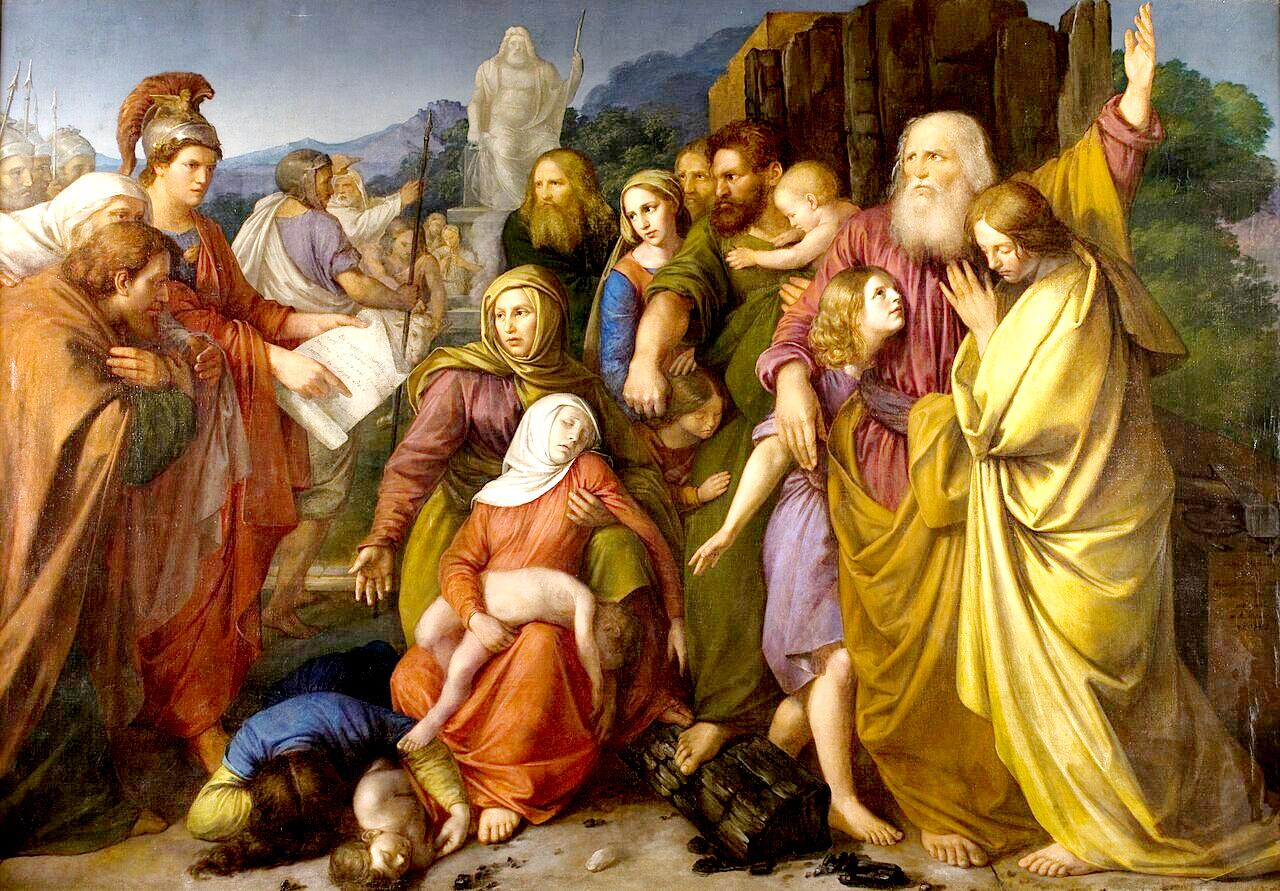
Despite the pressures on Judaism and the ascendancy of the Reformers in a Hellenistic world, the Jewish traditionalists were slow to revolt. Only with Antiochus' Decrees did the traditionalists rise up. the painting here by Polish artist Wojciech Korneli Stattler is a imaginmative depiction of the unrest (figure 1).
Judas Maccabeus launched a revolt that sought to overthrow the Greek rulers (167 BC). The Greek Seleucids had ruled Palestine since the collapse of Alexander's empire.
The revolt itself faced many problems. Not only did they have to face the Seleucid Army, but there was a serious internal problem. Just who was a Jew? Many of the Reformers had become so Hellenized that they they did not look like Jews to Jewish traditionalists. Thus it is no accident that the first person to be killed in the revolt was a Hellenized Jew. A Jew in Modin was sacrificing on a new Greek altar. He was slain by Mattathias, the elderly head of a priestly family in the town.
It was Mattathias' five sons led by Judah Maccabee that proceeded to lead the revolt against the regime Seleucids. The insurgents became known as the Maccabees. They have been described as moderate nationalists. They did not absolutely reject Hellenism. They themselves had been influenced by Hellenism. The employed Greek constitutional language to describe themselves
They employed brutal measures in their campaign, not uncommon in such insurrections. Many Reformers had failed to comply with Jewish traditions. When the Maccabees found uncircumcised Jews (the most obvious aspect of traditional Jews), they conducted forced circumcisions. They had no commitment to religious freedom among the Jewish community. Ironically there was a substantial degree of religious freedom prevalent in the Helenistic world until Antiochus' Decrees. The Maccabees saw religion as a collective matter, not subject to individual choice. The Maccabees succeeded in taking Jerusalem (164 BC). They rededicated and re sanctified the temple. Jerusalem and Judea was thus returned to Jewish rule (164 BC). This is the victory celebrated in Hanukkah festival.
The Maccabees created a new festival to commemorate their victory. Ironically it can be seen as part of Greek, not traditional Jewish, culture). Rabbis essentially added the lamp miracle to give God a more important role. Hanukkah (Chanukah, Hanukah, or Hannuka). is known as the Festival of Lights. It is an 8-day Jewish holiday that usually celebrated between late-November and late-December. It is held to commemorate the victory of the Maccabees victory over the Seleucid Empire, often described as the Syrians. The Seleucid Empire was actually a Hellenistic (Greek) empire centered on modern Syria. Hanukkah also celebrates the re dedication of the Temple in Jerusalem. Jews celebrate with 8 nights of traditional activities. This celebration has continued with Jews in the Diaspora around the world. Traditions include lighting the menorah, exchanging gifts, and enjoying foods treats cooked in oil.
The Maccabees ruled or had some authority in Judea until (37 BC). Differences soon developed between the traditionalists and those who seized control of the new state. Tensions thus developed in Judea even under Jewish rule. The defeat of the Seleucids left the Macabees in control of an independent Jewish state. The Maccabees began electing their priests. Historians have described the Maccabeean regime as quickly becoming corrupt, brutal and reactionary. The concept of reform had been thoroughly discredited by the Hellenizing extremists and Antiochus. Religious practice under the Maccabees stagnated. Scholarship declined as questioning orthodoxy became dangerous. The Maccabees became religious what can only be called religious oppressors as so many Jews had been Hellenized.
Sects appeared about the time of the Maccabeean revolt began (167 BC), perhaps a few decades later authored by the inhabitants of Qumran. It is not entirely clear what caused increasing religious unrest among the Jews at the time. Some such as the Essences are fairly well known to history. Others less so. They were pious Jews that resented Greek rule, but after the Maccabees, against the elders in their own Jewish leadership. Most believed that the elders were not being faithful to the strict traditions of the faith. They reacted in various ways. The Essenes convinced that Judea was not following God's strict instructions decided to forego temple rituals. Rather they lived in widely scattered communities where they sought to lead simple pious lives governed by strict rules. The Essenes in addition the the laws set forth in the Torah took ritual baths and rejected the idea of private property. Instead they lived a communal monastic life. The authors of the Dead Sea Scrolls seem to have been one of these dissenting sects.
And it was the Maccabees who would fatefully invite the Roman entry into Jerusalem. Some two centuries after the Dead Sea Scrolls were written, Qumran was overrun by the Roman Legions at the time of The Jewish revolt, The Scrolls seem to have been put into protective jars and hidden in caves at this time to keep them from falling into Roman hands.

Navigate the Historic Boys' Clothing Web Site:
[Return to the Old Testament Account and Historicity]
[Return to the Main Ancient Hebrew history]
[Introduction]
[Activities]
[Art chronologies]
[Biographies]
[Chronologies]
[Countries]
[Style Index]
[Bibliographies]
[Contributions]
[FAQs]
[Glossaries]
[Images]
[Links]
[Registration]
[Tools]
[Boys' Clothing Home]