At this time HBC has little information as to the ages of English boys wearing dresses in the 19th century. We know about the royal family, but are just beginning to acquire information on standard conventions. We have realtively few portaits of English boys wearing dresses, but this is because our 19th century English archive itelf is very limited. So our assessment of age conventions has only just begun. As far as we can tell, the numbers of available photographic images of boys in dresses drop sharply after age 5-6 years. This is an assessment based on the available photograpic images. And for the mot part the ages are our assessment because so dew images have ags recirded von them. Photography was developed (1839), but it is not unil the 1860s that thanks to the CDV that we hjave large nunbers of images. The English princes appear to have been breeched at about 5 years of age. HBC has, however, no details on how breeching was handled in the royal family. This was probably the norm, at least among upper and middle class Britons. Working class boys were probably breached earlier. A major shify occurred during the late-19th century. We see boys wearin kilt suits rather than dresses. This was especially true of the older boys sttill wearing skirted garments.
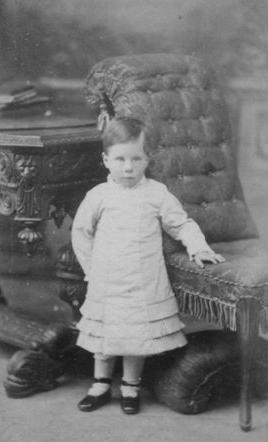
Figure 1.--This unidentified English boy loks to be about 2 years old. He wears a white or light-colored layered dress, The CDV portrait is undated, but was probably taken about 1880. The studio was J. Thirlwall in Hereford. The sepia image was affixed to an ivory card printed on the back in scarlet. There is no studio informtion on the front. An English reader reports, "From the style of this cabinet card I'd agree that could date from the 1880s, possibly the late 1870s.
2 Years
Our English archive is very limited. We believe, however, that most boys wore dresses in the 19th century when very young.. This seem to have been the especially case with boys from affluent families, but at age 2 years we see even working-class boys commonly wearing dresses. The unidentified boy here looks to be about 2-years old. He wears a white or light-colored layered dress (figure 1), The CDV portrait is undated, but was probably taken about 1880. We are less sure with working-class families.
We believe that it was fairly common during the 19th century for 3-year olds to wear dresses. We believe that many parents began breecing boys at age 3 years, but many boys at that age continued wearing dresses. Our limited English archive, however, does not yet enable us to make any valid asertions. We have archived several images showing English boys comminly wearing dresses throughout the 19th century. Not all biys, but a substantial number of them. We believe social class wa the orimary factor here. A good example is
a Liverppol boy who looks to be about 3 years old we think in the 1860s. He is wearing a low neckline print dress with baloon sleeves. The print dress has polka dots done in rows and coluuns. We also see a sash, but it is not an actual sash, but part of the dress pattern. We also note an unidentified Chester family with the boys all wearing dresses. The cabinent card portrait looks to date to the 1880s.
Most of the English boys wearing dresses were pre-school boys. This included 4-year olds. We do not yet have many example of English boys wearing dresses. We believe that this is primarily because our English archive is still fairly limited. As a result we are unsure at this time about how common it was for 4-year olds to wear dresses. We believe that quite a number, perhaps the majority of boys were being breeched at this age, especially boys from affluent families. Social class was probably a factor. We believe that working-class boys tended to be breeched earlier than boys from affluent families. There was, however, condiderable variation from family to family. We hope to be able to pursue some of these issues as our English srchive expands. As it is so small we also can not yet discuss styles. We do believe that kilt suits were not as common n Englsnd as in America. Thus boys not yet breeched were peibably more likely to wear dresses than american boys. By the same token, the greater afflunce in America by the late-19th century may have bment that breeching was being delayed more thn in Britain.
Age 5 is the last year that we see relly large numbers of boys earing dresses. A major factor here was school. Boys were normally breeched before beginning school which commonly occurred at about age 6 years. This was less definative in the 19th century when the public school system was less estanlished. England lagged behind America and Germany in establishing a public education system. The number of 5 year ols still wearing dresses declined notably in the late-19th century, especially the 1890s. Social class was a major factor in 5-year olds. Most working-class children were breeched by thus age, many a year or two rarlier. This was less true for boys from families in more comfortble circumtances. All of this of course varied chrononogically. But still we see quite a few boys still wearing dresses at age 5. A good example is an unidentified London boy in 1902. There is no age information on the card , but the boy looks to be about 5 years old. He wears a plain dress wiyh a pleated skirt. The major decoration is a lce collar and matching sleeave ciff. Thee is a wide waistband along with a back bow ansd sash.
As in other countries, English boys were generally breeched before beginning school at about 6 years of age. Here England was a little different than Ameica and Germany in that it was relatively late in developing a public school system. The wealthy in England were unsure about the scocial consequences of educating the children of the working class. Thus for much of the 19th century, working-class children were receiving very little education. Another complicating factor is that many affluent parents educated their younger children at home. HBC believes the image here shows a boy about 5-6 years old, probably photographed in the 1880s. An English reader reports, "From the style of this cabinet card I'd agree that could date from the 1880s, possibly the late 1870s." Younger working-class children might hve worn dresses, but this was no longer the case with 6-year olds. This means that we do not see many 6-year olds wearing dresses. This may not be accurately reoresented in the photogrohic record because the workirg-class was less likely to have portraits taken than the afflient. Here american practices may not be a good indicator in that Americn workers were betterpaid than European workers.
It was very rare to find boys of 11 years of age. Most boys were breeched by age 6 years of age. We think that a few boys from wealthy family schooled at home may have continued o wear dresses. We have found some portaits from London photographers. The children are not identified, but they look like boys with short hair and sometimes side parts. Without the dates we can not be entirely sure that thy are boys, but they certainly look like boys. Notably the dresses they are wearing are not the rekativel plain boy dresses we find kin the United States. The dresses look very much like dresses girls might wear, fancy fashionable creation. The exampls we have fojund eem to date to the 1870s-80s. And they include large lace collars and lockets.