|
The basic traditional garment is the kimono. It was traditionally the primary item of dress. Today it is primarily a garment worn for special occassions. It is worn by both genders, but styling varies. This is not a child's garment. Children's kimomos are essentially a scaled-down version of their parent's kimonos. The children's kimono would have been just as elaborate and made out of similar material as their parent's kimino, reflecting the famly's social standing. The chldren, if the family could have afforded it, would have had a formal kimono for special occassions like festivals and special family events. A modern child's kimono is usually very colorful and bright, similar to a woman's kimono. I do not think this was the convention in the 19th century, but our information is very limited. For a special day, dressing in a kimono can be a major undertaking, especially for a young girl. There are various accessories worn with the kimono. Girls wear matching zori shoes, purses, obi belts and hair accessories. Boys wear children's kimono sash belts. Boys' sash belts tend to be wide. They also might wear happi coat. Very small child might wear a hanten. Hanten are cotton garments stuffed with insulating filler (down or in modern time polyester), similar to a modern quilted jacket. Modern hantens as they are for younger children are very colorful and bright an unlike the kimono are very simple, making it wasy to dress the child.
Hakama are traditional Japanese pleated, wide-legged trousers. In available photographs they look more like skirts. And are usully impossible to identify unless indicated. Hskama historically were worn by samurai warrors. They contiunue to be worn in martial arts (Aikido and Kendo) or in formal or ceremonial events. Hakama were traditionll done in silk or cotton. Modern hakama are done in polyester-rayon blends or cotton. The cut is an exacting traditional seven pleats (five front, two back), a stiff backboard (koshiita), and straps (himo). They are worn over a kimono, and tied at the waist with specific traditional knotting techniques. They had tone folded very carefully to maintain the required crisp pleats. Modern fabrics hold the plets better. Hakama were a male garment, but there ewere exceptions. Women occasional wear them, such as teachers in graduation ceremonies and for masrtial arts. Hakama are also worn by miko or shrine maidens.
The basic traditional garment is the kimono. It was traditionally the primary item of dress. Today it is primarily a garment worn for special occassions. It is worn by both genders, but styling varies.
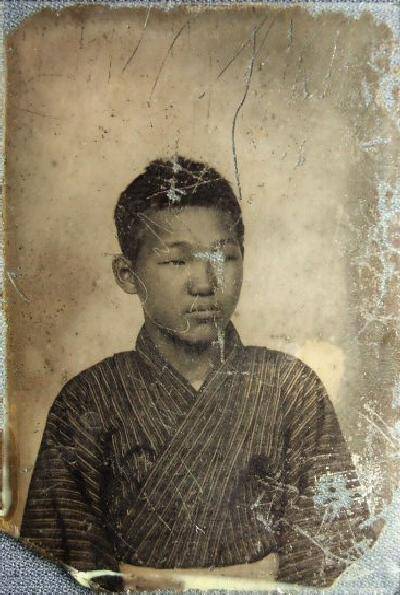
There are diffeent kinds of kimonos. We notice Okuda Michitaro wearing a hakama kimono. This was a skirt-like kimono once only for noys and nen. Today women and girls alo wear them.
Kimonos are not a child's garment. Children's kimomos are essentially a scaled-down version of their parent's kimonos. The children's kimono would have been just as elaborate and made out of similar material as their parent's kimino, reflecting the famly's social standing. The chldren, if the family could have afforded it, would have had a formal kimono for special occassions like festivals and special family events. A modern child's kimono is usually very colorful and bright, similar to a woman's kimono. I do not think this was the convention in the 19th century, but our information is very limited. For a special day, dressing in a kimono can be a major undertaking, especially for a young girl. There are various accessories worn with the kimono. Girls wear matching zori shoes, purses, obi belts and hair accessories. Boys wear children's kimono sash belts. Boys' sash belts tend to be wide. Children wear kimonos for Kodomo no hi. we also notice boys wearing kimonos to school before World War II.
Boys might wear a happi coat.
Very young children might wear a hanten. Hanten are cotton garments stuffed with insulating filler (down or in modern time polyester), similar to a modern quilted jacket. Modern hantens as they are for younger children are very colorful and bright an unlike the kimono are very simple, making it wasy to dress the child.
Here we are a little condused We note Japanese children, boys and girls, wearing what look tobe long skirts. This seems to have been a very common garment. We see many examples in the photographic record. But look to be skirts the boyscare wearing seem to be hakama. There are pleats involved. We are not sure what the Japanese name for these traditional long skirts were. The modern term is sukāto (スカート). We are not sure if that is the term that was used used for the traditional long skirts. Butvwe are not at all sure if what we thoughto be skirts are mot actually hkma, at least for the boys. Hopefully our Japanese readers can offer insights on this.
The traditional Japanese sock covered only the foot and had an indent between the big and second toe to accomodate traditional Japanese sandals. It was called "tabi" It was worn primarily by women and girls with kimono (and is still seen today when they dress in traditional fashion). Boys and men had something similar for formal attire; that may be tabi as well.
Traditional footwear in Japan was the zori sandal. I thought they were a centuries old style, but Webster's indicate the term first appeared at the turn of the 20th century. Apparently the term zauri was used rarlier. I'm not sure if there was any difference between the zaur and zori sandal. Zori sandals were made from straw with a flat sole. They were held on the foot by a thong worn between the big and second toe. They also were made in rubber, but I'm unsure when the first rubber zori appeared. The zori sandal appears to have been the inspiration to the modern flip-flop.

Navigate the Boys' Historical Clothing Web Site:
[Introduction]
[Activities]
[Biographies]
[Chronology]
[Clothing styles]
[Countries]
[Bibliographies]
[Contributions]
[FAQs]
[Glossary]
[Images]
[Links]
[Registration]
[Tools]
[Boys' Clothing Home]
Navigate the Boys' Historical Clothing Japanese pages:
[Return to the Main Japanese folk costume page]
[Return to the Main Japanese page]
[Activities]
[Choirs]
[Department store catalogs]
[Monarchy]
[Music recitals]
[Youth groups]
[School uniforms]