|
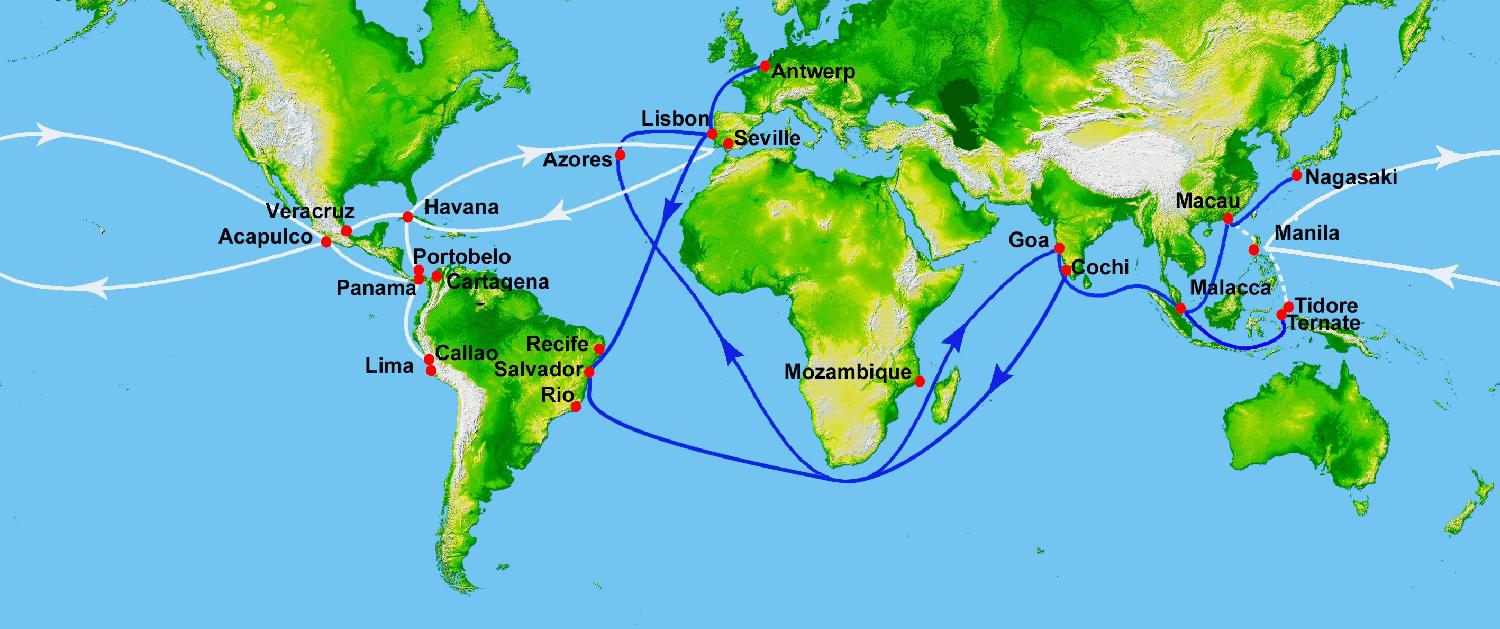
Manila was Spsain's Asian hub of the Manila galleon trade, transporting silver to China and Chinese goods to Acapulco. This was essentially the Pacific extension on to China of the Spanish Treasure Fleet/Flota de Indies. Remember the primary purpose of the European Voyages of Discovery, even Columbus' voyages, were to esatblish maritime trade routes with China. But once this had been accompllished the Europeans had a serious problem. They produced very little the sophisticated Chinese wanted. The Amer-Indian silver and mines seized by the Conquistadores in the Conquest of the Americas solved that problem. The Chinese very much wanted silver. In fact they had an insatiable appetite for the shiny metal. 【von Glahn】 Gold was for emperors and the very wealthy. Silver on the other hand was something in which every merchant and trader in all of Chjina could deal. The silver trade was essentially the beginning of a genuinely global economy. 【Flynn and Giraldez. China ...】 Manila galleons were Spanish ships that made annual round trip voyages crossing the Pacific. Spanish conquistadors found fabulous gold and sliver riches in the Americas. The Manila Galleons were the same ships as the better known Atlantyic treasure ships that brought gold, silver, gems and other riches products in the Atlantic/Caribbean from the American colonies to Spain, some of which were intercepted by the English sea dogs. The Manila Galleons sailed from Acapulco where silver was accumulated from Mexico and Peruvian mines for transport to Manila and then on to China. Spanish silver solved a major European problem. 【Flynn and Giraldez. Silk ...】 One author writes, "... to the people of Spanish America, they were the China Ships or Manila Galleons that brought them the cargoes of silks and spices and other precious merchandise of the East. To those of the Orient, they were silver argosies, laden with the Mexican and Peruvian pesos...." There was huge demand in Europe for Chinese products and virtually no demand for European priducts in China. The valuable Spanish silver did not outweigh the insatiable demand for Chinese goods. 【Baker, p. 1.】 Silk was the most coveted product. Other Chinese products included porcine, perfumes, tea, and other items. There were also cotton textiles from India. The Europeans had, however, little to offer the Chinese. Spanish silver solved that problem. The galleons also carried Spanish administrators and church men. They were the only method of communication between the Royal Government in Spain and the Philippine colony. The galleons were the economic lifeline for the Spanish in Manila. The Philippines were not nearly as productive as the American colonies. As a result of the Galleon trade, Manila for a time became one of the world's great ports. It was a key cog of the important trade between China and Europe. After being landed in Acapulco, merchants made profits of anywhere from 100–300 percent. 【Chuan, p. 113.] The galleon trading ships carried Spanish settlers and and military reinforcements. The voyages occurred once or twice annually crossing the Pacific. The trade made Manila the hub of the silver-based trade. And Manila one of the major global cities in the world, the impact on the wider Filipino economy is a more difficult question. Manila functioned as a trade entrepôt and not just between China and Mexico, but rather for Southeast and South Asia as well and the the other Spanish colonies in South America as well. Silks, porcelain, tea, perfumes, paper, and various manufactured goods came from China. Spices, aromatics, specialty woods, herbs, medicines, pearls, and cinnamon originated in the East Indies which the Dutch seized from the Portuguese. And slaves, jewelry, cotton textiles, iron, and gunpowder found its way from India.
Barker, Tom. "Silver, silk and Manila: Factors leading to the Manila Galleon trade," Scholar works-calstate.
Chuan, Hang-sheng. “The Chinese silk trade with Spanish-America from the Late Ming to the mid- Ch’ing Period,"” in Studia Asiatica Essays in Asian Studies in Felicitation to the Seventy-fifth Anniversary of Professor Ch’en Shou-yi, ed. Laurence G. Thompson (San Francisco: Chinese Material Center, 1975).
Flynn, Dennis O. and Arturo Giráldez. China and the Birth of Globalization in the 16th Centuryy
Flynn, Dennis O. and Arturo Giraldez. "Silk for Silver: Manila-Macao trade in the 17th century," Philippine Studies Vol. 44, No. 1 (First Quarter 1996), pp. 52-68.
von Glahn, Richard (1996). "Myth and Reality of China's Seventeenth Century Monetary Crisis,"Journal of Economic History Vol. 2: 132. "

Navigate the Boys' Historical Clothing Web Site:
{Returtn to yhe < href="/country/oce/phl/hist/ph-spa.html">Main Philippines: Spanish Colonial History page
[Return to the Main Philippines national history page]
[Return to the Main Philippines page]
[Return to the Main Spanish Empire page]
[Return to the Main Oceania page]
[Return to the Main countries page]
[Introduction]
[Activities]
[Biographies]
[Chronology]
[Cloth and textiles]
[Clothing styles]
[Countries]
[Topics]
[Bibliographies]
[Contributions]
[FAQs]
[Glossaries]
[Images]
[Links]
[Registration]
[Tools]
[Boys' Clothing Home]