|
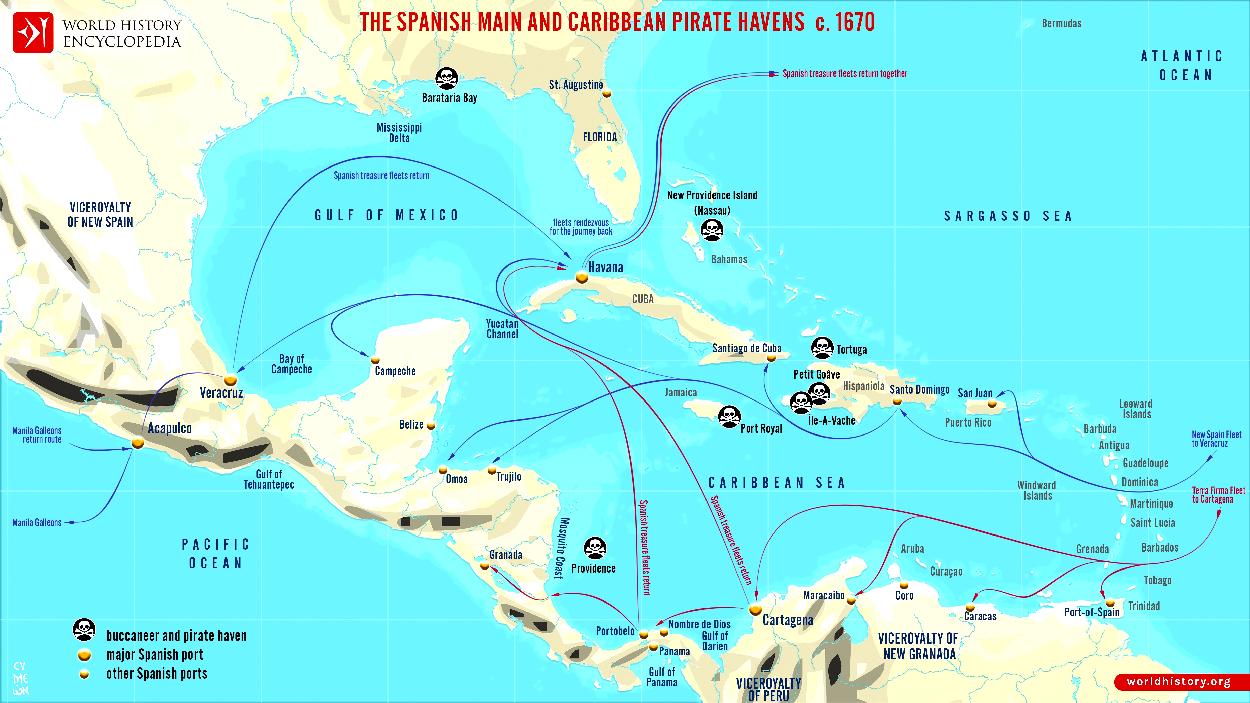
The famed Spanish treasure fleet, or Flota de Indies, was a carefully organized convoy of armed merchant ships and galleons. The Spanish in what is now Mexico, Colombia, and Upper Peru (Bolivia) seized and mined vast quantities of bullion (gold and silver). In the Mercantilist economy of the day that was an unprecedented bonanza. The governing objective of a Mercantilist economy was to acquire bullion, especially gold. There was so much gold, silver, and other treasure that transporting it back to Spain became an issue, especially privateers like the English Sea Dogs began seizing the treasure ships. Dutch privateers were also active because the Spanish were attempting to suppress Dutch independence. Despite the pirate and privateer drama, hurricanes were actually a far greater danger. Unlike today, there was no advanced warning of even the most powerful storms. The conseuences could be devestating. The Spanish began organizing large armed fleets or convoys to get the bullion back to Spain safely-- the Spamish Treasdure Fleets or Flota de Indies (1566-1790). It vwas all centered on the Caribbea (figure 1). It transported immense quantities of gold, silver, gems, and spices from their American colonies to Spain, fueling Europe's economy for over 2 centuries. The fortunes they carried attracted pirates and profiteers (legalized pirates financed by envious European countries without gold producing colonies). There was also severe hurricanes which were even more deadly than the pirates and profiteers. The Flota de Indies was organized by the Royal Government to protect their treasure ships from both pirates and other European navies--especially the English Sea Dogs. Much of the silver came from Potosí in Upper Peru (Bolivia). The silver was transported by llama caravans to Callao (Lima) and then shipped noeth to Panama, where other caravans crossed the narrow isthmus to the Caribbean. Emeralds and gold from Colombia had shorter routes. Silver from Mexican mines in the high mountain ranges and valleys northwest of Mexico City, including Zacatecas, Guanajuato, Taxco, and San Luis Potosí moved over te Camino Real to Veracruz. There was also a trade with China financed by Peruvian and Mexican silver--the Manila Galleons. This made the Philippine Islands an important Spanish colonial assett. This trade originated in Mexican pots of Acapulco and Puerto Vallarta. So the Caribbean Flota de Indies also carried Chinese goods back to Spain. The Flota de Indies fleets gathered in Havana, Cuba protected by powerful fort. From Havana it made the dangerous Atlantic crossing back to Spain. Major hubs feeding into Havana were Veracruz (Mexico), Portobelo (Panama), and Cartagena (Colombia). The Sea Dogs were not the only danger. Caribbean hurricanes were a huge danger. One of the most famous wrecks is the Nuestra Señora de Atocha (1622). The San José was sunk by the British (1708). Hurricanes destroyed much of the 1715 and 1733 fleet--creating Florida's Treasure Coast. The value of the cargoes is almost beyond comprehension. The British sank the San Jose instead of capturing it. After being found there was a legal battle between Colombia and Spain. It was a Spanish ship, but found in Colombian waters. The 150-foot-long, 64-gun, three-masted galleon's treasure included 200 tons of silver and emeralds, 11 million gold coins, an intact Chinese dinner service and other Chinese porcelain. A 2024 estimate valued the cargo at $17 billion dollars. 【Sarnoff】 Given the ongoing debasement of currencies, this might be a high as $25 billion in 2026 dollars. And remember that this was only one ship, albeit the flagship with an exceptionally valuable cargo. The Spanish Treasure fleets commonly in the 16th and 17th centuries were large convoys included 30 to 90 vessels, but this included escort vessels. Often there were two fleets organized a year. By the 18th century this had declined to 7-12 galleons as Potosí was playing out. We note a 2015 estimate of just the silver produced in th Americas totaling $539 million. Given the rise in silver prices this would in 2026 be about $1.5 trillion (excluding the brief $100 per ounce spike. The ultimate European terminus for the Spanish treasure ships was Seville (and later Cadiz), where goods were offloaded under the supervision of the Casa de Contratación. Interestingly the Spanish lost inteet in the Caribban because the goild and dilver was to be found on ghe mainland, but to get thetreasure back to Dpain thy had to transit th incresingky hostile waters of the Caribbean. The Caribbean isands themselves were of limited interest to he Spanish. With the rise of sugar plantations in the Caribbean (18th century), even small sugar islands became immensly valuable--a colonial bnonaza the Spanish largely missed. .
Sarnoff, Leah. "Most valuable treasure': $17 billion Spanish shipwreck from 1708 to be recovered The San José was sunk in 1708 by British warships off the coast of Colombia," ABC News (March 20, 2024).

Navigate the Childten in History Website:
[Return to Main Price Revolution page]
[Return to American gold and sliver]
[Return to Precious metal]
[Return to the Spain and the Americas]
[Return to the Spanish Economy: War and Economic Failure (16th -17th centuries)]
[Return to the Main Economics Page ]
[About Us]
[Introduction]
[Biographies]
[Chronology]
[Climatology]
[Clothing]
[Disease and Health]
[Economics]
[Freedom]
[Geography]
[History]
[Human Nature]
[Ideology]
[Law]
[Nationalism]
[Presidents]
[Religion]
[Royalty]
[Science]
[Social Class]
[Bibliographies]
[Contributions]
[FAQs]
[Glossaries]
[Images]
[Links]
[Registration]
[Tools]
[Children in History Home]