|
The American gold and silver quickly passed through Charles V's Treasury. It served to enable him to take out even more loans than he had already contracted. Charles by 1551 had borrowed 14.4 million ducats at interests rates approaching an astonisjing 50 percent. 【Hoopes 】 These were loans Spanish Treaaury could never pay off--even the American bullion flooding into the country. Cgarles and his soon Philip II would rulr over powerful states perpetually in debt. Charles' army did stop the Ottomans from moving further into Christian Europe, but it could not contain the Protesrant Revolution. But the impact of the gold and silver is much larger. Most visibly the American gold and silver helped finance Renaissance art. That was, however, only the most vissible impact. More importantly, mich of it went into the pockets of bankers, it played an important role in the expanding European economy. And it was not comtained in the Catholic principalities allied with the Hapburgs. The gold also financed the ill-fated Spanish Armada unleashed on England by Charles's son Phillip II (1588). Some of the gold flowed into other European treasuries as other maritime powers (England, France, and the Netherlands) began preying upon Spanish treasure ships. Some of the gold can be seen in gold leaf and trasures of churches and cathedrals across Europe. But much of the rest of the gold is difficult to trace with precission. What is known is that the American gold significantly increased the gold stock of Europe, resulting in both inceased inflation and an expansion of economic activity. The influx of American gold also played a role in the growing influence of the middle-class in northern Europe. Bullion from America helped create the "Price Revolution" in Europe. Such inflationary episodes significantly impcted affect existing social and economic relationships. Various groups can be affected and in Europe during the 16th century prices variously rose two to four times. This meant that landowners renting property and workers were adversely affected. Governments were also adversely affected. Taxes at the time were commonly flat sums and not a percentage of incomes. In this environment it was entrepreneurs that benefitted most. 【McNeill, p. ?. 】 Other factors were involved explaining the rise of the middleclass such as the expanding economy of Europe, improved maritime bulk transport, and technological advances were also involved. But American gold and silver were important factors. Much of the bullion, except that siphoned off by English and other freebooters, extered Europe through Spain. It was not the Spanish middleclass, however, that most benefitted. Spain used the bullion to import goods and it was merchants and entrepreneurs in the exporting countries that most benefitted. Spain manufactuers were rendered uncompetitive wih foreign imports. The results was that mnufacturing withered as it became uncometitive with foreign sources. Spain began importomg what it needed.
Amer-Indian peoples were basically a stone age people. The lack of metal weapons was one reason the Spamish comnquistadores were so suceesful against huge Amer-Indian armies. Strangely the had developed metalurgy technologies. This was primarily accomplished in South America by Andean and related coastal people. This process may have begun very early, beginning with gold work (about 2000 BC). Copper work followed later (about 1300 BC). These two metals have about the same smelting point (1064-84° C). The difference being that gold is not an active metal and thus cam be found in nature. Copper is an active metal and thus technologies had to be developed to refine the metal. We are not sure when the first silver work began. Silver has an even lower melting point (961° C), but like copper is an active metal and thus methods to refine these metals had to be developed. Researchers have found eviudence of work with lead and tin. Iron with its high melting point (about 1500° C) was beyond the reach of Amer-Indan craftsmen who did not have bellows. Nor did they master the bloom techology (reduction metalurgy) developed in Europe. There is evidence of work with platinum in Ecuador. That technology was graduall acquired by Meso-American people to the north. Ecuadorean marine traders are believed to have played an important role. For some reason, Amer-Indian metalurgy was never used to any significant degree to fashion useful tools and weapons. Their metal was primarily used to fashion religious art or personl adornment for the elite. South American civilizations had developed sophisticated technologies for the extraction, purification, and alloying of metals and metal crafting. Smelting was limited because the lack of bellows. Many alloys were developed. In fact the Soanish complained about the impurity of Inca gold. This was not brcause the Inca metalurgists were unskilled, but because they created alloys to enhnce the color characterustics of the gold. For the Inca it was color that was important, not purity. The Inca were the inheitors of a long histoy of technologicazl devlopment. It as, however, coastal peoople tht were especually gufyed, particularly the Chimu snd Moche. After conquering these people, their craftsmen were bought to Cuzco. The result of all this work was a considerable quatity of gold and silver which proved to be a powerful educement to conquest. What the Amer-Indian people had mined and refined, however, was a small fration of what the Spanish would find still unmined after the conquest. Espoecially as the Spanish intensified mining.
The famed Spanish treasure fleet, or Flota de Indias, was a carefully organized convoy of armed merchant ships and galleons. The Spanish in what is now Mexico, Colombia, and Upper Peru (Bolivia) seized and mined vast quantities of bullion (gold and silver). In the Mercantilist economy of the day that was an unprecedented bonanza. The governing objective of a Mercantilist economy was to acquire bullion, especially gold. There was so much gold, silver, and other treasure that transporting it back to Spain became an issue, especially privateers like the English Sea Dogs began seizing the treasure ships. FDutch privateers were aso active becausethe Spanish were attemotiung to supress Dutch independence. Although hurricanes were a far greater danger. The Spanish began organizing large armed fleets or convoys to get the bullion back to Spain safely (1566-1790). It transported immense quantities of gold, silver, gems, and spices from American colonies to Spain, fueling Europe's economy for over 2 centuries. The fortunes they carried attracted pirates and profiteers (legalized pirates financed by The American gold and silver quickly passed through Charles V's Treasury. It served to enable him to take out even more loans than he had already contracted. Charles by 1551 had borrowed 14.4 million ducats at interests rates approaching an astonisjing 50 percent. 【Hoopes 】 These were loans which the heavily indebted Spanish Treasury could never pay off--even the American bullion flooding into the country. Charles and his son Philip II would rule over powerful states perpetually in debt.
The Hapsburgs controlled the grreat powers of Europe (Germany and Spain). But they were confronted with a ruionous two-front war. Western scholars focus primarily on events in the West, Charles' (Germany) abd Philip's (Spain) struggles with Luther and the Protestants as well as issues with the English Sea Dogs and the other European maritime powers. But that was not all that threated the Hapsburgs. To the East was the threat of Ottoman Muslim expansion into Europe. Charles' army did stop the Ottomans at the games of Vienna from moving further into Christian Europe. And Philip's navy defeated the Ottoman navy. But all of this came at great cost. They could not, however, contain the Protesrant Revolution despite waging other costly military operations. All of thgese events powerfully impacted European history, but the economic impact of the huge flow of American gold and silver inyto Spain may have been even larger.
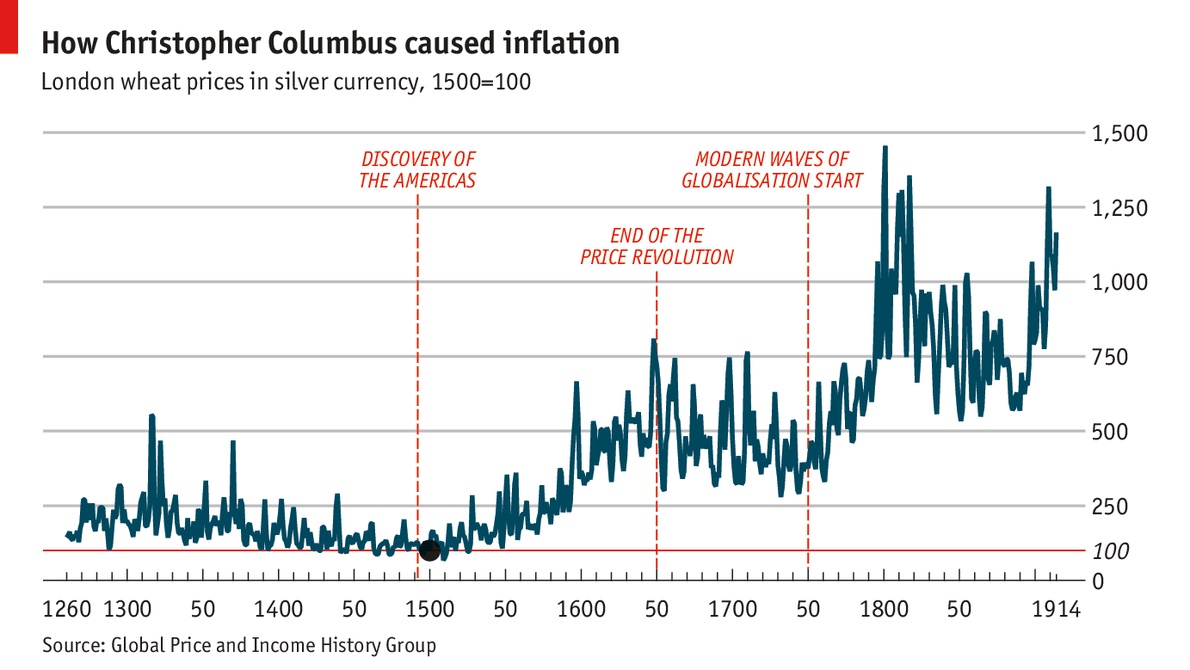
The quantity of gold and silver flowing into Spain as a result of their conquests in the Americas was mind boggling. But that was a small part of the huge impact on Europe. The influx of American gold also played a role in the growing influence of the middle-class in northern Europe. Bullion from America helped create the "Price Revolution" in Europe.
Prices for goods rose roughly 500 percent over time.
Tons of silver and gold extracted by Spain from the Americas (particularly modern-day Peru/Bolivia and Mexico) and poured into Europe. Most of it crried by Spannish galleons entered through Spain and subsequently circulated throughout Europe. There were other factors, but the Americn bullion was the primary factor. Monetary debasementwas another fctor. European rulers frequently reduced the precious metal content in their coins to pay hlp off debts, devaluing the currency.
The Europeam Price Revolution was a prolonged period of high inflation in Europe beginning from the mid-15th century to the mid-17th century. This resulted from the conquest vif the great Ameriian empires. The Aztecs fell to Cortez (1519) and the Inca fell to Pizzaro (1532). (There was more post comqwuest resitance in Peru.) At first the gold and silver camefrom looting the conquered empire. Some silver came from Mexicvan mines, then the Spanuish found Potosí in upper Peru (modern Bolivia)--essentialy a silver mountain (1545). There were various causes, but vthe porrimary reason for the infkation was massive influx of gold and silver from the Spanish American colonies.
Artists like to yhin nof themselves as cut above the restvof vhumanity anbd the crasser influences of soicirty. In fact art is significantly by economics, especially sucessful econmomies. The most vissible aspect of the gold and silver flowing into Europe was the financing of Renaissance art which you can see today in European churches and art galleries. Some of the gold can be seen in gold leaf and trasures of churches and cathedrals across Europe. But much of the rest of the gold is difficult to trace with precission.
And it was not comtained in the Catholic ptincipalities allied with the Hapburgs. The gold financed the costly and ill-fated Spanish Armada unleashed on England by Charles's son Phillip II (1588). Some of the gold flowed into other European treasuries as other maritime powers (England, France, and the Netherlands) began preying upon Spanish treasure ships.
Much of the gold and silver went into the pockets of bankers, had a massive impact on the expanding European economy. What is known is that the American gold significantly increased the gold stock of Europe, resulting in both inceased inflation and an expansion of economic activity. Such inflationary episodes significantly impcted affect existing social and economic relationships. Various groups can be affected and in Europe during the 16th century prices variously rose two to four times. This meant that landowners renting property and workers were adversely affected. Governments were also adversely affected. Taxes at the time were commonly flat sums and not a percentage of incomes. In this environment it was entrepreneurs that benefitted most. 【McNeill, p. ?. 】 Other factors were involved explaining the rise of the middle-class such as the expanding economy of Europe, improved maritime bulk transport, and technological advances were also involved. But American gold and silver were important factors. Much of the bullion, except that siphoned off by the English seadogs and otherr freebooters, extered Europe through Spain. It was not the Spanish middleclass, however, that most benefitted. Spain used the bullion to import goods and it was merchants and entrepreneurs in the exporting countries that most benefitted. Spain manufactuers were rendered uncompetitive wih foreign imports. The results was that mznufacturing withered as Spain imported what it needed.
There was a decline in real wages thriughout Europe. Wages and peasant earnmiungs for the most part failed to keep up with the soaring prices, This significantly lowered the actualmpurchasing power and standard of living for wage-earning laborers and peasants. Merchants, productive enterprises, and landowners who could sell crops at higher market prices benefited. Fixed-income groups and traditional feudal lords suffered. This accelerated the transition from the middle ages to our modern era. The economic center of gravity inRurope shifted decisively from the Mediterranean toward the Atlantic seaboard (England, France, and the Netherlands) invoilved in global commrce.
The European population decimated rebounded after the 14th century Black Death, began recovering (15th century). This increased the demand for food and basic commodities while supplies according to some observers did not keep pace, but availanle data shows no major inflation in the 15th cenrtury (figure 1). The Colombian Exchange had a huge impct on population. This was primrily dur to the humble potato. European farmers above all else wanted to grow wheat to poduce bread. But wheat is a crop developed for sunny climates with limited rainfall--Mesopotamia. Cloudy well-watered Europe was not ideal for wheat cultivaion. Farmers faced the poosibility of crop failures. Potatos in contrast were ideal. Potatoes significantly increased the calories that could be produced per acre which in turn droce population increases.
Hoopes, John. University of Kansas Lawrence Campus.
McNeill, William H. The Rise of the West: A History of the Human Community (University of Chicago Press, Chicago, 1991), 828p.
Sarnoff, Leag. "Most valuable treasure': $17 billion Spanish shipwreck from 1708 to be recovered
The San José was sunk in 1708 by British warships off the coast of Colombia," ABC News (March 20, 2024).
Navigate the Childten in History Website:
Spanish Royal Treasury
Two Front War
Price Levels
Cause
Chronology
Renaissance Art
Countries
Impact
Population Recovery
Sources
CIH

[Return to American gold and sliver]
[Return to Precious metal]
[Return to the Spain and the Americas]
[Return to the Main Economics Page ]
[About Us]
[Introduction]
[Biographies]
[Chronology]
[Climatology]
[Clothing]
[Disease and Health]
[Economics]
[Freedom]
[Geography]
[History]
[Human Nature]
[Ideology]
[Law]
[Nationalism]
[Presidents]
[Religion]
[Royalty]
[Science]
[Social Class]
[Bibliographies]
[Contributions]
[FAQs]
[Glossaries]
[Images]
[Links]
[Registration]
[Tools]
[Children in History Home]
Created: 3:36 AM 1/10/2021
Last updated: 3:36 AM 1/10/2021