|
The Columbian Exchange is the term historians and economists have give to the the massive, transfer of plants, animals, diseases, people, and technology between the New World (the Americas) and the Old World (Afro-Eurasia). The exchange at first came from the advanced Amer-Indian civilizations of Meso-America and Andean South America with Europe, but Africa and Asian would also ultimately be powerfully impacted. Thus was all initiated by Italian explorer in service of Spain, Christopher Columbus. With his First Voyage gets credit for initiating the process (1492). Portuguese explorer, Vasco de Gama, leading the first expedition beyond the Cape of Good Hope, also a vital step in he process--ensuring that the exchange would not be just with Europe (1497-99). Portuguese explorer Ferdinand Magellan would set in motion the first circumnavigation of the globe, meaning that the Colombian exchange would be a truly global phenomenon (1580-81). Columbus First Voyage was at first a disappointment because it yielded little gold. It was at first seen as more of a curiosity at court. It all began in he Caribbean (the Spanish Main), but with many subsequent European voyages quickly expanded to Mexico, Central America, and South America. North America would come later, but would ultimately have a huge impact beyond the Colombian Exchange. The Colombian Exchange itself set in motion exchanges that revolutionized the world economy and along with it international power politics and economies that still reverberate to this day. Gold and silver were to follow which had a huge impact on the mercantile economies of the day. Below the radar of the European courts was the immense impact on global diets. Of extraordinary importance were the humble potatoes and maize. In a world in which economies were till fundamentally based on agriculture, these two highly productive crops massively increased food production leading to population increases and blanching the rise of Europe on the world stage far beyond the gold and silver Spanish Conquitadores and European monarchs coveted. In tragic contrast was the devastating population collapse in th Americas because Amer-Indians had no genetic immunity to Europeans diseases like smallpox.
The Columbian Exchange is the term historians and economists have given to the the massive, transfer of plants, animals, diseases, people, and technology between the New World (the Americas) and the Old World (Afro-Eurasia). The term was coined by historian Alfred Crosby to describe one of the most significant ecological, agricultural, and social events in world history (1972).
The exchange at first came from the advanced Amer-Indian civilizations of Meso-America and Andean South America with Europe, but Africa and Asian would also ultimately be powerfully impacted. Thus was all initiated by Italian explorer in service of Spain, Christopher Columbus. With his First Voyage gets credit for initiating the process (1492).
Portuguese explorer, Vasco de Gama, leading the first expedition beyond the Cape of Good Hope, also a vital step in he process--ensuring that the exchange would not be just with Europe (1497-99). Portuguese explorer Ferdinand Magellan would set in motion the first circumnavigation of the globe, meaning that the Colombian exchange would be a truly global phenomenon (1580-81).
Columbus First Voyage was initially a disappointment because it yielded little gold. The Americas was at first seen as more of a curiosity at court. It all began in he Caribbean (the Spanish Main), but with many subsequent European voyages quickly expanded to Mexico, Central America, and South America. North America would come later, but would ultimately have a huge impact beyond the Columbian Exchange.
The Columbian Exchange set in motion exchanges revolutionized the world economy and along with it international power politics and economies that still reverberate to this day. Gold and silver were to follow which had a huge impact on the mercantile economies of the day. Below the radar of the European courts was the immense impact on global diets. Of extraordinary importance were the humble potato and maize. In a world in which economies were till fundamentally based on agriculture, these two highly productive crops massively increased food production leading to population increases and blanching the rise of Europe on the world stage far beyond the gold and silver Spanish Conquitadores and European monarchs coveted. In tragic contrast was the devastating population collapse in th Americas because Amer-Indians had no genetic immunity to Europeans diseases like smallpox.
Europeans began moving to the Ameicas. Population movement meant spreading diseases. The movement of Europeans spead European diseases to the Americas included smallpox, measles, influenza, typhus, malaria, and diphtheria, which caused a massive indigenous population collapse in he Amedicas. No one knows the extent of the collapse, but it mat hve been as high as 90 percent. This impcted the demographic profile od the poplsion as infigenous people peished and Euopean colonizers poured across the Alantic. The introduction of sugar led to amother popultion movement. The Arabs began the African slave trade (7th centuy AD). Slave trading was this a well established phenomnon in Europe. The introduction of sugarcane created the need for a labor force. The indigenous poplation collapse mean that the indigenos popltion could not be utiklixzd for plntation slave labor. Thus the Atlanic slave trade was born. Millions of captive Africans were transported to he Americas.
Important new animals appeared in the new world. This included: horses, cattle, pigs, sheep, goats, and chickens. This not only involved food sources. It meant power. In theera before mchsmizasion, animals were the pimay source of power. There are reasons that engines are ranked in horsepower even today.
New agricultural crops began to be cultivated in the America. This included grains especially wheat, sugar, rice, coffee, grapes, and citrus fruits. Among
these, sugar was especially important.
Diseases appearing in the Old World inmcluded in sipilus whic gave rise to the teem 'Montezyma's Revenge'.
No imprtant new animals appears in the Old World. The llama which was imprtant in he ndes, hekld no advantage ove exidsting amimls. Turkeys were probbly the most important animal, but it had a minimal impact. Guinea pigs were transfered, but had even less imopact than turkeys.
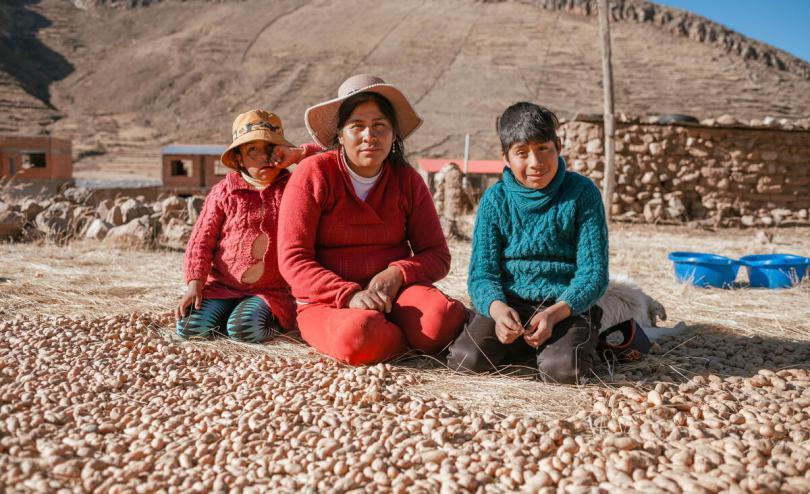
Agriculture dominated world ecoomies. The two most important crops were were maize (corn) and potatoes. The introduction of these high-calorie crops like potatoes and maize to Europe led to significant increases in food procuction making posible unprecedented population growth. Other crops included: sweet potatoes, tomatoes, beans, cacao (chocolate), vanilla, and tobacco. Sweet pottoes has a indirect path to Europe. Sweet pototatoes (Pomoea batatas) seem to have originted inthe region from Tucatan to northern-South Amerrica Meso-America, but the earlest evidence of cultivastion comes from Peru. Somehow they were transferred to Polynesians.
Crosby, Alfred. W. The Columbian Exchange (1972)

Navigate the Children in History Website:
[Return to the Main Agriculture page]
[Return to the Main Economics page]
[About Us]
[Introduction]
[Biographies]
[Chronology]
[Climatology]
[Clothing]
[Disease and Health]
[Economics]
[Freedom]
[Geography]
[History]
[Human Nature]
[Law]
[Nationalism]
[Presidents]
[Religion]
[Royalty]
[Science]
[Social Class]
[Bibliographies]
[Contributions]
[FAQs]
[Glossaries]
[Images]
[Links]
[Registration]
[Tools]
[Children in History Home]