
South African Religions
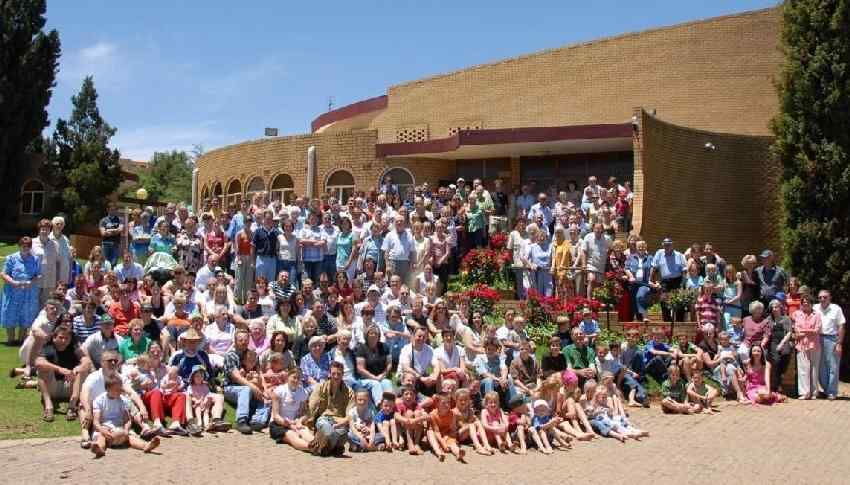
Figure 1.--This photo was taken in Florida Hills, a suburb of Johannesburg in Gauteng Province, South Africa. It shows the members of a Congregation in front of their church building. I don't know if that passed after the Sunday service or in another occasion. However we can see that, as to school, many children go barefoot to church.
|
|
South Africa has a wide diversity of religions. South African culture is widely based on Christian traditions, but many other religious traditions. South Africans follow many different religions and customs. The Governmrent has promoted Ch\risdtiamity. About 80 percent of the country idebntifies as being Christian.
Most South African Christians are Protestants. There are a number of denominations and an estimatedf 85 percent are members of a church. The original Dutch settlers were members of the Durch Reformed Church. French Hugenoughts and Jews expanded thee religious makeup. The British brought the Anglican Church and many other denominations. The religion in South Africa followed by the Khoisan peoples are complicated. Traditionally the Khoisan people fear one supreme god who they believe controlls the whole world. They developed rituals and made small sacrifices. They also feared an evil deity who they blamed for pain and misery. Their religious beliefs over time were influenced by the European settlers. The people of the remote areas of neigboring Botswana and Namibia still follow some of the Khoisan religious practices. Missioraries reached South Africa at an early time (late-15th century). The London Missionary Society sent Missionaries to the Cape colony (1799). They were followed by the Glasgow Missionary Society and Wesleyan Methodist Missionary Society. Missionaries from United States, France, Scandavia and Germany arrived during the 29th cntury. Indian workers brought the Hindu and Muslim faith. At this point we only have some limited informstion on Sunday schools.
Chronology
South Africans follow many different religions and customs. South Africa has a wide diversity of religions. South African culture is widely based on Christian traditions, but many other religious traditions. Africans before the Europeans had a animistic religious outlook. There were, however, many different people, both tribes that had lived in South africa an recently moved into southern Africa. This there are a range of African religious traditions. The religion in South Africa followed by the Khoisan peoples are complicated. Traditionally the Khoisan people fear one supreme god who they believe controlls the whole world. They developed rituals and made small sacrifices. They also feared an evil deity who they blamed for pain and misery. Their religious beliefs over time were influenced by the European settlers. The people of the remote areas of neigboring Botswana and Namibia still follow some of the Khoisan religious practices. The Government in the past has promoted Christianity. About 80 percent of the country identifies as being Christian. Most South African Christians are Protestants or Anglicans ften included in the Protesrant trdition. . There are a number of denominations. The Portuguese were the first European settlers to reach South Africa. The first European settles. however, were Dutch. These Dutch settlers were members of the Dutch Reformed Church. French Hugenoughts and Jews expanded the religious makeup. The British brought the Anglican Church and many other denominations. Indian workers brought the Hindu and Muslim faith.
Protestants reached South Africa at an early time (late-15th century). There was, however, not a major effort to convert the native effort. This was in sharp contrast to the Portuguese and Spanish Catholic conversion effort in Americas. But even the Portuguese and Spanish did not make the same effort at conversiin in Africa. This was largely in part because of racial attitides. This began to change in the late-18th century as Abolitionist Movements began to coalese, especially with Britain. This meant that attitudes toward Africans had began to change. Africans began to be seen as people whose lives matters with souls that needed to be saved. This meant that missionaries began to organize to convert Africans. European missionaries to Africa played what one author called a 'strangely ambiguous role'. They were undeniably motivated by a fervent wish not only to save souls, but by this time to serve humanity and bring about material and social changes to improve quality of life--what came to be called the 'white man's burden'. This meant that they also had a moral self-righteousness which resulted not only hasty and uninformed actions and efforts, but assessments of native mores, norms and values that prevented them from understanding the people they were attemting to help. In South Africa missionaries were involvement in local agriculture, irrigation and technology. These efforts secured a degree acceptance among the African population mostly located in rural society. The missionary effort also sought to impose alien European morality and work ethos upon the people they reached. This the native popukation largely resisted. Interestingly, this dichotomy did not manifest itself in debates between individuals, but commonly was a different within individuals. The London Missionary Society was the first to send missionaries to the Cape colony (1799). They were followed by the Glasgow Missionary Society and Wesleyan Methodist Missionary Society. Missionaries from United States, France, Scandavia and Germany arrived during the 20th century. Only slowly did missionary activities toward Africans begin to change, mostly after World War II and the fight against Apartheid. .
Weddings in South Africa like the vrious people which make up the country are highly diverse. They reflect the various cultural traditions, including the mnany African tribes, European (primarily Dutch and English), and Asian (mostly Indian). The wedding ceremonies to a a large degree refkect the various religious traditions of these many people. To a lrge extent, the African peoples have accepted Christianity and their weddings are thus an interesting mix of traditional African ab Chridtian belefs. The South Africans of European origins mostly dollow Dutch and English ceremonies. Wuddings often begin with the bridal procession into the church. The actual cremony begins with a dedication prayer. Then the actual ceremony begins. The cenrepoiece of the wedding is the exchange of vows. Then a unity candle will be lit. The couple will then be pronounced man and wife, and blessed by the officicating clergy man. Many have added the twelve symbols of life important in African culture to the tradoitional Christian creemony as well as African traditional religions and Mus\lim weddings. These twelve symbols are wine, wheat, pepper, salt, bitter herbs, water, a pot and spoon, a broom, honey, a spear, a shield, and a copy of Holy Scriptures. This is usually the Bible, but Muslims (mostly of Indian origins) will use the Koran. A wedding is not just a union of two solitary individuals, but actually two families. Each of the 12 sybols stand for an aspect of the love and strength which unites families being joined together. A wedding feast follows the ceremony and is known by the traditional African name Karamu. An aspect of many traditional African weddings is that the bride's and groom's parents carry a flame from their hearths to the home of the newly maried couple and a fire is kindled there.
Activities
At this point we only have some limited informstion on Sunday schools.
HBC

Navigate the Boys' Historical Clothing South African pages:
[Return to the Main South African page]
[S.A. children's lierature]
[S.A. choirs]
[S.A. school uniforms]
[S.A. youth groups]
Navigate the Boys' Historical Clothing Web Site:
[Return to the Main religion countries page]
[Introduction]
[Activities]
[Biographies]
[Chronology]
[Clothing styles]
[Countries]
[Bibliographies]
[Contributions]
[FAQs]
[Glossaries]
[Images]
[Links]
[Registration]
[Tools]
[Boys' Clothing Home]
Created: 5:11 AM 8/8/2009
Last updated: 6:30 PM 10/11/2019