|
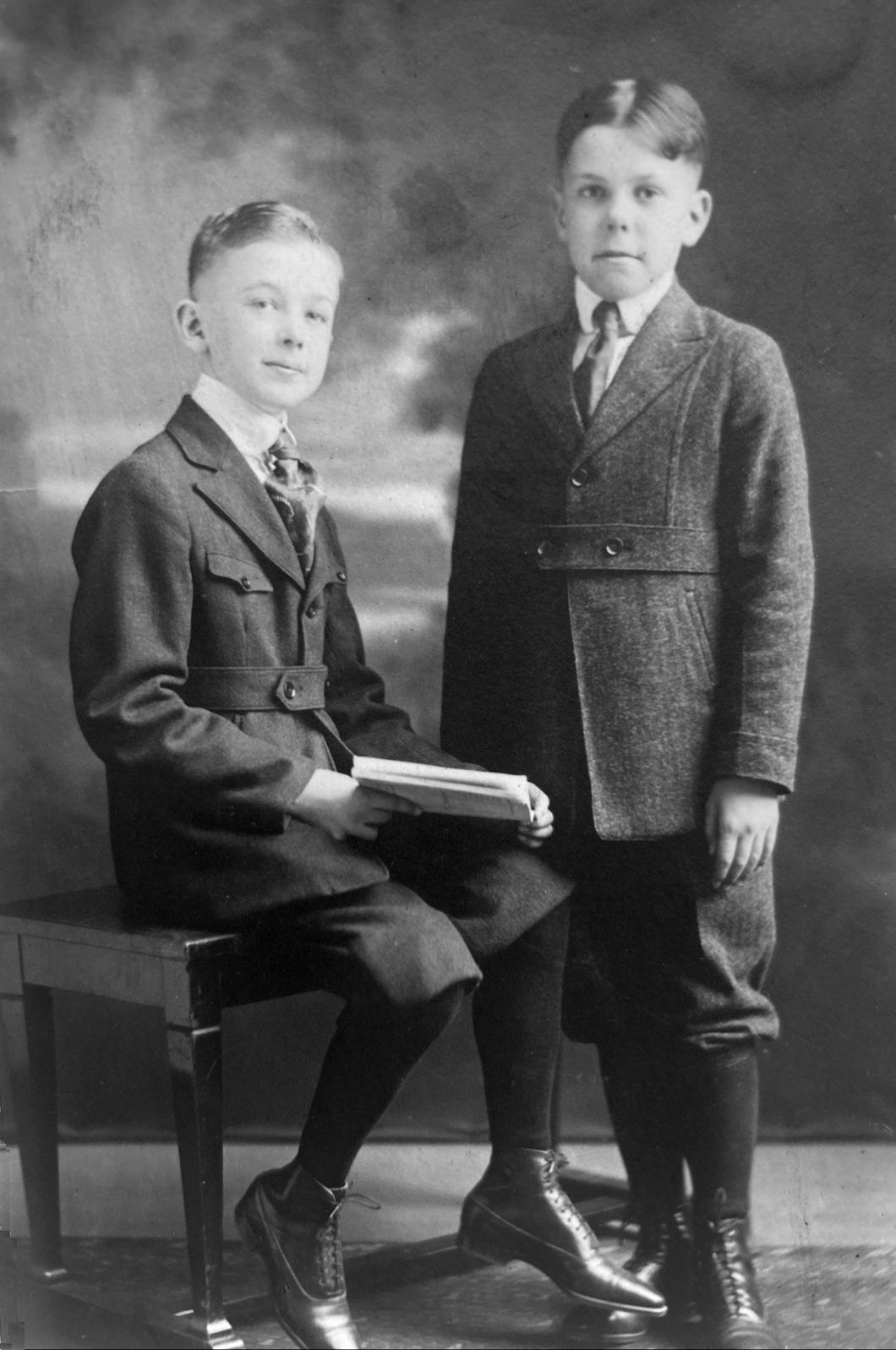
We also see boys' suits done in many different styles. Many of the various styles are historical styles. There was a greater varierty of suit styles in the 19th century than the 20th century. In eralier periods boys might wear a variety of styles. The different styles might be done in the various types of suits. We see Norfolk suits, for example, done as both collar buttoning as well as lapel sack suits. Styles fluctuated over time more rapidly than types of suits. The different types of suits were commonly available in many styles. There were many more styles mentioned in period catalogs, but many were terms used by individual merchants rather than style naes popularly used by the general public. The period catalogs often stressed the fabric nore than any mention of styling. Younger boys might wear Fauntletoy and sailor suits. Older boys might wear Eton, Norfolk, and lapel sack suits. Over time suits have evolved into baically one styyle -- a basic single-breasted lapel style sack suit, although double-breasted suits have never totally disappeared. At the same time, however, fewer and fewe boys tend to wear suits in our iccreasiungly casual world.
Eton suits appeared in the late 19th century. They had destinctive small jackets worn with stiff Eton collars and were mosly worn in England. The Eton suit can be confused because the Eton collar was very widely worn. Portaits show that the Eton collar and Eton suits had crossed the Atlantic as early as the 1840s. I do not know, however, just how popular the style was. The American primitive show here for a variety of reasons. HBC is fairly confident that the style of their suit and collar was inspired by the English Eton suits, the shape of the collars, the short black jackets, the long grey trousers all point to this. The image also shows how common it was during the first half of the 19th century for boys, even very young ones, to wear long pants after breeching. A British expert on Eton collars, however, notes that he wouldn't call the relatively unstiff flat-down-upon-the-shoulders collars depicted in the painting of the American brothers true Eton Collars. Although the latter probably evolved from the earlier type they are different in important respects. The true English Eton Collar stands higher and is much stiffer--and presumably rather more uncomfortable." Photographic evidence and fashion catalogs suggest that Eton suits and collars were not nearly as popular in America as in England. Eton suits were being worn by American boys in the late 19th century and at the turn of the century. The boys wearing them, however, are generally boys from affluent families. The style was much less commonly worn by middle-class boys. The collar itself was more popular than the entire suit. The Eton collr in America was much more commonly worn with sack suit jackets than actual Eton suit jackets. While wealthy boys might wear a proper Eton suit, more common was the Eton collar with an ordinary suit. While the Eton suit generally disappeared in the 1910s, the Eton collar continued to be worn with suits into the 40s. A destinctly American off shoot of the Eton suit was the American Eton suit which was beginnng in the late 1920s wiorn by younger American boys, a suit with a short lapeless jacket usually with suspender short pants. A juvenile Eton suit became a popular style for younger boys in the 1920s and continues to be worn today. It was initially worn with an Eton collar, but by the 1930s, Peter Pan collars had become more common.
No where was the Fauntleroy suit more popular than in America. Quite a number of boys wore formal velvet Fauntleroy suits, but many more boys wore less expensive suits with large lace or ruffled collars. American boys generally wore Fauntleroy suits with wide-brimmed sailor hats. Other head gear was worn, but was not nearly as popular as in Europe. Some boys wore their Fauntleroy suits with long ringlet curls. Most of the American boys with long hair wore ringlets. I was not common for boys to have long uncurled hair. One of the most destinctive elements of the American Fauntleroy suit was that it was worn with large, carefully tied bows. Most boys wore large bows to match the large collars. Almost all Fauntleroy suits, except for kilt suits, were worn with kneepants. Unlike England. knicker Fauntleroy suits were rare. The American Fauntleroy suit was often worn with heavy high top shoes that looked like boots. The patent leather pumps and buckle shoes worn in England were much less common in America. Here we have not extensively developed this page on American Fauntleroy suits. This is primarily because the main HBC Fauntleroy page has primarily been developed wiyh information and images about Fauntleroy suits in the United States.
We note a number of suit jackes done with military styling. Military styling was one of the many inluences on men and boys clothing. The most common military style jacket was the collar buttoning jackets popular in the mid-19th century. They were often blue like U.S. Army jackets. We also see wjat look like grey jackets, but this was not necesaeily to emulate a Confederate uniform. They commonly were done with a row of closely spaced buttons, sometimes brass buttons. The buttons were sometimes so closely spaced that they were obviously a stylistic statement rather than just practical closures. We also noticed various styled jacket with miltary features. This was often done as piping. These jackets were popular during the mid-19th century before ready-made clothes were stabdardized. Thus we see a range of different styles. Military fratures include epaulettes. pocket flaps, and stripe detailing on various elements of the suit like the collar, cuffs, pockets, and button front.
Norfolk suits was one of the most popular styles of boys suits during the late 19th and early 20th century. It was of course a European style imported from England. The style may have begun in the 870s, but we see many boys wearing jackets with Norfolk elements by the 1880s. The basic elements were vertical elements and horizontal waist belts. Some jackets only had the vents, but some had belts as well. In many sits the vents were only hinted at, in others they were pronounced. This was a style for school age bopys. Younger boys wore skirted garments and fbcy uits like Fauntleroy suits. The Norfolk style was also wirn by teenagers. There was quite a wide range of styles for the jackets. We see both collar-buttoning jackets and sack suit jackets with lapels. The collar-buttoning jackets were mostly worn in the 19th century. We note Norfolk suits with all kinfs of pants. Most boys in the 19th century wore them with knee pants.
The sack suit became the standard suit style for both men and boys. The sack suit first appeared in the mid-19th century. It began as a loose fitting single-breasted garment without a waist seam. The lapel was the destinguisjing feature of these suits. They were worn by men and boys. A related style, the collar-buttoning jacket was only worn by boys and seems to have evolved from military tunics. . It was seen at first as a somewhat casual suit or jacket style. It is now so standard that the simple term "suit" is used today to mean sack suit. Older boys' sack suit jackets could be quite plain. Sack suits generally had "V" fronts with lapels, but there were some exceptions. The two basic styles were single- and double-breased suits. There was a wide range of stylistic variatins affecting the lapels, pockets, and other features of the jackets. Both styles were widely worn for many years, but after the 1950s we mostly see boys wearing single-breasted suit jackets. There were some notable variations. One popular style for many years was the Norfolk jacket with destinctive pleats and belts.
The sailor suit is one of the most suceesful boys styles of all time. It was one of those rare coincidences of an outfit which both boys amd mothers liked. Sailor suits were introduced as boys' wear by Queen Victoria and Prince Albert in the 1840s when the Prince of Wales was outfitted in a white enlistedman's uniform. The first generation did not commonly wear sailor suits, but it became almost a uniform for British royals in the second generation. The second generation of princes aooeared in sailor suits after they were breeched. The style eventually spread to the Continent. The style gained momentum when Queen Victoria's daughters and grandaughters mairred into most of the important royal families in Europe. The style also spread to the new American Republic HBC has realtively little information about sailor suits in America during the mid-19th century. The sailor suit was one of the most popular styles for boys in the late-19th century. The style was conceived in England, but proved popular in America and coincided with the emergence iof America on the world scene as it was building a powerful navy. We also note girls wearing sailor styles. Paradoxically, the sailor suit continued popular in the anti-war environment of the post-World War I era and mothers continued willingness to dress small boys in the sailor suit. As sailor styles became increasingly popular with girls, fewer boys wanted to wear them. American boys have worn a variety of garments with sailor styling. Most of the garnments worn in Britain were also worn in America. The classic middy blouse was the standard shirt-like garmet, alough reefer jackets were also common. A range of pants incliding bell bottoms, knee pants, knickers, and short pants were also worn. The types of pants varied over time. Knee pants were popular in the late 19th-century. Short panrs became more common in the 1920s, but sailor suits also began to be worn by increasingly younger boys. There were also other items such as hats and caps as wll as coats, scarves, dickies, and other items.

Navigate the Boys' Historical Clothing Web Site:
[Return to the Main U.S. suit jacket page]
[Return to the Main U.S. country garment page]
[Introduction]
[Activities]
[Biographies]
[Chronology]
[Clothing styles]
[Countries]
[Bibliographies]
[Contributions]
[FAQs]
[Glossary]
[Images]
[Links]
[Registration]
[Tools]
[Boys' Clothing Home]