|
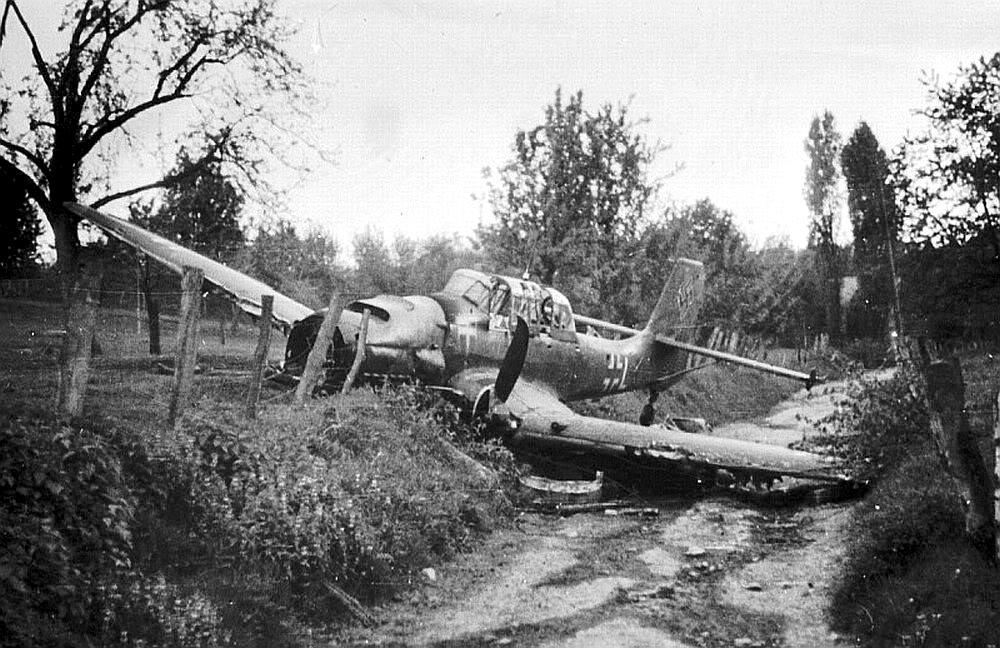
The Luftwaffe deployed a number of different fighters and bombers in the Battle of Britain. The principal fighter was the Me-109. The Me-109 was, however, the preeminent fighter in the opening years of the War, although its edge over British and French fighters is commonly overstated. It had several advantages, including fuel injection and canon rather than machine guns. The reason the Luftwaffe did so well in France was the concentration of force and its attack mode which put the the Allied fighters at a disadvantage, easy targets on the ground, without radar. Göring had high hopes for the longer-range twin-engine Me-110, but it proved embarrassingly disappointing. It required Me-109 escorts. The bombers included the Do-17, Ju-87, Ju-88, and He-111). The Ju-87 was single engine Ju-87 Stuka. It was a very effective dive bomber, but could only be used where the Germans had established air superiority which the Germans learned at considerable cost in the opening phase of the battle. The slow-flying Stuka was vulnerable to British fighters. Stuka squadrons when committed over Britain were decimated. This was not the end of the Stuka story. Göring had a habit of choosing friends over competency for important Luftwaffe posts. One such friend was a fellow World War I ace -- Ernst Udet. Even having no technical expertise, Göring put Udet in charge of aircraft development and procurement (1939). Udet was so impressed with the Stuka that he insisted that all new bombers have dive bombing capability. This was possible with a small plane like the Stuka. It was impossible for a heavy bomber which German aircraft designers tried ti tell Udet to no avail. The result was that Udet wrecked new plain development. He is a major reason that German did not development a heavy bomber. This all blew up on him when Barbarossa began unraveling. He shot himself (November 1941). The Do-17, Ju-88, and He-111 were twin engine medium bombers. The Luftwaffe failed to develop an effective strategic bomber. The Ju-88 was an effective medium bomber, but only available for the Battle of Britain in limited numbers. At the time of th Battle of Britain only the United States had a heavy bomber--the B-17 Flying Fortress. THE RAF began flight testing the Avro Lancaster during the Blitz (February 1941).

Navigate the CIH World War II Section:
[Return to Main Battle of Britain Luftwaffe page]
[Return to Main Battle of Britain forces page]
[Return to Main Battle of Britain page]
[Return to Main World War II air page]
[Biographies]
[Campaigns]
[Children]
[Countries]
[Deciding factors]
[Diplomacy]
[Geo-political crisis]
[Economics]
[Home front]
[Intelligence]
[Resistance]
[Race]
[Refugees]
[Technology]
[Bibliographies]
[Contributions]
[FAQs]
[Images]
[Links]
[Registration]
[Tools]
[Return to the Main World War II page]