|
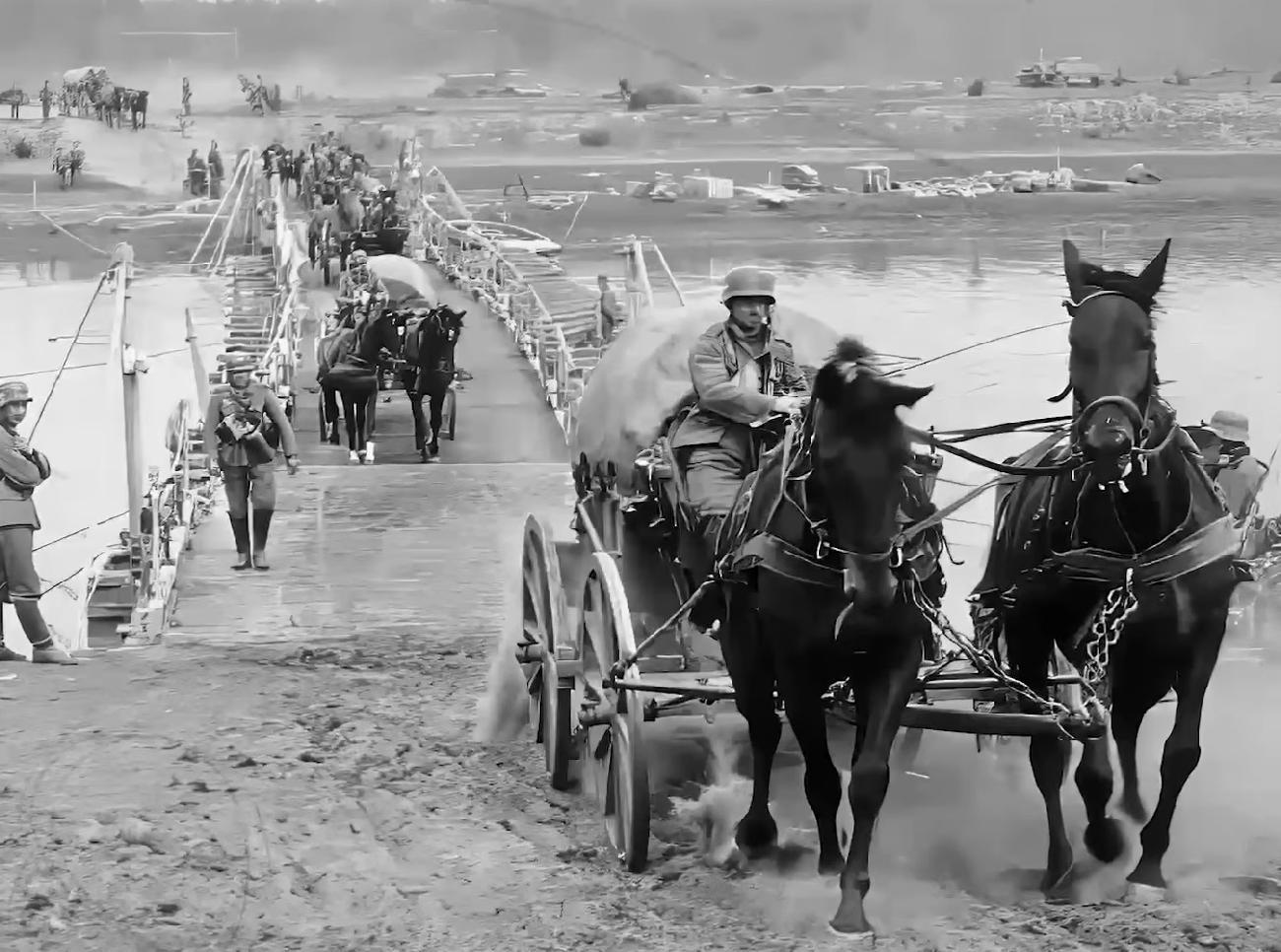
The largest numbers of horses were used by Germany and the Soviet Union. The horse was at the core of the German Army during World War II. Contrary to the Goebbels propaganda, the German Army was not a modern mechanized army. The reality of the German Army was that it war primarily dependent on the horse. 【McFarland】 Only about 20 percent of the Army was mechanized. Goebbels' propaganda continues to have an impact, because the photographers he dispatched with the Army were told to shoot tanks, not horses. And this film footage is what you see in World War II documentaries. German industry did not have the capability of fully mechanizing the Wehrmacht or of obtaining fuel for the vehicles they had. Vehicles were requisitioned throughout German-occupied Europe for Operation Barbarossa. Even so it was horse power that carried German supplies east. The German soldiers mostly advanced east on foot with horse-drawn cars.. Only about 20 percent of the German Army was mechanized. The reliance on horses became a real problem for the Germans as large numbers did not survive the first Russian winter (1941-42). Many also died in the second winter (1942-43). Shortages of petroleum forced the Germans to continue, even increasing the use of horses and issuing bicycles. It is no mystery why Hitler the German 1942 offensive (Case Blau) aimed as the Soviet oil fields in the Caucuses.
The largest numbers of horses were used by Germany and the Soviet Union. The Germans appear to have used some 3 million horses during World War II. They pulled together 0.6 million horses for Barbarossa alone (June 1941). Many of which did not survive he offensive.
The horse was at the core of the German Army during World War II. Contrary to the Goebbels propaganda, the German Army was not a modern mechanized army. The reality of the German Army was that it war primarily dependent on the horse. 【McFarland】 Only about 20 percent of the Army was mechanized. Goebbels' propaganda continues to have an impact, because the photographers he dispatched with the Army were told to shoot tanks, not horses. And this film footage is what you see in World War II documentaries. Only about 20 percent of the German Army was mechanized. We look at this number by looking at the number of Panzer and mechanized infantry divisions. While imprecise, it gives us a rough estimate. It is true that infantry divisions had a few vehicles for various purposes. They did not have trucks to carry soldiers. The German infantry soldier walked. He was on foot. Nor were there trucks for supplies. The supplies were carried by horse-drawn carts.
Now large numbers of motor vehicles can be built in a short period of time. The Americans proved that. How Germany obtained 3 million horses is an interesting question. A healthy mare can have a wide range of foals, with some producing as few as 5 and others, with excellent management, having 15 to 20 or even more over her lifetime. Horses typically stop growing and reach physical maturity around 3-5 years of age. Work horses, especially draft horses, usually begin light work after 3 years old. This means that the German Army needed horses 3-4 years old. So where did they all come from? The Germans may have used up to about 3 million horses in World War II. We think most survived the early campaigns which were short and fewer horses were needed because supply lines were short. Many hoses did not, however, survive the Soviet campaigns (especially the ones of 1941-42 and 1942-43) as well as he Bagration disaster (1944). The horses were tanned from a combination of domestic requisitions, state-run breeding programs, and, most significantly, the plunder and forced contributions from occupied territories across Europe. The conduction had to begin well before Hitler launched the War. This multi-faceted procurement system was essential because the German Army, despite its reputation for mechanization, remained heavily dependent on horse-drawn transport for the majority of its supply trains and artillery, especially on the difficult terrain of the Eastern Front and because of limited fuel shortages. Key sources of horses included:
German Farmers: In peacetime, German horses were registered for potential military use, similar to a human draft. When the war began, the army requisitioned vast numbers of horses from German farms, often 'technically purchasing/ them but at very low prices. German farmers had been a voting block the NAZIs had won over. It is unclear how seizing heir horses impacted their attitude toward the NAZIs, especially because here were often tight emotional bonds with the family horse. Of course when fathers and sons began disappearing in the East, there was an even greater impact. Few German farm families had more than one or two horses. In addition, the horse was important in farm operation. Removing the family horse seriously impacted farm productivity.
State breeding facilities: Germany maintained state-run breeding facilities, particularly in East Prussia and Hanover, to produce horses suitable for military and civilian agricultural purposes.
Allied and neutral countries: Horses were obtained from allied and neural countries. Hungary was especially important. The Germans did not jst seize material from occupied countries. Allied congeries also fared poorly. We do not have, however, details on horse purchases. We are not sure what he terms were for these purchases. Before he War began, the Germans even purchased some horses from the British, who had mechanized their own forces.
Occupied countries: As the war expanded, the Wehrmacht systematically looted horses from occupied countries or forced them to provide horses as part of 'occupation costs'. Poland was required to supply up to 4,000 horses per month. Large numbers (around 330,000) were taken from France. Ostkrieg German soldiers as they moved east simply looted horses from Soviet collectives and state farms as they moved east.
Even so it was horse power that carried German supplies east. The German soldiers mostly advanced east on foot with horse-drawn cars. Hose power was critical to the German logistical chain beyond the rail hubs, especially for the infantry. Each German infantry division relied on 1,200 horse-drawn wagons to transport its supplies. 【Van Creveld, p. 144.】 In addition a very substantial proportion of German artillery was moved by horses. This was also true of the Soviet Red Army and only began to change with the arrival of American Lend Lease trucks.
German industry did not have the capability of fully mechanizing the Wehrmacht. Germany had the second largest industrial base in the world--bolstered by its military conquests. The Germans produced vast quantities of steel--the most important raw material for weapons manufacture . But most of Germany's industrial output wet to fight the war in the West. And Germany did not have a large automotive sector--the most important civilian sector that could be converted to the production of military vehicles. So the Germans requisitioned vehicles throughout German-occupied Europe for Operation Barbarossa. Something that would create serious problems in the long run. The vehicles requisitioned in the West were not military grade and up to the challenge of the Soviet road infrastructure or more correctly the lack of a road infrastructure. Nor would they prove to be up to the challenge of the Russian weather. And maintaining them proved a huge problem, obtaining spare parts for so many makes and models would be an surmountable hurdle.
Germany had substantial quantities of coal. This was fine for the Reichsbahn and industry, but Blitzkrieg required oil. Military vehicles, tanks, trucks, aircraft, and U-boats all required petrolatum. And Germany did not have a petroleum resource. The Germans launched a synfuel industry. But this was expensive and produced much less than the Reich required. This was not an immediate problem as long as the Soviet Union was a NAZI ally (1939-41). It became a problem when Hitler invaded the Soviet Union and the Soviet oil spigot was turned off (June 1941), An when the Red Army did not collapse as anticipated, there was way to turn it back on. Germany just did not have the fuel to power a larger fleet of motorized vehicles. A better managed industrial effort could have conceivably have produced more vehicles. The Germans conceivably could have moved away from craftsmanship and quality to mass production. Bu even if they had, they simply did not have the fuel to power a significantly increased motor vehicle fleet. As a result, grass grazing horses was the only available option.
The reliance on horses became a real problem for the Germans as large numbers did not survive the first Russian winter (1941-42). Many also died in the second winter (1942-43). Here the horses offered a huge benefit. Cut off units could slaughter the horses and use the horse meet to supplement dwindling rations.
To wage modern war, Hitler needed oil. Depending on the largess of Stalin was not a viable long-term solution. So Hitler made the monumental decision to invade the Soviet Union (June 1941). Lerbensraum in the East was always Hitler's long-tetrm goal. He believed that the Soviet Union and Red Army woukd quickly collapse 'like a house of cards'. That wold give him access to the vast resources of the Soviet Union including oil. When that not only did not unfold as anticipated, but the Red Army struck back with damaging Winter offensive before Moscow (December 1941), Hitler needed to rethink his grand strategy and adjust military operations. Shortages of petroleum forced the Germans to continue, even increasing the use of horses and begin issuing bicycles. It is no mystery why Hitler decided that the German 1942 offensive (Case Blau) would be aimed as the Soviet oil fields in the Caucuses.
One not often addressed issue is the impact on farm production of withdrawing such a large number of horses. European agriculture except for Britain was not yet widely mechanized. We suspect this was a factor in the food shortages that plagued Europe during the War years. The major problem German farmers faced was a shortage of labor. 【Collingham, p. 158.】 Removing hoses from farms only exacerbated the problem. Horses were in short supply because they were requisitioned by the military. This became a real problem when military needs escalated with the invasion of the Soviet Union. 【Van Creveld, p. 144.】 Food shortages did not impact Germany as badly as during World War I because the Germans expropriated food from the occupied countries, especially France. The plan was to use food from the East. But the food obtained there proved insufficient even to feed the military forces committed there. It was France and the rest of occupied Western Europe that fed the Germans. But agriculture in occupied countries also declined. Like German farmers, farmers in occupied countries were denied important inputs like fertilizer and equipment as well as faced labor shortages. They were also dependent on horses and productivity declined when horses were expropriated by the Germans. Tragically for the people of these countries, a sizeable proportion of what was produced was seized by the Germans and shipped back to the Reich. But of course Germans were impacted after the War when they had to rely on domestic food production. Again, as after World War I, only food deliveries from America prevented famine and mass starvation. And reviving agricultural production in Germany and the former occupied countries was impeded by the lack of horses in he immediate post war years.
Collingham, Lizzie. The Taste of War: World War II and the Battle for Food (Penguin Books: New York, 1962), 634p.
McFarland, Ktherine V. "Warhorses amongst war machines: The German Army's use of horses and cavalry during World War II," University of South Carolina 2021), 95p.
Van Creveld, Martin. Supplying War: Logistics from Wallenstein to Patton (Cambridge University Press, 1977)

Navigate the CIH World War II Section:
[Return to Main World War II horse page]
[Return to Main World War II logistics and transport: Land continental--Road transport]
[Return to Main World War II animal species page]
[Return to Main World War II animal page]
[Return to Main World War II land weapons page]
[Return to Main World War II technology/tactics page]
[Return to Main World War II page]
[About Us]
[Biographies]
[Campaigns]
[Children]
[Countries]
[Deciding factors]
[Diplomacy]
[Geo-political crisis]
[Economics]
[Home front]
[Intelligence]
[POWs]
[Resistance]
[Race]
[Refugees]
[Technology]
[Totalitarian powers]
[Bibliographies]
[Contributions]
[FAQs]
[Images]
[Links]
[Registration]
[Tools]
[Return to Main World War II page]
[Return to Main war essay page]
[Return to CIH Home page]