|
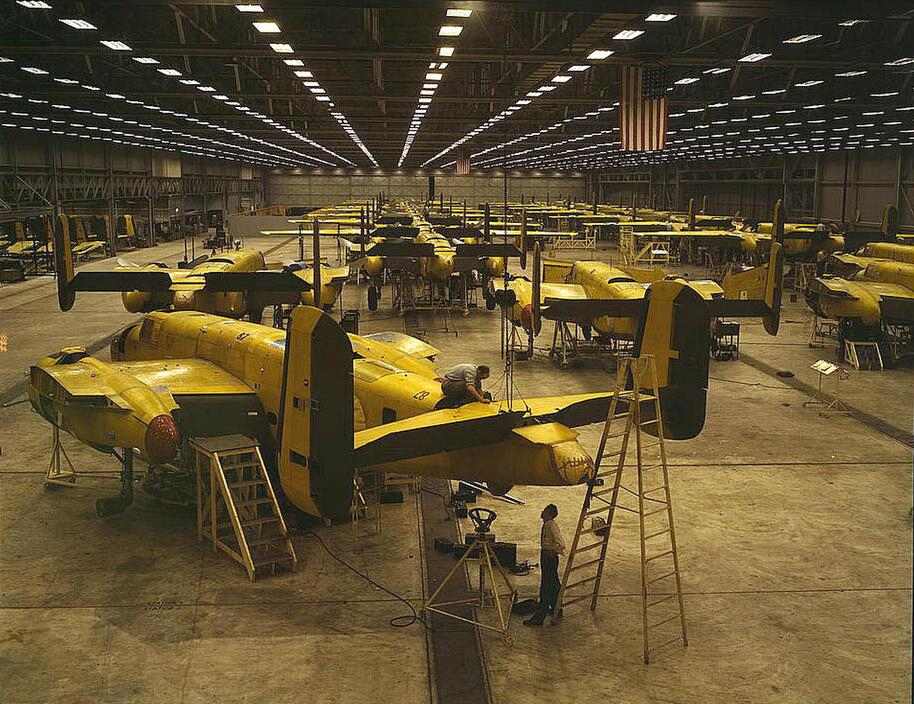
What would prove decisive in the air war was the huge productive capacity of the Allies once set in motion, especially the Americans. The Gernans dismissd reports about American production refusing to believe that production levels could be so rapidly ramped up. The German Embassy in Washinton was sending accurate open source repoorts through 1941. The numbers seemed so implausible that they were dismissed as misinformation. A newspaper aticle reported that one company, the Douglas Aircraft Comamy was producing 300 planes a month. One Luftwaffe commander dismissed the rerport out of hand. "Impossible! Such production would require a work force of 50,000 people working in facilities covering millions of square feet. This s beyond American organizational capabilities." There were not only American newspaper reports, but reports from German and Swedish business men in America. All were dismissed. The general attitude was that if we could not do it, the Americans surely bcoud not do it eithrr.
--Gen. Hans Jeschonnek, Luftwaffe Chief of Staff.
It was aeronautics that most destinguished World War II from earlier wars. The Germans began World War II with the word's most modern air force. They did not, however, have the largest industrial capacity to build aircraft. The German advantage was gained by a crass building program before the British and French began to rearm. Even so, the Luftwaffe was a tactical airforce designed to support the Wehrmacht's land offensive as part of Blitzkrieg. Germany did not have the indstrial capaity to buld a strtegic air force and had no substantial force of plans to wage a statehic bombing casmpaign. America and Britain did have the industrial capacity to build a strategic air force. World War II, as a result, was the first real air war. Both the Bitish and Germans were preparng a strategic bombing campaign in World War I, but the War ended before it had begun. Thus air commanders when World War II erupted had no real idea how to wage a strategic air campaign. Theorists had addressed the topic, but without actual experience, they remained theories when Hitler invaded Poland launcjhing the War. Nor except for the Germans did they understand how air forces could be used to efficely support land operations. This was in part due to the fact that the Luftwaffe was not created until 1935 and the Germans used officers recruited from the Heer. Britain and America on the other hand had a staff core that were focused on air warfare and an industrial base that could supply both strtegic and tactical aircraft. Radar and electronic beaming was to have a major impact on the air war. The Germans introduced jet aircraft. As Hitler delasyed the program, they did not become operational until the final year of the War, but it was to late to affect the outcome. Anerican and Britain wre also working on jets, but the Germans had a substantial lead. Allied inteligence helped to reduce the impact of the pioltless ram jets (V-1s). The German secret balistic missle weapn (V-2), while a technological marvel, had no real impact on the War.
The World War II air war had its antecedents in World War I. This began at the tactical level. But the Germans from an early point began strategic bombing. This had no material impact on the War, but had a huge impact on the psyche of the British people. So much so that when Hitler and Stalin launched World War II, Britain was the only country that had a modern integrated air defense system in place. In the inter-War era the public was worried about future wars and the bombing of cities. This actually materialized in Libya (1920s), China/Manchuria (1931), Ethiopia (1935) and Spain (1937). In each case the counties bombing were he three countries (Germany, Italy, and Japan) that would comprise the Axis powers. The air commanders at the time differed on the importance of tactical and strategic forces. Strategic bombing was adopted by America and Britain. Tactical ground support was favored by France, Germany, Italy, Japan, and the Soviet Union. The only country to actually build a long-range strategic bomber in the 1930s was he United Sates--the B-17 Flying Fortress. The Army Air Corps justified it as a important component of coastal defenses. Fear mounted after Hitler seized power in Germany (1933) and announced the new Luftwaffe (1935). The Soviet Union built the world's largest air force (1930s). The German bombing of Guernica bought the horrors aerial bombing into reality (1937). A year before World War II began, the abandoned, but well-armed Czechs capitulated just because of the threat of German bombing (1938).
Historians debate just when World War II began. A case can be made for the Japanese invasion of Manchuria (1931) or China (1937). The air war in China was, however, less important than in Europe. The Japanese did not have the advanced Blitzkrieg tactical doctrine the Germans, in part bcause of a weak radio communications sector. In addition, China did not have industrial cities to target. The air war in China was mostly terror attacks. The Japanese achieved impressive victories (1937-38), but when the Chinese withdrew into the interior the Japanese could no longer get to them to press the attack and the war in China stalemated.
Hitler after sizing power authorized massive arms spending. his mean that when war broke out, the German Luftwaffe was most powerful air force in the world (1939). The Germans benefited from a series of advances in aviation which rendered most existing aircraft obsolete just as the Germans began building modern aircraft. The technology was not. however, unique to Germany. NAZI propaganda made much of German science. It was impressive, but not all that much more advanced than the Allies. It is just as the Germans began massive spending with he technology before the Allies. Notably nearly all the impactful Luftwaffe aircraft were produced in the 1930s before the War. The Germans produced virtually no great aircraft during the War. In addition, the Germans had essentially worked out modern combined arms warfare--Blitzkrieg. And the new Luftwaffe along with the fast moving Panzers were a central cog in it. The result was a series of spectacular victories that gave the Germans control of much of Europe (1939-41). Fortunately for humanity, the Panzers were stopped by the Channel and the Luftwaffe was stopped by Britain's integrated air defense system masterminded by the RAF's Hugh Dowding (1940). This meant that the War in Europe was stalemated. German Führer Adolf Hitler decided to beak the stalemate by attacking the Soviet Union--Barbarossa (1941). A few months later, Japan decided to break the stalemate in China by an air attack on the United States naval base at Pearl Harbor. Both calculations are some of the most disastrous in history.
One aspect of the air war was how expensive it was. Air forces were a major component in all theaters of World War II. And air warfare consumed a large portion of the industrial output of the major powers. America, Britain and Germany devoted about half of their economy to the air war. Japan and the Soviet Union also spent lavishly, but we are not sure it reached half of the war economy. Strategic bombing was especially expensive. Britain had bombers when World War II broke out, but the French refused to let the RAF used them. After the fall of France, Germany was beyond the reach of Bomber Command. The `headlines focused on the Battle of Britain (1940-41), but under the radar Britain was building a new generation of bombers--long range heavy bombers that could reach the industrial cities of the Reich. The Avro Lancster began reaching Bomber Command squadrons (mid-1942). At the same time, American B-17s and the new B-24 Liberators were arriving in Britain. The around the clock bombing of the Reich began (1943). This is when the strategic bombing of the Reich began in earnest. The American and British air forces were dominated by the Bomber Boys. But fighters were need to fight the ground war as well as to protect the American day-light bombers. Historians disagree on the impact of the bombers. We think that they were much more impactful than widely accepted. In the end industrial Germany cease to exist. There is no doubt that success of Allied ground forces was immeasurably assisted by ground support operations. In the Pacific, the naval war turned into an air war, dominated by carriers used to seize island from which aircraft could operate. 【Overy】
Japanese commanders thought that they were beyond the reach of American bombers. And that the island outpost taken in early 1942 would prevent American bombers from reaching the Home Islands, The Pacific is a huge ocean. Japanese aircraft designed with extended ranges were a huge advantage. Even before advanced aircraft began reaching the Pacific, beginning on Guadalcanal those bases began falling (1942-43). The B-29 Super Fortresses (the most expensive weapon of the War) proved them wrong (1944). The strategic bombing of Japan began after the Americans took the Marianas (1944). Japan's wood and paper cities and the war plants in those cities were reduced to glowing cinders.
The War was finally brought to a conclusion by two atomic bombs dropped on Japan. This brings us back to a crucial meeting between Germany's most prestigious scientist, Max Planck, and the new Chancellor, Adolf Hitler (1933). Plank warned that the campaign against the Jews would 'mutilate' German science. Hitler was obstinate and refused to accept any of Planck's points. Towards the end of the meeting Hitler started to fidget around and mumbled 'You know what people say about me? They say I suffer from weak nerves.' A tirade followed. Hitler then started shouting, 'Slander!' He finally launched into one of his trade-mark rants against Jews and the Jewish menace. , "Our national policies will not be revoked or modified. Even for scientists. If the dismissal of Jewish scientists means the annihilation of contemporary German science, then we shall do without science for a few years!" Thus Hitler threw away his best chance Germany had of winning the War that was set on even before becoming Chancellor. There would be no German atomic bomb.
The airplane had been invented in America by two bicycle mechanics, the Wright Brothers (1903). At the time of World War I, however, the United States did not have modern combst aircraft. When America entered the War (1917), it had to use British and French planes. In the inter-war period, several countries developed important aircraft industries: America, Britain, France, Germany, Italy, Japan, and the Soviet Union. A key to building modern aircraft was aluminum. Thus a country's potential to build aircraft was the size of its aluminum industry. Aluminum production not only required bauxite, but vast quantities of electrical power. Some World War II planes were built with plywood (the British Mosquito and the German FW-190), but most were built with aluminum. Until the NAZI-take over in 1933, national aviation industries primarily depended on civilian demand. And here the largest civil aviation industry was in the United States. Pasenger aircraft were needed by a country the United States where as smaller countries had no great need for aircraft in domestic transport. Aircraft had played only a minor role in World war I. This was to be very different in World War II and the aviation industries of the beligerant countries had a major impact on the War.
Military planners after th terrible killing fields of World War I studied how to fight the next war with technology to minimize battlefield casulaties. And here massive air fleets seemed to provide the answer. It was the Lufwaffe which dominated Europe for the first 3 years of the War. It looked for a time that the Luftwaffe would win the War for the NAZIs. It was the Royal Air Force, however, that delivered the force defeat to Hitler's military. Germany began the War with a strategic and industrial capability inferior to that of the countries Hitler planned to conquer. Part of the NAZI concept of war was to wage it with superior technology. The NAZI defeat so early in the War should have given Hitler pasuse. It did not. Air Marshall Sir Arthur "Bomber" Harris when he was appointed to lead the RAF's Bomber Command stated that the Germans began the War with the unrealistic assumption that they would bomb enememy cities, but German cities would not be bombed. The British at the time were outproducing the Germans. The Luftwaffe destroyed the Red Air Force in the first few days of Barbarossa. It dod not, however, destroy the Soviet aircraft industry. Relocated Soviet began factories begun producing improved aircraft types in huge numbers. The Allies significantly underestimated the effectiveness of Japanese aircraft and the result was the loss od wide areas of Southeast Asia and the Paciic in 1942. More than any other country the United States decided to fight the War with a massive air force. About 25 percent of American war spending was devoted to the air war. Not only was this a greater share than Germany devoted to the Luftwaffe, the industrial capacity of America was much greater than that of Germany. The British focused on bombers. The Americans produced a wide range of aircraft for its various commands as well as for its allies. It took some time for the Allies to perfect tactics and production priorities, but by 1944 the Allies unleased a torrent of destruction, first on Germany and then on Japan that was in terms of destruction was unprecedented in modern warfare.
It was aeronautics that most destinguished World War II from earlier wars. There were two primary alternatives to air war. One alternative was tactical air operations to support land troops at the front. The second was strategic air operations targeting a country's ability to support the front-line soldiers. Many countries rejected the bombing of civilians as immoral. This was, however, a position not accepted by the Axis countries which launched the War. The Allies hesitated to bomb cities at the onset of the War, but the British once they survived the Blitz set out to build a massive bomber force. Even before entering tghe War, the United States adopted the doctrinme of a strategic air war. The United states believed that they could accurately bomb specific targets without causing massive civilian casualties. And the United States had the capacity to build both a strategic and tactical air force. pMilitary theorists in the inter-War era debated the most effective approach, but the alternatives chosen in World War II were largely determined by the country's industrial capacity. The aor dictrine adopted varied greatly from country to country. Both the Germans and Japanese put considerable emphasis on air power. The Germans began World War II with the world's most modern air force. They did not, however, have the largest industrial capacity to build aircraft. The German advantage was gained by a crash building program before the British and French began to rearm. Even so, the Luftwaffe was a tactical airforce designed to support the Wehrmacht's land offensive as part of Blitzkrieg. Germany did not have the industrial capacity to buld a strategic air force and had no substantial force of plans to wage a stategic bombing campaign. America and Britain did have the industrial capacity to build a strategic air force. In the Pacific, The Japanese also introduced air power. The Japanese has amall aviation industry, but China had even less. The Japanese placed less emphasis on close ground support, but from an early point began bombing Chinese cities with little opposition. The Japanese unlike the Germans created a poweful naval fleet air arm. World War II, as a result, was the first real air war. Both the Bitish and Germans were preparng a strategic bombing campaign in World War I, but the War ended before it had begun. Thus air commanders when World War II erupted had no real idea how to wage a strategic air campaign. Theorists had addressed the topic, but without actual experience, they remained theories when Hitler invaded Poland launcjhing the War. Nor except for the Germans did they understand how air forces could be used to efficely support land operations. This was in part due to the fact that the Luftwaffe was not created until 1935 and the Germans used officers recruited from the Heer. Britain and America on the other hand had a staff core that were focused on air warfare and an industrial base that could supply both strtegic and tactical aircraft. Little noticed at the time, the British during the Battle of Britain were already outproduciung the Germans in aircraft. Even without strategic bombers, the Germans at the onset of the War began bombing cities in Poland. bombing. They were so confidant of victory and disfainful of other countries that they believed that German cities would never be targeted.
The Germans developed some excellent aircraft, especially the ME-109 fighter which was in service throught the War. Other planes were developed, but only the FW-190 fighter proved successful before jets were introduced. Te French had competiive aircraft planes, but they were not used effectively by French commanders. British Hawker Huricans and Spitfires early in the War exposed weaknesses in the Luftwaffe. The British like the French also used their aircraft poorly, but fortunately haf the Channel which bought the time needed to adjust air combast tactics. . Radar and electronic beaming was to have a major impact on the air war. The Red Air Force also deployed a new generation of aircradt whn factories beyond the Urald came on line (1943). The Stermovick tank buster is the best known Soiviet aircraft. American Lend Lease not only provided the Soviets aircraft, but the aluminium needed by aircraft plants. The Germans introduced jet aircraft. As Hitler delasyed the program, they did not become operational until the final year of the War. The Messerschmitt ME-262 Schwalbe ("Swallow") was the first operational jet-powered aircraft and the most advance aircraft of the War. It was introducedm however, to late to affect the outcome. America and Britain were also working on jets, but the Germans had a substantial lead. Allied inteligence helped to reduce the impact of the pilotless ram jets (V-1s). The German secret balistic missle weapn (V-2), while a technological marvel, had no real impact on the War. The Japanese Zero made a major impact at the beginning of the Pacific War, but the Japanese unlike the Americans were unable to bring more advance aircraft into service. American before the War began working on strategic bombers. The Boeing B-17 is the iconic American bomber of the War. American commanders though it was well armed enough to fight its way into the Reich. This proved to be wrong. Unesorted B-17 and B-24s took heavy casualties. The ties in the air was only turned when the P-51 Mustang was introfuced to esort the nonbers. The British used the legendary Aero Lancaster to bomb at night, probably the most effective bomber of the War, until the B-29 came into service which was mostly used in the Pacific.
A a relatively small number of engineers and entrepreneurs possessed the technology and resources to design and manufcture aircraft engines. These indiviuals were clustered in only a few major countries: Britaian, France, Italy, Jaopan, the Soviet Union, and the United States. The industrual capacity to build aircraft engines largely determined the size of airforces of the combatant countries and the capabilities of thoe engines wer th primary factore in the capabilities of the planes built by the combatant countries. And here the United States had an edge. The growing civil aviation industry had created a demand for efficent, powerful aircraft engines. And the huge autmobile indtry meant hat there were technicians ad industrial capacity tht could be turned to manufacturing aircraft engines. No othercountry possessed a comparable capacity. German and Japan achieved stunning successes early in te War because they turned theirreatively limited industrial capacity to manufacturing high-performance arcraft and engines in quantity while the Allies wre still limiting military spending because of budgetary and social welfare concerns. The Soviets were also producing aircraft engines in large numbers, but because of the close nature of Soviet society, Soviet aircraft ad engines wre not up to Western. Only after the destruction of the Red Airforce during the first week of Barbrossa (June 1941) did the Soviets begin to produce qulity aircaftengines and aicraft. There were two basic types of piston aurcraft enfines, radial and inline. Some of the most important World War II fightrs (Me-109, Spitfir s, and P-51 Mustangs) used inline engines. Two of the best were the British Rolls-Royce Merlin engine and the German Jumo 210A engine (bsed on Rolls Royce technology). Inline engines permitted streamlining, but they had a major weakness. At even minor hit damahing ione of the pistons woulddsable the engine. Rotary engines could sustain signidicant battle damage ad cobntinue functining. Many important fighters used rotary engines (F4U Corsairs, Folk-Wolfe-190s, P-48 Thunderbolts,
F6F Wildcats, and Zeros). Two of the mo.st caoable rotary engines were the American Pratt & Whitney R-2800 Double Wasp engine and the BMW 801 D-2 radial engine
World War II aircraft were armed with machineguns, cannons, bombs, and rockets. World War I planes began with pistols and shotguns, but ended with machineguns and bombs. The Germans intoduced cannonns with the ME-109. The Allies used mostly machine guns (MGs), but as the War progressed began adding cannons. The difference was the size of the round. Both machineguns and cannins had their advantages and disadvantages. The larger round had a longer range and of course would do much more damage when it hit a target. But it fired fewer rounds in a 1 second burst then machineguns with smaller rounds did. The pilots had to ahve excellent gunnery skills or just lucky. But as aiming devices were improved then the 20 mm mc had the advantage. The MC was a technical innovation that the Germans introduced and the Allies had not mastered at first. The the cannons were best suited for a superbly trained pilot force like the Germans and Japanese had at first. The MGs more suitable for the novice flyers as the British and Americans had at first. The .50 caliber and .30 caliber MGs also had different ranges. The British went with the .30 cal. but used four per wing as opposed to the American standard three .50 cal. per wing except for the massive P-47 which had four .50 cals in each wing. Early variants of both the P-40 and P-51 had only two .50 cal in each wing. Both the German FW-190 and Me-109 had a mix of MGs and MCs in all variants. The Japanese Zero also had mixed weapons including a MC. The British began the War with MGs, but by late-1942 just about all fighters were using the 20mm machine cammon (MC). The American story is more complicated vecause they had so many different planes and variants. The P-38 had a mix armament and near the end of war were designing newer planes or variants of older ones all with 20mm MCs.
Access to raw materials played an important role in both the motivation for the Axis powers launching the War and the ability of both the Axis and Allies to wage War. From the point of view of raw materials, the Axis fought the War at a severe advantage to the Allies. And every assessment of raw materials and industrial production concerning World war II cames back to the same dynamic. The United states and the Soviet Union had the resourcs needed to wage global war. And the Royal Navy b;ocked Germajny's access to raw materials. Thus Hitler covetous vission was drawn East as he explained in some detail in Mein Kampf. By the same dynamic, Japan's vision was cast south, to the copious resources of the Southern Resource Zone (SRZ). A major raw material for waging mechanized war was oil, and this include the air war. Here all three Axis powers were at a very weak position. The air war required huge quantities of aviation fuel to feed gas-guzzeling high performance engines. Germany's only majpr source of natural oil was the Ploesti oil field in Romania, although they developed a large synthetic oil industry. Japan was in evem worse shape as they imported most of their oil from America--the primary country blocking access to the SRZ. Many raw materials were used to build air planes. The most important single material was aluminum. Great advances were made in aviation during the inte-War era. Planes were first used in any major way in World War I. These planes followed the Wright Brothers first flight by only a decade. They were were fragil creations made largely from wood nd canvas and held toether by bailing wire. All-metal planes appeared just a few years before the War. And for planes, light-weight aluminum was the metal most in demand. Here you needed not only access to aluminum ores like bauxite, but large quantities of electricity needed in the refinement process. And no country had a comparable electrical generating capacity to that of the United States as a result of both its huge industrial sector and consumer-based economy.
Radar and electronic beaming was to have a major impact on the air war.
One of the countroversies surrounding World War II is the Allied bombing campaign of Germany. Of course it was the Germans who began bombing civilian populations as a terror tactict to destroy civilian morale. This began even before the World War II during the Spanish Civil War with the bombing of Guernica in 1937?. Once the World War II began the tactic was used on Warsaw (September 1939), Rotterdam (May 1940), and on numerous British cities (1940-41). Once America joined the War in December 1941, a much larger bombing campaign was launched on Germany which by 1943 began to inflict serious civilian casulties.
After D-Day (June 1944), the Allied bombing campaign was significantly intensified. The Americans bombing by day, attempting to hit specific targets using the Nordon bomb sites. The British bombed by night and at best could hit specific cities. Large numbers of German civilians were killed, injured, or rendered homeless. Contrary to popular conceptions, the German economy was not effectively harnessed for war. Only when Albert Speer was put in charge did German industry begin to reach some of its potential. The Germans, as a result, despite the bombing were able to expand war production. Here the question that should be asked is how much more they could have expanded production had it not been for the bombing. The bombing significantly clearly disrupted the economy and the ability of the NAZIs to persue their development of new weapons.
Overy, R.J. The Air War: 1939–1945 (1980).

Navigate the CIH World War II Section:
[Return to Main World War II technology/tactics page]
[Return to Main World War II page]
[Biographies]
[Campaigns]
[Children]
[Countries]
[Deciding factors]
[Diplomacy]
[Geo-political crisis]
[Economics]
[Home front]
[Intelligence]
[POWs]
[Resistance]
[Race]
[Refugees]
[Technology]
[Totalitarian powers]
[Bibliographies]
[Contributions]
[FAQs]
[Images]
[Links]
[Registration]
[Tools]
[Return to Main World War II page]
[Return to Main war essay page]