|
Historical reinaction is popular in Europe as it is in Amerrica. Many cities have parades and processions dating back centuries. One particularly popular era in England is the Dickensian era. Reinactments of the early Victorian or Dickensian era are very popular. I'm not sure how popular this era is on the Continent, but there seems to be less interest in other countries. It is little observed in America--except in conection with Mark Twain festivals, Mark Twain and Huckleberry Finn. The outfits worn by American boys fpr these evens are much simplier and more utiliarian than the English Dicksenian events. The interest in this era is no doubt because of the continuing popularity of Charles Dickens' novels and the wonderful characters he created. HBC has noted, however, many inacuracies in the costumes prepared for the boys participating.
Dickensian is a term primarily used to describe a style rather than a precise time period.
Describing Dickensian beings to mind the seemier side of early Victorian London, with dirty streets populated with a dense mix of he gentry, workmen, and boy pickpocketd, hearess juges, and girls selling flowers, poorly paid clerks, all with destictive names. Dckens' book have been described as, 'mostly large tomes with a multitude of subplots surrounding a central morality narrative.' Class structure and especially inequality were the central themes of the majority of his writing, especially his most popularr works. Coveryin all of this into years is a little complivated. Charles Dickens was born (1812). He lived until 1870, but most of his best known books were written (1840s-50s). While he was not publshing (1820s), it seems likely that those years influended his subsequent writing because he was set to work at age 12 years (1824) while his father did time at Marshalsea Debtor’s Prison. Some of his best rememberd books are arguably: his early late-1830s works: The Pickwick Papers (1836-37), Oliver Twist (1837-39), and Nicholas Nickleby (1838-39). Some 1840s works stand out: A Christmas Carol' (1843) and of course David Copperfield (1849-50). There was some work in the 1850s: Bleak House (1852-53), Little Dorrit (1855-57), and 'Great Expectations (1860-61). A Tale of Two Cities (1859-59) was a rare departure into new thenes. As a result we roughly designate Dickensian as for clothing styles (1820s-50s).
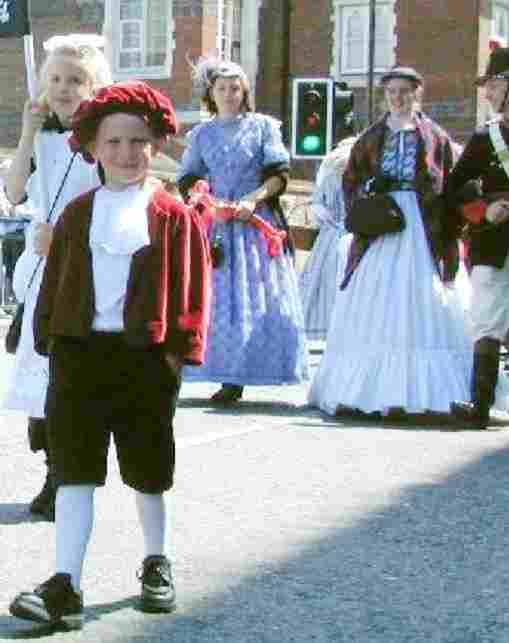
The boys pictured here have imaginative caps. They do not look like the kind of caps that were commonly worn by boys, but admitedly our information is limited at this time.
HBC is less sure of caps worn by boys. The tri-corner hat worn in the 18th century was little seen after the turn of the 19th century. Some boys wore military-style caps with a leather peak or bill. Tams were worn in the 19th centuy, but HBC is less sure about the time line for the type of tam worn by the boy in figure 1.
Many of these events are elaborately costumed. The most common boys' outfit for this era is the skeleton suit. Early skeleton suit styles were worn with knee breeches in the 18th century. By the turn of the 19th century, certainly by the 1830s-40s Dickensian era, all boys wore skeleton suits with long pants. In fact kneepants and knickers were rarely seen during this era. Boys mostly wore long pants. Interstingly, some mother think that historical dress for boys always requires shortened pants. Thus some Dickensian costumes are made with shortened pants--either knee pants or knickers.
Sailor suits were not really worn in the early Dickesian period (1820s-30), but was worn in the later Dikensian era (1840s-50s) . The Prince of Wales (future Edward VII) was dressed in a white enlistedman's uniform for a 1840 Winterhalter portrait. The sailor suit fashion developed after that, but did not become wodely popular until somewaht later. The sailor suit became so widely worn that in the popular mind it will do for any 19th century recreations. It also appears in Dikensian recreations because boys are often more willing to wear sailor suits than some of the other 19th century outfits. Here are a couple of young re-enactors from the 2002 Rochester Dickens Festival in the United Kingdom. One boy looks to be wearing a hired sailor suit or perhaps one made by mum (figure 1). Note mum had added some buttons on the sailor trousers to give it an early 19th century look like the trousers for skeleton suits. The boys' sailor suit, however, is probably closer to a turn of the 20th century outfit, whilst the other lad is dresses as a ragged-trousered Victorian urchin--although perhaps a little too well scrubbed. His trainers don't help his outfit, but given the cost of buying period footwear, this is understandable. His cap looks rather authentic.
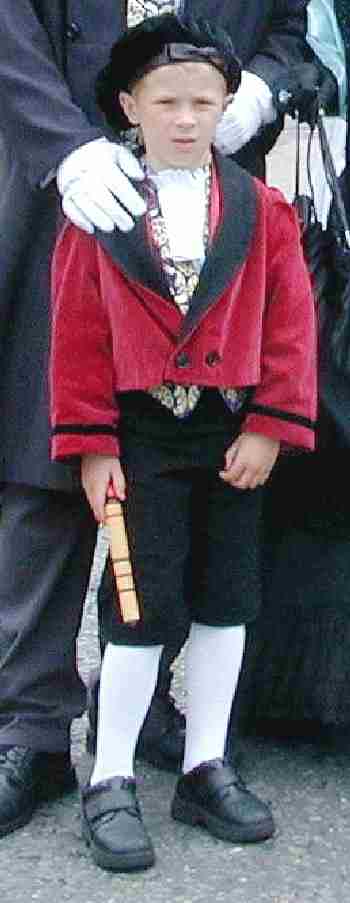
The boy here wears a white back-buttoning blouse with a jabot. Again this looks more like a 18th cebntury than a 19th century style.
Boys are often dome up in kneepants or knickers for these recreations. In fact, most boys at the time wore long trousers. It was boys who in fact forst introduced long trousers to polite society. Knicker-like pants had begin to appear in the 1930s, but long trousers were much more common until the 1870s.
|
The boys here wear white stockings. HBC does not believe that white stockings were very common, although white socks were worn with long trousers.
Historic re-enactors can perhaps be excussed if there are inaccuracies in footwear. Mums can often produce clothing of some historical accuracy without too great an expense. Historically accurate footwear, however, are not sometyhing a mum can piece together. Buying such footwerar could prove quite expensive.
Photography was invented in France (1839) and slowly expanded in Europe. Utspreas much more rapidly in America. The firstimages were Dasd (1840s). Anrotypes and tin types appeared (1850s). And then Albumen prints in much larger numbers (1860s). As aresult, there are actual photographs for half of the Dicksenian era,. This means ghere is a great deal of very accurate depictions to work from. And of course we have photographs of the costumes produced for reenctors. Many of these have absolutely no relationship o actutal Dikensian outfits. We do note a photographic grouup that had taken great pains to produce and photograph actual Dikensiaan outfits--JEH Photography. Bautifully done images. If done in black and white they might pass for actual 19th century images. .
One HBC contibutor commoents. "Anyone is vaguely Victorian dress is free to join the parade and many families make their own costumes. This looks like a home-made effort to me."
Another HBC contributor comnmenrs, "I am always impressed by how you catch these errors for re-enactors. I believe that some re-enactors are very careful, but most small boys do not care about the accuarcy and at festivals who is going to hurt a young child's feelings by excluding him because his costume is inacurate." Indeed HBC is not criticizing the boy. Interestingly younger boys like girls love to dress up in costmes, but they become very self-consious by 6 or 7 years of age. HBC does not critcize boys in incorrect costuming. Their interest in history should be incouraged. Mun should, however, take a little more care. HBC notes that many mothers make no effort to look into proper costuming and just assume in earlier periods that boys wore knee pants. In fact from about 1790-1820, boys from affluent families were more likely to wear long pants than their fathetrs.

Navigate the Boys' Historical Clothing Web Site:
[Return to the Main re-enaction page]
[About Us]
[Introduction]
[Activities]
[Biographies]
[Chronology]
[Cloth and textiles]
[Countries]
[Garments]
[Girls]
[Photography]
[Topics]
[Bibliographies]
[Contributions]
[FAQs]
[Glossaries]
[Images]
[Links]
[Registration]
[Search]
[Tools]
[Boys' Clothing Home]