|
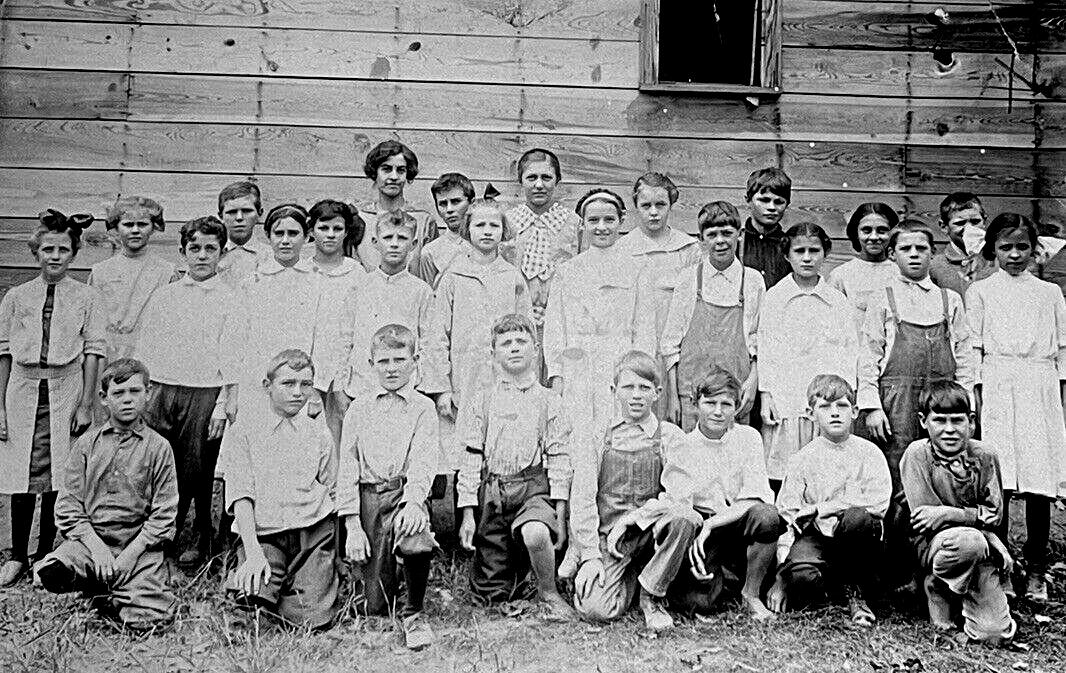
We have few images of early rural schools. Genre painting was not a form that naive/folk artists took an interest in paintings. They mostly painted portraits which is what Americans were willing to pay for. Photography was invented in France (1839) and quickly spread ti America. For the first time we have large numbers of images of people, including children. For the first two decades, however, we see very few school images. A problem was that the photographic formats were one shot affairs. Copies could not be made and they were mostly studio portraits. Thus school photography was not yet possible. The albumen process made school portraits more feasible because multiple prints could be made of an image so every family that wanted a copy could have one (1860s). We only see a few school images at first (1860s). The CDV was so mall that there were very few school photographs (1860s). The larger cabinet cards created more satisfying images (1870s). This was the beginning of the tradition of school photography. School portraits, mostly class portraits, began to become an established events (1870s). In rural schools of course, the whole school of course was photographed and not class photographs like in urban schools. Thus means there is a chronological record available on school, including rural schools available from the 1870s, although wee only begin to see many school portraits (1880s). This mostly meant the children posed together outside their school, bit there are some interior images as faster speed film was developed after the turn-of-the 20th century. We begin to see really large number of rural school portraits (1900s). And this continues into the 1910s and 20s. America was, however, changing. The 1910s was the last decade that a majority of American lived in rural areas. This mean that by the 1920s there were fewer rural school children. And another problem was surfacing. Small rural schools were very expensive to operate. There was not only the expense of maintaining small school buildings all over the state was a drain on resources. And also a teacher was often only teaching a small number of children. Henry Ford provided the answer. Ford did not stop with the Model-T Tin Lizzie (1907). Soon there were trucks, tractors, and busses. The internal combustion engine and mass production created an economical means of transporting children to school. States began consolidating small rural schools and bussing the children to large consolidated schools located in small towns. Yellow school busses began appearing all over the contra. This began in the 1920s and had closed many rural schools (1930s). After World War II (1945), the process was mostly completed by which time most small rural schools had mostly been phased out. A few have been retained, mostly in remote areas of Western states.
We have few images of early rural schools. Genre painting was not a form that naive/folk artists took an interest in paintings. They mostly painted portraits which is what Americans were willing to pay for. Photography was invented in France (1839) and quickly spread ti America. For the first time we have large numbers of images of people, including children. For the first two decades, however, we see very few school images. A problem was that the photographic formats were one shot affairs. Copies could not be made and they were mostly studio portraits. Thus school photography was not yet possible. The albumen process made school portraits more feasible because multiple prints could be made of an image so every family that wanted a copy could have one (1860s). We only see a few school images at first (1860s). The CDV was so mall that there were very few school photographs (1860s). The larger cabinet cards created more satisfying images (1870s). This was the beginning of the tradition of school photography. School portraits, mostly class portraits, began to become an established events (1870s). In rural schools of course, the whole school of course was photographed and not class photographs like in urban schools. Thus means there is a chronological record available on school, including rural schools available from the 1870s, although wee only begin to see many school portraits (1880s). This mostly meant the children posed together outside their school, but there are some interior images as faster speed film was developed after the turn-of-the 20th century. By the 1890s wesee large numbers of chool images.
Most of our rural school images come from the 20th century. We begin to see really large number of rural school portraits (1900s). And this continues into the 1910s and 20s. America was, however, changing. The 1910s was the last decade that a majority of American lived in rural areas. This mean that by the 1920s there were fewer rural school children. And another problem was surfacing. Small rural schools were very expensive to operate. There was not only the expense of maintaining small school buildings all over the state was a drain on resources. And also a teacher was often only teaching a small number of children. Henry Ford provided the answer. And as car ownershjip increased, Americans begn demanding better roads. All of this reduced the isolation of people in rural areas. Ford did not stop with the Model-T Tin Lizzie (1907). Soon there were trucks, tractors, and busses. The internal combustion engine and mass production created an economical means of transporting children to school. States began consolidating small rural schools and bussing the children to large consolidated schools located in small towns. Yellow school busses began appearing all over the contra. This began in the 1920s and had closed many rural schools (1930s). Another factgor was at olay--edcindarfy education. More and more children were begiining to attend high schools. High schools diploma were becoming more and more important. Rural chools coild effecrivly deliver primary-level material. Secondary level material was different. Many sibkects required more specialized teachers. And high schools needed to be situated in at least small towns. Thus bussing was needed for rural children to attend high school wich was becoming standard for modst uouhs (1940s). After World War II (1945), the process was mostly completed by which time most small rural schools had mostly been phased out. A few have been retained, mostly in remote areas of Western states.

Related Chronolgy Pages in the Boys' Historical Web Site
[Main Chronology Page]
[The 1900s]
[The 1910s]
[The 1920s]
[The 1930s]
[The 1940s]
[The 1950s]
[The 1960s]
[The 1970s]
[The 1980s]
[The 1990s]
[The 2000s]
Navigate the Related Boys Historical Clothing Style Pages
[Main country page]
[Long pants suits]
[Short pants suits]
[Lederhosen]
[Knee socks]
[Eton suits]
[Jacket and trousers]
[Blazer
[School sandals]
Navigate the Boys' Historical Clothing School Uniform Pages
[Return to the Main U.S. Rural Public School page]
[Return to the Main U.S. Public School location page]
[Return to the Main U.S. Public School page]
[Return to the Main National School page]
[Australia]
[England]
[France]
[Germany]
[Ireland]
[Italy]
[Japan]
[New Zealand]
[Poland]
[Singapore]
[Scotland]
[Singapore]
[United States]
Navigate the HBC School Section
[Return to the American public school pge]
[About Us]
[Chronology]
[Clothing styles]
[Countries]
[Debate]
[Economics]
[Garment]
[Gender]
[Hair]
[History]
[Home trends]
[Literary characters]
[School types]
[Significance]
[Transport and travel
[Uniform regulations]
[Year level]
[Other topics]
[Images]
[Links]
[Registration]
[Search]
[Tools]
[Return to the Historic Boys' School Home]