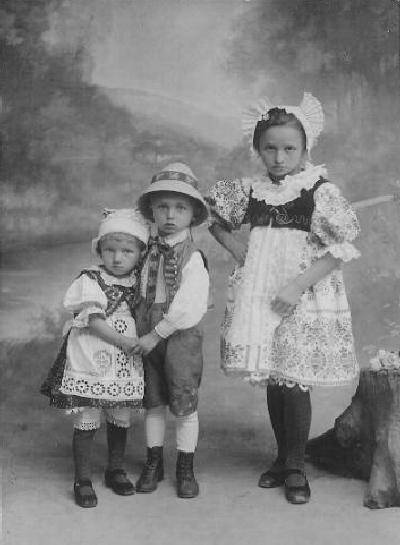
Figure 1.--Here we see a Czech family from Nova Paka photographed in Czech folk costumes. I'm not sure when the portrait was made, but would guess about 1910. We are not sure to what extent these costumes varied throughout the Czech areas of Bohemia and Moravia. Nova Paka is located today in the Czech Republic and is best known for its brewery which bottles BrouCzech beer. One internet comment reads, "If you want somewhere a little off the main tourist trails, that still oozes Czech charm and heritage with no McDonalds in sight, then Nova Paka can give you the real experience."
Czech leaders from Bohemia declared independence from Austria during the 1848 revolutions. The Austrian Army, however, crushed the Czech revolts and restablished Austrian authority in Bohemia. The Austrians needed Rissian help to do the same in Hungary. The Prussians with their victory in the Austro-Prussian War ended Austria's hopes of unifying Germany under the Hapsburgs (1866). After the Austro Hungarian Empire was created (1867), the Czech areas of Bohemia and Moravia were administered by the Austrians. The Czechs were the third largest national group in the Austro-Hungarian Empire (after the Germans and Hungarians). The Czechs were about 13 percent of the Empire's population. Czechs were the dominant ethnic group in Bohemia and Moravia as well as areas of Silesia. Emigration began in the 1870s, primarily to the United States. Language was by far the single most contentious issue in Austro-Hungarian politics. Sucessive governments faced this difficult issue in various ways and in different principalities. Minorities wanted to use their language in the schools as well as in government. Austrian Prime Minister Kasimir Felix Graf Badeni attempting to address the issue gave the Czech language equal standing with German in the internal government of Bohemia under the "Ordinance of April 5, 1897". Austrians were outraged at this. The Emperor ultimately dismissed Badeni. The Czechs under another prime minister lost the right to use their language in newspapers and in the workplace. We believe that Czech fashions in the cities were similar to styles in Vienna and oter major cities. Clothing in the country still included folk styles, especially in the 19th century.
Organizational Problem
We have a problem in using photographs from Bohemia and other Czech areas as a source of information on Czech clothing. The major cities of the Austro-Hungarian Empire were cosmpolitan. Thus the children photogrphed in a city like Prague may hve been Czech or they could have been other ethnic groups like Germans/Austrians, Hungarian, and others.
Czech leaders from Bohemia declared independence from Austria during the 1848 revolutions. The Austrian Army, however, crushed the Czech revolts and restablished Austrian authority in Bohemia. The Austrians needed Rissian help to do the same in Hungary. The Prussians with their victory in the Austro-Prussian War ended Austria's hopes of unifying Germany under the Hapsburgs (1866). After the Austro Hungarian Empire was created (1867), the Czech areas of Bohemia and Moravia were administered by the Austrians.
Ethnic Groups
The Czechs were the third largest national group in the Austro-Hungarian Empire (after the Germans and Hungarians). The Czechs were about 13 percent of the Empire's population. Czechs were the dominant ethnic group in Bohemia and Moravia as well as areas of Silesia. Austria-Hungaria was, however, a multi-ethnic empire and there was a substantial degree of ethnic mixing. This was especially true in the cities where the ethnic ballance might be different than the surrounding countryside. The Jewish minority was concentrated in the citiesand often spoke German. In addition the German population was substantially higher in the northern areas bordering Germany, such as the Sudetenland and Austrian/Czech Silesia. Thus there is reason to believe that an unidentified portrait taken in Toppau/Opava is probably a German family. There were also Poles in Silesia. The Czechoslovakian Republic that was created after World War I would inherit this ethnic mix as well as the Slovaks east of the Czech lands.
We believe that Czech fashions in the cities were similar to styles in Vienna and oter major cities. his may have been the case for some time because Bohemia has been ruled by the Hapsburgs since the 13th century. Clothing in the country still included folk styles, especially during the 19th century. This of course changed over time with urban clothing becomeing increasingly important even in rural areas. We do not yet have a sufficently large Czech archive to chronicle these developments, but are collecting information.
We have little information at this time about the clothing worn in the Czech Lands of the Austro-Hungarianm Empire. Our basic assessment at this time is that they were very similsar to Germany and Austria, at least in the cities. Some of the cities, had substantial German populations, On the northern fringe of the Czech lands, the cities might even had German majorities. So the influence of German fashions is easy to understand. We are less sure about the clothes worn in the countryside by the more ethnically dominant Czech population. We suspect that the city populations within the Empire wore essentially the same garments with similar styles and conventions. This assessment is complicated by the fact that much of the photograohic recird is from gthe cities which had substantial German populations. Thus many of the the children in the photographic record from the Czech lands may be ethnic Germans. This is further complicated by the fact that Germans living in the Czech lands may have been influenced by the Czrchs. The first step in our pricess is to collect images from the Czech Lands. Information on garments and their relation to Austrian/German garments needs to be confirmed as we build our Czech archive. It was the country populations which may have worn more destinctive garments with local decorations that varied and became folk styles.
Emigration
Emigration began in the 1870s, primarily to the United States.
Family images are a wonderful source of fashion information brcause they not only show waht boys and girls olf different ages as well as adults were wearing at any given time. Individual portraits of boys whuch we we also use are valuable. But family photographs help to put boys's fashions in context. Here we are talking about both formal portaiys as well as family snap shots. The portraits show basically the same styles popular in Austria and Germany.
Language
Language was by far the single most contentious issue in Austro-Hungarian politics. Sucessive governments faced this difficult issue in various ways and in the different principalities. Minorities wanted to use their language in the schools as well as in government. Austrian Prime Minister Kasimir Felix Graf Badeni attempting to address the issue gave the Czech language equal standing with German in the internal government of Bohemia under the "Ordinance of April 5, 1897". Austrians were outraged at this. The Emperor ultimately dismissed Badeni. The Czechs under another prime minister lost the right to use their language in newspapers and in the workplace.
Photography
We do not know much about Czech photography yet. The great advances in photography were made in England and France abd later in America. The German economic area in central Europe did not make major contributions. Germans took to the new technology enthusiastically. Many of the early photographic studios in Central Europe were opened by German entrprenuers. And this was also true in Eastern Europe, including Tsarist Europe. What is now the Czech Republic was during the 19th and early-20th century ruledd by Austria (Aistrian Empire or Austro-Hungarian Empire). Thus there is no way of kmowing who the subjects are. The populations throughout the Empire were more mixed than is the case today. The subjects in the portraits could b Cechs or theu could be Germans/Austrians, Slovaks, Hungarians, Ruthenians (Ukranians), Poles or Jews. Fortunately the city is often specified on CDVs and cabinet cards, so we know whee the portrait was taken. After World War I. Czechoslovakia was created. Photographic trends ere similar to those in Germany. There was some shiting of population, but until World War II the country still had a very mixed population. We do not yet know about photographic trends in Communist Czechoslovakia. Only with the Velvet Revolution and the disolution of the union with Slovakia (1993) did the Czech Reoublic become alargely Czech state.