|
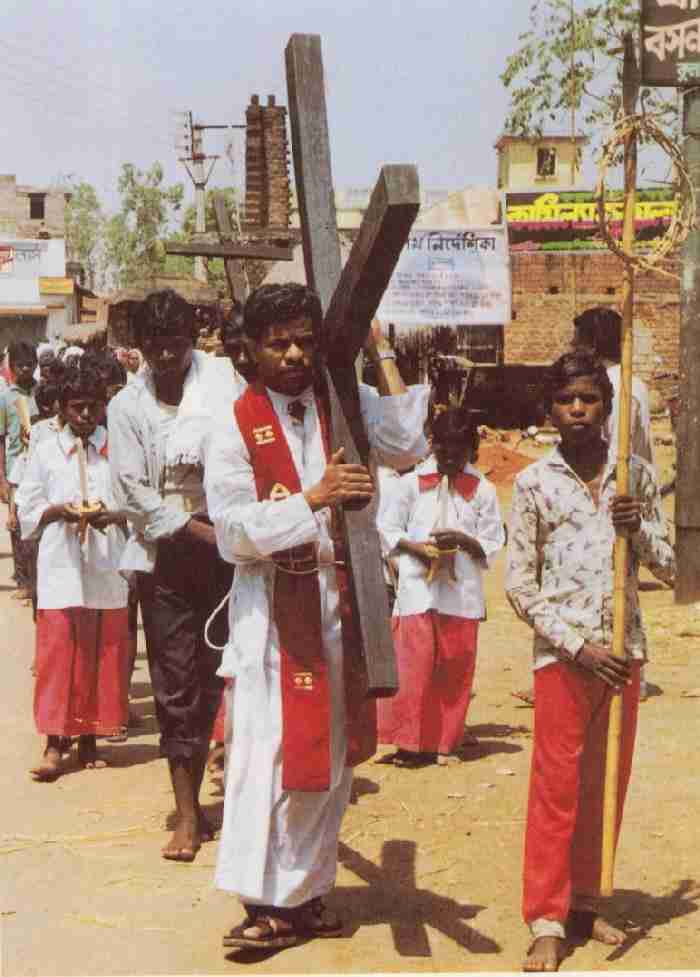
India has a fascinating religious history. Two of the world's great religions rose in India. The principal religion of India is Hinduism. Hinduism is a religion almost uniquely associated with India and neigboring Nepal as well as the East Indies (especially Java) where it was carried by Indian traders. For a range of historical reasons it has not spread to other countries. There are Hindus in other countries, but almost always restricted to Indian emmigrants. A more recent religion rising out of India is Budhism, but it was so effectively destroyed by Hindus, even before the Islamic invasions. that its origins were almost unkown even in the early 19th century. Islam entered India with the Mongol warriors in the 16th century. As in so many counties it was introduced by conquest. There are large numbers of Muslims in India, even after the partition that createrd Pakistan. While Muslims are a minority, India is in fact the world's most populace Muslim nation. The primitive people of India were animists, but much of this was incorporated into Hinduism and survives as a range of local traditions. There are small numbers of other religions. Europeans introduced Christianity to India.
India has a fascinating religious history. Two of the world's great religions rose in India (Hinduism and Budhism). I am not sure why that was. There were countless religious sects in the ancient world. Just why these two religions triumphed over other competing sects is an interesting question. And why two great religious traditions would arise in a single country is another interesting question. Two other important religions (Jainsin and Sikhism) were also born in India. And an imported religion (Islam) has made great inroads.
India has often been seen as a highly spiritual country. I am not sure just how to assess this. It is notable that the world's five great religions were born in such confined areas. Three came out of the Middle East (Judiaism, Christiamity, and Islam). The other two came out of India (Hindism and Budhism). And India has given birth to several smaller, but important religions. Budhism has almost disappeared from India, but Islam has made strong inroads. In fact India is the wotld's largest Muslim nation, although they are still in a minority. There are many other religious traditions in India. One of the most important is the Sikihs as well as the Jains. And there are also Christians as a ressult of the European colonial era, especially the British Raj. And there is also the contunuing influence of primitive Animism.
The rich religious tradition of India is indeed a fact of considerable interest. Is India a more spiritual society thn other civilizations? And just what dies that mean? It is unclear why so many great religion traditions emerged from a relatively small area--the Middle East and India, The Middle East was one of the important cradles of civilization and a commercial crossroads. India while one of the cradles of civilization appears because of the Himalays as a more isolated environment which for some reason seems to have been a relgious hothouse. .
India is a highly religious country where religion plays an important role in the lives of many people. There are several important religions in India. Two of the world's great religions (Buddhism and Hinduism) originated in India as well as several other smaller religions. India also has the largest Muslim community in the world. While there was a horrifying explosion of religious hatred at the independence of the country (1948-49) and there have been scattered terrorist attacks, the various religious communities have for the most part managed to live in exceptionl harmony. The country's Muslim minority has for the most part found the country's democratic institutions offered adequate protections. It is unclear how rising Islamic fundamentalism and resort to violence will affect India. I am not sure about the country's laws concerning religion and education. The country has a Hindu majority, but the state schools are secular. We do note meditations in schools. I'm not sure how common this was. I'm also not sure about Indian laws concerning schools operated by religious groups.
One of the most impresive achievements of India, in addition to creating the world's largest democracy, is religious toleration. Tolerance is an integral part of Indian life a tradition extending back to ancient times. One author sees tolerance as India�s true national identity. There have been periods of intolerance such as the Mogul Muslim rulers following Akbar and trrible out breaks of comminal violence sucha s the terrible ioting followin the partition of thRaj. India today is a multi-religious and higly tolerant society. And with a few exceptional incidents, Indian people of all religions live in peace and harmony. This is an important part of the identity of the Indian nation. India is a predominntly Hindu nation, but there is a substantil Muslim minority as well smaller number od many othef religion. There is complete religious freedom for all of these groups. Muslim leader Muhammad Ali Jinnah did not think this was possible and demanded partition to crate a separate Muslim state. This was the genesis of Pakistan. But in Pakistan the tolration and religious divrsity of India was lost. Ironically, there is more toleration and religious freedom for Muslims in India than Pakistan. Today in Pkistan not only are non-Muslims common targets of violence, but Muslims who do not adhere to the majority Sunni deomination. The tolerant religious tradition was strengthen by the British Raj, but it was a long-established traditioin well before the arrivl of the British.
It is an important component of the Indian way of life. Indians believe in plurality or as the great independence leader Mahatma Gandhi phased it, 'the manyness of reality'. Gandhi had virtually insane economic ideas, but his
philospical ideas have inspired people around the world, including Martin Luther King in America and invigorated the Civil Rights movement. Ghandi like most Indins are Hindu and the impulse for toleration has come primarily from Hindu thought. The Hindu religion is centered on 'advait vad'--monism. Monism is the philosophical and religious view that all variety of existing things can be explained in terms of a single reality or substance, albeit manifested in different ways. Hindus believe that everything in the cosmos is an 'ansh', or part, of divinity. They believe in the concept of an indwelling god. Every human has having a content of divinity. Hindu theology accords equal value to all human life, although this sems hard to recocile with the casr=te system. This is, howver, the source of the culture of Indian tolerance.

Navigate the Boys' Historical Clothing Web Site:
[Introduction]
[Activities]
[Biographies]
[Chronology]
[Clothing styles]
[Countries]
[Topics]
[Bibliographies]
[Contributions]
[FAQs]
[Glossaries]
[Images]
[Links]
[Registration]
[Tools]
[Boys' Clothing Home]
Navigate the Boys' Historical Clothing national pages:
[Return to the Asian Country religion page]
[Return to the Country religion page]
[Return to the Main Indian country page]
[Return to the Main countries page]
[Australia]
[Belgium]
[China]
[England]
[France]
[Germany]
[Indonesia]
[Ireland]
[Italy]
[Japan]
[Korea]
[Malaysia]
[Mexico]
[The Netherlands]
[Portugal]
[Scotland]
[Spain]
[United States]