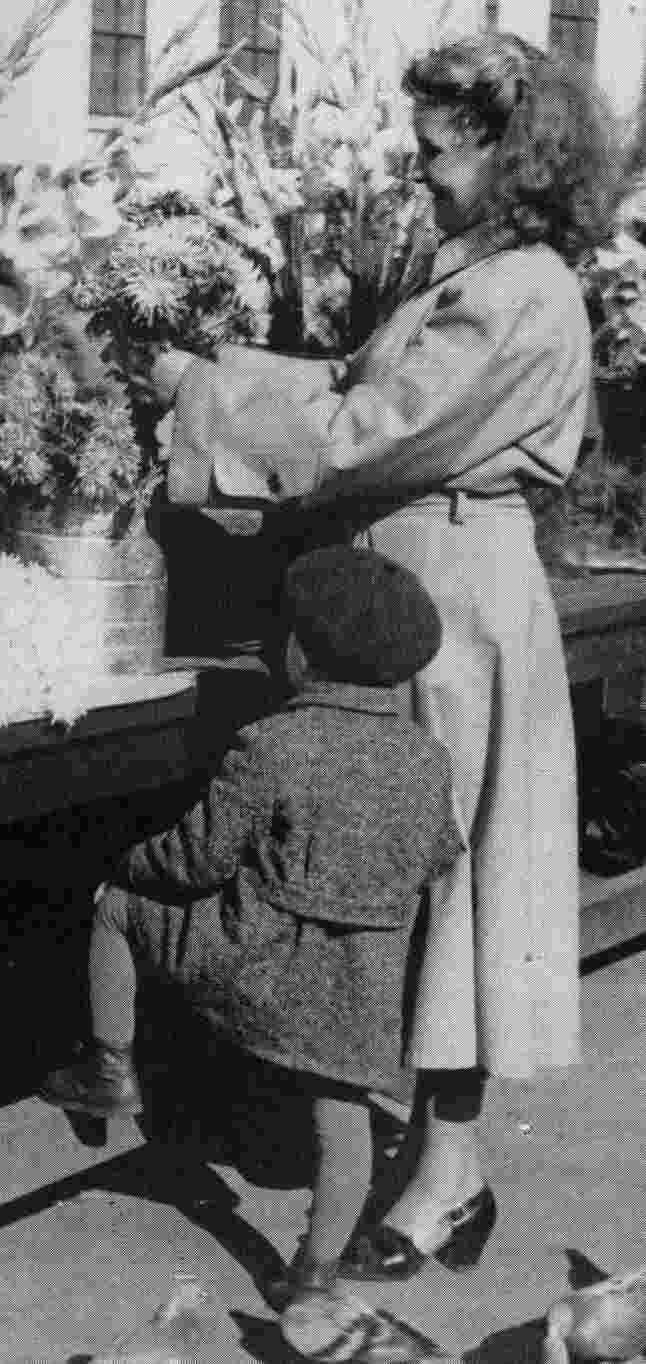
Figure 1.--This photograph was taken in the central market in Riga during 1956. It shows a boy with his mother shopping for flowers. The boy, probably no older than 6 or 7, is dressed for chilly weather and rather formally since he is out shopping with his mother. He wears a tweed overcoat with a belted back and a beret. We note other images of boys in Eastern Europe wearing berets. He wears short pants, long dark stockings, and high-top shoes. This was probably standard dress-up wear for little boys during the 1950s.
Lettish tribes first appeared along the Blatic during the 10th century AD. The Letts came under foreign rule in the mid-12th century. From that time the Letts were dominated by Germans, Poles, and Russians as well as a brief period of Swedish control. The German Teutonic Knights controlled the Letts (1158-1562). The Germans Christinaized the Letts and introduced Feudalism, making the Letts serfs in German estates. Latvia at the time was divided into two states (Livonia and Courland). The Poles and Lithuanians defeated the Teutinic Knights (1562) beginning an era of Polish control (1562-1795) interupted only by a short period of Swedish control. As a result of the Polish Partitions, Russian obtained control of at first Livinia (1795) and subsequently Courland as well which lasted until the Russian Revolution (1917). Latvia obtained its independence in the turmoil resulting form World War I and the Russian Revolution (1918). After two decades of independence, Lativia was invaded forst by the Soviet Union (1940) and subsequently NAZI Germany (1941). The Red Army droved out the NAZIs (1945) and Latvia was for over four decades administered as a Soviet Republic. With the disolution of the Soviet Union (1991), Latvia again achieved its independence.
Neolithic Era
Anthropologists have found evidence of human habittin in what is now modern Latvia (9000 BC). Very little is known, however, about the origin or culture of these early people.
Baltic Peoples
The first recognizable group to inhbit Latvia were a Finnish people which evolved into the Finno-Ugric Livian tribes (3000 BC). Next of pre-Baltic tribes appear (2000 BC). These people evolved into the Baltic Couranian, Latgallian, Selonian and Semigallian tribal groups. Lettish tribes first appeared along the Blatic (10th century AD). They gradually coalessed into a recognizable unit destinct from the Finnish peoples. The Lettish peoples were eventually conquered by the Germans who named their new territory Livonia (mid-12th century AD). From that time the Letts were dominated by Germans, Poles, and Russians as well as a brief period of Swedish control.
German Rule (1158-1562)
The Grmn influence began in the 11th century. Some sources suggest that the German inflence began wth the shipwreck of German sailors near the Daugava River (1054). This developed into a German settlement and expanding German influence. The German Brothers of the Sword conquered the Letts (1158) The Germans Christinaized the Letts and introduced Feudalism, making the Letts serfs in German estates. Latvia at the time was divided into two states (Livonia and Courland). The Brothers merged with the Teutinic Order (1237). Bishop Alberth of Livonia founded Riga (1201). The town became an important commercial center and joined the Hanseatic League in (1285). Thus Riga and the surrounding area began to develop cultural and economic ties to Christan Europe. The Germans introducted Christianity and the Feudl system. The Lettish peoples were made serfs ruled ver by a German nobility. Non-Germns were able to obtain limited trading and property rights.
Polish Rule (1562-1795)
Subsequent wars between the Germans, Poles, Sweedes and Russians resulted in the partition of Latvia and continued foreign rule for centuries. The Polish-Lithuanian Commonwealth defeated the Teutinic Knights (1562) durng the Livonin Wars (1558-83) began an era of Polish control (1562-1795) interupted only by a short period of Swedish control. The Polish-Lithuanin Commonwealth gined control of the Latvian-populated duchies of Pardaugava, Kurzeme and Zemgale.
Swedish Rule (1600-1721)
The Swedes during the Polish-Swedish War (1600-1629) gined control of Riga and the Duchy of Pardaugava except for Latgale. This left Latvia again split ethnically.
Russian Rule (1721-1917)
Russia's victory over Sweden in the Great Northern War (1700-1721) gave Russia control over Swedeish Latvian territories and other Baltic areas (1721). Other areas of Latvia and Lithuania were controlled by Poland. As a result of the Polish Partitions, Russian obtained control of at first Livinia (1795) and subsequently Courland as well. This left Tsarist Russia in control of all of modern Latvia. Russia control lasted until the Russian Revolution (1917). Despite Polish, Swedish, and finally Russian control, the German nobility remained in place with their Latvin serfs.
Mostly German landowers continued to exercise autocratic authority into the 19th century. A series of local decrees during the Napoleonic era began to undermine the German nobility and Latvian serfdom (1804). The Russians abolished serfdom, first in Courland and then Livonia (1818-19). There was, however, no landf reform and the klargely German nobility continued to own most of the land. The Russians approved a local law which permittd the creation of small-scale peasant-owned farms independent of the large German-owned baronic estates (1849).
Reforms progressed slower in Latgale which was part of Vitebsk Governorate. Here serfdom was only abolished when Tsar Alexander II abolished serfdom in Russia (1861). The Latvian economy began to develop and industry appeared (mid-19th century). Urban populations began to grow as more ethnic Latts moved to the cities seeking jobs. Courland and Vidzeme became one of the most industrialized provinces of the Russian Empire. Tsar Alexander III launched a Russification program (1880s). Abd Latvia like other largely non-Russian provinces was affected. The Tsar sought to
reduce the autonomy of Poland and the Baltic provinces along with pogroms against Jews. The result was large scale emigration to America, although Latvians were less prone to emigrate than Lituanins abnd Poles. We are not sure why this was. Russification included measures like expanding the use of the Russian language in government administration, courts and education. This mean replacing both German or Latvian with Russian. The schools were required to teach classes in the Russian language. We are not sure how much teaching there was in Latvian before this time. There would have been relatively few books published in Latvian.
Independence Movement (19th century)
We see little evidence of any Latvian nationalist spirit until the mid-19th century. Even the French Revolutin seems to have had little impact on Latvia. Part of the reason for this was that there was no Latvian ruling or intelectul class and thus no real development of Latvian literature or culture. The Latvians were largelly serfs and thus tied to the large German Baronic estates. Thus there was no opportunity for education or travel and exposure to the new ideas sweeping Europe. Gradually the Latvian population begn to increase in the towns and cities. As the Baronic estates controlled most of the agricultural land, a large landless, urban class came to comprise over half the population. The turning point for Latvia was the the Tsaristinitiated Russification process. This affected both the Germans and Latvians. The Baltic German Catholic clergy and literati were threatened by Russification and Orthodox Christianity. Thus the Germans, a minority, began to move closer to the Latvians. They became more tolerant of the Latvian language and culture. Patrons (with Lettish names like Alunans, Barons, Krastins, Kronvalds, Tomsons and Valdemars) formed Jauna Strava--the Young Latvian Movement. The initial focus was cultural and economic rather than political. They sought to promote Latvian language and culture and expose the the socio-economic oppression of the Latvian peasantry. As was the case elsewhere in Eastern and Central Europe, such cultural movements gradually acquired political dimensions. Jauna Strava evolved into the Latvian Social Democratic Party (LSDP) (1901). The LSDP advocated the moderate positin of transforming the Tsarist Empire into a federation of autnomous democratic states. The LSDP into two groups (1903). The more radical group was the internationalist Latvian Social Democratic Worker's Party which was fixiated on a international revolution. The more dominant grou was the more nationalist Latvian Social Democratic Union (LSDU) which concentrted on national self-determination.
Russian 1905 Revolution
The War withb Japan was a major factor in bringing about the Russian Revolution of 1905. The War led to price increases, especially food prices. Workers staged a strike occurred at the Putilov steel plant in Saint Petersburg (December 1904). This led to demonstrations and strikes with people advocating democraric reforms like a free press and an elected legislature (Duma). The Tsar began making concessions. A general strike was organized in Riga. Russian army troops opened fire on the demonstrators in Riga killing 73 and injuring 200 people (January 13, 1905). Tsarist troops opened fired on a large demonstratiion approacghing the Winter Palace in St. Petersburg (January 22). The shooting of these demonstrators resulted in wide-scale, more violent demonstrations and riots demonstrations throughout the Russian Empire which reached serious levels during the summer. The revolutionary activity moved to the countryside where most ethnuic Latvians still lived. Latvians elected 470 new parish administrative bodies--94 percent of the parishes. This was accompanied by mass meetings and demonstrations. There was not only an anti-Eussian tone to these demonstrations, but the demonstratoes attacked against Baltic German nobles who held much of the landed estates. The Latvians burned estate buildings abd seized estates. Some got hold of weapons. There were armed encounters in rural areas between the German nobility who organized militias and the Latvian peasants. This was especially pronounced in Vidzeme and Courland. Latvian peasdants seized several towns in Courland and surrounded other towns. The peasants in Livland gained control of the important Rūjiena-Pärnu railway line. Some authors report thousand armed clashes during 1905. Russian authorities declared martial law was declared in Courland (August 1905) and in Livland (late-November). A national Congress of Parish Representatives was held in Riga (November). The Russians deployed special punitive expeditions. The Russioans executed 1,170 Latvians. There were no investigations and trials. As the revolutuinary fervor subsided in Russia proper, the revolutionary movement gradually subsided in Latvia (1906).
Latvia at the time of World War I was a part of the Russian Empire. The initial fighting was in East Prussia and Poland, but after Hindenberg and Ludendorf snashed Russian armies at Tannenburg and other battles (1914), the Germans moved into Poland and the Baltics (1915). Terrible Russian losses caused theRussian Army to mutiny and the Tsar to abdicate. This was followed by the Bolshecick Revolution (October 1917). Latvian nationalists were anti-Communist abd formed the Latvian National Council (LNC) (October 29, 1917). German occupation forces did not allow the LNC to organize an independent government or recruit an army. The Germans were intentent on organising Latvia as a subject Baltic duchy.
Russian Revolution (1917)
Terrible Russian losses caused the Russian Army to mutiny, leading to the Russian Revolution. The Tsar abdicated (February 1917). The Provisional Government continued the War. The Bolshevicks made peace a major issue. The Bolshevicks finally seized control (October 1917). The terrible military situation increased Latvian and LSDU support for the Bolshevik Revolution. The Latvians hoped that this would mean a "free Latvia within free Russia." LSDU activists formed the soviet "Iskolat Republic" in the area of Latvia that was not yet occupied by the Germans.
Latvia obtained its independence in the turmoil resulting form World War I (1914-18) and the Russian Revolution (1918). The Latvians formed a national council after the Bolshevik Revolution and the radicialization of the Revolution (November 1917). The Latvians were unable to declare independence or create a national army as the Germans had occupied the country. The Germans did not want an independent Latvian republic. Rather they attempted to set up a Baltic duchy
continued. With the German Army in Latvia, the Bolsheviks made no effort to invade. The Bolsheviks under the terms of the Treaty of Brest-Litovsk (1918) were required
to agree to the loss of Latvia. After the German defeat on the Western Front and the armistace, the Germans began to withdraw from Latvia (November 11). TheLatvians formed a people's council with moved to establish a republic led by Prime Minister Karlis Ulmanis. As its first important act, the council proclaimed Latvia's independence (November 18). The Bolsheviks moved against Latvia, captured Riga and installed a Soviet Government. Fighting between Allied forces, the Bolshevicks, Lettish nationalist forces, and Balts (Baltic Germans continued for nearly 2 years. Here a young British officer, Harold Alexander, played an important role leading the
Landeswehr (essentially a small German force) in Latvia. Foreign troops evacuated (early 1920) and the Latvians signed a peace treaty with the Soviet Union recognizing Latvian indeoendence (August 11, 1920).
The end of the war with the Bolshevicks mean the beginning of Latvia's independence. A peace treary was signed with the Soviet (August 11, 1920). The League of Natins admitted Latvia (1921). Ethnic Latvians were an absolute majority in the new independent Republic. The Government headed was headed by Prime Minister Ulmanis and was established as a democratic, parliamentary republic. It recognized Latvian as the official language, but granted cultural autonomy to the country's sizeable
minorities. A constitution was adopted (1922). The new government instituted sweeping economic reform. The country faced huge problems. The War had devastated Latvian agriculture. The Russians had evacuated most important factories. The Depression brought more problems leading to political turmoil (1930s). Prime Minister took the unprecedented step of dismissed parliament (May 15, 1934). He banned strident and left-wing political parties supported by the Soviets. He moved to tightened authoritarian state control over Latvian social life and the economy. Thriughout the tutmoil Latvia maintained a neurtral stance as an independent republic.
After the outbreak of World War II (September 1939) Latvia was in an impossible position. The NAZI defeat of Poland destroyed the only buffer in the region. Unbeknownst at the time, the NAZI-Soviet Non-Aggression Pact had assigned Latvia and the other Baltic Republics to the Soviets. After two decades of independence, Lativia was invaded first by the Soviet Union. The Soviets immediatelt began making demands on the Latvian Government. Latvia was forced to sign a 10-year mutual assistance treaty leasing Latvian bases to the Soviet Union (October 5, 1939). The treaty allowed the Soviets to garison Latvia with 30,000 troops. After Hitler called the Baltic Germans home to the Reich, Latvia also signed a repatriation treaty with the NAZIs covering the return of 60,000 Baltic Germans. The collapse of France in the West precipitated the final Soviet move against the Baltics. The Soviets accused the Latvians of colluding with the Estonians to form an anti-Soviet alliance. The Soviets demanded the establishment of a pro-Soviet Givernment and permission to garrison additional Soviet military forces in the country. Before the Latvian Government could react, the Soviet Union occupied the country (June 17). The Soviets then staged a closely supervised election which resulted in a Cimmunist Government. The new Goverment proceeded to Sovitize the Latvian Government and military. The newly elected parliament petition the Soviet Goverment for admitance to the Soviet Union (July 21) which was granted (August 5). Latvia was subsequently invaded by NAZI Germany (June 1941). The Germand reached Riga (July 1). Relatively little fighting occurred as the German Panzers pressed east. The Soviets had disbanded the Latvian Army. Latvians would, however, fight on both sides of the sr=truggle on the Eastern Front. The Red Army reentered Latvia (1944). Fierce fighting occured in Latvia. Hitler refused to withdraw and the Red Army cut iff aubstabtial German firce in Kurland pocket. They did not surender until the end of the War (May 19845).
Soviet Rule (1945-91)
The Red Army droved out the NAZIs (1945) and Latvia was for over four decades administered as a Soviet Republic. The Western allies, however, refused to recognize Soviet jurisdiction.
Independence (1992- )
With the disolution of the Soviet Union (1991), Latvia again achieved its independence.