
Portuguese History
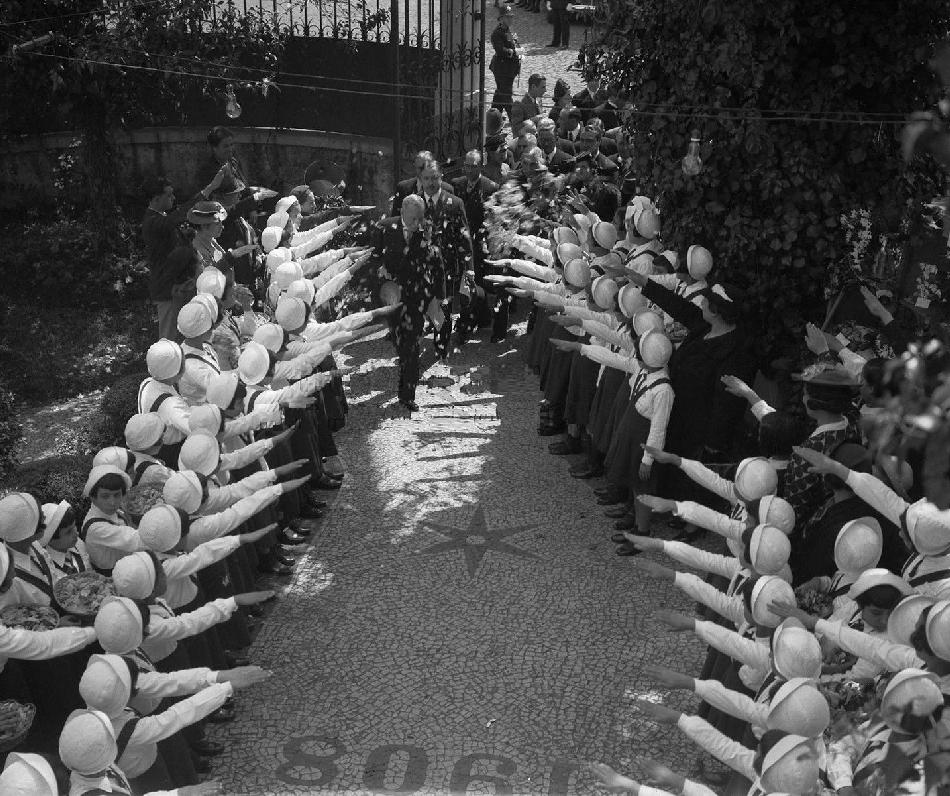
Figure 1.--Gen. António Óscar Fragoso Carmona (1869–1951) was a former Minister of war and the the 11th President of Portugal (1926–51). He was a Republican, but no believer in democracy. He played the central role in Salazers's rise to power. Here we see him we think in the 1930s visiting what looks like a girls' school. The Salazar regim had Fascist trappings, but was not a full blown Fascist state.
|
|
Portugal is one of the two modern countries that has emerged from the many small kingdoms that appeared on the Iberian Peninsula after the fall of the Roman Empire and the Germanic invasions. The situation was further complicated by the Moorish invasions of the 8th century and the 600 year war between and among Moorish and Christian kingdoms which did not end until the fall of Grenada in 1492. Portugal in fact was born from this struggle to reconquer Iberia from the Moors and the first Portuguese king was the son of a French noble. Portugal in the 15th century burst on the European stage as the country leading the great European voyages of discovery. Here Prince Henry the Navigator was a leading figure in making Portugal a leader in maritime technology. This allowed Portugal to acquire great wealth through trade and an create an expansive empire. The corrosive impact of the Inquisition on thought and discourse including the expulsion of the Jews caused a long period of decline during rich Portugal became a European backwater and one of the poorest countries in Europe.
Pre-history
The first humans to inhabit the western portion of the Iberian peninsula were the Neanderthals. They are believed to reach the are of modern Portugal (100,000 BP). Actual evidence is limited. Anthropologists have discovered A Neanderthal tooth at Nova da Columbiera cave in Estremadura. Estremadura is a region of central Portugal along the Atlantic coast around Lisbon. The Neanderthal tooth is one of the oldest human fossils so far discovered in the Iberian Peninsula. Homo sapiens arrived from the north (around 35,000 BP) and rapidly the Iberian peninsula. The most important of the pre-Celtic tribes were the Cynetes who inhabited southern Portugal. They developed developed a written language, something the Celts did not achieve. The primary evidence of the Cynetes were the stelae they left.
Ancient History
The history of Portugal until the middle ages is inseparable from that of the other states of the Iberian Peninsula, now known as Spain. The Celts reached the Iberian Peninsula (first millennium BC). Waves of Celts from Central Europe crossed the Pyrenees. DNA evidence suggests that they intermarried with the local populations. Different ethnic groups resulted and evolved into into many tribes. Knowledge of Celtic culture is limited, but there is some archaeological and linguistic evidence. The Celts emerged as the dominant population in northern and central Portugal. The non-Indo-European people, primarily descendants of the Cynetes continued to dominate the south. Some small coastal settlements were founded by Phoenician-Carthaginians and Greeks, essentially trading posts. These were some of the few such outposts outside of the Mediterranean basin. The Romans arrived as a result of the Punic Wars. Portugal became the Roman province of Lusitania (2nd century BC). The name of Portugal came from Portucale, a Roman and Post-Roman settlement at the mouth of the Douro River.
Visigothic Kingdom (5th-8th centuries)
The Visigoths (Germanic tribe) in the 5th century AD seized control of the region as the Roman Empire fell. Portugal at the time did not exist as a separate kingdom but was just part of the Visigothic kingdom. The Visigothic ruling class lived apart and heavily taxed the Hispano Roman population.
Moorish Conquest (711)
The Moors crossed the Strait of Gibraltar in the eighth century. The invasion was launched by the Arab governor of Tangiers--Ṭāriq ibn Ziyād. He landed an army of about 9,000 men. (the rock of Ṭāriq, Jabal Ṭāriq, where he landed is modern Gibraltar). Visigothic King Roderick rushed south, but was defeated by Ṭāriq's Berber troops near the River Guadalupe (711). Roderick had won his crown in a civil war and some of his defeated opponents joined the Moors. Musa, the governor of Ifriquiyya (North Africa) landed a second larger army of 18,000 men (712). Musa's Berber army had many Arab officers. He defeated remnants of the Visigothic army and Ṭāriq and Musa met in Toledo, the Visigothic capital. Subordinates swept through what is now modern Portugal. There were no major battles or substantial resistance to the Moors in Portugal. Thus commenced the Moorish occupation over Portugal and much of the Iberian Peninsula. The Moors and Arabs introduced their religion, culture, architecture, and agricultural techniques to the region. The Moors encountered relatively little resistance from the conquered peoples. The Visigothic (German) rulers never mixed with the Hispano-Roman population of the Iberian Peninsular. The people found they were more lightly taxed by the Moors than their former Visigothic rulers. Even some Visigothic aristocrats and Christian clergy accepted Moorish rule. There was a degree of toleration in Islamic rule that allowed Christianity to continue. The subject of conversions to Islam is not well understood and historians differ on the degree to which this occurred. By the 9th century the name Portucale/Portugal was applied to a region between the Douro and Minho rivers. The Moors converted large numbers of people in southern Portugal, but encountered more resistance to Islam in the north. Christian resistance gradually grew into the Reconquista.
Christian Remnants
Almost all of the Iberian Peninsula was subdued by the Moors except for the extreme northwest. It is unclear why the Moors allowed this small Christian enclave to survive under the leadership of Pelayo. There are a number of reasons. A Moorish army failed to subdue Christian forces in the Cantabrian mountains (722). Here remnants of the Visigothic Gothic forces joined with local Christian defenders. The Arab defeat at the Battle of Covadonga in Asturias is often sited as the launch of the Reconquista. The Arabs were also defeated when they crossed the Pyrenees and invaded the Frankish Kingdom. Charles Martel defeated them at Poitiers (732). The Moors at this time undoubtedly had the potential of defeating the Christian Remanent in the northwestern corner of the Iberian Peninsula. The fact that this did not occur seems to have primarily resulted from divisions among the Islamic forces. Divisions developed between Berbers and Arabs and between Islamic rulers. These divisions absorbed the energies of the Islamic forces as they divided the rich new province. Divisions in the Visigothic kingdom were a factor in the success of the Moors, the survival of Christianity primarily resulted as a result of division in Islamic forces.
The Reconquista (997-1064)
Bermudo II, King of the Leon reconquered the territory between the Douro and Minho rivers (now northern Portugal ) from the Moors early in the Reconquista (997). As a result, Portugal became a fiefdom of Leon. Ferdinand I, King of Castile and Leon, in 1064 completed the reconquest as far south as present-day Coimbra. The reconquered districts were then organized into a feudal country, composed of Spanish fiefs. Portugal later derived its name from the northern most fief, the Comitatus Portaculenis, which extended around the old Roman seaport of Portus Cale/Callaici (present-day Oporto/Porto). One of the most powerful French noble, Henry of Burgundy in 1093 came to the assistance of Castile when it was attacked by a Moorish army. In gratitude Alfonso I of Castile made Henry Count of Portugal.
Henry of Burgundy Count of Portugal (1066-1112)
Count Henry of Burgundy, one of the most important French nobles. After being made Count of Portugal by Alfonso I of Castile played a major role in the dynastic history of both Portugal and Spain. Henry was the son of Henri de Bourgogne (1035-72), Duke of Burgundy. He had ties to the Iberian Peninsula as his mother was Sybille de Barcelona (1035-74). He was born in Dijon, Burgundy (about 1066).
Alfonso VI of Castile was the most powerful Christian ruler in Spain, he declared himself as Emperor of "All Spain" (1077). Count Sisnando Davides of Coimbra, the leading Portuguese nobleman, participated in an invasion of Moorish Granada (1080).
Almoravids tribe crossed the Mediterranean to help the Spanish Moors stave off Christian attacks. They defeat Alfonso IV near Badajoz (1080). Raymond of Burgundy and his cousin Henry of Burgundy come to Iberia to help fight the Moors (1086). Yusuf ibn Tashfin conquered all Iberian taifas (1090). Raymond and Henry of Burgundy returned to Iberia to continue the fight with the Moors (1090). Count Sisnando Davides of Coimbra died (1091). Raymond of Burgundy married Dona Urraca daughter of Alfonso VI of Castile (1091). Taifa of Mértola was captured by the Almoravids army (1091). Alfonso VI made Henry of Burgundy Count of Portucale (1093) and granted Henry control of Portugal and Coimbra (1094). Henry established connections to the Castilian royal family by marrying Theresa (1070-1130), an illegitimate daughter of King Alfonso VI of Castile (1039-1109).
Alfonso gives the County of Portulaca to his Theresa as a present on her wedding (1097).
Henry also began the campaign to separate Portugal from Leon.
He married his daughter Teresa Enrique (1102- ) to ????. His son Alfonso (1110-1185) became the first king of Portugal. The Treaty of Tordesillas recognized him as the first king of Portugal (1179). Alfonso I married Matilda of Savoy (1125-57). Their daughter Urraca married Ferdinand II King of Leon. His family line would eventually lead to the union of Leon, Castile, Navarre, and Aragon and modern Spain. Alfonso's son became Sancho I (1154-1212) of Portugal.
Foundation of a Dynasty (1139)
The foundation of the modern kingdom of Portugal is generally dated from 1139 when Portugal became an independent kingdom, free from the sovereignty of the neighboring Iberian kingdom of Leon. The European map in the medieval era was very complicated. Many royal and noble families controlled far-flung provinces often not connecting. Some of the nobles such as the Burgundians aspired to royal status. The modern Portuguese state can trace its foundations to just such a dynastic struggle. Burgundy was a fiefdom of the French king but rivaled the French court in wealth. Burgundy was enriched by the wool trade and noted for wonderful tapestries and textiles. Henry of Burgundy desired to rule independently in his Portuguese lands. On the death of his father-in-law and patron, Alfonso I of Castile in 1109, Count Henry, and later his widow, Theresa, refused to continue feudal allegiance to Leon.
Portugal thus began its independent history. Alfonso Henriques rebelled against his mother to wrestle the Condado Portucalense away from the Kingdom of Leon. He also began a series of peninsular wars, but with little success. Henry's son, Alfonso Henriques, in 1128 rebelled from his mother's regency. The Portuguese Knights accepted him as King Alfonso I (1143). The independent Portuguese kingdom was confirmed when the Pope recognized its independence in the Treaty of Tordesillas (1179). Portugal thus became one of the oldest nations. Portugal established its borders very early (1297), rare for an European country.
The Portuguese Monarchy and Nautical Charts
Portugal is located on the western shore of the Iberian Peninsula, wedged between Spain and the Atlantic Ocean. This geographic location along the Atlantic coast is the reason why Portugal quickly became an ocean-bound country. It set the stage for centuries of European sea adventure and discoveries.
Portugal thus became a focus of maritime expansion and trade when it's navigators sailed out to explore nearly two thirds of the world, greatly expanding the world known to Europeans. Modern nautical charts in many ways can trace their history to the work sponsored by the Portuguese monarchy.
This began early in the 15th century (1415) and set the tone for the next centuries. A major force in this effort was Prince Henry 'The Navigator'. Portuguese set out in newly developed ships and sails on epic voyages that would take them to the East, something that had tantalized Europeans for centuries.
Beginning in the 1440s, Portuguese ships ventured further and further into the Atlantic and down the Southern coast of Africa. These navigators first accumulated knowledge of the South Atlantic (by 1487), then the Mozambique Channel (by 1497). The Portuguese founded trading posts along the African coast as they moved south. The Portuguese would thus be the first Europeans to discover the ocean routes to India, The Spice Islands (Indonesia), China,and Japan. And they crossed the Atlantic to Brazil and Canada. The date given for Brazil (1502) may not be accurate.
After every expedition, map-makers for Portuguese kings incorporated information from the most recent voyages of exploration. By 1502, Portuguese cartographers were creating enormous master charts containing all the latest knowledge of coastlines, and oceans. Because these master charts were regarded as state secrets--few Portuguese originals (such as Jorge Reinel's) have survived. Most of charts known today are pirated copies collected by jealous Italian competitors--the Cantino (1502) map and the Maggiolo (1516). By 1505 and probably earlier as well, each of the major Atlantic ports also had a separate approach chart detailing soundings, dangers, and other information needed to guide sailors safely into port. Sailors and airline pilots today use separate approach charts for each sea and airport.
Jewish habitation of the Iberian Peninsula predates the Christian era. Portugal was Christianized during the later Roman era and Christianity was strengthened by the Visigothic conquest and subsequent kingdom. During this era and during the Moorish era there was an era of relative conquest. This gradually shifted in the second millennium as the anti-Semitism common in Western Europe spread to the Iberian Peninsula. Jews played an important role in early Portuguese history, especially the voyages of discovery. They were protected an honored by many Portuguese kings and were rewarded with important posts. Finally Manuel I (1494- ) banished the Jews only a few years after Ferdinand and Isabella banished them from Spain. Manuel acted on the insistence of the Spanish princess he was to marry (1497).
Portugal played a major role in the great European voyages of discovery. Here geography played a major role. Portugal is the most westerly situated country of Europe. The Pyrenees cuts Iberia off from the rest of the Europe. Connections were by sea. The Iberian Peninsula juts out into the Atlantic Ocean. This meant that the country has had a deep connection with the sea. The main European connection with the East was the Silk Road, This put the countries at Europe's western periphery at a disadvantage. This began to change in the 15th century. Europeans began to grasp geographic realities at the same time nautical engineering main important gains and the Ottomans seized Constantinople, cutting connections to the Silk Road. Portuguese navigators moving south along the coast of Africa, finally rounded the Cape of Good Hope and reached first India and eventually China. Portugal built an empire which came to include the Azores, the west African coast, parts of southern Asia, and Brazil. Portugal was transformed from a minor European state to one of the most important and wealthy in the 16th century.
One of the important questions in Portuguese history is why Portugal did not become part of Spain with the expansion of Castile. All the rest of the Iberian Peninsula, both Moorish and other Christian states, did with the exception of Portugal. A young King Sebastian fighting the Moors in Morocco was killed (1578). His body was never found. He left Portugal without an heir to the throne. This resulted in a dynastic secession crisis. Sebastian's elderly granduncle, Cardinal Henry, was chosen as a care-taker king. Henry I died only 2 years later (1580), leaving the country without a monarch again. Portugal was a relatively recent creation as a nation and from an early point had to be concerned with the expanding Spanish kingdom of Castile. Philip II of a now united Spain was the most powerful monarch in Europe at the time with a vast empire. It was Philip who dispatched the Great Armada to conquer England. He also had a dynastic claim to the throne through his mother's side as the grandson of King Manuel I. Philip thus laid his claim to the throne. The leading Portuguese candidate was António, Prior of Crato, the illegitimate son of one of the younger sons of Manuel I. Philip not only had a better dynastic claim, but he had th advantage of a powerful army to enforce his claim. Philip invaded Portugal, making himself Philip I of Portugal (1580). The two countries were not unified, but they now had a single ruler. Many Portuguese objected to Spanish rule. Antonio established himself in the Azores and held out there (until 1593). He died (1595). Portugal was disrupted by a series of impostors claiming to be the lost King Sebastian (1584, 1585, 1595, and 1598. This became known as Sebastianism, a movement which would occasionally spring up in Portugal from time to time. Portugal had led the European outreach, but as a small country did not have the capacity to compete with its larger European rivals once geographic secrets were out. Union with Spain began a long period of decline. Portugal with in the Spanish Empire became theoretically an autonomous state, but was essentially under Spanish rule as a kind of colony. The Consejo de Portugal was the principal administrative units used by Philip to rule the country. The Consejo was on the same administrative order as the Consejo de Indias.
Spanish rule was at first light. Philip II and III maintained Portugal's separate status. They were careful to appoint Portuguese nobles to important posts. Portugal retained an independent legal system, currency and government. There was even talk of moving the Spanish capital to Lisbon. Madrid was a relatively recent choice as the Spanish capital.
Philip IV changed this. He moved to make Portugal a Spanish province. Portuguese nobles lost their power. This resulted in increased anti-Spanish feeling. At the same time, Spanish operations to suppress Protestantism in the Spanish Netherlands (modern Belgium and the Netherlands) and participation in the Thirty Years War, placed enormous strains on the Spanish economy and royal finances. The Duke of Braganza in Lisbon was proclaimed king as John IV (1640). He came from one of the great Portuguese noble families and a descendant of King Manuel I. The Duke launched a Portuguese war of independence against Spain. Ceuta governors (in Morocco) did not accept John and remained loyal to Philip and Spain. Philip with a depleted treasury decided against another major war in Portugal. He did continue to assert his dynastic claims. Spain finally recognized Portuguese independence (1668).
Eclipse
Portuguese historian tend to explain the decline of the Portuguese empire to the rise of two other great powers, especially the Netherlands and Spain as well as England and France. Portugal was a very small country and could not in the long run compete with the larger European maritime countries. The Dutch eventually faced the same problem. But this was only part of the reason for Portugal's decline. Portuguese navigators and map makers made an important contribution to the expanding body of scientific knowledge. But the learning that made Portugal's maritime exploits possible dried up in the 16th century despite the wealth that poured into the country. Portugal did not participate in the scientific discoveries that transformed the rest of Europe. There are no important Portuguese scientists or technical innovations, even in areas like ship building and design. One has to ask why. And here one is led to the Inquisition that came to dominate both Portugal and Spain. The religious intolerance that led to the expulsion of the Jews and the search for heretics had a stifling impact on all areas of academic query and thought. The result was that Portugal once more declined to a European backwater despite the possession of an empire. While Western Europe prospered, Portugal along with Spain became one of the poorest countries On the continent. The declining popularity caused many Portuguese to emigrate to Brazil. The numbers of emigrants were so large that John V prohibited further emigration (1709). He also elevated Brazil to a vice-kingdom.
Republic (1910)
King Manuel II was crowned (1908). The young monarch was unable to control the rising popular demand for a republic. A popular insurrection and finally an army revolt forced King Manuel II to abdicate. This was the end of the Portuguese monarchy which dated to the Reconquista. He went into exile in England. A Republic was proclaimed and a provisional government assumed power. Manoel de Arriaga assumed control of the Government, but a series of short-lived, unstable governments followed. A new constitution was approved (1911). It was a liberal constitution which for the first time separated church and state. The new Government was decidedly anticlerical resulting in strained relations with the Vatican. This and other liberal forces would also alienate conservative forces which would re-exert themselves after the War.
Portugal sided with its traditional ally the the British in World War I. The Portuguese Army even before the War began fought border skirmishes with German troops in East Africa. Portuguese East Africa (Mozambique) bordered with German East Africa. German agents attempted to incite tribes in Angola which bordered on the German colony Southeast Africa (Namibia). The Royal Navy's command of the Seas, however, made German operations in Africa impossible. The Portuguese Parliament declared its support for the Allies (August 7, 1914). While supporting the Allies, Portugal did not actually enter the War for 2 years. The Portuguese Government seized German ships in its harbors (February 1916). Germany responded with a declaration of war. After formally entering the war, Portugal contributed forces to the Western Front. About 100,000 Portuguese troops fought in the War, both on the Western Front and in Mozambique.
The First Republic Overthrown
The First Republic after the War began far-reaching reforms to reshape Portuguese society. The Republic approved a liberal constitution with major reforms such as restrictions on the Catholic Church. This angered conservative elements including the Army. In addition Portugal made little economic progress. General Antonio Carmona conducted a military coup (1926). He became prime minister, but in effect had dictatorial powers. He was elected president for life in a plebiscite (1928). He turned power over to Finance Minister Dr. Antonio de Oliveira Salazar (1932).
Salazar Dictatorship (1932-68)
Dr. Antonio de Oliveira Salazar (1889-1968) ruled Portugal as a dictator with Fascist trappings. He considered becoming a priest as a young man. He attended a seminary. He then studied at the University of Coimbra. Salazar religious convictions led him to a faction became involved with a political faction desiring to implement the social principles enunciated by Pope Leo XIII. After receiving a doctorate, Salazar taught political economy at the University of Coimbra. He was elected a deputy (1921), but was appalled by parliamentary politics. After a military coup he was appointed Minister of Finance (1926). He helped put Portugal's chaotic finances on a form basis. This launched his political career. He was appointed premier by President (General) António de Fragoso Carmona (1932). He seized power as dictator with the approval of a new constitution. He proved to be the longest ruling non-monarchical ruler in Europe. He established a Fascist-like dictatorship, but it is probably not quite accurate to describe as a Fascist. Perhaps the deepest beliefs he held were religious. Once in power his policies were a kind of fusion of Italian-style corporate Fascism and Catholicism. He created what he called the The Novo Estado--the New State with a new constitution (1933). The mismanagement of the 1920s contrasted with Salazar's competence in reorganizing the country's finances, even creating a budget surplus. He earned considerable support from the army, church, monarchists, upper middle classes, aristocrats and the right in general. Salazar's New State was in fact a return to 19th century authoritarianism. It was both anti-democratic and anti-parliamentarian. His economic principles are infused with the encyclicals of Pope Leo XIII and other Catholic theologians. Especially important were Rerum Novarum (1891) and Quadragesimo Anno (1931). Salazar's New State was based on traditional Roman Catholic principles--order, discipline, and authority. He rejected Marxist class struggle and rather saw a social structure based on harmony and common interests and values. This is not to say that Salazar did not have differences with the Church. He finally signed a Concordat with the Vatican (1940). This altered the anti-clerical policies approved during the Republic years. The Roman Catholic Church was given exclusive control over religious instruction in the public schools. Harmony sounds positive, but harmony was achieved by the Army and security services suppressed dissent. Salazar's economic policies benefited the wealthy oligarchy, but Portugal continued to be one of the poorest countries in Europe.
Portuguese Fascism
Salazar's adoption of Fascist policies (political dictatorship, police state rule, bans on trade unions, strident anti-Communism, and corporatist social and economic policies) gave his regime a Fascist aura. As a result his regime was approved as sufficiently Fascist by Hitler and Mussolini. There were, however, important differences. Historians differ on whether Salazar should be considered as Fascist. Salazar saw the corner stone of the state as the family, the parish, and Christianity. This was a fundamental difference with Fascism which sought to replace both the family and religion with alligence to the Fascist state. There was also none of the racist obsession that infused German NAZIs. The question of how to classify Salazar is difficult. He certainly admired Mussolini and Hitler in many respects, especially their strong leadership and anti-Communist policies. He found the pagan, anti-Christian elements of NAZIsm repugnant.
Dr. Antonio de Oliveira Salazar ruled Portugal as a dictator with Fascist trappings. He maintained a neutral policy, but there were strong pro-Axis support in the country. Portugal also had a historically special relationship with Britain that even preceded the Napoleonic Wars. Salazar's adoption of Fascist policies (political dictatorship, police state rule, bans on trade unions, strident anti-Communism, and corporatist social and economic policies) gave his regime a Fascist aura. He supported Franco in the Spanish Civil War. As a result his regime was approved as sufficiently Fascist by Hitler and Mussolini. Portugal was of some importance to Germany in World War II. Portugal was the principal source of Wolfram ore which yielded tungsten. This was a critical material because tungsten-hardened steel alloys had many military applications in machine tools, armor plate, armor-piercing projectiles, and other uses. The Germans pioneered the use of tungsten. As a result of these and other NAZI purchases, the Salazar regime benefited from the War. Salazar insisted on payments in gold. Here accounts vary as to the extent to which the regime profited from the War. NAZI intelligence agents were active in Portugal as were British agents. Portugal's role is complex. Salazar also cooperated with the Allies, especially as the German military situation shifted. Salazar leased the British important bases in the Azores for naval campaign in the Atlantic. Of course given Anglo-American naval power, he had no real choice. He also permitted Jewish and other refugees to escape the NAZIs by both boat and air.
Post War Era
Salazar retained power into the post-War era. His repressive policies help to keep Portugal the poorest country in Western Europe. The country was allowed to join NATO.
Colonial Wars
Nationalists in Portugal's last remaining colonies (Angola, Mozambique and Guinea) launched struggles for independence. The strains of fighting the independence movement weakened the Salazar dictatorship.
Socialist Regime
A Socialist government replaced Salazar. A radical Socialist regime granted independence to the African colonies and tried to bring about rapid social change in Portugal itself. A Socialist constitution was adopted (1976). The Government;s effort caused considerable problems, including a severe recession. There were 16 governments formed (1974-87). More moderate governments came to power and reversed some of the actions of the previous Socialist governments, especially the nationalizations of large industries and banks (1980). The economy responded and Portugal has made great progress in joining Europe. Income levels are still below the European average, but considerable progress has been made toward closing the gap.
HBC

Navigate the Boys' Historical Clothing Web Site:
[Return to the Man European history country page]
[Introduction]
[Animals]
[Biographies]
[Chronology]
[Climatology]
[Clothing]
[Disease and Health]
[Economics]
[Geography]
[History]
[Human Nature]
[Law]
[Nationalism]
[Presidents]
[Religion]
[Royalty]
[Science]
[Social Class]
[Bibliographies]
[Contributions]
[FAQs]
[Glossaries]
[Images]
[Links]
[Registration]
[Tools]
[Children in History Home]
Navigate the Boys' Historical Clothing Polish pages:
[Portuguese choirs]
[Portuguese movies]
[Portuguese orphanages]
[Portuguese school uniforms]
[Portuguese sailor suits]
[Portuguese youth groups]
Navigate the Boys' Historical Clothing Web Site:
[Return to the Main Portuguese page]
[Australia]
[Canada]
[England]
[France]
[Germany]
[Ireland]
[Italy]
[New Zealand]
[Poland]
[Scotland]
[United States]
Created: 6:10 AM 10/30/2007
Spell checked: 12:54 AM 10/4/2018
Last updated: 12:53 AM 10/4/2018