*
Spanish boys clothes activities ropa del niño españa español actividades

Spanish Boys' Clothes: Activities
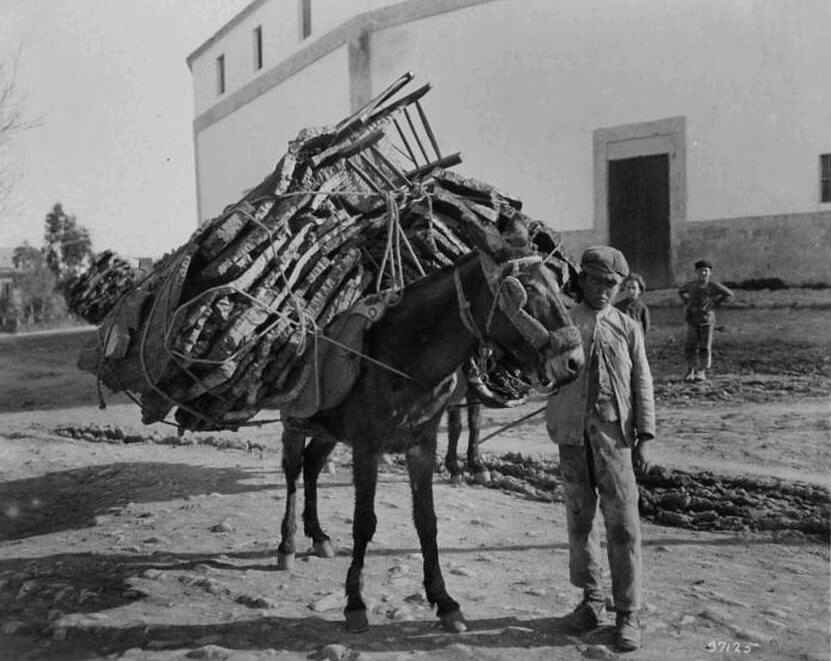
Figure 1.--Here a Spanish peasant boy brings a load of cork into town on a mule. Cork was the bark of the cork tree and Spain was a major world producer. The photograph is undates, but was proably taken in the 1910s or 20s. Notice the boy wears long pants. Most city boys at the time wore short pants.
|
|
HBC has collected information on a variety of activities in which Spanish boys have participated in over time. Of course boys the world over tend to partiocipate in many of the same activities. Many of these activiities involve specialized costumes or involved some destinctive styles in Spain. Some were affected by poverty as Spain gradually after florishing in the Middle Age became a European backwater despite having a large colonial empire to exploit. Other images show trends in Spanish boys' clothing over time. Some of the activities include choir, choir, dance, games, religious observation, school, sport, and many other activities. Economics is a major factor here. Many Spanish boys until after World War II worked, this included large numbers of peasant boys involved in the rural work force. Gradually after rejoining Europe Spain has become more prosperous, although socialist economics asin other European countries have undermined economic progress.
The boy choir tradition is a European tradition originating in the needs of the
medevil church for litugical music. Many countries of Western and Central Europe, have long choral traditions. The strongest tradition is catholic, but boy choirs have also been created in protestant countries. One would think that with this background that there would be a large number of boy choirs in Spain. In actuality there are only a few. " Escolania " in Spanish means school for singers, usually in a religious environment. It is similar to the French term " Manécanterie ".
Spanish children have commonly worn school smocks . Many still do. Spanish school children were commonly wearing smocks by the 1930s, although I am not sure when this paractice first began. Short pants were common until the 1970s. Young kindergarten age children still commonly wear smocks in Spain. It is no longer common, however, for older boys to wear them--but some still do. A Spanish contributor to HBC in 1999 reported school boys about about 7 or 8 years old still wearing the smocks over their street clothes.
First Communion in Spain has been a major event, as to be expected in a Catholic
country. Boys in the 1920s commonly wore formal dark suits, sometimes with wing collars and whire bowries. This is less so now, but ardently Catholic families still do attach great importance to the event. For the children it has become a bonanza, even exceeding Christmas, although only once. A Spanish contributor informs HBC that sailor suits are popular for boys' First Communion suits, even in the 1990s.
We do not yet have much information on Spanish play activuties. Our Spanish archive is still fairly limited. As far as we can tell children's play is similar to that prevalent in other European countries. An imprtant factor here is economics. Spain in modern times was a European backwater and a relatively poor country. Economics has a major impact on children's play. Children in poor countries have fewer play experiebces. many have to devote themsekves toassusting the family livlihood at an early age. And of course poor families cannot afford nuch in the way of toys for the younger children. A factor in Spamish poverty was the arid conditions prevalent in Spain, limiting agricultural producivity. And throughout much of the county's history agriculture was the primary contribution to natioanl wealth. And in the 19th century for a range of cultural matters, Spain did not industrialize like many other European contries. We have some intersting information on games from the Canary Islands. As for sports, Spain like most countries today is largely mesmerized by soccer (futbol). And has vecome very good at it. Unkike America, interest in other sports is rather limited inncomparison.
Religion has played a major role in Spanish history and culture. Spain is a predominately Roman Catholic country, although like the rest of Europe, observation had declined in an increasingly secular country. We do not know a great deal about religion in ancient Spain. Some of the country was briefly dominated by Carthage, but seized by Rome in the Punic Wars (3rd century BC). To what extent the Chartheginians spread their relgion, we do not know. Roman paganism seems wide spread at the time the Empire was established and Rome completed its conquest of Spain (1st century BC). As in other areas of the Empire, Christianity slowly spread and became the state religion (4th century AD). The prosperous Roman colony was desvestated by pagan Germanic tribes (5th century AD). The Visigoths emerged as the dominant force and established a kingdom which eventually united with the the largely Christian and more numerous Roman-Iberian people. King Reccared made Christianity the state religion and recognized the authority of the Roman pope (6th century AD). Almost all of the Iberian Peninsula was conquered by invading Moorish tribes who introduced Islam (8th century. Gradually suviving Christian princes in the northwest aided by Charlemagne launched the (Reconquista). Christian and Muslamic zealots considered the diversity of religion a weakness. In fact the period in which Christians, Jews, and Muslims oracticed their religion weith a degree of freedom led to Spain becoming the brightest intelectual and cultural center in Europe. Gradually the Christan kingsoms expanded southward and re-chrritianized the Peninsula which was completed with the fall of Granda (1492). Almost immnediatelly Ferdinand and Isbella expelled the Jews and Muslims. The Inquisition went after the Conversos and effectively prevented Protestantism from gaining a foothold in Spain. The monarchy also waged war against both the Protestants in northern Rurope and the Mislim Ottoman Turks in the Mediterranean. It also firmly established Catholocism in its overseas empire. Despite the great wealth from the Empire, Spain wasted huge sums in military expeditions. And because the Inquisition stifeled the intelecual discourse and sciende sweeping much of the rest of Europe, the economy declined. Spain became a backwater, but a very Catholic backwater. The Spanish Catholic Church continued to be a very conservative force into the 20th century. The Church supported Franco in the Civil War (1936-39). And throughout the Franco era, the state supported the Church. Since Franco's death (1975), Spain has developed a more secular scociety. Today in Spain most people identify as being Cathloic, but this is often more of a cultural than a religious description. Many left-wing Spainards view the Church in negative terms. Socialist governments have passed secular legislation on marriage and abortion. As with other European countries, Muslims from North Africa, especially Morocco, have emigrated to Spain. There is also a small Jewish minirity.
Many Spanish boys worked until after World War II. Spain was a largely agricultural country with a large peasant population. Spain is a good example of the mind-bending ignorance prevalent concerning economic trends. Many people associate the industrial revolution and capitalism with poverty and child labor. Do an internet search on child labor and see how many sites begin the discussiion historically with the idustrial revolution. In relity it is the countries (like Spain) that did not participate meaningfully in the industrial revolution where chil labor was indemic. And it was the rich ndustrial countries (here Britain was a laggard) that create public school systems for children rather than having them work from an early age. Spain passed a law organizing the primary school system in Spain (1857). Attendance was made compulsory from 6 to 9 years of age. In 1939 a new law stated that the attendance would have been compulsory untill 12 years of age, but this rage limit was not enforced everywhere. Enforcement was especially lax in poor communities and rural areas. It was fairly common to see school-age boys working in Spain. Large numbers of Spanish boys were involved in agricultural work. It is difficult to assess why Spain did not make greater progress against child labor. Left-wing authors will question the morality of conservative groups. Amother facor is that Spain was aoor, largely agricultural country with limited resources available to expand the education system. The efforts of workers to obtain basic rights was a major cause of the Civil War. Left-wing groups pushed for major reforms. Many were hostile to capitalism and property rights. The country's conservative Church, industrialists, and landowners were unwilling to concede, in part because of the fear of Communism and the terror directed against the church and properrty rights in the Soviet Union. The peasantry still highly incluenced by the Church were not as enthusiastic about radical reform as the the urban work force. Only after World War II did Sopain pass a law that reorganized the Spanish primary school (1945). Attendance was made compulsory for children 6 to 12 years of age. And this time eforcement was more strict. [Galvez]
The principal Spanish youth group is the Scouts. At this time we only know of one other Spanish youth group--the Fascist youth organization under the Franco regime. There may have been a Pioneer group during the Civil War era, but we have no details at this time. We know, however, relatively little about this group or the Scout movement during the Fascist era. With the fall of Fascism this group disappeared and currently the Scouts are the only important Spanish youth group.
Sources
Gálvez, Inmaculada Egido. "La evolución de la enseñanza primaria en España: organización de la etapa y programa de estudio, " Tendencias Pedagógicas (1995), pp. 75-86.
HBC

Navigate the Boys' Historical Clothing Web Site:
[Spanish art]
[Spanish choirs]
[Spanish ethnic groups]
[Spanish movies
[Spanish royalty]
[Spanish youth organizations]
Navigate the Boys' Historical Clothing Web Site:
[Introduction]
[Activities]
[Biographies]
[Chronology]
[Clothing styles]
[Countries]
[Bibliographies]
[Contributions]
[FAQs]
[Spanish glossaries]
[Images]
[Links]
[Registration]
[Tools]
[Boys' Clothing Home]
Navigate the Boys' Historical Clothing national pages:
[Return to the Main Spanish page]
[Return to the Main countries page]
[Australia]
[Belgium]
[England]
[France]
[Germany]
[Ireland]
[Italy]
[Japan]
[Korea]
[Mexico]
[Scotland]
[United States]
Created: September 20, 2003
Last updated: 11:43 PM 5/19/2020