
Tom: Childhood Play
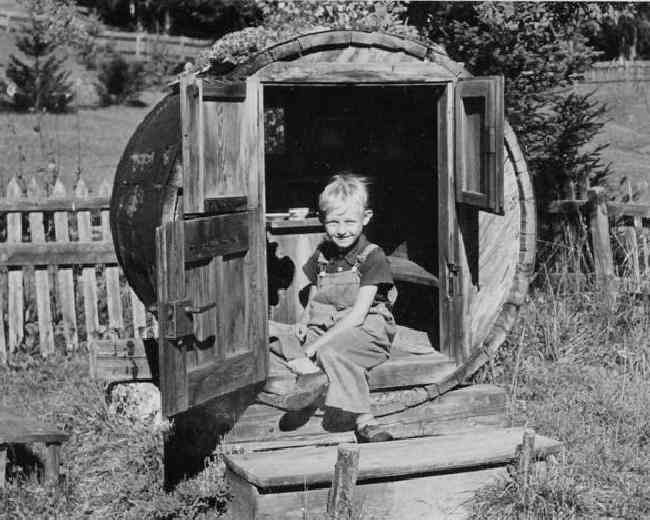
Figure 1.--Here I am in my play house during 1943. This play house was an old wine cask which the wine farms used to cure their wine. There were many vinyards in the region. It was made of oak. Inside there was a little table and two benches and in the back was a window. On top, one can see the creation of a small rock-garden. Next to the play-house we had a sand-pit where we created a lot of our imaginary roads, etc.
|
|
I had a lovely childhood, despite the difficult times. Most of our games were out-doors. In the evenings we did a lot of crafts, read a book or played cards. I had a great play house which my father built (figure 1).
This play house was an old wine cask which the wine farms used to cure their wine. There were many vinyards in the region. It was made of oak. Inside
there was a little table and two benches and in the back was a window. On
top, one can see the creation of a small rock-garden. Next to the play-house
we had a sand-pit where we created a lot of our imaginary roads, etc.
I really do not recall any specific games we played. Naturally there was no TV and the radio was mostly used to listen to the news, which of course during the War was very dramatic. We could pick up both Swiss radio stations and the NAZI German broadcasts. Once in a while a talk-show or comedy was broadcast as well as music. My sisters natrually had their dolls and we boys had some craft-games, kind of redecessors of "Lego" etc. Most of our day time was spent outdoors, where our imagination was the only limit we had. We played Indians or built castles ot tree-houses etc. and in winter there was always a big igloo under construction or we built our own small ice-rink or went sledding on the nearby road etc.
I had a lovely childhood, despite the difficult times. I really do not recall any specific games we played. Sports were not as important as they are today. Most of our games were out-doors. Our bedrooms were very basic without all the computers, electronic equipment, and communication devices that modern children have. Most of our day time was spent outdoors, where our imagination was the only limit we had. We played Red Indians. Funny that appaled more to us than William Tell. I'm not sure why. We also built castles ot tree-houses etc. We diverted the irrigation channels to create lakes and rivers. The local farmers were not to happy about that. In winter wehen the snow arrived, the diversions were endless. There was always a big igloo under construction or we built our own small ice-rink or went sledding on the nearby road etc.
Playhouse
This play house was an old wine cask which the wine farms used to cure their wine. There were many vinyards in the region. It was made of oak. Inside
there was a little table and two benches and in the back was a window. On
top, one can see the creation of a small rock-garden. Next to the play-house
we had a sand-pit where we created a lot of our imaginary roads, etc.
Tom tells us about his wagon "These wagons were common on farms and homes, to transport what ever had to be collected. In this case, it looks like I had some small wood in the wagon. I recall transporting trash, vegetable, dirt, etc. The long beam is the handle by which the wagon was pulled. You see at the front, there is a cross-piece on which one can pull. This beam could be moved up and down and when moving left or right, moved the front-wheels to steer the wagon. There was also a brake that could be activated and would apply a brake-shoo on the rear wheels. It is visible on the rear wheel. The way I was using the wagon in this instant, was by sitting in the front of the wagon, and holding the steering-beam between my legs to steer the wagon. As this road went downhill, the wagon accelerated and I got a "free" ride. By the way, next to the road is a typical cow from the Valais. These cows are very agile in the mountains and in the spring and fall there are always cow-fighting competitions, which are very popular. These cow-fights are very harmless. The stronger cow, just pushes the weaker one out of the ring, and therefore wins."
Evening
In the evenings we did a lot of crafts, read a book or played cards. I had a great play house which my father built (figure 1). My sisters natrually had their dolls and we boys had some craft-games, kind of redecessors of "Lego" etc.
Radio
Naturally there was no TV and the radio was mostly used to listen to the news, which of course during the War was very dramatic. We could pick up both Swiss radio stations and the NAZI German broadcasts. Once in a while a talk-show or comedy was broadcast as well as music.
Sources
Voute, Tom. E-mail message, May 19, 2006.
HBC

Navigate the Boys' Historical Clothing Web Site:
[Introduction]
[Activities]
[Bibliographies]
[Biographies]
[Chronology]
[Clothing styles]
[Countries]
[Contributions]
[FAQs]
[Dutch glossary]
[FAQs]
[Images]
[Links]
[Registration]
[Tools]
[Boys' Clothing Home]
Navigate the Boys' Historical Clothing national pages:
[Return to the Main Tom page]
[Return to the Main Swiss page]
[Australia]
[Belgium]
[England]
[France]
[Germany]
[Ireland]
[Italy]
[Japan]
[Korea]
[Mexico]
[Netherlands]
[Scotland]
[United States]
Created: 9:40 PM 5/16/2006
Last updated: 9:41 PM 2/10/2011