|
World War II was the greates military struggle in human history. Millions of people from every importnt county were involved in the struggle. HBC has prepared several biographies of some of the main political and military figures involved in the War. The biographies here just scratch the surface as t the important individuals involved in the struggle. We plan to add additional biographies and encourage readers to submit biogrphies of individuals they believe to have played important roles.
Many of these biographies, however, are just at the beginning phase. As the focus of HBC is on childhood, we will give some attention to their childhood in addition to providing information on their adult lives as well for the historical background.
Field Marshal (Alexander, Harold Rupert Leofric George) was born in London during 1891, but grew up on the family estate in Ulster. He was trained at Sandhurst and during World War I commanded a battalion of Irish Guards on the Western Front. After the War he bought the Bolshevicks in the Baltics with a unit of largely ethnic-Germans. He cpmmanded the British 1st Division and as commander of I Corps oversaw the Dunkirk evacuation. He is nenowned for the North African campaigns against Field Marshal Erwin Rommel during World War II (1942-43). Under Eisenhower he oversaw the Allied drive on Tunia and the invasion of Sicily and Italy. He was one of the few commanders that was able to work amicably with Montgomery--a major accomplishment in itself.. He later commanded the Italian campaign (1943-45). He was Governor General of Canada (1946-52), granted the rank of Earl (1952) and becoming the Minister of Defence under Winston Churchill (until 1954).
General Korechika Anamial was a supporter of Gen. Hideki Tojo. He was a combat commander during most of World War II. He served in China, Manchuria, and finally in western New Guinea. He was a rare Japanese soldier to surviuve New Guinea. He must have witnessed the Allies military superiority there. He was recalled to Japan after Tojo resigned (late-1944). He was appointed Minister of War in the Suzuki cabinet, in part because of a personal relationship with the Emperor (April 1945). Anami was a 'fight to the death' warrior, an attitude that still dominated the Japanese military. He wanted to fight it out with the Americans, basically an Okinawa defense of the Home Islands. He believed that a bloody fight on would force the Americns to accept some of the Japanese terms for ending the War, and avoid military occupation. The August 14 coup plotters expected him to support them in their effort to repudiate the Emoeror's surrender decision. He prioved ununwilling to chasllenge the authority of the Emperor, He had signed the surrender document. His refused to support the coup is the major reason it failed. The next morning after the coup failed, Anami commited seppuku shortly before the Emperor's surrender broadcast. Notably Tojo himself did not have the intestinal fortiude for it.
Wystan Hugh Auden was born in York (1907). He is one of the best known British 20th century poets. Auden's poetry was noted for pursuing and interweaving left-wing politics, morals, love, and religion. One of his most famous poems is 'September 1, 1939' wih pacifist tones. His ealier pacfism was, however, moderted by experiences reporting on Facism in Germny, Spain, and China. He became a critic of the Allied Strategic Bombing Campaign after the war, especully RAF Bomber Command. He prticipated in the U.S. Strategic Bombing Survey, picking up on how inaccutate bombing was, especially Bomber Command. Of course it easy to criticize the mombing, more difficult to come up wityh an alternative way of destroying the monsterous NAZI Reich. Like many critics, he never explain how Britain could have better fought the War. And notably, he decamped England for the safety of the United States once it became clear that war was coming. And like most critics, he ignores the fact that British bombing was a major factor in the NAZIs orienting the German war economy to fight the War in the West rather than the Ostkrieg. We note that Auden claims to have come to dilike 'September 1, 1939'. We are not sure if that was the case, moke likely he was embarassed by it.
Herbert Backe in the Ministry of Food (REEUL) is generally seen as the author of the NAZI Hunger Plan which is sometimes referred to as the Backe Plan. He was powerul force in the Ministry even before he was finally appointed Minister (May 1942). Hitler appears to have more confidence in Backe than the original minister, Daree. Many of the NAZI war criminals are very well known. The Hunger Plan which may have killed 4-5 million people, mostly Soviets, was one of the great crimes of the War. It was one element of Generalplan Ost that was actually implemented. Despite conceptulizing and implementing on of the great crikes of history, ouside historians specializing in NAZI history, Backe is virtually unknown. Backe was born in Georgia, at the time a Tsarist province. With the outbreak of World War I, Tsarist officias interned him as an enemny alien. He managed to escape and get to Grmany duruing the Russian Civil War. He was at the time of World War II one of a rising tier of young second level professionals in the NAZI Party. He was an advocate of invading and deindustrialing the Soviet Union. He wanted to demolish Soviet industry and eliminate the Soviet industrial work force. He thought that the Soviet Union should be turned back to an agricultural economy focused on produing what for western Europe. This coincided with Hitler's idea in Mein Kampf. There was no idea of taking control of Soviet industry which was substantial, bur rather retuning the East to an area of peasant agriculture. Backe was critical of Stalin's agriultural policy, wich was to seize control of it through collectivization and use the agricultural harvest to finance industriliztion. As a result, Soviet grain exports were only a fraction of Tsarist levels. This made Germany dependent of trans-Atlantuc grain (American, Argentine, and Canadian). Backe wanted to end this dependence by sezing control of Soviet grain production. In Backe's view this would create a continent Grossraumwirtschaft and an efficuent division of labor, an industrialized Western Europe and a peasant-based agricultural eastern Europe. This mean eliminating the uneeded urban population of the Soviet Union. Staatssekretär Backe took the lead role in this matter.
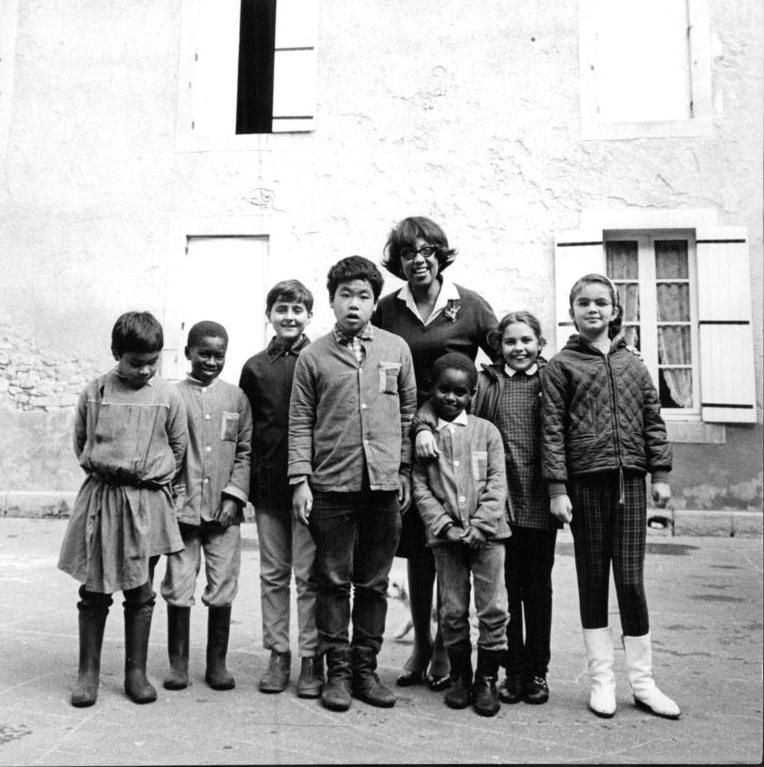
At the onset of World War II Amerian singer and dancer Josephine Baker volunteered to work for the French Red Cross, but was recruited as an agent by the French military intelligence service. She gathered intelligence at embassy parties. She remained in France after the German invasion. As an American citizen, she could have left. Unlike many French movie and other entertainers, she secretly worked for the Resistance, an incredible act of courage. She is reported to have smuggled messages hidden in her sheet music and even in her underwear. She left Paris and helped shelter Free French sympthtizers. Her role as an entertiner gave her a cover to travel extensively. She probably wisely went to Vichy North Africa. After the Torch Invasion, she entertined Free French troops. Baker after the war was awarded both the Croix de Guerre and the Legion of Honour with the rosette of the Resistance, two of France's highest military honors.
Italo Balbo was a leading Italian Blackshirt and early supporter of Benito Mussolini. Like Mussolini and other Blackshirts, he served in World War I and was disappointed with what Italy gained in the peace settlement. After the War, Balbo became an effective Fascist organizer in his home region of Ferrara. He was one of the four principal architects of the Blackshirt March on Rome that resulted in Mussolini and the Fascists seizng power (1922). Mussolini gave him the job of building the Italian Royal Air Force (1926). He became the leading voice for Italian aviation. Mussolini appointed him Italy's Marshal of the Air Force (Maresciallo dell'Aria). The flamboyant Balbo cme to be seen as a possible successor to Mussolini who began to see him as a threat. Mussolini decided to make him Governor of Libya, a the time a kind of exile. Mussolini saw Libya as akind of springboard to a huge African colonial empire. Balbo continued to reside in Libya as Musolini begn moving Italy toward a German alliance and war. Balbo was the only leading Fascist to oppose both Mussolini's alliance with NAZI Germany and the
anti-Semetic racial laws that Hitler demanded. As Mussolmi moved toward war, Balbo as Commander-in-Chief of Italian North Africa (Africa Settentrionale Italiana--ASI), would hve played an mportant role. Onlt two weeks after Mussolini declared war, Balbo was killed by friendly fire. Italian anti-aircraft gunners shot down his plane over Tobruk.
William Maxwell 'Max' Aitken, better known today as Max Beaverbrook or more correctly the 1st Baron Beaverbrook, was born in Canada (1879). He developed an interest in journalism while still in Canada where he grew up. Along with journalism he demonstrated an ability to make money. He parlayed his Canadian schoolboy journalism into a British newspaper empire. He moved o Britain which offered more scope for prodigious energies. He became an English newspaer tycoon and a major fixture in British society and politics during World War I. He has won a seat in Parliment (1910) and was soon knighted and eventually raised to the peerage--becoming known as the Baron of Fleet Street. He played an important roles in the Tory Party politic during the War, developing a close relarionship with Lord George. After the war he foucused primarily on his newspapers. He turned The Daily Express into the most successful mass circulation newspaper in the world. He was primarily interested in economic issues like free trade. He strongly supported the Tory Governments of Stanley Baldwin and Neville Chamberlain (1930s). And that included appeasement. The slogan 'There will be no war' aooeared in the Daily Express. Beaverbrook would, hoever, play an important role in the war that did come. He was also close to Winston Churchill who he eventually realized was right about Hitler and the NAZIs. Churchill upon becoming primeminister persuaded him in perhaps his most brillint appointment of the War to serve as Minister of Aircraft Production (May 1940). It was a surprosing appointment, but Beaverbrook suceeded in engineerng an extrodinary increase in aircraft production which would become the major focus of the British war industry. Beavrbrook made an important contribution to the critical Battle of Britain. Britain in part because of Beaverbrook would have the planes it needed to fight the Battle of Britain despite the Luftwaffe bombing. The major problem for the Royal Air Force would be finding the pilots for the planes rolling off the production lines. Beaverbrook was widely accclaimed for his role in increasing aircraft production and sevicing, the importance of is often not recognized. We see, however, more attention today given to NAZI Armaments Minister Albert Speer. Speer's contribution seems overated and his reliance on brutal slave labor not given adequate attention.
Germany was a European country with a strong Christian tradition, both Protestant and Catholic. Yes there was little resistance to the NAZIs from the German church, especially the Protestant church. One of the rare voices of resistance was Dietrich Bonhoeffer. He was born in Berlin (1906). His father was a professor of psychiatry and neurology at the University of Berlin. Dietrich was a bright boy and excellent student. He earned his PhD and becasme a lecturer in systematic theology at the his father's University (1931). Soon after, Adolf Hitler was appointed Charcellor (1933). Bonhoeffer became a leading figure in the Confessing Church which became the center of Protestant resistance to Hitler and the NAZIs. He organized and led the underground seminary of the Confessing Church. He describes his ideas and experiences with the underground seminary in his book, Life Together. Another book, The Cost of Discipleship criticises what he referred to as "cheap grace," grace which he described as an excuse for moral laxity. The Christian tradition in Germany generally accepted the political estanlishment--basically Hesus' instruction of rendering unto Ceasar. Life in the Third Reich, however, led him to the conclusion that Christians had to resist evil even it was perpetrated by legitimate state authorities.
Martin Luther Bormann (1900-45) was a NAZI Nazi Party official and most importantly head of the Party Chancellery. He rose to great power because as Adolf Hitler's private secretary, he largely controlled not only access to Hitler, but thg flow of information to him. Bormann used his position to become one of the most powerful person in the Reich. Bormann was to young to see actio in in World War I although he joined a unit in the final months of the War. Bormann joined a right-wing paramilitary Freikorps organisation fighting left-wing groups (1922). At the time he was working as manager of a large estate. He was involved in a murder along with his friend Rudolf Höss (future commandant of Auschwitz). He joined the NAZI Party (1927). And the Schutzstaffel (SS) (1937). He initially worked in the Party's insurance service (1927-33). He was a master organizer. He moved to another Party office, in fact the most important section--the office of the Deputty Führer. Apparently Rudolf Hess recognized his talents. He served as Hess' chief of staff (1933). This connected him with one of the NAZI luminaries. Bormann used his position to build an extensive personal bureaucracy and involve himself as much as possible in NAZI decision making. And most importantlyv gained acceptance into Hitler's inner circle. He began ccompanied Hitler not Hess everywhere, providing briefings and summaries of events and requests. He started acting as Hitler's personal secretary (1935). Hitler like Hess recognized his skills. Bormann was given Hess' former duties as the Head of the Parteikanzlei (Party Chancellery). While Bormann star was rising, the opposite was true of Hess who Hitlernow rarely turned to for advus or counsel. And was not commonly seen at Berchesgarten. This is what promted Hess' surprise flight to Britain (1941). Hitler was furious and despite Bormann's connectiins with Hess, he did not suffer. In fact he became increasingly important to Hitler. Bormann did not have command responsibility for Holocaust actions. He was, however, one of the leading proponents within the NAZI hierarchy for the persecution of the Christian churches and favored harsh treatment of both Jews and Slavs in the expanding NAZI zone of control as a result of military victories. These trends were apparent in his early connectiin with the Freikorps mirrored Hitler's own impulses.
Omar Bradley was born into a low-income family in Clarl, Mossuri (1893). A college education was unobtainable which led him to West Pont. He graduated from West Point (1915). This was the famed class that 'stars fell on'. The Germans asked for an Armistice in World War I before he was deployed to France. He thought that this ended any chance for a future high rank. Like other important American commanders, he languished in the peace time Army and the very limited appropriations approved by Congress. He developed relations with Eisenhower, Patton, Macarthur, and Marshal . At the time war broke out in Europe, he was a training officer and though he would again not be involvd in a combat commnd. He was, however, based on the people he had impressed, part of the Totch Invasions of North Africa (November 1942) and served under Gen. Patton in Sicily (July 1943). With Patton in disgrave ncause of the slapping incident. Eisenhower chose Bradley to head American ground forces preparing for the Normandy Cross Channel invasion. He commanded the the United States First Army that established the American bridgeheads in Normandy and after the landings the 12th Army Group. This was the largest army group ever led by an ameriucn commnder. He planned Operation Cobra that obliterated athe Panzer Lehr Division, blasting a hil in German lines enabling the Normandy breakouut. This unleased the American coiled spring that had built up in Normsndy. Bradley was a competent, but unimaginative commander. He is often referred to as'The GI General' a name given him by Earnie Pyle. According to an Arlington Cemetary biography because of 'his care of an compassion for those soldiers under his commamnd'. In this regard he is often compared favorably to the flamboyant Patton. This comarison is more complicated than often posed. Sending men into combat aggresively is not always the path to lower casualties. Bradley's caution arojund Falaise led to many German troops escaping that would later cause serious american casualtis in the Bulge.
Hitler met Eva Braun while she was working for his persona; photographer--Heinrich Hoffman (1929). Hoffman played an important role in creating an appealing image that could be sold to the German people. She was 17 years old and he was more than twice her age. The NAZI Party had at the time just become a major force in German politics. She is today well known to history. During the 12 years of the Third Reich, she was unknown to the German people. Only Hitler's inner circle knew about the relationship. Some authors believe Hitler did not want her to become public knowledge because he wanted to be seen as married to the German people. This may be an important factor. Another factor may also be involved and that was Hitler's dark hair and brown eyes. It is likely that Hitler did not want to foster children because they would likely not be the Aryan ideal of blond and blue eyes. Unlike the wives of many world leaders, Eva stayed strictly out of politics. That was just how Hitler wanted it. She was perhaps vacuous, but not stupid. She knew that this was what Hitler wanted in a woman. She was very interested in photography. She dreamed of becoming a major Hollywood movie maker. It is Eva's home movies, many taken at Berchtesgaden, that provide us glimses of the private life of Hitler. She saw herself as making an important record/ These were home movies without any sound. Interestingly new technologies developed in 2006 now allow us to hear what was being said in these movies. Of course in viewing her movies, the question arises as to how she could be so close to such an evil man. She herself, was not an evil oman. In factshe was well liked by those around herm but genberally dismissed by the NAZI bigwigs. This leads to the question of how much she knew--the same question that is still debated about the Germn people in general. This is not known with any certainty, but there are certain known matters that suggest she knew a great deal--certinly the charcter of the regime. And there is good reason to believe she knew far more than the average German.
Miles Rutherford Browning was brn in Perth Amboy, New Jersey (1897). He was an American naval officer who served in both World War I and II. He plyed an nimprtant role on the Pacific War. Browning was a pioneer in the development of aircraft carrier combat operations, promoting the idea that aggression was vital, especially the importance of getting in the first strike. Browning devised Adm. Halsey's hit and run tactics striking at occuoied Japanese island bases (early 1942). It was Browning on USS Enteprise tht convinced Adm. Spruence to stike at the Japaanese Kidō Butai assoon as it was located after bombing Midwy (June 1942). The citation for his Distinguished Service Medal states: "His judicious planning and brilliant execution was largely responsible for the rout of the enemy Japanese fleet in the Battle of Midway."
William Christian Bullitt Jr. is best known as an American diplomat, but engaged in journalism and wrote novels. He was born to a destinguished Philadelphia family (1891). His father was William Christian Bullitt Sr. His grandfather was John Christian Bullitt, founder of the notable law firm Drinker Biddle & Reath. His mother was Louisa Gross (Horwitz). Bulitt graduated from Yale University (1912). He was voted 'most brilliant' from his class. At Yale, he was a member of Scroll and Key. He attended Harvard Law School after Yale, but dropped out when his father died (1914) As a young man he had rdical ideas. As a very young diplomat he was sent on a special mission to negotiate with Vladsamir Lenin on behalf of the Paris Peace Conference (1919). This has been called a missed opportunity to normalize relations with the Bolsheviks, mostly by authors who do not understand the chatctet of Lenin and the nature of the Bolshevilks. He became the first U.S. ambassador to the Soviet Union (1933). He would becoime a fervent anti-Communist. He was the the U.S. ambassador to France at the beginning of World War II.
Admiral Wilhelm Canaris was a World War I U-boat commander and war hero. He was appointed to head the Abwehr, German military inteligence (1935). He is one of the most mysterious figures of World War II. While a committed German patriot, he was horrified at SS attrocities in Poland that he personally witnessed. Other attrocities campe to his attention such as plans to kill importantPolishish officials and nobels as well as highly educated and cutures Poles to destroy the Polish inteligencia--the repository of national culture (Aktion AB). From that point he began to work to prevent a NAZI victory in the war. A great deal is known about his activities, but the full extent of his activities may never be known. He was extrodinarily effective, The NAZIs had no idea of his activities until the last months of the War. He was close to many top NAZIs like Goebbels who trusted him without reservation. Only after the Wehrmacht Bomb Plot (July 1944). Hitler had him hanged at Flossenburg Concentration Camp (April 9, 1945). Hitler had movies takrn so he could watch. The Americans liberated the Camp (April 23). German military intelligence during World War II was highly ineffective. It is unclear just what Role Admiral Canaris played in this.
Neville Chamberlain was a decent man who was determined to avoid another war. He is perhaps the best example in history that decent people who oppose war can do terrible damage. He may also well be the greatest failure as a prime minister in British history. Not because he was dishonest or venal, but because he was unwilling to confront evil and use use power. Up through Munich most most British people agreed with this approach, the result was catastrophe in Europe and almost the end of Britain as an independent country. His name will be for ever associated with the policy of appeasement and the Munich Conference.
Chiang was a Chinese general who became prominent in the Kuomintang (1923). He led the Northern Expedition to unite China (1926-28). He first cooperated with the Communists, but broke with them (1927). He married Mei-Ling Soong was a graduate of Wellesley and sister-in-law of Sun Yat-Sen became an effective spokeswoman for her husband in the United States. He dominated the Chinese Goivernment (1928-48). He led Chinese resistance after the Japanese invasion (1937). His Government was accudsed of corruption. After World War II, The Communists defeated him in the Civil War. He and his followers fled to Taiwan (1948).
Chiang Wei-kuo, Generalissimo Chiang Kai-shek's adopted son had a fascinating life, especiallyb his eraly life. He was born in Jaopna while the KMT was exiled there. His father had an affair with a Japanese woman and beleving that this would ruin his and the boy's future in China, asked Chaing to adopt him. Wei studied economics at Soochow University. He and his brother, Chiang Ching-kuo, then studied at Moscow University. The KMT at the time was seen as a revolutionaru political movement. And Stalin did not trust Mao, meaning the Chinese Communists were a rare fireign Communist Party tha he coulkd not control. Once in Moscow, the boys would be held as basically political prisoners by the NKVD on the orders of Stalin. When Ching managed to get them back, he sent Wei to NAZI Germany for military training. He was commissioned as a Unteroffizier in the Wehrmacht. He commanded a panzer unit during the Austrian Anschluss (1938). He was then preparing to see action in the German invasion of Poland. By this time, however, German-Japanese cooperation was well established and he was recalled home to China (1939). He returned home to China through the United States during which time he gave lectures to U.S. Army groups on German Panzer (armored) tactics. Once back in China he partcipated both in the Second Sino-Japanese War and the Civil War. After the Communist victiory, he escaped with his father to Taiwan and played an imoportant role in the Nationalist Goverment.
British statesman and author, considered by most historians to be the greatest of all primeministers for his role in warning about the dangers of Germany' military buildup in the
1930s, and after being ignored, leading the seemingly hopeless resistance to the NAZIs during the darkest days of World War II when Britain stood alone. He was born at Blenheim Palace, Oxfordshire and had a trurbulent childhood. He was born into one of te most elustrious families in England, a descendent of the Duke of Marlborough. His father was a brilliant parlimentarian who considered his son slow and a disappointment. His mother was the beautiful American heiress, loving but tied up in the social swirl of the time. He was educated at Harrow and Sandhurst, the Royal Military Academy. Churchill was an early voive in Britain warning of the menace of NAZI Germany, but was largely ignored. His contribution to the Allied victory was enormous, including the critical Mulberry floating docks on D-Day. His most important contribution was his refusal to deal with Hitler after the fall of France when many in the cabinent were preaped to accept a British Vichy. Then there was that booming, resonating defiant voice which heartened the British people during the Blitz and 5 years of war. As President Kennedy explained, "He mobilized the English language and sent it into battle."
Mark Clark is one of the most controversial of the great American World War II commanders. General Eisenhower brought him to England (1941) and assisted in the planning of Operation Torch, the Allied invasion of North Africa (November 1941). Clark worked with OSS operative Robert Murphy to bring the Vichy forces in North Africa into the Allied camp. Clark negotiated the deal with Vichy leader Admiral Jean-Francois Darlan which proved very controversial. Clark was promoted to major general (three stars), the youngest to receive that rank (October 1942). He was given command of the 5th Army in North Africa. After Sicily, the Allies invaded Italy (September 1943). Montgomery with the British 8th Army landed at the Toe of Italy. Clark and the American 5th Army landed further north at Salerno, near Naples. German General Albrecht Kesselring focused his forces on the Americans at Salerno, but withdrew when he was unable to dislodge the American bridgehead. Both the British and Americans tooked substantial casualties. Clark and Alexander have been criticised for lackluster leadership. This may have been a factor, but another factor was that the Allied force had been weakened to focus on the cross-Channel invasion of France. The Anzio invasion failed to dislodge the Germans, Allied troops led by Polish and French units finally broke throuh at Casino (May 1944). In the ensuing Allied offensive, Clark has been criticized for the glory of liberating Rome (June 1944) rather than cutting off retreating German forces. Kesselring was able to set up another strong defensive poiton in northern Italy--the Gothic Line. Clark replaced Alexander as commander of the 15th Army Group in Italy (December 1944). He was promoted to full general with his fouth star (March 1945). He ovrsaw the Allied offensive which breached the Golthic Line and the collapse of German resistance. Generl Kael Wolff surrendered unilaterally. Clark served as commander of the U.S. occupation forces in Austria.
John Curtin was the Australian Prime Minister during much of World War II. Some consider him to be the greatest of Australia's prime ministers. John was born in Creswick, a tough gold mining town (1885). He grew up in an Irish family. His father was a policeman, but infermity forced him to resign his post and work managing various small hotels. The family needed money and John, although bright, could not persue his education. He had to look for a job. He moved to Melbourne and found a job as a newspaper copy boy. While his education ws cut short, he became a voracious leaders. His reading and work on the newspaper caused him to become interested in politics. He developed strong opinions and voiced them to people he met. He was strongly influenced by socialist writings. Australia joined Britain in World War I (1914). The issue of conscription became a major national issue. Curtin stronly opposed conscription and even soent a few days in jail because of it. He viewed the War as Britain's war, not Australia's war. As in many countries, World War I had a powerful impact on Australian politics. In one of histories many ironies, the WorldcWar critic became Australia's great war leader in World War II. Upon taking office in 1941, only 2 months before Pearl Harbor, he told Australians, "???? has ended in Australia".
Édouard Daladier was prime-minister of France during a critical point in French history. He was born in Carpentras, France (1884). He studied at Lyons under Edouard Herriot who led the Radicl Party, acctuallu a center-left oparty. . He joined the Radical Party, actually a center-left oparty. He was elected mayor of Carpentras (191) abd then entered the Chamber of Deputies in the same year. He became kniown as the 'Bull of Vaucluse' because of his thick neck. He came to replace Herriot as party leader. His first position in government was minister of the colonies (1924). He held several other government posts, including minister of war. He became oprime-minister twice (1933 and 34), but for brief periods. Adolf Hitler's rise to power caused a shift in the French lft which had been strongly anti-war. Led by Socialist Leon Blum, Maurice Thorez, Edouard Herriot, and Daniel Mayer formed the Popular Front (1934). The Communist Party, the Socialist Party, and Daladier's Radical Party joined the Popular Front. They won the 1936 parlimntary election, gaining 376 seats. .
Blum became prime minister and Daladier Minister of War. The Popular Front enacted a range of social reforms as well as nationlizing the Bank oif France abd the arms industry. It did not change basic Frencch defense policy.
Daladier supported Blum's attempt to provide military aid to the Spanish Government, but British Prime Minister Stanley Baldwin more concened with the Communist threat and thus on a policy of appeasing Hitler as well as foreign minister Anthony Eden convinced him to instead adopt a policy of neutrality. Britain and France were allies, but Frnce was a jinior partner with a nmuch smaller industrial base. France had no chance of confrionting Germany without Britain. Daladier became prime-minister (1938). Along with Chamnberlain he participated in the Munich Conference, but basically ad to follow Chambelain's lead. And Chambrlain like Baldwin was set on appeaement. France had treaty obligations to Czechoslovakia, Britain did not. But without Britain, Daladier did not dare meet its obligation to the Czechs. Thus Daladier reluctabtly agreed to the Munich scciords, sging over the heavily fortified Czech Sudetenland to the NAZIs. He was Minister of Defense when the Germans struck in the West (May 1940). He intended to cintinue resistance from French North Africa, but was arrested by Vichy authiorities. He was among the French oifficals tried for treason by the Vichy Government at the Riom Trial, basically Pétain's effort to vindivate the French Army. The Germans pit a stop to the trial as the defendents were allowed to defend themselves (1942). The Germans took custody of him (1943), but he survived the War.
Admiral Jean-Francois Darlan was assigned the task of modernizing the French Navy (1929). Primeminister Leon Blum appointed Darlan as admiral chief of staff (1936). The following year he was promoted to admiral of the fleet commanding all French maritime forces. Darlan held right-wing and anti-British convictins. He came to think that NAZI Germany would win World War II. He thus like Pétain concluded that resistance was futile and not in France's interest. He thought that France should seek the best deal that could be obtained from Hitler. Admiral Darlan, after Dunkirk assured Churchill that he would never allow the French fleet to fall into German hands. He signaled every captain commabding a French vessel that he was go scuttle his shipif the Germans attempted to seize it. Darlan appears to have expected Churchill to accept his word on this, not understanding that when the fate of nations are cinvolved, personal assurances can not be accepted as fully reliable. The French Government had promissed the British never to make a separate peace with the Germans. After Primeminister Paul Reynaud resigned (June 16, 1940, Darlan agreed to support his replacement, Henri-Philippe Pétain. Pétain named him minister of the navy. Hitler did indeed offer terms, severe ones, but terms. What men like Darlan an Pétain did not grasp is that after Germany had won the war, he could impose what ever termns he wanted. Munich had shown tht he was not a man of his word. Pétain signed the armistice, Darlan ordered the French fleet to colonial bases in North Africa to keep them out of German hands. He also orderd the Navy to remain loyal to the Vichy government. Darlan's anti British sentiment was more than reinforced when the Royal Navy sank much of the French fleet at Oran (July 1940). Pétain appointed Darlan to replace Pierre Laval as vice premier (February 1941). He also designated Darlan as his successor. He also ppointed Darlan as minister for foreign affairs, defence and the interior. Pétain appointed Darlan Commander in Chief of French armed forces and the High Commissioner in North Africa (January 1942). Hitler seems to have trusted Laval more than Darlan. Thus Darlan resigned his cabinet posts (April 1942) and they were assigned to Laval. Darlan remained Petain's deputy premier. Darlan was in North Africa when the Allies landed (November 1942). Darlan ordered Vichy troops to resist. He was not sure in what force the Allies had landed and was still convinced the Germans would win the War. He eventually ordered them to surrender, but secretly ordered Vichyvauthorities in Tunisia where the Allies had not labded to let the Germans bring in reinforcements. Eisenhower to get the Vichy forces to stop fighting agreed to allow Darlan to retain his position. EEisenhower appointed Darlan as civil and military chief of French North Africa. General Charles De Gaulle was furious, but the decession saved quite a number of Allied and Frenchh lives and allowed the Allies to get on to fighting the Getmans. Darlan did not, however, escape tge Resistance. A young French royalist, Ferdinand Bonnier de la Chapelle, shot him in his office (December 1942). It is only after Darlan's death thatva final break with Vichy came. Jews and other intenees were finally released from the work camps. I am not precisely sure when this occurred.
Rudolf Diels was born in in Berghaus in Taunus (1900). His fsther was a farmer. He was a political figure in Weimar and close to Hermann Göring. After the NAZIs seized power, Hitler put Diels in charge of the Prussian police. Göring apponted Dieks to head to head the Gestapo (1933-34). After serving in World War I, he studied law at the University of Marburg (1919). He joined the Prussian interior (police) ministry (1930). He was appointed to an advisory position in the Prussian police (1932). He was asigned to suppress political radicals, both Communists and Nazis. At the time Hitler seized power, Diels headed the Prussian political police in Berlin. Hitler appointed Göring minister for Prussia, replacing Karl Severing. Göring was impressed with Diels' work willingnessto work with the new NAZI Government. Göring appointed him as chief of the new Prussian state police department 1A, responsibke for political crimes (April 1933). Department 1A was the small Gestapo unit. It was Diels who interrogated Marinus van der Lubbe arrested for setting the Reichstag fire (February 27, 1933). Diels was reported to have a terrinle temper and could be ruthless to detainees he questioned. Diels ran afoul of Reinhard Heydrich who with Himler was attempting to seize control and centralize German police units. He was nearly arrested during the Night of the Long Knives purge. Control of the Gestapo was turned over to Himmler and Diels dismissed (April 1, 1934). He briefly served as Deputy Police President of Berlin. He was appointed to the local government of Cologne as a "Regierungspräsident". He kept close to Göring and married Görings's cousin. Heydrich did not forget him. Göring saved him from arrest on several occassions. He refused orders to arrest Jews (1940). He was also targeted during the July Bomb Plot investigations. After the War he submitted an affidavit requested by the Allied prosecution team at the Nuremberg Trials (1946). Göring's defence lawyer called him as a witness. He worked in the post-war government of Lower Saxony (1950) and the Ministry of the Interior (Police) until retiring (1953). He published two memoirs. He died after a hunting accident (1957).
Dietrich was born in Bavaria (1892). Like other members of his generation, he fought in World War (1914-18). He was a crewman in one of the first German tanks, but the Germans generally failed at tank profuction in World War I. The British tanks, however, played a major role in the Anglo-American 100-Day Offensive that forced the Germans to ask for an Armistice (1918). Dietrich after the War, like many Germans, were disillusioned with the Versilles Peace Treaty and the Weimar Republic. He joined the Freikorps (Free Corps). This was radicaized right-wing youth and former soldiers who were hostile to the Socialists who formed the Weimar government, but even more hostile to Communists who attempted to seize power. The Freikorps gained a reputation for brutality in supressing the Communists and workers. The suppression of the Communisyts in Munich was a leading example. Dietrich naturally gravitated to nationalists and eventually the NAZI Party after hearing Hitler speak. Hitler confoirmed all his basic suspicions that the Marxists and Jews were responsible for Germany's misfortunes. Dietrich joined the NAZI Party (1928). He became Hitler's driver and bodyguard. Dietrich became a senior figure in the Waffen SS. He fought on the Eastern Front with considerable destinction and was known for his brutality. Hitler chose him to be a principal commander in the Battle of the Bulge (December 1944-January 1945).
General Sir John Dill was born on Christmas Day, the worst possible day for a boy, in County Armagh, Northern Ireland (1881). He was a career military offucer, He first served in the Boer War when he wasonly 18 years old. He then served with hinor in World War I. After the war he was made director of the important Office of Military Operations and Intelligence of the British War Office (1934). In recognition of his service, he was knighted for service to the Empire (1937). In part because of his oversight, the British Army was the most mechanized in the world at the onbset of World War II, albeit much smaller than the Whermacht. When Hitler invaded POlan, launching World War II, Dill was already serving as chief of the Imperial General Staff (IGS). He was respected for his strategic vission. It was Dill backed by Churchill who argued for reinforcing the British Army in Egypt with 150 tanks (August 1940). This of course was at a time that the Whermacht was massing in Channel Ports for Operation Overlord and the Battle of Britain was rageing. The British Army in Britain had not yet been fully reequipped after being forced to leave their equipment at Dunkirrk. Dill championed Churchill's effort to defend defense of Greece against the German invasion (March 1941). This effort failed and military historians debate the wisdom of the effort. Dill fell out of fvor with Churchill, largely because of reverses in North Africa. Churchill wanted more aggressive commanders. Churchill decided to remove Dill from the IGS and transferr him to the United States, a strategm he used with other high profile individuals (Devember 1941). Dill was assigned to become Britain's chief military representative in Washington. Dill arrived in Washington just after Pearl Harbor. Amnerica nf Britain were now fighting allies. While in Washington, Dill who had had only limited associations with Americans developed an intimate personal friendship with General George C. Marshall, the U.S. Army Chief of Staff. The Anglo-American World ar II relationship is often discussed primarily in terms of the relationship between President Roosevelt nd Prime Minister Churchill. This of course ws vital, but only part of it. The Dill-Marshal relationship, and many others like it, was also vital. Nothing like it developed with the navies, in part because Admiral King was an Anglophobe. And the rlarionship was vital for the war effort. Much of Britain;s war material cme from America. And British caution and experience prevented what could have been a disaterous cross-Channel invasion in 1943. Dill live to see the Allied D-Day achievement. He did not live to see the final victory he worked so hard to achieve (November 1944). General Marshall intervened to have Dill buried at Arlington National Cemetery, the only foreign soldier to so honored.
William Dodd was a respected academic involved in Chicago politics. He argued against the prevailing view that Germany alone was responsible for World War I. President Roosevelt appointed Dodd the new Anerican ambassador to NAZI Germany (1933). Hitler and Roosevelt came to power within a month of each other, and died within days of each other. Dodd's appointment was a surprise. Dodd himself was surprised. He was an academic, but not a rich Ivy League patrician. He made do with his State Department salary. He even brought his old used car to Berlin and drove it himself. The big car enthusiast NAZIs were not impressed. Nor did Dodd entertain on the level of ambassadors from other important countries. The Embsssy staff was also not impressed. He had to contend with NAZI propaganda lies and violence as well as snobs and anti-Semites in the State Department. One interesting side note was Ambassador Dodd's daughter, Martha. She had affairs with several important NAZIs, including Ernst 'Putzi' Hanfstaengl who for a time was close to Hitler. He even tried to recruit her for Hitler. She was put off by his bad breath and world view. Insted she connected with a Soviet diplomat who recruited her to spy for the Soviets. 【Larson】 Dodd resigned (Fall 1937), but stayed on while his replacement was chosen. He was replaced by Hugh R. Wilson. After returning to America, Dodd actively campaigned agauinst the isolationists, warning about growing danger of Germany, Italy, and Japan. He spoke extensively about NAZI racial and religious persecution.
Engelbert Dollfuss He was an Austrian conservative Christian Social (CS) and Patriotic Front statesman who seized dictatorial power in Austria. Engelbert Dollfuss >was born in Texing, Lower Austria. His parents, Josepha Dollfuss and Joseph Weninger, were unmarried. They were of peasant origin. They were unavle to marry because of his father's limited income. Josepha married landowner Leopold Schmutz in Kirnberg. He did not adopt Engelbert. The boy was raised as a devout Roman Catholic. A good student, he received a scholarship for the minor seminary of the Archdiocese of Vienna in Hollabrunn (1904). He earned tained his Matura degree (1911). He began studies at the Vienna seminary, but subsequently deided tio study law at the University of Vienna. With the outbreak of World War I, Dollfuss had difficulty entering the Austro-Hungarian Army because he was so short (under 5 feet). Having served as Minister for Forests and Agriculture, he was appointed Federal Chancellor in the midst of a giovernment crisis. Dollfuss was a conservative and fervent Catholic and was a string propnent of Austrian independence. Unable to sustain a parlimenbtary government, he dismissed parliament, banned the Austrian NAZI Party and assumed dictatorial powers (1933). He also suppressed Socialist Social Democrats (1934). He decribed his regime as 'austrofascism' implemented by authoritarian First of May Constitution. Austrian NAZIs without Hitler's apprival assasinated him as part of a failed coup (1934). His successor Kurt Schuschnigg maintained Austrian independence until Annscluss ordered by Hitler (1938).
Admiral Karl Dönitz commanded the Kriegsmarine U-Boat fleet which came very close to victory in the North Atlantic. He is widely credited with conceiving the tactics that almost defeated the Allies. Less commonly mentioned is his inflexibility. Unlike the Allies he did not adapt to the changing military situation. The tactics Doenietz employed at the start of the War (1939) were the same he used later when the U-boats were decisively defeated (1943). Because of the failure of the German surface fleet and the fact Dönitz was an ardent NAZI, Hitler appointed Dönitz as overall naval commander. Then Hitler before shooting himself, named him as the new head of state, but not the second Führer. Dönitz had no allusion about the military situation. His only real task as Führer was to arange Germany's surrender. He seems to have some illusions about forming an occupation government that would be recognized by the Allies. For the week he theoretically controled NAZI Germany, his chief concern was to get as much of the Wehrmacht as far west as possible so that they could surrender to the British and Americans raher than the Soviets. The NAZIs seemed to have leaned where the post-War occupation zone boundaries would be drawn. The Allies were unablre to try Hitler at the Nurenberg War Crime Trials, but they did try Dönitz. He was not tried for his brief stint as Führer, however, but for his war time activities. This proved complicated, however, because of the American submarine campaign in the Pacific. Additional information has surfaced about Dönitz after the Nuremberg Trials. He liked to distribute the booty from the Jews murdered at the death camps to his U-boat crews.
James Harold Doolittle was born in Alameda, California (1896). He would become the most famous USSAF commander of World War II, eclipsing even USAAF commander Hap Arnold, primarily because of the famous carrier-based bombing attack on Tokyo (1942). Most American military commanders became famous during the War. Doolittle was famous before the War. At a very young age, the family moved to of all places Nome, Alaska. Jimmy was short even as an adult. Growing up in a rough place around larger boys, he became quite a scrappy kid. He made a name for himself as boxer until he he came across his first love -- aviation. Doolittle studied as an undergraduate at University of California, Berkeley, graduating with a Bachelor of Arts in 1922. He became one of the best known aviation pioneers, winning many races. His public profile was only eclipsed by Lindbergh. Doolittle took vitiation seriously. He earned a doctorate in aeronautics from the Massachusetts Institute of Technology (1925), the first issued in the United States. Compare this with his main adversary--Luftwaffe Chief Herman Göring who probably never opened a book on aeronautics. In the barn storming eras, he executed maneuvers with planes that others did not believe possible. He won races, set speed and distance records, and pioneered 'blind' (integument) flying. He won th Harmon Trophy which made all-weather airline operations practical. He served as flying instructor during World War I and became reserve officer in the United States Army Air Corps. Out of the seducer, he played a major role in developing 100-octane aviation gasoline on a commercial scale. He had become aviation manager of Shell Oil Company. This would help save Britain in the Battle of Britain and play an important role in Allied air successes during the War. He was recalled to active duty as America began preparing for World War II (1940). His major assignment was o help American automobile companies convert to aircraft production. His claim to public fame came with what will always be known as the Doolittle Raid on Tokyo (1942), which earned him the Medal of Honor presented personally by President Roosevelt. That was a morale boost for the American public, but his major contribution to the war effort was in command of the Eighth Air Force--the Mighty Eighth waging the air offensive against th Reich. He replaced Carl Spatz Eighth Air Force commander (1944). He introduced a range of new tactics, although much of his resulting success winning the air war over the Reich was due to the arrival of the P-51 Mustang escorts.
Benito Mussolin appointed Giulio Douhet (1896-1930) his first Undersecretary of Air was. Douhet was an Italian Air Force Officer who theorized about air tactics after World War I. The air plane had made its first significant appearance during World War I. Great advances, as a result, were made in aviation. The War ended, however, before strategic bombing had begun. After the War, military experts debated the effective use of air pforces in future wars. Douhet wrote Air Power which advocated using strategic bombing to defeat an enemy. Despite an extensive debate, countries ended World war II without any idea of how to best use air power or the impact of strategic bombing. The Luftwaffe chose the alternative approach, using airpower for tactical ground support. This was not the result of a theoretical debate, but because the Luftwaffe was created with Wehrmacht officersnd Germany did not have the industrial capability of building a tactical and stategic air force. The United states and Britain did.
Duclos, Jacques - (France, 1896-1975)
Stalinist Jacques Duclos was a major figure in the French Communist Party. Moscow trained Duclos was the leading French figure in Party secturity. He participated in the Popular Front (1935) as well as became the Comintern Representative in Spain. Unlike many French Communists, he supported Stalin's Non-Agression Pact with Hitler. Tbe French Government outlawed the Party. The French Government after Hitler and Stalin agreed to the Non-Agression Pact banned the Communist Party (1939). French Communist leader Maurice Thorez sought refuge in Moscow. Duclos went into hiding and became the leader of underground French Communist Party. After the German invasion and occupation (1940), seeing the Pact as an alliance, he and other associates met with Gestapo agents seeking the leglization of the Party. This did not occur and Duclos became a major figure in the Resistance, although orders from Moscow limited actions. Many French Cimmunist were agast at the Non-gression Party. Stalinists like Duclos followed orders from Moscow and supported it. They also avpid overt actions gainst the NAZIs. The NAZI invasion of the Soviet Union renoved all ambiguities. The Communists were the leading element in the Resistnce. Duclos was hopeful that they could seize power after th Liberation, but were out msnuered by General De Gualle. Duclos and Pierre Villon founded the Communist-based resistance group, Front National (FN). He also helped to direct the Frances-Tireurs Partisans, the military action wing of Party (May 1942). The FN reached an agreement ith non-Communist resistance groups (Combat, Comité d'Action Socialiste, Liberation, Francs-Tireur and the Armée Secrete). The unified resistabce effort was he Conseil National de la Resistance. After the War, Duclos continued to lead the Party. France and Italy had large Communist Paries. The Communists had gained great prominance as the most effective resistnce groups. Duclos hoped to seize powet, but as outmnuered by De Gualle.
Until he was sent to England by Marshall, he was largely unknown by the American people. It was General George C. Marshall that made Eisenhower's career. After Pearl Harbor (December 1941), Marshall called him to Washington for a war plans assignment. Eisenhower arrived in Europe (1942) convinced that the primary ffort should be to invade France and relieve the Red Army fighting for its life on the Eastern Front. Churchill convinced him that periferal areas should be secured first. 【D'Este】 Churchill was wrong about the "soft under-belly of the AXIS. He was right that American troops were not yet ready to take on the battle hardened Germans. Eisenhower He commanded the Allied Forces landing in North Africa (November 1942). It was to be Marshall that would command the Allied invasion of France, but FDR told him that he could not do without him in Washington. Marshall recommended Eienhower. FDR was hesitant to appoint such a junior officer, but aceeded to Marshall's judgement and appointed Eisenhower Supreme Commander of the European theater. Eisenhower thus oversaw the D-Day invasion (June 1944), France. His order "Let's go" was the single most important decission of the War. A British journalist observing Eisenhower interacting with the soldiers describes "an untimate bond with a great romantic enterprise". It is chilling to thank what might have occurred if it they had failed. It was Eisenhower's skills as a diplomat which were most valuable after D-Day, especially dealing with Montgomery. The campaign after the Normandy breakout and the liberation of Paris (August 1944) has been hotly bebated concerning the merits of a single thrust rather than the broad-front approach Eisenhower decided upon. Eisenhower had to decide on pushing the American offensive or to seek defensive positions to build up for a German counter offensive and the push in Germany. He rejected a plan proposed by Montgomery. 【David Eisenhower】 After the Battle of the Bulge (December 1944) and crossing the Rhine (March 1945), Allied armies rolled into Germany. Eisenhower did not cross the Elbe and push for Berlinthat he was, fooled by Stalin on the matter. 【D'Este】 Others claim that he had no sesire to lose men to achieve a political objective. 【Wukovits】 His son maintains that he made the correct decission to pursue the German field armies rather than racing the Russians to Berlin. 【Davide Eisenhower】 He was apauled at what he found at the the NAZI concentration camps. When the NAZI generals surrendered, Eisenhower had subordinates at the actual surrender ceremonies (May 1945). And afterwards refused to return military honors to the Germans.
Dr. Enrio Fermi received the Nobel Prize in Physics (1938). Fermi had political problems with Mussolini and Fascism. And he had a Jewish wife. He obtained an appoitment with the University of Chicago deparment of metallurgy. Fermi had encouraged Einstein to wrire to President Roosevelt (October 1939). At the sanme time, the University of Chicago fielded one of the worst teams in American football history. University president Robert Maynard Hutchins decided to end the football program and famously said, "Football has the sane relation to education that bullfighting has to agriculture." This left the large University Amos Alonzo Stagg stadium vacant. Einstein's letter to Presidebt Roosevelt bore fruit. And the Japanese attack on Pearl Harbor had lent a sence of urgency. Thus with Government funding in hand, Fermi requeted permission from the University to carry out an important experiment for the U.S. Army. He provided no details, but the University quickly granted permission. Work began and truck loads of material soon began arriving in as much secrecy as could be maintained in the center of Chicago (Summer 1942). The end result was Chicago Pile No. 1. Fermi and his colleages achieved the world's first self-sustaining nuclear reaction (December 1942). It was a major step in the Manhattan Project.
Admiral Frank 'Jack' Fletcher is arguably the most underated American carrier commander of the Pacific War. He played a crituical role in the early naval battles in the Pacific. He was born in Iowa abiout as far as you can get from any ocean in America. He inprobably received the Medal of Honor for a shore operatiion during the occupation of Veracruz (1917). Though he had little experience with carriers, Fletcher directed Allied forces at the Battle of the Coral Sea (May 1942) and at the Battle of Midway (June 1942). Although Adm. Spruance commonly gets much of the credit for the Midway victory, Adm. Fletcher was in command when the devestatung strike was launched on the Japanese carriers. Fletcher oversaw the American carriers in the first Anmerican offensive action of the War--Guadalcanal (August 1942)/ Thuis was Adm. King's brauinchild. And King was unhappy with Fklrtcher for withdrawing his carriers leaving the Marines ashore unprotected and poorly supplied. Fletcher more tha king understood the vulnerability of the carrirs and at thus stage of the War the need to orotect them. And he understod more than King, just how good the Japanese were. If the Anmerucan carriers had been lost early in the campaign, the Marines could not have prevailed on Guadalcanal. The Japanese demonstrrated their proficency in carrier warfare at the Battle of Santa Cruz (October 1942), sinking Hornet and badly damaging Enterprise. By this time, however, the Marines were well established on the island and had the Cactus Air Force to oprotect them as well as American battlships. Adm. Nimitz with hearty baporoval sidelined Fletcher for the rest of the War.
Francisco Franco was a Spain's most respected soldier and decided to join a military coup against Spain's democratically electdm but increasinly left-wing governmnt. This led to the Spanish Civil War (1936-39), a run up to Wold War II. Franco is generally seen as a Fascist dictaor because of the support providd by Hitler and Missolini and the regime's trappings. Francisco was born in El Ferrol (1892). His father following a family traitoon was an officer in the Spanish Navy. His mother was a dvoted, upper-middle-class Roman Catholic. Francisco planed to follow the family tradition and enter the Navy as well. The Spanish-Americn War (1898-99) intervened. The Spanish fleet was largely destroyed in the War. With such a reduced fleet, fewer officers were needed which meant reduced admissions were accepted at the Naval Academy. Francisco still bent on a military career decuded instead on the Ary. Francisco at 14 years of age entered the Infantry Academy at Toledo (1907). He graduated 3 years later )1910). He immeitely volunteered for active duty in the campaigns ahinst the Rift Tribes in Spanish Morocco. He was stationed there (1912). This was the only place the army was knvolved in combat and the place for a young officer to make his name. It was dangerous service, but he proved an effective commander an played a key role in the Spnish victory. He rose rapidly and became the youngest general in the army and the most respected Spanish commander. Like many Spanish officers, he found himself, a right-wing Catholic monarchist, in a left-wing, increasing secular republic. Republican officials tried to demote him, but he was appointe chief of staff of the Spanish Army (1935). He used his office to purge the army command of left-wing Reoublican sympathizers. figures and strengthened military institutions. When Republicn authorities began mocing against the right-wing Army, Franco joined a military coup. This led to the Civil War (1936-39). The coup may hve failed with out extensive military support from Hitler and Mussolini. Germany's newLufrtwaffe and Panzers got their first trial in Soain. The Democracies failed to support the Republic, although the Soviet Union provided aid. Franco gained control of Spain, installing a military dictatorship (1939). Many including Hitler, expected Franco to join the Axis. He declined to do so nd unlike other Fascist leaders, protected not only Spanish Jews, but fireign Jews who managed to reach Spain. He ruled spain for neatly four decades until his death in 1975.
Andre Frangois‐Poncet was France's Ambassador in Berlin during Hitler and the NAZI rise to power. Frangois‐Poncet was born in Provins, southeast of Paris (1887). His father was a senior civil servant--a counselor of the Court of Appeals in Paris. He pursued journalism German studies at Paris's prestigious Ecole Normale Superieure, becoming a professor of German. He fought In World War I as an infantry lieutenant. He was ordered to the French Embassy in Bern, Switzerland as an attaché, a dramatic change in circumstance beginning his diplomatic career (1917) He entered politics and was elected to Parliament (1924). He rose quickly was appointed under secretary of state (late 1920s). He served as a delegate to the League of Nations. Prime Minister Pierre Laval appointed him him Ambassador to Berlin where he witnessed Hitler's rise to power. He was not a German hater and indeed was what might be called a 'Germanist' and had a deep admiration of Germany and German culture. This set him apart from the other major ambassadors in Berlin. He dscribed Hitler's gaining power was the 'the victory of the Huns over the Germans'. He was a keen observer of Hitler and the NAZIs. An American journalist described him as 'the best informed ambassador in Berlin'. 【Shirer】 He reported not only on rearmament, but on Hitler's intentions. When he met with Hitler, he spoke flawless German. Hitler was personally aware of Frangois‐Poncet's accurate reporting and tried to involve him in a conspiracy to justify the Night of the Long Knives purge (1934). Frangois‐Poncet warned repeatedly and and in great detail, but futilely. One of several ambassadors who did the same. It is easy to blame what Baldwin and Chamberlain for appeasement, but they faced an electorate that was fundamentally opposed to another war or real opposition to the NAZIs that was seen as threatening war. Frangois‐Poncet was one of several ambassadors who warned about the NAZIs, including the American William Dodd and the British Eric Phipps. They could not, however, change the fervent public aversion to war in the democracies. Frangois‐Poncet after the Munich Conference asked to be transferred out of Berlin (1938). He watched the fall of France from Rome. He then joined the Vichy Administration (1940). The Gestapo arrested him for anti-German activities (1943), but he survived the War and played a role in the post-War era.
Hans Frank was born in Karlsrule, Germany (1900). During World War I he joined the German Army when he reached conscription age (1917). After te War like other young men with right-wing politics, he joined the Freikorps. He thus participated in the suppression of the Communist uprising in Munich. Soon afterwads he joined te NAZI Party. He was with Hitler in the Beer Hall Putsch (1924) Like Hitler he was no severely punished and studied law. He then became a legal adviser to Adolf Hitler and the NAZI Party. NAZI Party fortunes changed with the Depression (1929). Frank was one of the many NAZI deputies elected (1930). After Hitler was appointed Chancellor, he appointed Frank Minister of Justice in Bavaria (1933).
Frank complained about extra legal NAZI killing and lost influence with Hitler. After Hitler launched World war II and occupied Poland (1939), he appoited Frank Govenor General of Poland. Under Frank, the NAZIS conducted one of the most brutal occupation regimes in the War. After the War, Frank was arrested and tried for war crimes at Nuremburg. He was found guilty and executed (1946).
Kiyoto Furuta (古田 清人) was a Japanese carrier dive bomber pilot. Hevwas born in Yamaguchi Prefecture to a poor farm family with five children. Desiring tgo escape the hard work in the field, he volunteered for the Imperial Japanese Navy (1931). He trained at Kure naval base and y became a mechanic. He wanted to become a pilot. He passed a pre-test for naval pilot training, but had ear problems which were eventually resolved. He trained at the Kasumigaura Training Naval Air Station near Tokyo. He graduated from 32nd class, specializing in dive bombing. He flew Aichi D3A dive bomber from the carrier Akagi during the Attack on Pearl Harbor and the Indian Ocean Raid, and later from carrier Shōkaku in both carrier battles during Solomon Islands Campaign, where he scored bomb hits on the until then charmed U.S. carrier USS Enterprise--the only American carrier left. He actually suceeded in hitting Enterprise twice--at the Battle of the Eastern Solomons and Sanya Cruz. Two caartier hits was a rare feat for naval aviators. Japan did not routinely bring its experienced pilots back to help train new recruits. They stayed on station until shot down, losing their irreplaceable combat experience. An exception was Lieutenant Kiyoto Furuta, one of the most extrodinary naval aviators of the War. Furuta would be one of the few IJNAS aviators to take part in the Pearl Harbor attack and survive the War. He survived but like many other former officers had a trouble finding a job, since former officers were not allowed to hold public jobs in the post-war period according to the policy dictated by the Ameriucan occupation authorities.
Cdr. Minoru Gend was known in the Imperial Navy as "Madman". He was one of the innovative young offivers with which Yamamoto surrounded himself. He was Japan's most brilliant naval air commander. He led the strike force on Pearl Harbor. Kry aspects of the strike such as shallow torpedo atacks and level bombing were masterminded by Gena He is reported to have said, "... the great follies of the world were the Great Wall of China, the Pyramids, and the battleship Yamamoto". He opposed kamakazi attacks and at the end of the war commanded an elite fighter group. He survived the War and played a major war in Japan's new Air Force.
George VI was born Albert Frederick Arthur George Windsor in 1895 at York Cottage, Sandringham, Norfolk. He was called Bertie in the family. Albert was never intended to be king. A biographer calls him, the reluctant king. It was his older brother who was to be king. But Albert rose to the occassion and it was his qualities, rather than those
of his popular but undiscplined older brother, that reflected the needs of the British people in perhaps their darkest hour.He was the son of King George V and Mary of Teck (Queen Mary). George was known as "Bertie" to the family, was never intended to be king. In fact he stammered and public appearances were a terrible ordeal for him. Many thought him unsuited to be king. It was his older brother who was destined from the beginning to be king. But he proved his detractors wrong, cotrageosly leading his embattled nation through the dark days of World War II.
Henri Honoré Giraud served in both world wars. He was captured by the Germans in both wars and escaped from POW camps. After General Giraud 's second escape in 1942, some of the Vichy ministers to curry favor with thevGermans tried to send him back to Germany and possible execution. The American saw him as a possible alternative to General DeGualle with which President Rossevelt developed apecial aversion.
Joseph was reportedly raised by a weak father and domineering mother who idolized him. He apparently had few friends as a boy. His club foot made him an object of derision to other children. It also kept him out of World War I. He was an excellent student and earned a Ph.D in German literature. Goebels joined the NAZI Party after meeting Hitler in 1925. Hitle appointed him Gauleiter, or party governor, in Berlin. He founded the Party magazine Der Angriff (The Attack). After HItler sized power he made Goebels Minister of Propaganda and National Enligtenment in 1933. He served in that position until killing his six children and himself in Hitler's Berlin bunker at the end of the War.
The Reichmarshal's mother was kept by a half Jewish Austrian nobleman, perhaps even his father. Hermann was apparently a cheerfully unruly boy. He was sent to a military boarding school at the age of 11 where he was punished for choosing his half Jewish godfather as a great German. His school mates found out about it and paraded him around the school with a placard hung around his neck, "Mein Pate ist ein Jude" ("My Godfather is a Jew."). The humiliated Hermann ran off home. Heydrich who organized the Holocaus had a similar experience. Bios: Ella Leffland, The Knight, Death, and the Devil Morrow, 1989/90.
General Charles de Gaulle is the most important French political leader of the 20th century. His name today is averywhere in France and the former colonies (airport,
streets, places, ect.). DeGualle commanded an armored division in the first year of World War II. He refused to surrender after the German invasion in 1940. He
escapd to France and organized the Free French resistance to the German's and the Vichy French Government colaborating with the Germans. He made inspired
radio broadcasts to occupied France. DeGualle quarled with both Churchill and Roosevelt who did not recognize his Free French movement as the Goverment of
France. After D-Day, however, his popularity helped himn to quickly organize a government in the liberated areas.
General Hans Guderian was one of the most innovative and effective commander of World war II. He was the strongest advocate of Blitzkrrieg in the Wehrmacht before World War II. Blitzkrieg was the tactic of comined arms (ground and air attack). Fast motrized armored units with air support would break throuh weak ponts in the opposing defenses and then rampage through rear areas destoying command and control and cutting the front line off from reinforcement and supplies. Blitzkrieg was actually conceived by English tnk proponents, Liddell Hart and J. F. C. Fuller. It was Guderian who was able to put the theories into force. He explained his concepts in Achtung--Panzer!. He impressed Hitler who made him the driving force in building the panzer units and that would bring decisive vicyories in Poland (September 1939) and France (May 1940). Guderian was also impressive during Barbarossa in the Soviet Union (June 1941). He commanded Panzergruppe 2 which played a key role in the great German victories. Hitler failed to take is advice about keeping focuded on Moscow. In horrible winter conditions Guederrian attempted to envelop Moscow, commanding the southern pincer force. but was stopped by Soviet resistance and the weather. Hitler releaved him from command (December 1941). He never achieved the rank of Field Marshal because of his disputes with Hitler. Hitler was forced to bring him back after the disaster at Stalingrad, but he never received another major combt command. Heated disputes with Hitler finally brought his finl dimissal (March 1945).
Ernst Franz Sedgwick 'Putzi' Hanfstaengl was born in Munich (1887). He was the son of a wealthy German art publisher, Edgar Hanfstaengl, and an American mother. He spent most of his early years in Germany and later moved to the United States. He began but did not complete Hrvard. He entred his father's art-publishing business. He became a confidant of Hitler before the NAZIs seized power. He was introduced to Hitler in the early-l920s by Captain Truman-Smith, the U.S. Military Attache in Berlin. He was impressed and became a fervent Hitler supporter. He provided some financial support. He is said to have saved Hitler's life (1923). Hitler apparently found him amusing and his company diverting when not talking about politics. Hanfstaengl knowledge od art and muical abilities apparently impressed Hitler. Hanfstaengl was also useful to Hitler, introducing him to Munich high-society and helping to polish his image. Hanfstaengl was unique in that he was a rare individual who could move efforlessly among Hitler's various groups of acquaintances. His only official post was head of the Foreign Press Bureau in Berlin, but this pit him i the way of Propagnd Minister Goebbels. Hanfstaengl began to fall out of favor after Hitler seized power. Hitler apparently ordered Hanfstaengl to parachute over Spain and act as an agent for Franco in the Spanish Civil War. Hanfstaengl became convinced was really a plot on his life. He talked the plane's pilot to return to Germany. Albert Speer, another Hitler intimate, writes that it was an elborate practical joke and no harm was actually intended. Speer is one of the best sources on thNAZI inner circle and usually offered a good assessmnt of he individuals involved. And the plot does seem out of character for Hitler. Even so, Hanfstaengl was terrified and decided to defect. Hanfstaengl was interned for a time in a Canadian prisoner of war camp. After Americaa entered the War, Hanfstaengl began to see that Germany was going to lose the War. President Rosevelt helped to get him released.
Legendary Ammerican World War II carrier commander William "Bull" Halsey was born in 1882. All we know about hisboy hood clothing at his time is that he wore sailor suits as a boy. He entered the U.S. Naval Accademy at Anapolis in 1900. He was popular, but not abilliant student. He graduated 43rd in a class of 62. He was a part of the Geat White Fleet that President Theodore Rooseveltsent on a world tour. It called at Yokahama which was Halsey's first experience with the Japanese. His first command was a torpedo boat. Much of his naval career was spent on destroyers. He followed aviation with considerable interest. At the time planes were primarily conceived as scouts for the fleet. He was offered command of the Saratoga in 1934. This required to earn his wings. At age 52 he chose the most difficult program--that for a pilot.
Air Marshall Sir Arthur Harris watched London buring during the Luftwaffe's Blitz of London (1940). He famesously said at the time. "The Garmans have sown the wind, and so they shall reap the whirlwind." At the time the RAF did not have the capability of retailiating in force. Harris and others seethed to bring the population centers and war industry of the Reih under the bomb bays of a modern force of four-engine heavy bombers. He did more than watch. He carefully studied the results of the Luftwaffe coperations and concluded that Bomber Command could do better. Harris replaced J. E. Baldwin as head of RAF Bomber Command (February 1942). He would acquire the name of Bomber Harris. He was a fervent advocate of winning the war through air power. And he took command at the same time that the redoubtable Avro Lancaster squadrons began to be activated giving Bomber Command the capability of hirtting the Reich hard for the first time. Harris adopted a policy of area bombing which Propaganda Minister Goebbels called terror bombing. Goebbels of course did not mentined that German Führer Adolf Hitler had from an early pointed threatened and carried out terror bombing. Goebbels and the NAZIs did not so much object to the concept, their complaint was that German cities were being subjected to it. Harris is perhaps the most controversial major Allied military commanders of the War. He was a proponent of bombing German cities to disrupt the German war economy. He is often accused of targeting civilians. This is not entirely true. Most importsant German industrial targets were located in the cities. Harris became head of Bomber Command just as the famed Lancaster came into service giving the RAF the capacity to strike with foirce deep into Germany. And at a time when American had etered the War and was building up the 8th Air Force to join in the strageic bombing campaign. A British reader writes, "Air Marshall Harris was vilified not many years ago for his alleged indiscrimiate bombing of German cities, particularly Dresden. It seemed to be a bit harsh. The tone of the vilification was such that some people wanted to dub him a War Criminal. One of the difficults the RAF had was finding the target. This improved with the developed of more sophisticated radar and the 'Pathfinder' force. (Light bombers would fly ahead of the main bomber force, come in at low level and pin point the target with incendaries.) Harris' view was that carpet bombing achieved the desired result, but not only because the target would be 'down there somewhere', but it was total war. After all who started it! The contiuation of the destruction of the cities was becoming questionable later in the war. The Americans tended to bomb by day, sufferering higher casualties than the RAF, but finding the target was easier. Nonetheless they carried out 1,000 bomber raids and carpet bombed the cities." The morality and effectiveness of the strategic bombing campsaign are two open questions. It should be born in mind that the critiism of Air Marshal Harris are easy to make today with the NAZIs safely defeated.
|
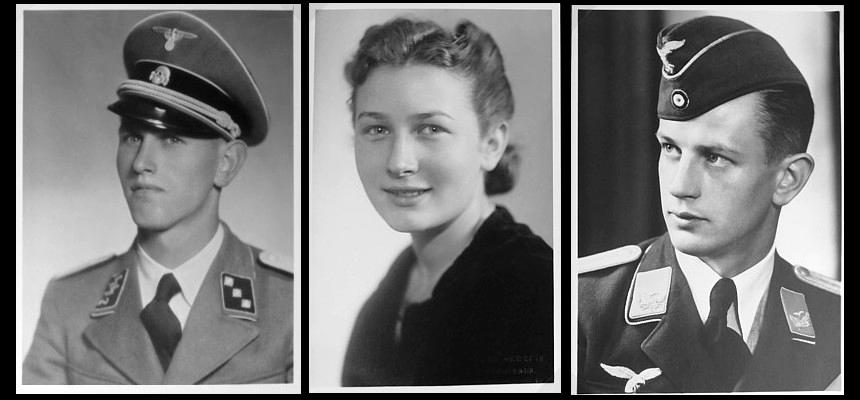
The World War II bio section of our website deals primarily with the major figures in the war, including economic, military, political, religious, and scientific leaders with of course a ficus on the military figures. Much of the world's population was caught up in the War to varying degrees. And all of those people have interesting stories to tell, playing their part, however small in history. One of these induividuals is a young German junior SS officer. What makes Hartmann stand out is that he was an avid photographer. Many Germans convinced of theuir cubilising mission, took their camerras to war with them, to record theur exploits ikn the East. And he has left a fascinating photographic record of one young man's NAZI and World War II expereince. His images showcase all kinds of interesting aspecrs, including family, the Hitler Youth, Aryan certification, military training, Lebensborn marriage, SS assessment, military equipment, Ukranian friendship, the trackless East, primitive infrastructure, and a sencelass death in eastern Ukraine. Through it all Hartmann remained a dedicated, loyal supporter of Hitler and the NAZI mission as was his young wife.
Dr. Ernst Heinkel was born in Grunbach (1888). He was was a German aircraft designer, and manufacturer. He began as a machinist at a foundry, but Heinkel studied at the Technical Academy of Stuttgart and eventually earned a PhD. He became interested in aviation, primarily because of the Zeppelins. He built his first aircraft before World War I and was almost killed when it crashed. During the World War I he was involved with the Albatross, a successful reconnaissance plane early in the War. He designed several land- and seaplanes for the Hansa-Brandenburg company which he joined (1914). He founded Heinkel Flugzeugwerke, one of Germany's two most important aircraft builders (1922) The was frustrated by Allied restrictions on German aviation and evaded them by working in Sweden. He also worked with Japan to evade Allied inspection teams. He joined the NAZI Party before Hitler seized power, primarily because of the Allied restrictions on his company. He ran into trouble with the NAZIs at an early point because they forced him to fire valuable Jewish employees (1933). The NAZIs recognized him as a Wehrwirtschaftsführer--an executive of an important company to the war effort. He was locked into major competition with Willy Meeserschmidt who was more compliant with NAZI demands. Heinkel Flugzeugwerke began using forced Jewish labor (1941). 【Crowe】 We are not sure about details of Heinkel personal involvement. Ongoing problems with the NAZIs resulted in Luftwaffe Chief Herman Göring seizing his company. Heinkel was detained until he agreed to sell controlling interest in his factories to Göring (1942). Heinkel moved to Vienna and opened a new design bureau. Heinkel aircraft played an important role in the War. The He-111 was the Luftwaffe's most important bomber during the War. The He-177 was the Luftwaffe's greatest failure, but this was primarily the result of interference from the Luftwaffe director of research and development, Ernst Udet.
The NAZI Vice-Führer was born in Egypt where his father had established an import-export business. Growing up in a villa surrounded by a luxurious garden, Rudolf received a disciplined, Teutonic upbringing that clashed with his romantic temperament and the exotic Near East setting. He was an early supporter od Adolf Hitler and during the early years his closest associate. He gradually lost influence in the NAZI hierarchy. He is best remembered for a dramatic flight to Britain (May 1941). He in the run-up to Barbarossa to prevent a two-front war. He was tried and found guilty at Nurrenberg, but did not get a death sentence because he was not directlt involved in the Holocaust.
Reinhard Heydrich is one of the vruly evil figues of history. He became known to the world as "The Hangman", considered by most to be the architect of the Holocaust. Adolf Eichmann is often seen as the director of the Holocaust. Eichmannwas in fact primarily the administrator of the Holocaust. It is Heydrich more than any other single individual who planned the Holocaust. Heydrich at the time of his death was the thitd most powerful individual in NAZI Germany and in all liklihood if he had lived and the NAZIs had won the War would have been the second Führer.
One of the most moving persoinal accounts from the Pacific War comes from a little 7-year old Okinawan girl -- Tomiko Higa. Tomiko was the youngest of nine children in a samurai family. She lived on a farm near Shuri, the ancient capital of Okinawa and the central point of the Japanese defene of the island. At the time, Okinawa was the most dangerous place in the world and Suri was the most dangerous place in Okinawa. The Amnericans spent more than amonth trying to crack through the Suri Line and throwing all of the massive fire power at their disposal at the deeply entrenched Japanese forces. And little Tomiko waa all alone and in the middle of it. Tomiko's mother has died when she was only 3 years old. Her father raised her amd her sisters alone. The children are on their own after their father doesn't return home from work. Her brother was killed beside her while they slept one night on the beach where they had dug holes in the sand for refuge. She then she becomes separated from her and sisters in the confusion and horror of Battle for Okinawa. Tomiko struggles to survive on the battlefield amist some of the fiercest fighting of the Pacific War.
SS Reichführer Himmler represents the true embodiment of evil in the 20th century. He grew up in a middleclass German family. His father was the headmaster at a gymnasium (academically selective seconadry school). He could be extremely cruel to the boys in psychological ways. One boy remembers how he and his brother were expelled by being pubically humiliated before the class when their farher could not pay the school fees. His father had an interest in romanticised German history which hr passed on to his son. Heireich and his brothes were outfitted in dresses and sailor suits as boys. Heinrich was not a brilliant student, but did very well because he was extremely diligent. He was dissapointed in World War I becaue he did not complete officer cadet training before the War ended. One biograpger mainatins that although he was strongly anti-semitic that the Holocaust was forced on him by Hitler from above and Heydrich from below.
Andrew Jackson Higgins, a Louisian boasr builder famously said, "The Navy doesn't know a damn thing about building small boats, but by God I do." It would take a Congressional investigatiion to prive him right. But he was and the plywood Higgins Boats were an essential componment of the Allied victory in both Europe and the Pacific. One observer called him the 'modern Noah".
Emperor Hirohito reigned from 1926-1989. He reigned throughout World War II. He was a head of state, but he did not create state policy, He dutifully accepted the decessions of his ministers as increasingly military givernments moved toward war in the 1930s. It is not clear if he had quams about Japanese militarism or the expansion of the Empire by military force. The only decession that we know of that he made during the War was the decession to surrender. Here after the atmomic boms were dropped and the Soviets invaded Manchuri, the War Cabinent was split. Hirohito thus made the decession to surender. He was thus the last Japanese emperor to uphold the Shinto idea of imperial divinity. his was changed by a new Cinstitution following Japan's defeat in World WarII. Hirohito reigned just over 62 years
after acceding to the throne on December 25, 1926. His life of 87 years and 8 months made him Japan's longest-living Emperor. He was also the longest-reigning
Emperor in Japanese history.
There was in Europe only one important political leader who desired a war--Adolf Hitler. Hhe saw war as an exhaulting human expeience. Even before he seized power in 1933 he began to see a war as the only way of creating a new European order. The only question in his mind was when and how to launch the war for maximum strategic advantage. Here he proved remarakably astute until the Ludtwaffe's failure to force tghe British to seek terms. Hitler not only saw himself as a strstehic war planner, but as a great tactical commannder and as the War progressed played an increasingly important role in Wehrmacht operations. Historians debate Hitler's effectiness as a war leader. Here his basic strategic concept was to divide his enemies and defeat them one by one which was the same tactic used in domestic politics. Here his on failure was the failure to defeat the British and then going on with the Soviet invasion with the British still undefeated in the rear. His grasp of the political situation proved more insightful than that of the military and was responsible for the startling success of the Germans early in the War. His actions in the Rhineland, Austria, and Czechesolvakia were all at first opposed by elements of the Germany military. He played key roles in the campaigns aginst Poland, Norway amd in the West against France and he was proven correct against more timid military commanders. Jodl based on these campaigns called him "a great military leader" even after the War. 【Schramm, p. 1721.】 After the early military victories, his value as a military leader declined even has he played an increasing important role in German planning. The one exception was his insistance on holding in the Winter of 1941-42 before Moscow. In general, however, after the success in France, his decisions were almost always wrong. These include a long litiany: a switch of tacics in the Battle of Britain to bomb London, the invasion of the Soviet Union (this is debateable), the division of the army in the Soviet Union in both 1941 and 42, the decalration of war on the United States, the failure to allow Von Paulis to break out at Stalingrad, the use of reserves to bolster the Afrika Corps after Allemain and Torch, the failure to attack the Normandy bridgehead in force, the attack in France leading tp the Falaise pocket, various unsuccessful stands in the East, the deployment of SS Panzer divisions to defend Budapest leaving Berlin essentially undefended, and fianlly the decession to fight on the west side of the Rhine. Jodl does agree that Hitler did when the tide turn against Germany interfere in operational matters which disrupted the military, some times disastrously. 【Schramm, p. 1721.】 Hitler also had a major role in German armaments. Here he had some successes such as the selection of the anti-tank gun used in Soviet campaign. 【Picker, p. 96.】 He made, however many huge mistakes. He delayed the German jet program and then insisted that the Me-262 be used as a bomber. Huge resources were devoted to the V-1 and V-2 programs which had little real impact on the War. He cobstantly went for massive projects like the Bismarck or tiger tank when more numerous smaller systems would have been more effective. Here Hitler appears to have over-emphasized the psychological impact of weapons. It was his idea to install sireens on Stuka dive bombers and he ordered several terror bombing raids. He also greatly over emphasized the power of the will--especially in Russia. He consistently demanded more of the German troops there than was physically possible. 【Hadler, p. 489.】
The Battle of Britain made a German cross-Channel invasion impossible in 1940. The triumphant German Wehrmacht, however, dominatd Europe. The Royal Navy was hard-pressed in the Atlantic. It was unclear at the end of 1940 if the British were prepared or able to continue the fight. The President while on a vacation cruise receive a letter from Prime Minister Churchill explaining that Britain was prepared to continue the fight, but was running out of money to purchase weapons and raw material. This letter would set in motion two actions. He decided to send Harry Hopkins o Britain. Second, he began to formulate Lend Lease. Before commiting America's defence to Britain, the President needed to know know just how determined Britain was. The American Army was still not equipped with modern arms. Should America provide the still limited production of armaments to Britain before its own military was equipped. Many around Roosevelt, including his closest adviser Harry Hopkins, were unsure how closely Roosevelt should tie American defenses to Britain. Roosevelt dispatched Hopkins to assess Britain's determination and situation. Churchill did not understand just who Hopkins was. His advisers told him that Hopkins was close to the President. Informed of Hopkin's WPA work, Churchill thought he was a social worker and began giving him statistics about loos (bathrooms) and electrity in British slums. Hopkin's interupted him. "Mr Churchill, I don't give a damn about your cottagers. I've come over here to find out how we can help you beat this fellow Hitler." Of course nothing could have pleased Churchill more. Churchill rose and said, "Mr Hopkins, come with me," and the two disappeared into Churchill's study. Churchill proceeeded to escort Hopkins all over the United Kingdom, from rhe Royal Navy Scappa Flow in northern Scotand to the Channel beach defenses in Kent. Hopkins was shocked by the ruins left by the Luftwaffe in British cities. They spent time together at Chequers, brcoming fast friends. Churchill called him "Lord Root of the Matter". Churchill completely converted him to the British cause. No one really knew what Hopkins would say in private to the President when he returned to Washington. At a small dinner party hosted by Lord Beaverbrook before he returned, Hopkins rose to propose a toast. "I suppose you wish to know what I am going to say to President Roosevelt on my return. Well I am going to quote to you one verse from the Book of Books. ... "Whither thou goest, I will go and where thou lodgest I will lodge, thy people shall be by peple, and thy God my God." Hopkins then added in on ending, "Even to the end." Tears were streaming down Churchill's face. 【Goodwin, pp. 213-213 and Meacham】 Hopkins became the administrator of Lend Lease, the American program to supply Britain and the other Allies.
Admiral Max Horton was the central figure in arguably the most important battle of World War II --the Battev of the Atlantic (1939-45). He was born in in Rhosneigr, Anglesey, Wales (1883). His parents were Robert Angel Horton and Esther Maude Goldsmid of the famous D'Avigdor-Goldsmid Anglo-Jewish family. He joined the Royal Navy as an officer cadet, still a young teenager (1898). He won a bravery award for rescue operations at sea at an early age. His Royal Navy career specialized in submarines. When World War I erupted, he was a submarine commander. He ended the war as commander of the Submarine flotilla serving in the North Sea and Baltic. We was awarded DSO’s for sinking several German ships. t was Horton who initiated the tradition of submarines flying the ‘Jolly Roger’ flag on returning after successful patrol. He captained various battle ships, one of the most prestigious Royal Navy assignments. He was promoted to Vice Admiral (1937). And as war approached, he commanded the Reserve Fleet, a command that in peace time had not been taken too seriously. He made important improvements that prepared the men for their coming role in active service as the Royal Navy rapidly expanded during the War. He then was then given command of all Royal Navy submarines. At the onset of World War II, he created the Atlantic Convoy rescue system picking up survivors from U boat sinkings. They operated fully equipped hospital facilities and naval surgeons, saving countless lives. Finally he was promoted a full Admiral and given one of the most vital assignments of the War-- Commander-in-Chief, Western Approaches. At the time, the Royal Navy and Royal Canadian Navy had made important improvements, but the Battle of the Atlantic was still not going well and the Americans were understandably preoccupied with the Pacific. Horton introduced a range of new tactics to increase the operations of convoys. Horton was a force of nature that dominated his command. He was not a man to sufferer fools lightly. Some have accused him of bullying subordinates. One battle he did not win was with a young teenage Wren --Janet Okell, basically a school girl, was one of the few not intimidated by him. When Horton arrived at Western Approaches, he was doubtful about 'The Game'. This was a mock battle devised to train escort commanders. Janet was one of a team of Wrens conducting The Game and the one assigned to take on the new commander. After Janet repeatedly bested him, he predictably accused her of cheating, but was eventually converted. Horton benefited from much that was not available to the Western Approaches Command at the start of the War: new technological advances and weaponry, increasing air cover, and Ultra decrypts. But it was Horton that made it all work. He also created hunter-killer teams to seek out and destroy the German U- boats, made possible by increasing Allied ship construction. The result was radically increased U-boat sinkings (mid-1943). Adm. Dönitz's son Peter was lost at this time. Most historians as well as Prime-Minister Winston Churchill credit him with playing a major role in the Allied victory in the critical Atlantic campaign.
Rudolf Franz Ferdinand Höss was born in Baden-Baden in southwest Germany (1900). He trained for the priesthood. His father's unexpected death and the outbreak of World War I changed his plans. He joined the German army at a young age (1916). He was wounded three times and was twice awarded the Iron Cross. After the War he joined the East Prussian Free Corps (Freikorps) (1920). He was involved in suppression of disturbances in Latvia and in quelling worker demonstrations in the Ruhr. Still involved with the Freikorps, he met Adolf Hitler (1922). He was deeply moved by Hitler. He not only joined the NAZI Party, but renounced his affiliation with the Catholic Church. When France and Belgium entered and occupied the Upper Rhine region (1923), Höss was involved in the assassination of Freikorpsman Walter Kadow. He was arrested and sentenced to 10 years in prison. He was released as part of the general amnesty (1928). Höss joined the SS (1933). He was was assigned to the Dachau Concentration Camp. Himmler appointed him adjutant of the Sachsenhausen concentration camp (1938). He was then chosen to be the Kommandant of the new Auschwitz Concentration Camp which was created as a work camp (early 1940). Himmler met with Höss and told him that Hitler had given orders for the final solution of the Jewish question and that "I have chosen the Auschwitz camp for this purpose." (May 1941) Höss converted a small part of Auschwitz for that purpose--the BirkenauVernichtungslager. Höss oversaw the constructin of gas chambers and crematoria which had the capcity to kill some 2,000 people in an hour. He spent the day compiling data on the corpses like a goiulish bookkeeper and then went home yo his loving wife and childrenen. The family was sconced in a spaceous villa on camp grounds. His children remember his as strict, but loving. He oversaw millions of innocent human including children being destroyed in the gas chambers, then creamated in the attached ovens, and their gold teeth harvested. Höss despite all these horrors he was perpetrating actually wrote poetry about the 'beauty' of Auschwitz.
Muhammed/Haj Amin al-Husseini was a Palestinian Muslim cleric in the British Mandate of Palestine.
He was born 1893/95. His father was the Mufti of Jerusalem. The family was a respected aristocratic family Ottoman Judaean part of Palestine. He studied religious law at al-Azhar University, Cairo and subsequently attended the Istanbul School of Administration. Hemade the pilgrimage to Mecca where he acquired the honorrific title of "Haj" (1913). He joined the Ottoman Turkish Army during World War I. He subsequently seserted while in Jerusalem and oportunistically aided the British who were driving into Palestine (1917). He emerged after the War as a violence-prone, anti-Jewish fanatic. British authorities arrested him for organizing an attack on Jews praying at the Western Wall (1920).
appointed Grand Mufti of Jerusalem under the Brisish Mandate of Palestine. He was a devoted pan-Arab nationalist. He became themost important Palestinian political leader during the British Mandate era. He helped inflame anti-Jewish feeling and was associated with disturbance and riots often attacking Jews in Palestine. Expelled by the British, he helped inspire a pro-NAZI uprising in Iraq aimed at expelling the Brirish (1941). When the rising failed, Husseini fled to NAZI Germany. During World War II while in Germany he collaborated with the NAZIs. His primary interest was the anti-Jewish and anti-British orientation of the NAZIs. He seemed to have ignored the fact that NAZI racial doctrine classified Arabs as an inferrior people. The NAZIs found him useful to promote anti-British propaganda in the Arab world. He urged NAZI leaders to kill nore Jews and was involved in forming Muslim Waffen-SS units in the Balkans. These units were involved in attrocities against both Jews and Serbs. With the defeat of the NAZIs, Husseini managed to escape to Cairo where Eggyptian authorities sheltered him and other NAZI war criminals. From Cairo he persued his pan-Aran annd anti-Semetic politics. Husseini is one of several Arab figures that were strongly influenced by NAZI/Fascist idelology. The next major Palestinian leader was Hussaeini's nephew Yasser Arafat.
Colonel-General Alfred Jodl was Chief of Operations for the German High Command (OKW). He was an early supporter in the military for National Socialism. Thus he was not a military man who had no role in brining the NAZIs to pwer, but a mikitary man that stringly supported Hitler and the NAZIs. Even after Stalingrad he believed in Hitler. He expplained to NAZI Gauleiters gathered in Munich that Germany would in the War (November 1943). "My most profound confidence is based on the fact that at the head of Germany there stands a man by his entire development, his desires, and striving can only have been destined by Fate to lead our people into a better future." 【Davidson】 Unlike Keitl, he was no toddy and had a sound military mind. He also had the courage to speak up to Hitler which is why he never got a Field Marshal baton. His advise to Hitler on Norway proved correct. The two quareled over the Soviet campaign. Hitler rejected his advise on Stalingrad and was determined to dismiss him after the success of the Stalingrad campaign. Of course the campaign failed and failed disasterously. It is arguable if Operation Blue could have suceeded given the Wehrmacht's limited resourrces, but failure did not necessarily mean the loss of the entire 6th Army and associated formations. This came about because Hitler rejected Jodl's advice. Of course giving soud advise is not what promoted your careerv in Hitler's Germany. The relationship between the two was never the same after Stalingrad. Hitler retained him to the end, despite the tension that had developed. Hitler unlike Stalin did not kill men who gave him sound advise that prived correct. He only fired them. Jodl was an exception. Jodl was surprised when he was told after the War that he would be tried as a war criminal. Given the widespread murder of millions and the German military's participatiion in those murders this seems difficult to understand.
Henry J. Kaiser was the proverbial American self-made man. His parents were German immigants. His father was a cobbler. He had very little education, yet he solved major problems. He played a major role in the construction of the Hoover Dam. What he is best known for today is genius behind the Liberty Ships. Other countries pursued the War by turning the economy over to the Givernment. America turned it over to capitalism. And the best examole is the Kaiser Shipyard Comapny. Kaiser knew nothing about ships and shipyards. But he knew about mass production. Britain before America entered the War needed merchant ships to replace those being sunk by maurauding shipyards. Abnd wuithout large numbers of new merchant vessels, Britain could niot be saved nd America could not wage war in Europe or the Pacific. American shipyards had order backlogs so the British offered a contract to create a shipyard to build a ship they had designd. Kaiser basically accepted the ship design which would gradually change, but insisted that he would be free to design the yard and building methods. The British were miffed that someone without experience knew more about building ships than they knew. But they were desperate and gave Kaiser the contract. President Roosevelt called the resulting Liberty Ships 'Ugly Duckilings, but recognized their critical value. Kaiser also produced the Gato-class submarines and the Casablanca class escort carrier. The Gato-class subs would play a major role in cutting Japan's war fasctories off fromn the raw materiakls of the Southerrn reserach Zine. The Germans attempted to replicate Kaiser's methods, but coukd get the modular parts to fit together well. 【Speer】 Kaiser's shipyards sould build more carriers than all of Japan. Kaiser had trouble with the U.S. Navy, so he went right to President Roosevelt who ruled in his favor. And it was Kaiser who was the genius behind the all important Landing Ship tank (LST). They were desigbned in Britain, but built in America. Without the LST, D-Day would have been impossible. Andrew Jackson Higgins would have similar problems with the Navy. A relatively unknown senator, Harry Truman, would order an investifastion and again the Navy lost.
Albert Kahn is arguably the most under-regozied American in American corporate history. He was born in Rhaunen, a town near Frankfurt, Germany into a Jewish family (1869). His father Joseph Kahn trained as a rabbi. His mother Rosalie had an artistic bent, both the visual arts and music. The Kahn fasmily emigrated to the United Stastes seekin oportunity (188). Albert was years old. They settled in Detroit. We are not sure why, but it was an enormouly fortuitous decision. Albert along with Henry Ford would play a huge role in the making of modern America. As with other Jewish-immigrants, there were challenges, but not as many as if hey had remained in Germany. Albert was the oldest of eight children. He had gto leave school in the 7th grade to help support the family. Even without a highschool diploma, he nbecame an arrchitect and was able to send his younger brithers to university and they become architects or engineers. He landed a job at the architectural firm of Mason and Rice. He won Rotch Traveling Fellowship, to study abroad (1891). He toured Germany, France, Italy, and Belgium, observing and draeing Europe’s classic buildings. He and his brothers established an architectural firm in Detroit an play a major role in the making of the automobile industry that played such a major role in destroying the NAZI tyranny.
Hans Kammler was born in Stetin (1901). He did not serve in Wirkd War I, but was active in the Frei Korps in the Baltic after the War (1919). He began university and was awarded an engineering doctorate (1932). Jyst before that he joined the NAZI Party attracted by NAZI doctrine (1931). After graduating he joined the SS, seeing this was a way of advancing. His first jobs were innocuous, but eventuall became involved with the SS Race and Settlement Office which as at the center of the most heinous NAZI war crimes. This was probably no accident givem Kammler's ideological mindset. His civil engineering was put to use in designing imprtant camps like Auswitz and Majdanek. He worked on the crematioria, imprioving their disposal rate. He did not design the gas chanmbers, but improving the ability to dispose of the killers grisly work helped increase the killing capacity of the camps
Kammler was put in charge of the secret weapoon prograns as the War progressed. During this he was resonsibe for major war crimes. He reached the rank of SS-Obergruppenführer who at firsr oversaw construction projection programs at NAZI concentration camps. He was then put in charge the V-2 rocket and second generation Fighter Programs toward the end of the War. He was head of the SS Office of Unit C in the Economic Administration Main Office. The projects were not warv crimes. The treatment of the slave workers used to build the weapons were war crimes. He disappeared (May 1945). He was never procecuted. What happened to him is the subject of considerable controversy.
Field Marshal Wilhelm Keitel was Chief of Staff of the German High Command (OKW). Keitel in contrast to Jodl was a complete toddy--which exolains why he became a field marshal and Jodl did not. He was clever to an extent. He was the kind of individul tht office workers will recognize, able to advance his career, but in an army bosting of a surplus of brilliant commanders, without any real talent -- in his case military talent. He was, however, useful to Hitler who did not really want military expetise, but a non-entity to simply transmit his orders without bothersome questions. Hitler was much less interested in advise, than some one to relay his orders. Hitler was confident that he had the answers. Keitel as a result was thus hated throughout the Wehrmacht for this very reason. He was tried at Nuremberg for war crimes. Göring thought he should not have been tried because he was just transmitting orders. Keitel's signatute not Hitler's, however, was on the the shameful extinction orders. He was found guilty of war crimes and hanged.
James Howard 'Dutch' Kindelberger (1895 – 1962) was an American aviation pioneer. He famouslky led North American Aviation (1934-60). He was not only an emensely competent aviatiin engineer, but a cilorful character famous for demanding hard work, orderliness and punctuality. He was born in Wheeling, West Virginia (1895). The fa,ily was descended from German (Deutsch) immigrants originating in from Nothweiler, Pfalz. The Dutch knick name results is also why the Pennsyvanian Germans are called Dutch. His parents were Charles Frederick Kindelberger, a steelworker, and Rose Ann Kindelberger. Kindelberger dropped out of high school in the 10th grade and began working in the steel industry along with his father. He soon decided that a career in the steel mills was not going to be his future. He took correspondence courses to gain his high school certificate. He then managed to not only enter Carnegie Institute of Technology to pursue engineering (1916). At the time working class children did not commonly enter high school, and here Futch managed to enbter one if the most prwsstigiuous engerring universuties in America. Not only that, but he was elected class president. When America declared war on Germany, he would elist and wound up in the air corps (1917). Among the individuals he became associated with were Hap Armnold and American ace Billy Mitchell. He married Thelma Knarr after the War (1919) They had two children. He was associated with an amazing number of aviatioon achievenments beginning with helping designed the bomber Gen Mitchell famouslu=y used to sink a World War I battleship. He went on to run North American aviation during World War II. And was chisen by the industry to head the Aircraft War Production Council. North Anerican produced a staggeing 42,000 aircraft to help win the War, including the fabulous P-51 Mustang, but Kindelberger played a key role in expabding prduction throughout America's aviation industry.
Admiral Ernest King was the most important naval commander of World war II. He was born in Lorain, Ohio (1878), one of several naval commndrs fromthe Middle East. He attended the United States Naval Academy at Annapolis, graduting (1901). he was fourth out of 67 in his class. During World War I he served on the staff of Vice Admiral Henry T. Mayo, commander of the Atlantic Fleet. After the War in the peace-time Navy he received many varied commands, including submarine and aviation commands. King was appointed to head the Navy's postgraduate school (1919-21). His first sea command was a refrigerator ship. He qualified as a submariner (1922 and commanded a submarine sub-division. He next learned to fly (1930) and commnded the aircraft carrier Lexington (1930-32). He then attendd the Naval War College. He next took over the Bureau of Aeronautics (1933). King then commanded Air Base Force where he was responsible for more than 1,000 seaplanes. Seaplanes were important in the 1920s-30s because airbases were more limited and thus sea planes were this of more utility. He ordered his pilots trained for night operations. President Roosevelt chose him to command the Atlantic Fleet (January 1941). Here the United States began an undeclared naval war with Germany to ensure the deliveru of Lend Lease aid to ghe British. After the devestating Japanese carrier attack on Pearl Harbor, the President chose King as Commander in Chief of the U.S. Fleet. Few in that post had such varied naval experiences, including two of the key areas with which the United Sttes would fight the naval war, submrines and carriers. Perhaps his greatest achievement was effectively organizing the ennormous administrative and logistical operation to support the largest naval force in human history across the world's oceans. He at first resisted organized convoys. King developed an abrasive reputation even before his appoinment as naval commander. As a key member of the Joint Chief of Staffs he frequently clashed with Army Chief of Staff, General George Marshall. He was not as committed to the Germany First doctrine as Marshall, but never openly opposed it.
Like Marshall he opposed the Torch landings in North Africa. He advocated a greater focus on the Pacific War. King, MacArthur (Supreme Commander of the Southwest Pacific Area), and Nimitz concurred that the first first objective beyond holding Pearl, was to protect the sea lanes to Australia which resulted in the deployment of two precioys carriers in the Coiral Sea (May 1942). The Japanese finally moved to force the American carriers to battle by attacking Midway (June 1942). The resukt was the loss of four of the First Air Fleet's six mainline carriers. King insisted on lhe Guadalcanal campaign as part of the effort to keep the sealanes to Australia open (August 1942). Marines were used because MacArthur inidisted that the Army was not yet ready. King and McArthur also differed on the Solomons, Central Pacific, and Philippines Campaign. King also opposed Armerican efforts to involve the Soviets in the Pacific War. He was unhappy about the British moving assetts o the Pacific afterthe Atlantic was secured. Congress approved the promotion of King, Leahy, and Nimitz to five-star rank (December 1944). King retured after the War (Decenber 1945). He died of a heart-attack (1956).
William Lyon Mackenzie King was Canada's longest serving primeminister and considered by most historians as Canada's greatest primeminister. The King name was well know to Canadians before he etered politics. His grandfather, William Lyon Mackenzie, led the Upper Canada Rebellion (1837). He was born in Berlin, Ontario (renamed Kitchener). He had a younger sibling named Jennie. King was a gifted scholar and earned five university degrees, including a Ph.D. from Harvard in political economy (1909). King was first elected to Parliament as a Liberal in a 1908 by-election. He was appointed Canada's first Minister of Labour (1909), but lost his seat in the next general election (1911 ). He worked in the United States for the Rockefeller family to help them improve labor relations. He returned to Canada during World War I to run in the 1917 general election. The principal issue was conscription issue. He lost the election, primarily because English-speaking Canadians strongly supported Britain and conscription while King opposed conscription. The Liberal Party chose his as their leader after World War I (1919). Public opinion had begun to chage about the War and King's position on conscription was seen as principled. He became primemiister 2 years later (1921). He was Canada's primeminister for much of the following three decade thriugh 1948 (except for 1926 and 1930-35). He was primeminister during World War II. He loyally followed Britain into the War and oversaw Canada's participation. He developed a solid working relationship with President Roosevelt and negotiated inmportant defense agreements with the United States.
Pierre Laval was a French politician during the Third Republic and the Vichy period. , he served briefly as Prime Minister (1931-32 and 1935-36). His legacy will be ultimately assessed based on his collaborationist role during the World War II German occupation of France and the Vichy Government. Pétain named him Vice Premier (1940) and then Prime Minister (1942). He also served as Information Minister, Interior (Police) Minister, and Foreign Minister). He cooperated with the NAZIs in may areas, including securty and the abti-Semetic oppression of the Jews. He also copperated in German's exploitation of the Frech economy and compulsory labor in the Reich war industries. It is probably true that Pétin and Laval saved French lives. It Vichy hd m=not complied, the Germans would have used force. But what the Vichy politicins did not understand or chose not to consider was what the NAZIs planed to do with France and the French people after they had won the War. By caving into the Germans, Vichy put Western Civilization in danger and put their faith in the good will of Adolf Hitler and his NAZI regime. Frace in the end was saved by Britain and America, but because of Vich'y compliance with NAZI rule, the NAZIs had a real chance of winning the War. Laval with the libertion of France fled to the Reich. At the end of the War he sought refugein Spain, but was turned over to Allies. The French Governent tried him for treason ad executed him.
William Daniel Leahy was born in Hampton, Iowa (1875). His father, Michael Leahy, was a lawyer, had served as Captain of Wisconsin Infantry Volunteers during the Civil War. Willian had hoped to attend the Army's West Point Academy, but when he was unable to secure an appointments he won an appointment to the Naval Academy where he graduated (1897). Midshipman Leahy was assigned to USS Oregon, then in the Pacific. He was in that battleship when she made her famous dash around the horn in the Spring of 1898 to participate in the Battle of Santiago on July 3.
Having completed the two years' sea duty -- then required by law -- he was commissioned Ensign on 01 July 1899. At that time, he was on the Asiatic Station, where, during the Philippine Insurrection and the Boxer uprising in China, he served in USS Castine, USS Glacier and commanded the gunboat USS Mariveles. He returned to the United States in 1902, and for the next five years did duty in USS Tacoma and USS Boston which was stationed in Panama during the early period of construction of the canal.
His first shore cruise was at the Naval Academy. Beginning in 1907, he served as instructor in the Department of Physics and Chemistry for two years. He went to sea in 1909 and served as navigator of the armed cruiser USS California in the Pacific Fleet. During the American Occupation of Nicaragua in 1912, he was Chief of Staff to the Commander Naval Forces there.
Late in 1912, he came ashore in Washington as Assistant Director of Gunnery Exercises and Engineering Competitions. In 1913, he was assigned to the Bureau of Navigation as a detail officer where he served until 1915. At that time, he took command of the dispatch gunboat USS Dolphin, and established a very close friendship with the then-Assistant Secretary of the Navy Franklin D. Roosevelt, who cruised with him on the ship. He was in that assignment in early 1917 in West Indian waters and had additional duty as Senior Aide on the Staff of Commander Squadron Three of the Patrol Force Atlantic Fleet.
He served for almost a year as the Executive Officer of USS Nevada and in April 1918 went to command USS Princess Matoika, formerly Princess Alice , transporting troops to France.
After a short cruise in that command, he came ashore in 1918 and served for three years as director of Gunnery Exercises and Engineering Competition in the Navy Department, and as senior member of the Fire Control Board. In 1921, he went to sea in command of USS St. Louis, flagship of the Naval Detachment in Turkish waters during the war between Turkey and Greece. At the end of that war, he was given command of Mine Squadron One, and in 1922 further additional duty as commander, Control Force.
When he returned to the U.S. and from 1923 to 1926, he served as Director of Officer Personnel in the Bureau of Navigation, and then had one year in command of the battleship USS New Mexico. In 1927, he reached flag rank and became Chief of the Bureau of Ordnance. After almost four years, he went to sea in 1931 as Commander Destroyers Scouting Force.
In 1933, he came ashore in Washington as Chief of the Bureau of Navigation for two years, when he went to sea as a vice admiral, and Commander Battleships Battle Force. In 1936, he hoisted his four-star flag in USS California and
Commander in Chief Battle Force.>
He had a destinguished, but convention naval career including service with destroyers and battleships. He was appointed Chief of Naval Operations (1937). He worked with President Roosevelt who took an interest in naval affairs andwas working to strenhthen yhe military. It is at this time that the possibility of another war became increasingly likely. He retired just weeks before World War II broke out in Europoe (August 1939). President Roosevelt who had come to rely on him told him, "Bill, if we have a war, you're going to be right back here helping me run it." The President appointed him Governor of Puerto Rico (September 1939). The President selected him as the U.S. Ambassador to Vichy France (November 1940). This is an indication of the imprtance that the President still attached to Vichy at the time. Leahy returned to Anerica after the death of his wife (May 1942). The President chose him to oversee the American Joint Chiefs -- a rare individual that both the Army and Navy trusted (July 1942). This meant a retrun to active duty. This meant that he presided over the United States Joint Chiefs of Staff. And when meeting in Aerica the Combined (Anglo-American) Chiefs of Staff. He was confirmed as Fleet Admiral becoming one if the five-star American milkitary commanders (Novmber 1944). He continued in his post of chairman of the Joint Chiefs into the post-War period, working with President Truman. He resigned (1949).
General Philippe Leclerc was perhaps the most important French military commander in World war II. He fought against the Afrika Corps in the Western Desert. As commabnderv of thecFrench 2nd Armored Division he spearheaded the liberation of Paris (August 1944). He helped liberate Strassbourg, reduce the Colmar Pocket, and invade the Reich. After the War, he was assigned to help restablisg French control of Indochina. He advised the French Government to 'nehgoyiatec at all costs'. 【Moore】
Leopold was the eldest son of King Albert I and Queen Elizabeth. He and his brother were emacualtely dressed, often in fancy outfits, as boys by their fashionable mother. He ascended to the throne in 1934 as Leopold III after the tragic death of his father. Although greeted with great warmth by the Belgian people, his reputation was tarnished by his surender of the Belgian Army in World War II after it had been mauled in the 1940 NAZI invasion. Unlike Queen Wilhimina in the Netherlands, he refused to flee to England, an act
of some courage, but proably unwise given the circumstances. Thus when the Allies entered Belgium in 1944, Leopold was never returned to the throne. His brother Charles served as regent until 1951 when his son Baudouin was crowned.
Robert Ley was the director of the NAZI Reich Labor Front (DAF). His father was a poor peasant farmer. Robert was born in Niederbreidenbach (1890). He was a pilot during World War I. He was shot down over France, but surb\vuved (1917). He was a POW for over 2 years. After the war Ley he worked as a pharacist,but was fired because he came to work drunk. Unemployed, he joined the National Socialist German Workers Party (NAZIs) as it was recoveringvfrom the Beer Hall Putsch fiasco (1925). Hitler was apparently impressed by him and made him Gauleiter for Rhineland South. Gregor Strasser in the radical wing of the SA had a falling out with Hitler as President Hindenburg and Chancellor Kurt von Schleicher attempted to split the NAZI Party (1932). Ley replaced Strasser as leader of the Reich Organization. Ley also began publishing the NAZI magazine Westdeutscher Beobachter. (Hitler who saw Strasser as a dabgerous rival and he was he was one of the targets during the Night of the Long Knives. After Hitler was appointed Chancellor and armed with the Enabling Acts, he moved against the free trade unions. Hitler suppressed the trade unions and ordered labor leaders arrested. Almost all were socialists or communists and opposed to Hitler and the NAZIs. He then ordered Ley to forming the NAZI German Labour Front (DAF) to replace the free trade union movement. Ley seized the union funds and facilities. The DAF sponsored the Strength through Joy program. Given his role in mobilizing labor for the War, Ley was deeply involved in the NAZI slave labor program. American airborn soldiers arrested Ley who was hiding near the Austrian border. The Allies charged him with war crimes. The IMT defendants were confined at Nuremberg for their trial. Ley rather surprisingly given the statements he made earlu\ier, he penned a statement denouncing Anti-Semitism. He then hanged himsel in his cell (October, 1945).
Charles Linburg was once of the most respected americans of the 1920s and 30s. He was the famed Lone Eagle who in 1927 flew the Atantic solo. A photograph of Lindburgh with his mother shows him at about 5 years of age with beautiful curls and dressed in a lovely sailor suit. His mother reportedly constantly hovered over him, but was not outwardly affectionate. When he was older, she would always put him to bed with a handshake. His father was distant. Once when his son fell into a river, he didn't jump in after him--expecting the boy to learn to swim. Lindburg's reputation was diminished when after war broke out in Europe, he returned from England and joined the isolationists in the effort to prevent America from aiding Britain and France.
Crowe, David. "Oskar Schindler: Yhe untold account of his life (Westview Press: 2004).
Davidson, Trial of the Germans (1966).
Hadler, Generaloberst. Kriegstagebuch ed. Hans-Adolf Jacobsen, 3 vol (Stuttgart, 1962).
Goodwin, Doris Kearns. No Ordinary Time: Frranklin and Eleanor Roosevelt: The Home Front in World war II (Simon & Schuster: New York, 1994), 759p.
Larson, Erik. In the Garden of Beasts: Love, Terror, and an American Family in Hitler's Berlin (Crown, 2011), 488p.
Meacham, Jon. Franklin and Winston (Random House, 2003).
Moore, William Mortimer. Free France's Lion: The Life of Philippe Leclerc, DeGualle's Greatest Genera (2011), 384p.
Picker, Henry, ed. Percy Ernst Schramm. Hitler's Tischgespräch im Führerhauptquartier, 1941-42 (Stuttgart, 1963).
Schramm, Percy Ernst., ed. Kriegstagebuch des OKW iv: 1944-45 (Frankfurt-on Main, 1961), pt. 2.
Shirer, William L. The Rise and Fall of the Third Reich: A History of Nazi Germany (New York: 1960), 1249p.
Speer, Albert. Richard and Clara Winston, trans. Inside the Third Reich (Avon Books: New York, 1970), 734p.
Wistrich, Robert. Who's who in Nazi Germany (Macmillan Publ., New York, 1982).

Navigate the CIH World War II Pages:
[Return to Main World War II biography page]
[About Us]
[Biographies]
[Campaigns]
[Children]
[Countries]
[Deciding factors]
[Diplomacy]
[Geo-political crisis]
[Economics]
[Home front]
[Intelligence]
[Resistance]
[Race]
[Refugees]
[Technology]
[Bibliographies]
[Contributions]
[FAQs]
[Images]
[Links]
[Registration]
[Tools]
[Return to Main World War II page]
[Return to Main war essay page]