|
The successful NAZI conquest of Poland was followed by inactivity in the West. Hitler was ready to move west and scheduled several Western Offensives, but the General Staff managed to disuade him for a variety of reasons, primarily the insuitability of the weather. The press styled the inactivity "The Phony War"--a term originally coined by isolationist Senator Borah in America. The French Army refused to sally beyond the saftey of the Maginot Line. In actuality, it was a deadly race with Britain and France attempting to rearm so that they could meat the inevitable German Western Offensive. The Germans had to knock out the Allies before they could rearm with the support of American industry. To the surprise of many, Hitler after Poland did not unleash the Lufwaffe on the Allies--not yet. [Freidel, pp. 328-329.] The initial panic by civilians subsided. British children that had been evacuated began coming home, especially as Christmas approached.
German Pamzers attacjed Poland (September 1). The new German weapons were on display in Poland and the German Panzers crossed the border and the Luftwaffe began bombing Polish cities. The British and French declared war (September 3). The invasion was made possible by a Non-Agression Pact that Stalin had approved with Hitler. The Luftwaffe destroyed the obsolete Polish Air Force on the first day. Wehrmacht armored units using a new tactic called blitzkrieg or lighting war breached the Polish frontier and sliced deep into the country.
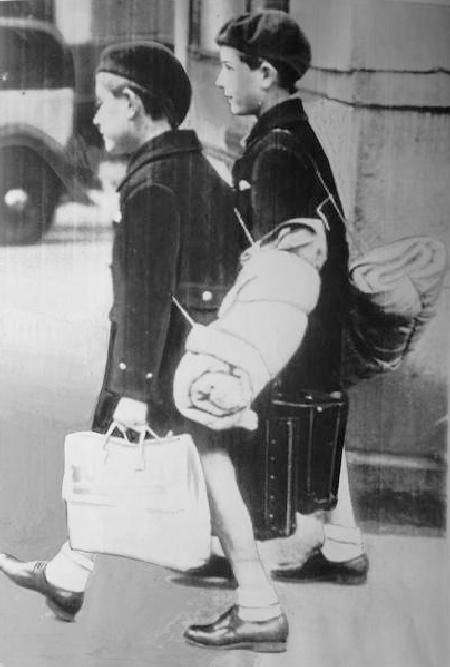
The Allies, especially the governments and public, believed that the NAZIs would begin the War by launching an aerial bombing campaign. There was great fear that this would include poison gas attacks. There was huge discussion of this in the inter-War era, especially after Hitler's rise to power. Paris was in range of Luftwaffe bombers, London was not in any meaninful way a long as the Low countries and France stood between . As far as we know, these evacuations only took place in Britain and France, not in Germany during Britain and the Germans. The British began evacuating London and other large cities even before declaring war. The British were not prepared for war, but one area they had prepared for was a German aerial bombing attack. This was the result of German Zephin and bomber attacks during World War I. The first step was to get the children out of London and the other large cities. The evacuation was not mandatory and quite a number of parents held on to their children. It was one of the largest mast movement of civilians in the history of War.
There were dipolmatic contacts. German diplomats contacted the Allies through the Netherlands. Hitler convinced himself that that the Aliies he had so successfully bullied at Munich would actually fight. He seems to have been unaware of how his tearing up the Munich Agreement and invading Czechoslovakia changed the situatuion. He wanted time to digest Poland. It is not known what Hitler would have done had the Allies not declared war. Almost certainly he would have attacked France. He had a Non-Agression Pact with the Soviet Union and Hitler never would have attacked the Soviets with the French Army in tact on his western border. Thus the French Army had to bestroyed. He knew only to well what had occurred during World War I. The British insisted that the Germans should withdraw from Poland and Hitler rejected this out of hand. Thus no diplomatic solution was possible.
The British and French expected a disaster after they declared war. They thought that Hitler would order the Luftwaffee to bomb British and French cities and that, as in World War I, another huge German Army would again invade Belgium and France. This did not materialize. The successful NAZI conquest of Poland, however, was followed by inactivity in the West. The Germans were at first concentated on Poland with only minimal forces deployed defensively in the West. Neither the British or French, however, were about to launch another War. Leaders and the public just could not understand how another major conflict could occur. The very idea to many was stillm unthinkable. They were willing to launch an invasion of Germany or bomb Germany. The British and French were unwilling to risk the casualties that might come with offensive operations. The memory of the enormous World War I casualties were still strong. The term 'Phoney War' was reportedly coined by Idaho Senator William Borah. Borah had helped block American ratification of the Versailles Treaty after World War I. This and other actions had earned him the name, 'the Great Opposer'. He was in 1939 one of the leading Republican Isolations resisting President Roosevelt's efforts to aid the Allies. Winston Churchill who was recalled to the Government as First Lord of the Admiralty termed it the �Twilight War�. The German term was �Sitzkrieg� � 'sitting down war'. These terms were widely adopted by the press. So while the Panzers smashed through Poland and the Luftwaffe bombed Polisgh cities, the Allies in the West did next to nothing.
Both Britain and France went to war reluctantly. Even after declaring war, they hoped not to have to wage war.
The Allies The Allies hoped that a naval blockade and resulting economic hardship of Germany would force Hitler to his sences without the enormous casualties that could result from an offensive policy. Germany has some real weaknesses, in particular the lack of needed oil resources. Control over the Ploesti oil fields in Romania and synthetic plants were inadequate, but the Soviet Union supplied the Germans large quantities of oil and other strategic materials. The Allies as in World war I set up a naval embargo. The Soviet deliveries, however, undermined the effectiveness of the Allied naval embargo. The Allies also hoped that they could convince the German people not to wage war. Prime-minister Chamberlain still appears to have been oblivious to the nature of the NAZI state. Britain engaged in �bombing� raids over German, but primarily dropping propaganda leaflets. Sir Kingsley Wood, Secretary of State for War, who oversaw the operation called them 'truth raids'. The idea was to tell the Germany people about what their Government was doing. And it would show Hitler and other NAZI officials how vulnerable their country was. The British on the day they declared war (September 3), dropped 6 million copies of 'Note to the German People'. The Luftwaffe was largely engaged in Poland and did not yet have have night fighters. The GermAns did begin to expand their anti-aircraft batteries. The leaflets of course had no impact on the German war effort.
The British began preparing their beaches for war during the Phoney War. We are not sure just what was done during the phoney war, but we notice images of civilians filling sand bags just before the Germans launched the War. The activity at the time was probably more to prepare sand bags for protecting city buildings than defending the beaches. The beaches were a major source of the sand. With France in the War, the British Channel coast was still a rear area. Even so, the beaches had to be patrolled to some extent to guard agsinst spies and sabatouers who could be landed by U-boats during the night. We believe that civilians continued using the beaches for the rest of the summer, but our information is limited. Many of the city children of course were evacuated. After the fall of France, this changed dramtically (June 1940). The British Channel beaches became the front line of the War rather than the rear areas they had been in Wotld War I. They had to be fortified against the expected German invasion--Operation Sea Lion. The British set about building concrete landing traps, barbed wire barriers, scaffolding all along the coast, but especially the southeast coast where the Germans were expected to land. The Army also began laying mines in large numbers. Artillery was at first very limited as most had been left behind at Dunkirk. Large areas of the sea front was sealed off for about 3 years. Piers were an important part of British beach resorts. The Army even demolished parts of the piers at Hastings, St. Leonards, Eastbourne and Brighton to ensure that the Germans could not make use of them when the landings began. Plane spotters were positioned at or nearby the beaches. People along the southeastern beaches saw the Luftwaffe German air armadas crossing the Channel and then RAF pursuit of the raiders trying to reach their French air bases. Small beach areas were finally reopened for swimming in the summer after the D-Day landings(1944). Digging up the mines after the War was a major project.
After Hitler invaded Poland (September 1, 1939), Britain anf France declared War on Germany (September 3). The British Expeditionary Force (BEF) was sent to France and positioned along the Belgian border. Given the size of the German Army, it was a relatively small force. The Belgians also braced for another attack, but did not enter the War abd did not coordinate defensive strategy with either the BEF or Frrench Army. The BEF was thus deployed along the French-Belgian border. The French with some validity complained that the British commitment was inadequate and that they were not taking the situation seriously enough. At the time of the German invasion (May 1940), the BEF was composed of 10 infantry divisions organized in three corps and a tank brigade. Virtually all of Britain's modern equipment (tanks and other military vehicles, and artillery) was dispatched with the BEF. Royal Air Force (RAF) squadrons were also deployed to France. The BEF was supported with a force of about 500 aircraft. The BEF was about a tenth of the Allied force on the Western Front. Interestingly the BEF was the only fully mechanized force involved in the campaign. The Wehrmacht had a powerful mechanized force, but a substantial part of the Wehrmact was still not mechanized and relied on horses as draft animals. (This was still the case a year later when Hitler launched Barbarossa.)
Bekgium and the Netherlands had very different World War I exeriences. Grmany invaded Belghiumm but not the Nertherlands. The purpose of invading Belgium was to get to France. The Netherlands was not useful in getting to France. And during the War, as in Scanbdanavia, there was consuderable sympathy foir the Germans. So the Dutch stuck with neutrality as their primary in defense in World War II. There was some thinking about Vesting Holland and a slight increase in defense spending, but the major defense was neutrality. Belgium was different.
As Germany invaded Belgium (1914), it became one of the Allies during World War I. There had been no symplathy for the invading Germans. Belgium remained part of the Allied coalition after the War. During the inter-War era, Belgium changed its defense policy. Instead of joint plnning with Britain and France, it decicded on neutrality agsain--despite the failure of neutrality in World War I. As aesult, the Maginot line ended at the French birder and there was no pre-War defense planning with the Allies--so as to not atagonize the Germans.
The fighting in Poland was largely over by the end of October. This permitted OKW to shift forces west. Hitler was ready to move west and scheduled several Western Offensives, but OKW managed to disuade him for a variety of reasons, primarily the insuitability of offensive operations during winter weather.
Just before the outbreak of war, Parliament passed the Emergency Powers (Defence) Act (August 1939).
It permiitted 'such defence regulations as appear necessary or expedient for securing the public safety, the defence of the realm, the maintenance of the public order and the efficient prosecution of any war in which His Majesty may be engaged, and for maintaining supplies and services essential to the life of the community.� This greratly expanded the Government's police powers. The act permitted the arrest, trial and punishment of anybody deemed to have gone against these regulations. The Govement was further enpowered to: detain anybody deemed by the government to be a threat, take any property other than land needed by the government, enter and search any property, and Change any existing law if it was necessary for the war effort. Such an enormous expansion of Government police power did not transpire without public discussion, including some criticsm. Imprisonment without trial and essentialy suspending
Habeas Corpus were enormous steps in democratic Britain. One of the most outspoken Government critics was MP Dingle Foot. He famously said that Britain was fighting two wars: one against Nazi aggression abroad and Nazi tendencies at home.
The Allies anticipated an immediate German air offensive. The Luftwaffe's bombing raids during the Spanuish Civil War had been widely publicized. The Luftwaffe bombers, however, did not come. The Germans were busy in Poland, engaging both military targets and bombing Polish cities. Northern French cities were in range of German bombers. The British were beyond the range of effective bombardment, but this was not fully understood at the time war was declared. The Air Raid Precautions (ARP) was the British civil defense organisation. It was established long before World War II and the Battle of Britain. With the outbreak of war, the British strict enforced the blackout. ARP Wardens went door to door to help residents with black out procedures. Violaters were fined. The German mombers diod not come, but traffic accidents quickly escalated. The solution was low-density street lighting to prevent pedestrian/road accidents (December 1939). Curbs were painted white to help motiorists an night. There was no night-time lighting of any description permitted within 12 miles of the south-east coast, the most exposed point. The slit headlights were introduced (January 22, 1940). At the same time, a 20 mph speed limit was set in built-up areas. The instalation of family bomb shelters also went ahead as people installed both the Anderson and Morrison shelerrs.
It is not entirely accurate to refe to this period as the Phoney War. There were in fact quite a number of things that were hppening. The NAZIs were in the process of instituting a horendous occupation regime in Poland. The German concentration camp system was being extended to Poland. The Germans were arresting Polish officials and intelctuals. Many were shot outright and others faced a slow death in the concentration camps. And the horrific suppresion of Polish Jews begun as they were hearded into ghettos. Further east the Soviets were conducting an even more extensive series of aggressions. The Soviets in cooperation with the Germans also invaded Poland. They also put in motion the occupation of the Baltic Republics, the Winter War with Finland, and the seizure of eastern Romania. After the defeat of the Polish Army, the Germans began moving west to prepare for their western offensive.
The French Army refused to sally beyond the saftey of the Maginot Line. France's defensive line was named after the War Minister Andre Maginot who began building it. The idea was first proposed by French World War I commander Joseph Joffre and Construction began in 1930. It was a massive system of defences, most of which was built underground. There were three interdependent fortified belts with anti-tank emplacements and pillboxes protecting bombproof artillery casements. These concrete and steel emplacements stretched between Luxembourg and Switzerland.
Artilery emplacements and interlocking strong points were designed to stop a German invasion. The Maginot Line has gone diwn in history as a gigantic military failure. In fact it did prevent a German break through, but the Germans went around it. Plans were in place to continue the Maginot Line to the Channel. The War broke out before this project began. Thus the Maginot Line stopped at the Belgian frontier. While the Maginot forced the Germans to go around it, criticism over the cost is valid. It cost 7,000 million francs and adsorbed a substantial share of French fedense spending. Drench military olanners believed that the Ardennes, the heavily wooded and hilly area to the north of the Maginot Line, was impassible to tanks and thus could be lightly defended.
The Germans had also fortified their border. The Siegfried Line in western Germany, however, was much less elaborate than the Maginot Line.
It was a deadly race with Britain and France attempting to rearm so that they could meat the inevitable German Western Offensive. The Germans had to knock out the Allies before they could rearm with the support of American industry.
The Allies turned to America for assistance. Aginst the background of war in Europe, President Roosevelt who did see the dangers from the NAZIs and Japanese militaists, with great skill and political courage managed to not only support Britain in its hour of maximum peril, but with considerable political skill managed to push through Congress measures that would lay the ground work for turning American into the Arsenal of Democracy, producing a tidal wave of equipment and supplies not only for the American military, but for our Allies as well in quantities that no one especially the AXIS believed possible. President Roosevelt saw American national interest differntly fom most Americans who determined to avoid involvement in another world war. From the onset of war in Europe, President Roosevelt set out to transform America from an isolationist neutral nation into a technically non-beligerant country waging an undeclared naval war in the North Atlantic.
To the surprise of many, Hitler after Poland did not unleash the Lufwaffe on the Allies--not yet. [Freidel, pp. 328-329.] The Germans coukld have struck France from their bases, but Britain was for the most part beyond the range of the Luftwaffe. In actuality, the Luftwaffe was a tatical force designd to support the Wehrmacht, not a strategic bombing force.
The principal German military action in the west was launching the naval war--the Battle of the Atlantic. The U-boats first victim was the Athenia, a passanger liner (September 3). The German action suggested that the Germans were not going to limit the U-boat attacks as in World War I.
Actually this was not true. He did place limits on U-boat operations. He never wanted a wat against Britain. He wanted to defeat France, but his principal focus was on the East. Before Churchill became Primeminister he hoped that the British could be convinced to join his anti-Bolshevick campaign or at least forced to remain neutral. But even more practically, he was thinking about America. Neither he or others at the time were fully aware of just how significant America would be, but Hitler did realize that America was very important. And he also realized that the Kaiser's dimissive attitude toward America and the decesion to resume unrestricted submarine warfare had brought America into World War I. He was determined not to make the same mistake this time. (Ironically he would later declare war on America.) The U-boat attacks on Bfitish merchantmen was follow by the most dramatic U-boat attack of the War. U-boat captain G�nther Prien managed to take the U-47 into the main Royal Navy base at Scapa Flow (October 14). Prien succeeded in defeating the elaborate defenses and sank HMS Royal Oak and because of the surprise there were heavy casualties. Prien was lauded in the German media and personally decorated by the F�hrer. Much of the British public were informed of the attack by Lord Haw-Haw's Berlin broadcasts. The Germany Navy was not ready for the War. The Navy of all the services was the least prepared for War. German's economy in the 1930s had limits. Thus Hitler gave priority to the Wehrmacht and the Luftwaffe. Only limited resources were made available to the Kriegsmarine. Thus only a small U-boat force could be deployed. Even so, they did considerable damage. The British had thought that the invention of sonar (asdic) during Wotld war Ihad made U-boats obsolete. This proved not to be the case.
Following the declaration of war, the Germans did not launch Luftwaffe raids on British cities. In fact, the Luftwaffe was a tactical force and did not have the capability for any extesive air campaign against Britain from German bases. The fighting was largely restricted to Poland. The Allies made no real effort to suppot Poland besides declaring war and instituting a naval blockade of Germany. The fighting in Poland was over by early October. There was little fighting on the Western front. The press took to calling the war "The Phony War". There were no important German bombing raids on Britain. The children for the most part were understandably unhappy and wanted to come home. And the Government began requiring that parents make a small monetary contribution. As a result, many parents began bringing their children home. There was of course a great desire on the part of the children by Christmas 1939 to come home. Some children stayed put, but parents brought most of them home. Many children, about 75 percent, had returned home by January 1940. The Government launched a campaign to persuade parents to leave the children where it was safe. The poster here is an example (appendix 1). Thgey also made cheap railroad day fairs available to parents so they could visit their children. The Phony War, however did not last, The Germans finally launched their long anticipaed Western Offensive. And after the fall of France, the German bombers would come. The children had to be evacuated again.
The most widely held opinion is that Allied leaders were lackluster and the military beset with a defeatist attitude, especially the French. Some believe that French defeat was inevitable, in part because of the stunning, rapid German victory. Some historians, however, argue that the military disaster that occurred was not preordained. One British author argues that the Allies were prepared and had the military resources to resist the Germans. [Smart]
The beginning of the end of the Phoney War occurred in Denmark and Norway. The one Allied offensive in the first year of the War was planned to secure Norway. The Germans responded with an offensive north on April 9, invading Denmark and Norway. It was a rapidly organized invasion to counter a planned British attempt to move into Norway to cut off iron shipments. The German Krriegsmarine suffered severe losses, especilly of destroyers. The British fough on in northern Norway for 3 weeks, but the superiority of the Luftwaffe finally forced them to withdraw. The loss of Norway not only provided access to raw material, but meant that the U-boats could not br bottled up as they were in World war I. It also mean later in the War that supplying Russia would be very difficult.
Freidel, Frank. Franklin D. Roosevelt: Rendezuous with Destiny (Little Brown: Boston, 1990), 710p.
Smart, Nick. British Strategy and Politics during the Phony War: Before the Balloon Went Up (Studies in Military History and International Affairs).

Navigate the CIH World War II Section:
[Return to Main English World War II page]
[Return to Main French World War II page]
[Return to Main World War II campaign page--first phase]
[Return to Main World War II campaign page]
[Return to Main World War II page]
[About Us]
[Biographies]
[Campaigns]
[Children]
[Countries]
[Deciding factors]
[Diplomacy]
[Geo-political crisis]
[Economics]
[Home front]
[Intelligence]
[Logistics]
[POWs]
[Resistance]
[Race]
[Refugees]
[Technology]
[Totalitarian powers]
[Bibliographies]
[Contributions]
[FAQs]
[Images]
[Links]
[Registration]
[Search]
[Tools]
[Return to Main World War II page]
[Return to Main war essay page]
[Return to CIH Home page]