|
Modern war requires oil. All three Axis countries had a significant problem. They were not self-sufficient in petroleum. Each of the Axis countries attempted to resolve this limitation to varying degrees of success. Japan would require huge quantities of oil of it planned to wage a naval war in the vast stretches of the Pacific. Japan had to import almost all of its oil in peacetime and war would significantly increase the quantities required. Japan was a densely populated, resource poor country. Expansion into Korea and Manchuria (Manchukuo) managed to acquire many needed resources. The most critical resource that Japan lacked was oil. And to make matters worse, the United States was the major world producer of oil. America was also Japan's principal supplier--the same country the United States would have to fight if it was to seize an empire in the resource-rich South Pacific--especially the DEI which had developed important oil fields. The United States attempted to dissuade Japan from waging aggressive war in China. The United States began a series of trade restrictions until it became clear with Japan's move into southern Indochina that Japan was preparing to launch a major aggressive war in the Pacific. America responded with an oil embargo. This action made war inevitable. It only became a question of when and where Japan would strike. Japan had oil stockpiles that could supply its normal needs for 2 years, but only about 1 year if Japan went to war because of the huge increased requirements to fight a naval war. This set in motion a time table. Japan had either to decide to cease aggression in China or go to war before it ran out of oil.
Japan was a densely populated, resource poor country. The most critical resource that Japan lacked was oil. Japan did have some limited sources of oil. Japan produced about 2.7 million barrels of oil domestically. The domestic wells were located at Akita, Niigata and Nutsu. This was about 0.1 percent of world production 1941). This was approximately comparable to a single day of American oil production. Japan expanded into Korea as a result of the Russo-Japanese War es (1904-05). More were acquired in Manchuria (Manchukuo) (1931). As a result Japan many needed resources, but very little oil. Manchukuo fields provided another 1.0 million barrels. They obtained another 1.0 million tons from fields in Formosa (Taiwan). As Japan moved toward war the situation was that more than half of the Japanese market for oil and petroleum products was controlled by Stanvac Company (Vz) and the Rising Sun Company. Vz evolved into Esso/Exxon Mobil after the War. Rising Sun was the Japanese name for Royal Dutch Shell Oil (a British-Dutch Joint Venture). While Japan had very little oil, it did have sizeable coal reserves. The Japanese attempted to build a synthetic fuel industry like the Germans launched, but failed as a result of the technical expertise and the as well as the lack of needed alloy and catalytic metals. The Japanese were well of aware of the serious weakness to which the oil situation placed them. The Imperial Japanese Navy (IJN) was especially concerned because a Navy can not operate without fuel acquired its own petroleum refinery to manufacture heavy fuel oil for the fleet (1921). The IJN added a second refinery during the War (1943). The IJN also owned and directly operated its own coal mine in Korea. The largely unmotorized Imperial Japanese Army (IJA) was less interested in fuel. The IJA moved largely on foot with horsepower. The only opened a refinery during the War (1943). They also opened a synthetic fuel plant in Manchuria. Both the IJA and IJN had imprtant air services requuiring aviation fuel. Japanese refineries produced avation fuel, bt it was of reklatively poor qualty. Japanese aviation fuel quality during the Pacific War was ignificantly inferior to American standards, peaking around 87/91 octane compared to the Aerican 100/130 octane, leading to reduced engine performance and reliability issues. The Japanese turned to water-methanol injection (ADI) to achieve the boost pressures generally achieved in Allied aircrafts. As the war progressed, the quality of Japanse aviation fuel declined even further. Oil shortages forced Japanese refinries to use low-quality substitutes like pine root oil. This not only degradedg fuel quality, but damaging engines which impacted prformance.
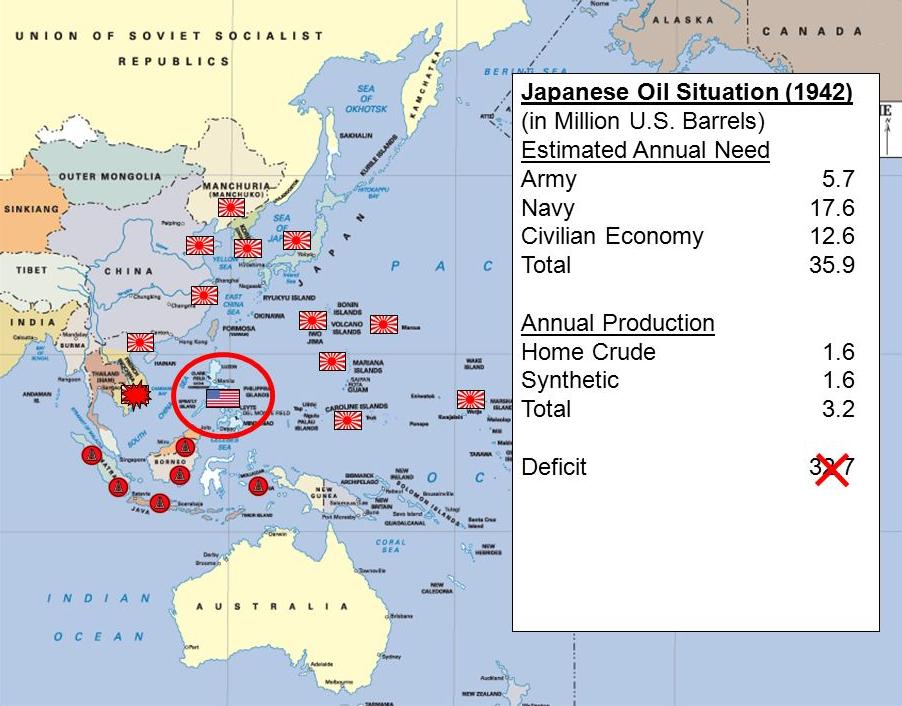
Japan with an industrial economy and a large navy required large quantities of oil. The ongoing war in China increased Japanese oil consumption. Modern war inevitably results in greater oil usage. Worst still, rather than a quick victorious campaign, the ware proved to be a quagmire and went on for 4 years with no end in sight. Unable to force China to make peace, the Japanese militarists began to consider their options. A rising star among the Militarists was 'The razor' -- Gen. Hideki Tojo was an advocate of total war and concerned about Japan's need for both empire and resources. Ending the War was out if the question. But the war in Europe created possibilities. Britain, France, and the Netherlands were weakened and two of this countries had colonies with oil fields in what the Japanese called the Southern Resource Zone (SRZ). The Imperial Japanese Army was not a mechanized Army. This meant that oil requirements were somewhat limited. The Imperial Navy was different, it required large quantities of oil to operate. The Navy participated in the war in China, but on a limited scale. The Pacific War would be very different. It would be primarily a naval operation and vastly increased quantities of oil would be needed. Naval commanders believed it was feasible because they could seize the vast oil resource of the SRZ meaning primarily British Borneo and and the Dutch East Indies. One source estimates that the Imperial Navy required at least 18 million barrels and the Imperial Army some 6 million barrels. 【Mawn】
No only was Japan almost totally dependent on imported oil, but Japanese oil companies had been shut out of the major oil-producing areas. Japan imported about 90 percent of its oil. To make matters worse for Japan, the United States was the major world producer of oil and Japan's principal supplier. And America was beginning to back demands that Japan withdraw from China with increasingly serious economic sanctions. And America with its Pacific fleet was the country Japan would have to fight if it was to expand its aggression beyond China and move to seize an empire in the resource-rich South Pacific--the Southern Resource Zone. Japan imported 1.0 million barrels from Soviet Sakhalin. There were other options, including British Borneo, the Dutch East Indies (DEI), Mexico, and Venezuela. And Japan did import some oil from the DEI and Mexico. In the DEI two companies were important, Shell and the Standard-Vacuum Oil Company (Vz) Shell was a British-Dutch joint venture. Vz was a subsidiary of Standard Oil (New Jersey) and Socony-Vacuum. The DEI possessed the largest reserves in East Asia, but British fields in Borneo were also important. Japan's major source of oil was the United States. The problem for the Japanese is that the British and Dutch generally followed American initiatives as did Mexico and Venezuela. This left Japan vulnerable to economic and political pressure and America moved beyond polite diplomatic messages to applying pressure in the form of economic sanctions. In addition, the Royal Navy controlled access to Middle Eastern oil and the U.S. Navy controlled access to Latin America oil, not only through diplomatic pressure, but through control of the Panama Canal. Before the invasion of China, Japan had been purchasing 80 percent of its oil in the United States (1937). The United States through its moral persuasion policy had succeeded in convincing American ship owners to reduce shipments to Japan without any formal action. Thus on the brink of war the Japanese were only obtaining 60 percent of their oil from America (1941). The American sanctions were painful, but the United States continued selling oil, if reduced amounts. America knew that the game changer would be an oil embargo. Japan would consider it an act of War. Japan would have to either accede to American demands or go to war.
The United States attempted to dissuade Japan from waging aggressive war in China. This proved ineffectual as the Japanese military steadily expanded it role in the Government. And the military even more than the civilians were convinced that Japan both needed and deserved a colonial empire. They saw that as not only appropriate for a great power, but necessary for the Japanese economy. Their major goal was China. Japan was blunted by the Red Army in efforts to Strike North (August 1939). Siberia had vast resources, but at the time, oil was not one of them. The Strike South Faction gradually gained power and here the oil and other resources of Southeast Asia beckoned. In the face of these domestic political developments, American diplomacy proved ineffectual. There was essentially nothing the United States could have dine short of recognizing the Japanese conquest of China. And of course there is no assurance that Japanese aggression would have stopped there.
The war in Europe opened new opportunities for the Japanese. The fall of France to the Germans rendered the French incapable of defending their colonial possessions. Hitler in the Franco-German Armistice (June 1940) allowed the new French Government in occupied Vichy to retain control of its colonies. This meant that the Japanese could move against Indochina. Indochina was important for a variety of reasons. Indochina had some resources, but it was geography that primarily attracted the Japanese interest. Possession of northern Indochina closed one of the last routes through which the Allies, primarily America, could aid China. Possession of southern Indochina put the Japanese within striking distance of the oil-rich DEI and Malay through which they could attack Singapore. The Japanese first moved against northern Indochina. Even before the French surrendered to the Germans, the Japanese French Ambassador in Tokyo with a series of demands (June 19). Tokyo demanded that France immediately cease shipment of all war materiel to China and to admit a Japanese Control Commission to regulate the border with China. Japanese troops massed on the Chinese border with Indochina and Imperial Navy ships sailed into the Gulf of Tonkin to demonstrate that these were no longer requests. The Japanese Government gave the French 48 hours to comply. The Japanese at the same time demanded that the British cease deliveries of war material to China over the Burma Road. An agreement was finally reached with the new Vichy Government which did not have the capability of resisting the Japanese (August 30). This allowed the Japanese to move military forces into the northern area of French Indochina (1940). A major goal of the Japanese was to cut off the flow of military supplies to China. The Japanese not only achieved that objective, but now could use French airfields to bomb Chinese targets.
After the Soviet Red Army destroyed a Japanese force on the Mongolian-Manchurian border and the negotiation of a NAZI-Soviet alliance, the Japanese militarist orientation shifted from a Strike North to a Strike South orientation. (July-August 1939). When Hitler and Stalin launched World War II (September 1939), tremendous opportunities were oped up for Japan. Britain, France, and the Netherlands were no longer in a position to defend their possessions in the SRZ which included the oil Japan so desperately needed. The only major problem was the American-controlled Philippines Islands. Which as can be seen here stood square in the middle between the Japanese Islands and the SRZ. The Americans, unlike the Europeans, has committed to independene for its one important colonial possession. The Philippines did not have important oil resources, but the strategic position meant that Japan could not be confident of transporting SRZ oil as long as the Americans held the Philippines.
Shortly after the Japanese began to move into French Indochina, American code breakers broke into the Japanese diplomatic Purple code (September 1940). The results confirmed what American diplomats had long believed, that Japan despite public protestations to the contrary, was preparing for war. The United States in response began a series of trade restrictions to dissuade Japan from continuing the war in China and further aggressive steps in Southeast Asia, The first step was the Export Control Act (July 1940). Japan responded with the Tripartite Pact (September 27, 1940) joining with the Germans and Italians, but not entering War. The goal was to deflect American pressure. The result was to harden American policy. The United States for some time held back from the ultimate embargo--oil. The Magic decrypts made Japanese intentions clear as did their move into southern Indochina. The United States thus well before Pearl Harbor knew that Japan was preparing an aggressive war in the Pacific.
With the Japanese occupation of northern Indochina and the revealing Purple intercepts indicating that the Japanese were intent on seizing the Southern Resource Zone, the Roosevelt Administration began debating how to respond. The Export Control Act (July 2, 1940) gave the President the authority to take a range of actions on American exports of 'essential defense materials' without further Congressional authority. The Cabinet was divided on just how to respond to the Japanese. Secretaries Morgenthau, Stimson, and Ickes argued for a real embargo that would really affect Japan--namely an oil embargo. The British were pushing for such an embargo. State Secretary Hull argued against an oil embargo. He was supported by the Navy Department which would have to fight a war in the Pacific. They argued that an oil embargo were tantamount to declaring war. They were right, but did not understand that the Japanese were moving toward war even without such an embargo. President Roosevelt, understanding that an oil embargo meant war, vacillated, not yet ready to make such a momentous decision. Chief of Naval Operations, Admiral Harold Stark dispatched a formal memorandum to President Roosevelt clearly stating that an oil embargo meant war (July 24). That same day in the afternoon, Ambassador Nomura, President Roosevelt, Admiral Stark, and Under-Secretary of State Welles met in the White House. Roosevelt not yet aware that the Japanese had forced Vichy to consent to the occupation of southern Indochina, suggested to Nomura that a diplomatic accommodation could be found on the basis of the neutralization of Indochina. He emphasized the key was that no Japanese occupation must take place. Roosevelt spoke openly to Nomura who he respected. He explained that the United States had abstained from imposing an oil embargo because he had no desire to give Japan an excuse for seizing the oil fields of the oil-rich Dutch East Indies. He also explained that he could not justify continued oil deliveries to Japan if Japan was to continue aggression. He said American public opinion would not accept this, especially with gasoline rationing. When Ambassador Nomura returned to the Japanese Embassy, he cabled Tokyo expressing his opinion that American embargoes were eminent if the Japanese didn't accept the President's proposal on the neutralization of Indochina. The Japanese Government never responded. The Japanese move into southern Indochina finally convinced the President that stronger action was needed. Southern Indochina brought the Japanese within striking range of the American Philippine Islands, British Malaya and Singapore, and the DEI. The final American action was President Roosevelt issuing Executive Order 8832 (July 26, 1941). This froze Japanese funds in America. 【Anderson】 Britain and the Dutch Government in Exile followed suit. This essentially meant a total trade embargo. Not only could Japan not buy oil and petroleum products (aviation fuel) in the United States, but it now did not have the foreign exchange reserves to buy oil from other sources, even the DEI. To make the the American position crystal clear, President Roosevelt froze Japanese assets (July 26). Freezing Japanese assets effectively prevented Japan from importing American oil. It amounted to an oil embargo. Britain, the Dutch, New Zealand, and the Philippines followed suit.
Japan had to import most of its oil in peace time and from the United States. War would require vastly increased oil supplies. Waging naval war in the vast stretches of the Pacific would mean huge increases in oik consumption. Japan had oil stockpiles that could supply its normal needs for 2 years, but only about 1 year if Japan went to war because of the huge increased requirements to fight a naval war. The American oil embargo set in motion a time table. Japan with the clock ticking had either to decide to cease aggression in China or go to war before it ran out of oil. The oil embargo and assets-freezing order according to one historian 'made war with Japan inevitable'. 【Morison】 He explains that 'a general impoverishment' of the Japanese economy was threatened with insufficient oil for 'normal domestic consumption, let along naval operations.' Japan of course had the option of making peace. But the militarists who invaded China would not be detered from conquering China by mere economic sanctions. Rather their answer was more aggression, seizing the resource rich Southern Resource Zone (SRZ).
President Roosevelt knew that the oil embargo would mean war. The Japanese were unlikely to back down. He was worried that the Japanese would seek an alternative to war with America. That would be to attack British and Dutch colonies with oil fields . That would give them the oil they needed, but would avoid war with America. The President was unsure how American public opinion would react. The Japanese were, however, entirely focused on military considerations. And the idea of leaving the American Philippine Islands with air, army, and naval bases astride their sea lane connections SRZ was rejected out of hand. The result was Pearl Harbor. Nothing the Japanese could have done so infuriated the American people. Suddenly a poorly armed, vacillating people were turned into a unified nation, with a fierce desire and terrible resolve to wage war. And unlike other victims of aggression, America had the capacity to do just that with an energy beyond that of any other nation. After Pearl Harbor, the President no longer had to be concerned about American public opinion or Congressional budget concerns. America was all in, up to hilt. And Hitler 4 days, genius that he was, solved the President's German problem by declaring war.
As Japanese naval commander Yamamoto struck first at Pearl Harbor (December 1941). Spearheaded by the powerful First Air Fleet, Japan in 6 months after Pearl swept over Southeast Asian and the central Pacific with largely ineffective Allied opposition. The American Pacific Fleet was largely immobilized, although the American carriers, Yamamoto's primary target, had not been at Pearl. The British position in the Far East was based on Singapore. The fall of Singapore (February 1942) shocked the world and opened the way for the rapid seizure of Burma and the Dutch East Indies. Japan also attacked the American forces in the Philippines, destroying most of the Air Corps planes on the ground, even though MacArthur had reports of the attack on Pearl Harbor several hours before the Japanese struck his air fields. The American in the Philippines held out for several months before running out of supplies and surrendering (April 1942). America soon learned of Japanese atrocities during the Bataan Death, fueling American hatred of the Japanese. After naval victories, Japanese paratroopers successfully seized the Dutch oil field largely in tact, altho the Dutch and British samaged the refineries to disable them. Japan then invaded New Guinea and the Solomons in preparation for an eventual assault on Australia.
War with the United States was a huge risk. The fact that the Japanese would risk war with such a powerful country speaks to the importance of oil. As the War played out, most authors think that it was y was pure insanity for Japan to go to war with the United States. This is especially the case because a naval war by definition is an industrial war, and Japanese industry was dwarfed by American industry. The Japanese military was incensed by the Washington Naval Accords (1921) which limited naval spending. Actually even though Japan was assigned a lower quota and America and Britain, it was advantageous to Japan. Japan did not have the financial capability to build much more than it did, but it allowed American and British building, especially American building which could have built much more. Even so, the Japanese decision is not as insane as it seems today. That was because the Japanese thought the Germans who were only miles from Moscow had destroyed the Red Army, And if that was the case, the Japanese case for war was much more reasonable. The only hint that he Red Army was not destroyed, the Counter-Offensive before Moscow came only as the bombs were falling on Pearl Harbor, meaning that there was no going back--the die had been cast. oil was intrinsically at the heart of the Pacific War. It was thw major reason why the Japanese launched the Pacific War. It determined the dirction if the Japanese advance. It had a hge impact on bth he Japanese and American conduct of the War. The Americans had it and the Japanese did not. It wold lead to the deindustrialization of Japan.
1939: The Japanese were studying how to benefit from the developing conflict in Europe, as they had done in World War I. Given their alliance with Germany and long held goals, he Strike North faction was focused on Soviet Siberia. Major battles fought with the Red Army on the border of Soviet dominated Mongolia convinced the Japanese that they did not have the military capability to deal with the Red Army (July 1939) Then without consulting the Japanese, Hitler signed an alliance with Stalin (August 1939). The Japanese were aghast, and never fully trusted the Germans again. Hitler and Stalin launched the War by invading Poland (September 1939). But the Japanese never anticipated the Soviet Union being a German ally. As a result, the Strike South Fraction rose in prominence. It is thus only in late 1939, that the idea of launching a Pacific naval war became to take shape. Japan at the time was primarily concerned with China and its inability to achieve a military solution. America and Britain were beginning to take war in China seriously and offering the Nationalist regime some assistance.
1940: President Roosevelt and most Americans continued to hope that the Allies (Britain and France) could deal with the Germans, requiring only material report. The French Army was widely seen as the most capable in the world. The German Western invasion and Fall of France shocked the world (June 1940). The resident moved the Pacific Fleet to Pearl Harbor (June 1940). The United States had been increasing naval spending, but on a still limited scale. The two Ocean Navy Act, opened the flood gates. Japan realized that once these ships began reaching the fleet, Japan could no longer compete, but ships take time to build. And the major ships authorized included the Essex-Class carriers and Iowa -class battleships would not begin reaching the fleet until 1943. Congress passed the Export Control Act, giving the President the authority to control exports of raw material and equipment of military importance. With the fall of France, French Indo-China was virtually defenseless. The Japanese demanded access to northern Indo-China. in part to prevent material aid from reaching Nationalist China. America diplomatic messages became increasingly critical. American code breakers broke Japanese Purple (diplomatic) code and thus able to understand Japanese moves. Actual commercial acts of consequence followed.
1941: The war in China was draining Japan, a serious economic burden, but the country was no nearer to defeating the Nationalists which had with drawn into he country's rugged interior. Japan neighbored American diplomatic notes and commercial sanctions. Then they moved troops into South Vietnam until the oil embargo was issued (July 194). The Hull Note made it clear that the United States as demanding that Japan end its aggression in China and withdraw from the country. Hard line Gen. Hideki Tojo was appointed prime-minister (October 1941). He decided on war unless the United States essentially accept Japanese control of China. Japanese carrier aircraft struck Pearl Harbor lunching the Pacific War (December 1941). The United States immediately ordered its submarines to conduct unrestricted submarine warfare.
1942: Both Japan and the United States were prepared for a commerce war like the German U-boats were waging in the Atlantic. . Japan did not think it as an effective use of its submarine force. The United States which had been critical of German U-boat tactics saw the submarine as a fleet scout mission. Its captains were not trained to be aggressive nor did they have a dependable, well tested torpedo. As a result in 1942, the Imperial Navy operated primarily on ts reserves (figure 1). Because of leadership issues and torpedo problems, the American submarines had almost no impact on he crude oil being shipped from the DEI and British Borneo. The old fields were seized in tack, but the refineries were damaged. Repairs were complicated when a ship carrying equipment and experts was sunk. The Japanese began to use their submarines to supply isolated island garrisons, something only marus had the capacity to do.
1943: The Japanese increased oil production somewhat, but consumption declined. The Japanese fleet was largely inactive in (1943). No major fleet engagements occurred. battles were fought. The Unites States Navy finally solved its torpedo problem (late 1943) and the U.S. submarines finally began sinking marus in numbers by the end of the year. This was facilitated by breaking the maru code. Japanese convoys/marus reported their position daily. While some oil did get through to the Home Islands. Japanese occupation was disaster for the people of Southeast Asia and he South Pacific. The economies of the region depended heavily on the British merchant marine withdrew with the Japanese conquest. The Japanese marus which replaced them, only carried Javanese military freight. Thus local economies collapsed.
:
1944: American summaries destroyed the Japanese maru fleet. This included oil tankers. Oil ceased arriving from the SRZ. The situation was so bad, that the major Japanese ships had to be based in Singapore near the oil fields. Also not reaching the Home Islands were mineral ores and food. And the end of 1944, the Japanese maru fleet no longer existed. Allied bombers also began hitting oil refineries in the DEI. Japan began he War with the finest cadre of naval aviators-in the world. They were meticulously trained. The last important carrier battle of the War was the Battle of the Philippines Sea (June 1944). The result was the Great Marianas Turkey Shoot (June 1944). The Japanese pilots were slaughtered because they were so poorly trained. This was the case because fuel was not available for their training.
1945; The American submarines had a problem in 1945, they had run out of targets. They were reduced to using their deck guns to sink sampans and fishing boats. There primary use became picking up downed American flyers. The marus that had not been sunk, stated in port. When the Yamato sailed on its final mission (April 1945), only enough fuel was loaded to get to Okinawa. American B-29 bombers began doping acoustic mines. This centered on the Kanmon/Shimonoseki Straits separating Kyushu. This largely ended coastal maritime traffic.
The Dutch interest in the Indies was initially spices. With the Industrial Revolution in Europe, demand rose for a range of natural resources. And the DEI was rich in many important industrial resources. The single most important resource was oil. Most of the oil came from from Sumatra. The DEI oil was most abundant and among the sweetest crude oil produced anywhere in the world. The Dutch Indonesian oil fields were some of oldest in the world. Commercial fields were discovered in northern Sumatra (1883). The Koninklijke Nederlandsche Maatschappij tot Exploitatie van Petroleum-bronnen in Nederlandsch Indië (Royal Dutch Company for Exploration of Petroleum sources in the Netherlands Indies) was founded (1890). The Shell Transport and Trading Company was a British company that had began drilling in Kalimantan (1891). The two companies merged to form Royal Dutch Shell (1907). Royal Dutch Shell became a major international oil giant. Initially they dominated oil exploration in the British and Dutch Malay-Indonesian colonies for three decades. Royal Dutch Shell was soon operating concessions in Sumatra, Java, and Kalimantan (Borneo). Royal Dutch's output from the DEI came to represent about 4 percent of total world production. What was to become Indonesia's most important oil fields (Duri and Minas) in central Sumatra, were discovered just prior to World War II by Caltex (a joint venture between the American companies Chevron and Texaco). Production did not, however, figure in World War II. By the time of World War II, the annual output of 65 million barrels annually was more than enough to make Japan self-sufficient and fuel not only Japanese industry, but all of the increased demands that would be required for a naval war in the Pacific. The DEI did not produce crude oil. The Dutch at a cost of 150 million gilders built a huge refinery at Balik Papan in eastern Borneo (1920s). Oil was, however, not the only resource. The DEI ranked only behind British Malaya in tin production. Production totaled 44,563 tons (1940). The Dutch also mined bauxite and coal in the DEI. There was also copra, nickel, rubber, timber, quinine, and important foodstuffs such as sugar, rice, tea, and coffee.
As far as we can determine, Japanese naval calculations for launching the Pacific War were almost entirely military. They did not calculate the logistical issues. The Japanese merchant (maru) fleet was barely adequate in peace time. War massively escalated fuel consumption. And the Japanese did not have the needed marus. They successfully seized the British and Dutch oil fields , but restoring them to productive operations and delivering the oil produced there to the Home Islands was a very different matter. Japanese imports of crude oil and refined products never approached pre-War levels. Imports plummeted as a result of the American oil embargo (1941). The Japanese managed modest increases, (1942-43), but far below pre-War levels. The situation was so bad, that major elements of the Imperial Fleet had to be based in Singapore and not the Home Islands. When the American submarine campaign kicked in (1944), imports soon fell to minimal levels.
The Japanese gained control of the Dutch East Indies after Pearl Harbor as a result of devastating victories over Allied naval forces assembled to defend the islands such as the Battle of the Java Sea (February 1942). The seizure of the oil fields were already in progress.
The first target was Borneo which was first attacked as part of the Malay campaign. Borneo was divided between the Brutish and Dutch.
The British had begun to substantially reduce the output at facilities on Borneo (August 1941). Output fell 70 percent. British military planners intent on husbanding resources to defend Singapore decided not to defend Borneo, including Brunein and Labuan. After receiving news of the Japanese attack on Pearl Harbor, the British began the already prepared destruction of oil fields and airfields at Miri and Seria. Orders for the demolition of the refinery at Lutong and the oil wells were issued and immediately carried out (December 8). Soon after, the Japanese began landing on British Borneo (December 16). They captured what was left of the oil fields at Miri and Seria and the refinery at Lutong. The Japanese conducted further landings Kuching (December 24), Jesselton (January 8) and Sandakan (January 17). They were furious at the destruction and lashed out at the British officials that fell into their hands.
The Dutch Borneo facilities located further south and east were targeted next.
The Japanese began operations against Dutch Borneo (January 11). The first Japanese landings were on Tarakan island. The Pamoesian and Djoeata oil fields there produced 6 million barrels annually. The badly outnumbered Dutch destroyed the 700 oil wells on Tarakan to deny the oil to Japan. The outraged Japanese murdered the captured Dutch POWs.
The Dutch began destroying oil facilities at Balikpapan (January 18). The Japanese landed in Balikpapan and occupied the town and oil refineries without any Dutch resistance. A month later the Japanese murdered 72 Dutch POWs and two Dutch civilians at Balikpapan for having destroyed the oil facilities (February 20). These atrocities seemed to have been carried out on the initiative of local commanders. There was no action taken by higher commanders as a result. nor was there any censure for the local commanders.
The Japanese landed unopposed at Sandakan, British North Borneo (January 23-24).
The Japanese next captured Bandjarmasin, the capital of Dutch Borneo, unopposed (February 10).
The refineries on Borneo were estimated to have the a capacity to supply up to 35 percent of the refined petroleum products Japan required as well as more than half of refined products need by the Japanese forces in the Philippines.
The Balikpapan refining and oil center was second most important in the DEI and Borneo. Only the Palembang refinery on Sumatra was more important. The Balikpapan refineries processed 5.2 million barrels of crude oil annually and produced needed aviation gasoline, diesel and motor fuel, kerosene and lubricating oil. Balikpapan’s Pandansari refinery, known as the 'the Ploesti of the Pacific'”, was a new and very modern plant producing badly needed aviation fuel. The Edeleanu plants produced sulfuric acid for the solvent treatment of aviation gasoline.
The oil fields on Tarakan island produced nearly 0.4 million barrels of crude per month. Borneo crude was light enough to be burned directly in ship's boilers, without refining. The IJN turned to this expedient later in the War, but discovered that the sulfur content so high that it would ruin the boilers.
The British and Dutch attempted to disable and destroy the SRZ oil fields and refineries before they fell into Japanese hands. The Japanese were furious and murdered many of the POWs taken in the area of the fields. This was the beginning of terrible Japanese atrocities that the Japanese had begun in China and would continue throughout the Pacific War. As bad as the treatment of Americans and Brits were, their treatment of the Dutch was even more barbaric. We are not sure just why this was, but suspect that the Japanese calculated that the Dutch unlike the British and Americans were an impotent, defeated nation. We are not sure at this time how badly damaged the oil fields and refineries were and how long it took the Japanese to bring them back into operation. One source reports that, "... the initial attempt to deny Japan the oil in the East Indies was only a temporary setback. While the Britis effectively put their refineries out of action. The Dutch were less successful and as a result for much of the Pacific War the Japanese Army contolled important refineries in the DEI, most importantly the former Royal Dutch Shell oil refineries in Sumatra. This included Pangkalan Brandan and Pladjoe (Pladju) and Standard-Vacuum Oil Company's (Stanvac) refinery at Sungei (Soengai) Gerong. A time-delayed Dutch demolition charge exploded and destroyed about 80 percent of Standard Oil's NKPM refinery (February 15), but the Japanese 2nd Parachute Raiding Regiment captured the BPM refinery at Pladjoe intact. While the Dutch demolition charges destroyed the oil storage tanks, the refinery was left largely intact. The Japanese would name Pladjoe the "No. 1 Refinery" and Nihon Sekiyu managed it. These refineries on Sumatra were important because they were close to Singapore where the Japanese f'eet was based. This was a major success for the Japanese. The No. 1 Refinery had a capacity of refining 45,000 barrels a day and this included high quality high octane aviation fuel. And of particular importance, the remote location meant it was largely shielded from Allied air attack. The primary location of Japanese crude oil production was at Prabumulih, south of Palembang in southern Sumatra. The crude was piped to the large Pladjoe refineries north of Palembang. This was important because of Japan's shortage of tankers. The Japanese Army also captured Stanvac facilities. 【Hackett. "Oil fields..."】
Japan was also able to restore the Borneoi Balikpapan oilfields with astonishing results that far exceeded their goals. Oil production in the Southern zone in 1940 was 65.1 million barrels. In 1942, the Japanese managed to restore 25.9 million barrels, and in 1943, 49.6 million barrels (75 percent of the 1940 level). With the East Indies oil, Japan was able to import enough oil to make up for the oil embargo in July 1941 by the Americans, British, and Dutch. There was no lack of oil, and the Japanese fleet could even refuel locally at will. They even struck a giant field in central Sumatra in the Minas structure. All these events helped make Japan feel that the oil problem, which was the driving force for its aggression, had been solved." 【PSU】
The American submarine campaign was hampered by by poor strategic and tactical concepts and ineffective torpedoes in 1942. The American submarines by 1943, however, began to significantly affect the delivery of raw materials to Japan. The American submarines targeted the Japanese merchant marine (maru) fleet. While the big fleet carriers got the headlines. The American submarines sunk over 50 percent of all vessels destroyed during the War. The Japanese merchant marine was almost completely destroying, cutting the country's war industries off from supplies and bringing the country close to starvation by 1945. The American submarines did to Japan what the German u-boats tried to do to Britain. Surprisingly the Japanese submarine fleet had little impact on the Pacific campaign. Unlike the Americans, the Japanese began the War with the effective Type 93 Long-Lance Torpedo. The Japanese Navy never used their submarines to interdict American supply vessels. Rather they were used to target fighting ships with only limited success because of their tactical deployment. The Japanese used their submarines as scouts and to target warships. As the American offensive moved toward the Home Islands, the Japanese used their submarines to supply bypassed island garrisons, some of which were near starvation. They were also used to supply bypassed island bases where garrisons were close to starvation. They also managed to get some secret German military technology to Japan late in the war (1944).
Oil scarcities affected the deployment of the Imperial Fleet. The Japanese inability to being the Dutch East Indies refineries on line as quickly as planned, meant that oil in anticipated quantities did not materialize. This compounded the situation created by the Midway operation. Admiral Yamamoto's Midway operation involved virtually every major ship in the Fleet. It used huge quantities of oil. As a result in the subsequent naval campaigns, the availability of fuel and the potential fuel usage had to be considered. Japan extensively used in cruiser force in the Solomon's campaign, but only deployed its battleships sparingly (August-November 1942). This was at a time when the American Navy had very few battleships available as a result of the Pearl Harbor attack. The availability of fuel also affected other major naval operations, especially the Battle for Leyte Gulf (October 1944). By this time the American submarine campaign had significantly degraded the Japanese tanker fleet. The convoluted, complex Japanese battle plan was in part dictated by fuel shortages.
Japan began World War II with both superior aircraft types and an elite corps of about 400 carrier pilots. The Japanese has a long, exhaustive pilot training program, perfectly adequate for any short victorious wars in which Japan may engage. Japan's war plan called for a short war with the United States in which the the American Pacific Fleet, especially the carriers, was quickly destroyed early in the War, When the Pearl Harbor attack failed to achieve this goal, the Japanese carrier pilot force was gradually attrited, especially the all in important squadron leaders. The Japanese, unlike the Americans, did nor return especially skilled pilots to flight school to serve as instructors. Thus once lost, their skills and experience were totally lost to the Japanese. The United States even before Pearl Harbor had greatly expanded pilot training programs. The Japanese did also, but not to the extent of the Americans. The major problem they faced was the shortage of aviation fuel. The only way to gain experience as for a plot is to participate in extended in flight training programs and log in flight time. And this required large quantities of aviation fuel. Fuel the Japanese did not have. Thus after the Coral Sea, Midway, and the Solomons, most of Japan's experienced carrier pilots had been lost. This led to the Japanese disaster in the Philippine Sea (June 1944). It proved to be the last of the great carrier battles of the War. The situation at the beginning of the War was reversed. The Americans had a greatly improved fighter, the Hellcat, and it was the Americans who were well trained and experienced. The battle as a result, is commonly referred to as the Great Marianas Turkey Shoot.
The oil facilities the Japanese seized (1942) were not remote from the Japanese base in Singapore, but they were from Allied military operations, meaning that for over 2 years they produced massive mounts of fuel needed by the Japanese Navy and Army in the region as well as shipments to the Home Islands. The American submarine campaign would not begin to kick in until late-1943 which began to interdict shipments to the Home Islands, but local deliveries, especially to Singapore were largely unaffected. Sumatran and Borneo were beyond the range of Allied bombing (1942-43). The Allied Combined Chiefs of Staff meeting at Cairo, Egypt addressed this issue (November 1943). The Cairo Conference (SEXTANT) discussed future military operations against Japan. Allied power by that time was growing. The U-boat threat had been defeated and American aircraft production was in full swing. One decision was to organize very long range range (VLR) bombing of Japanese targets in the DEI, chief among them oil facilities. The result was a series of American bomber air attacks and British carrier attacks. Operation Boomerang was the first attack (August 1944). The USAAF Twentieth (XX) Bomber Command launched 54 B-29 Super Forts based at Chengtu, China from a new RAF China Bay strip near Trincomalee, Ceylon to make a night radar attack on the Pladjoe refinery at Palembang. It was bombing and mining raid attacking facilities at Palembang. Results were of limited success and this was the only raid attempted from Ceylon. Further attacks would occur after the disaster at Leyte Gulf destroying most of what was left of the Imperial Fleet which had been based in Singapore. This was followed by another USAAF Twentieth (XX) Bomber Command B-29 attack (November 1944), this time hitting Singapore, both the Royal Naval Base’s King George VI Graving Dock and the refinery at Pangkalan Brandan, a small refinery in northern Sumatra close to Singapore. The British struck next with a carrier force (November 1944). British Task Force 67 launched (November 1944). This was the first of a series of carrier attacks on Sumatra-- Operation Outflank. The first Outflank attack was Operation Robson. Two carriers attacked he Pangkalan Brandan refinery, but bad weather adversely affected the results.
The refinery was heavily damaged, oil storage tanks, a small tanker was set on fire and two locomotives were struck.
Task Force 63 returned to Sumatran water and attacked Palembang as part of Meridian One, hitting the refinery at Pladjoe (January 24). The refinery was badly damaged. Japanese aircraft intercepted the attacking force and significant damage was done to Japanese aircraft on the the ground and in the air.
Task Force 63 returned to Sumatran waters off Palembang and launched Operation Meridian Two (January 29). They targeted Sungei Gerong refinery on the opposite side of Musi River from the refinery at Pladjoe. They badly damaged the Pladjoe refinery and conducted fighters sweeps of the airfields at Lembak and Tanglangbetoetoe. Major damage was done to the refinery including wrecking the cracking plant and power-house.
The Americans joined the action. The XX Bomber Command was conducting an anti-shipping campaign. They began mine laying missions during full moon periods (January 25/26). . Forty-one B-29s laid six minefields in the approaches to Singapore. The following night, 10 B-29s laid 55 mines in the Straits of Johore near Singapore. Another 22 B-29s laid mines near Singapore (March 28/29). None of the bombers were lost. .
The USAF XX Bomber Command launched three B-29 bomb groups to destroy attack oil storage facilities on Bukom and Sebarok islands off the south coast of Singapore as well as those on Samboe Island near Batam Island in the DEI (March 12). Bad weather spoiled the attack. The Americans returned (March 29/30. A force of 29 B-29s attacked Bukom Island from altitudes between 5,000 and 7,000 feet. Seven of the oil tanks on the island were destroyed, but most were undamaged. No B-29s were lost. This was not a high level attack for B-29s, but even from this altitude, results were disappointing.
These attacks on the Japanese oil facilities in Sumatra were followed by Australian landings on Borneo (May-July 1945). .
Strategic bombing was a new innovation to warfare in World War II. Air staffs had not yet worked out how to conduct such a campaign and what assets should be targeted. The United States learned a great deal as part of the strategic bombing campaign against Germany. The seizure of the Marianas (July 1944) brought the Home Islands within the range of the new B-29 Superforts. It took some time, however, to extend the runways and establish the air groups in the Marianas.
The American Strategic Intelligence Section of the Air Staff reached the conclusion that the Japanese petroleum industry should be targeted. The Joint Chiefs of Staff believed that destroying Japanese refineries cut off fuel to the Japanese military, especially the navy navy and air force which could shorten the war. Gen. Carl A. Spaatz, commander of the U.S. Strategic Forces in Europe had noted how the destruction of the German oil industry had shortened the war in Europe.
When he assumed command of the U.S. Army Strategic Forces in the Pacific, Spaatz supported the plans being drawn up to destroy the Japanese petroleum industry. Maj. Gen. Curtis E. LeMay, commander of the 20th Air Force, and Brig. Gen. Barney Giles, the deputy commander also supported the effort. The campaign, however, did not begin until rather late in the War. The assignment was given to the 315th Bomb Wing, 20th Air Force. The targets were the oil refineries and the oil storage facilities. The 315th Bomb Wing conducted 15 bombing missions against Japanese oil facilities and succeeded in causing significant damage (June 26-August 14, 1945). The U.S. Air Force by this point in the War was able to hit targets with considerable accuracy. Unlike the campaign in Europe. The Japanese air defenses were unable to significantly challenge the American bombers. General LeMay wrote to the Wing Commander, Gen. Frank Armstrong, concerning the attack on the Maruzen Oil Refinery at Shimotsu,"you achieved ninety-five percent destruction, establishing the ability of your crews with the APQ-7 to hit and destroy precision targets, operating at night. This performance is the most successful radar bombing of the Command to date." The United States Strategic Bombing Survey (USSBS), concluded that because the bombing campaign against the Japanese oil industry did not begin until May 1945, the naval blockade of Japan had largely cut off oil imports leaving the refineries very little crude oil to refine. 【Horowitz】
Thank you for your interest in our site. If using any of our material, partially or in full, we ask that you always provide an active hyperlink to the pages that you have consulted.
Hackett, Bob. "Oil Fields, Refineries and Storage Centers" (2013-16). Under Imperial Japanese Army Control
Horowitz, Manny. "Were there strategic oil targets in Japan in 1945?" Air Power History Vol. 51, 2004.
Mawn, Paul E. "Oil & War."
Morison, Samuel Eliot. U. S. Naval Operations in World War Vol. III The Rising Sun in the Pacific.
Penn State University (PSU). "Oil strategy and World War II," Egee 120 (2020). This courseware module is part of Penn State's College of Earth and Mineral Sciences' OER Initiative.

Navigate the CIH World War II Section:
[Return to the Main Japanese Road to War in the Pacific]
[Return to the Main Japanese energy page]
[Return to the Word War II Japanese strategic concept page]
[Return to the Main World War II Japanese page]
[Return to the Main World War II oil page]
[Return to the Main World War II page]
[Biographies]
[Campaigns]
[Children]
[Countries]
[Deciding factors]
[Diplomacy]
[Geo-political crisis]
[Economics]
[Home front]
[Intelligence]
[Resistance]
[Race]
[Refugees]
[Technology]
[Bibliographies]
[Contributions]
[FAQs]
[Images]
[Links]
[Registration]
[Tools]
[Return to Main World War II page]
[Return to Main war essay page]