|
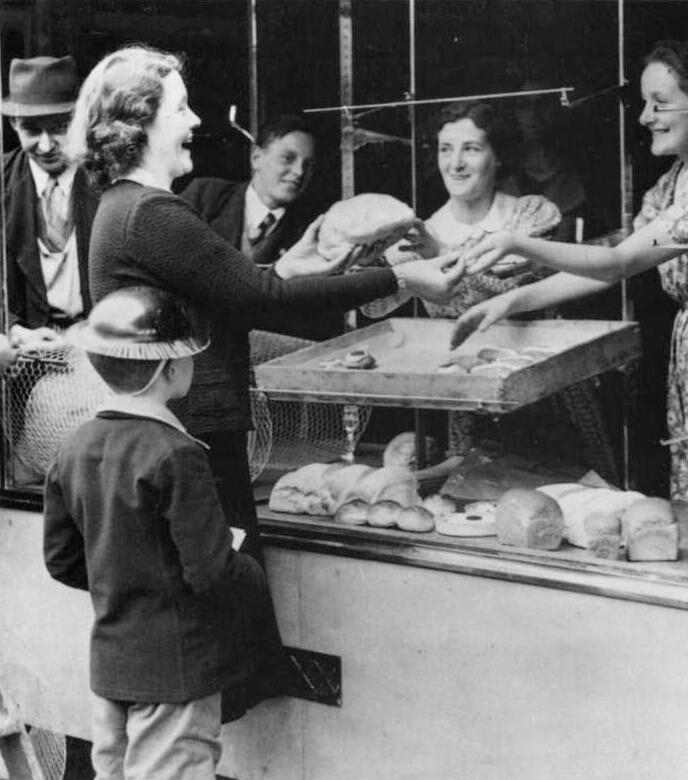
Britain declared war on Germany in September 3, 1939, after NAZI Germany invaded Poland. England within months initiated a rationing system. One of Germany's principal strategies in the War was to launch a naval blockade which centered on u-boats. The fall of France in June 1940 enabled the Kriegsmarine to significantly intensify that campaign from the captured French ports. As the War situation worsened, the Government had to reduce the rationing allotments. We had thought that the British Government in 1939 at the outbreak of World War II initiated a strict rationing program. We are having a difficult time determining just how the British approached rationing. Different sources provide different dates. Every Britain, man, woman and child, were issued with a ration card and a National Registration card (an identity card). The ration cards were presented to shopkeepers who cut the appropriate number of coupons for the rationed item at the time of purchase. The number of coupons cut was determined by the Ministry of Food. Sometimes more or less were taken depending on the supply of any particular commodity. Fruit and many veggies, unless they were grow yourself. Oranges and bananas which were imported were a very rare luxury. Other imported items (sugar and chocolate) hit children hard. Items of food rationed included Meat, (including bacon); milk and milk powder, the later was mainly for children and invalids; eggs; clothing and footwear; Petrol and oil, these of course were reserved for essential services. The ordinary person had none or very little. I do not have precise details of the amounts allowed of each item. Much use was made made of factory canteens or cafes near by the work place. Where meals could be had without surrendering of precious food coupons. Clothing and footwear were made to a standard. All items conforming to a war time standard had a special brand mark.
Britain was an industrial nation that relied on the sea lanes to import food for its large urban population. The success of the U-boat as a commerce raider forced the British to introduce a rationing system. Food became increasingly scarce, especially meat. People largely relied on potatoes. The Germans were convinced that Briton's need to import food made it vulnerable to a naval blockade by Germany's U-boats. Even without unrestricted submarine warfare. the Germans U-boats took a substantial toll on British shipping. The World War I U-boat, however, was not a true submarine, but a surface bot that could submerge. Restrictions on its operations substantially reduced its effectiveness. Thus the Germans decided to reintroduce unrestricted submarine warfare (March 1917), even though it meant that America would probably come into the War on the Allied side. This proved to be dreadful miscalculation. The Ministry of Food finally introduced rationing. The rationing system and, after the U-boat threat was largely defeated, food from America meant that Britons did not go hungry. Briton also benefited from a bountiful 1917 wheat harvest. At the end of the War, food consumption in Britain was close to pre-War levels. There were, however, serious problems with British food and food rationing during World War I.
Britain at the time if World War II had a population of about 50 million people, most of whom lived in cities and towns. As with World War I, the country was still importing about 70 percent of its food. This meant about 20 million tons of shipping was needed just go keep Britain fed. Shipping would be a major factor in World War II. Britain had the world's largest merchant marine, but he ships flying the Red Ensign would become the primary target for the German Kriegsmarine. The requirement varied as to the type of food imported: butter (90 percent), cheese (70 percent), fruit (80 percent), meat (50 percent), and sugar (70 percent). Shipping requirements varied. Onions from France required little shipping. A substantial quantity of butter, cheese, and meat came from New Zealand--a fifth of British meat, a quarter of the butter and half of the cheese imports came from New Zealand. Substantial ship tonnage was needed for such long runs as it took so long to complete a single voyage. Thus the German strategy would be to cut the sea lanes and starve Britain out of the War. Fortunately Hitler and the German Admiralty believed that the U-boat had been shown as ineffective in World War I. Hitler seized power in Germany (1933) and within a short period the British Government had to begin planning for another War. Unfortunately the British public did not support the needed military preparations. The Government among other steps began planning for wartime rationing (1936). They wanted to avoid the mistakes made in World War I. The Government established a Food (Defense Plans) Department as part of the Board of Trade to begin the planning. Actual ration booklets were printed up as war over German threats in Czechoslovakia seemed likely (1938).
Britain declared war on Germany in September 3, 1939, after NAZI Germany invaded Poland. Britain within months initiated a rationing system. As the War situation worsened, the Government had to reduce the rationing allotments. The Government was forced to drastically reduce food and clothing consumption. This was a problem the Germans did not have. With early successes in the War and brutal NAZI tactics, the economies of the occupied countries were looted to supply the need of the Reich. England was not self sufficient in food production. Just to feed the nation, large quantities of food had to be imported. Concerning clothing, all of the cotton, the primary raw material for clothing, was imported. All of the country's oil had to be imported. If the German's could cut the Atlantic sea lanes, they could not only prevent America from effectively entering the War, but they could actually force Britain to surrender.
The Battle of the Atlantic was arguably the most important of the War. Without victory in the Atlantic, Britain could not remain in the War. Nor could American bring its immense resources to bear on Germany. The campaign in the North Atlantic was the longest of the War. One of Germany's principal strategies in the War was to launch a naval blockade which centered on u-boats. The fall of France (June 1940) enabled the Kriegsmarine to significantly intensify that campaign. Even with American help before the United States entered the War, the Royal Navy was hard pressed to keep the North Atlantic sea lanes open. America and Britain were not able to turn the course of the campaign against the u-boats until mid-1943.
The British had two problems. First the War had bankrupted the country. Only American Lend Lease permitted the country to continue the War. Second. shipping was limited to both import war material and consumer products like food. Imported products like sugar and coffee were strictly rationed. Large numbers of British children spent several years of their childhood without chocolate, oranges, and bananas. The shipping problem was worsened for several years by the effectiveness of the German U-boat offensive in the North Atlantic.
The British introduced rationing and price controls to ensure that supplies of
food, clothing, and certain other consumer products were equitably distributed at at reasonable prices so each family was provide for despite their economic status. Unless some system was establish, well to do people could buy the available food and consumer goods and the working class would be in a desperate situation. There was also a financial factor.
Britain's difficulties were not just the u-boats, the enormous cost of the War was another factor in the rationing.
I had thought that the British Government in 1939 at the outbreak of World War II initiated a strict rationing program. We are having a difficult time determining just how the British approached rationing. Different sources provide different dates. One source reports that on December 1939 meat rationing began. On January 1940 bacon, sugar and butter were put on the ration list. On June 1941 clothing rationing was announced and continued until February 1949. Another source suggests that the British did not begin rationing as a war measure until 1940 At first only meat was rationed. Gradually as shortages worsened, other foods were added to the list. Rationing was introduced January 8, 1940. Meat rationing began March 11. More and more foods were added to the list. Not only were food stuffs hard to obtain, but quantities were limited. Many felt hungry and housewives complained about the time they wasted queuing for food. The ration book became were issued for every man, woman and child, ensuring a fair distribution of what meager essentials were available. All imports would be in short supply, as were much of home grown and manufactured commodities. The German U-boat campaign caused problems importing food as war materials were so desperately needed. It was the food rationing that is most remembered today, but clothes were also rationed. During the dark days of the battle with the U-boats in the North Atlantic, British officials were not even sure that Britain could maintain food supplies. Clothing was severely rationed.
A Ministry of Food was created during World War I only after 2 years had past. Immediately after Parliament declared War the second time (September 3, 1939), the Ministry of Food was reconstituted (September 4). Prime-Minister Chamberlain chose William Morrison to lead he agency. A few months later he replaced him with Frederick Marquis, Baron Woolton. He proved to be a brilliant choice. Marquis had the ideal credentials. He was a former social worker and former managing director of the Lewis store chain. He knew how to communicate with consumers. He had been awarded a peerage just before the war for his achievement with British industry. He had not previous political experience. He would serve as Minister of Food (until December 1943). By that time the food system was well established and Prime-Minister Churchill found a new job for him -- the Ministry of Reconstruction where he could begin planning how to rebuild Britain after the war. Woolton genius was that he understood that solving the food problem required more than just rationing available food and limiting what people ate. He ordered his Ministry to treat the British public as consumers and educated them on basic nutrition. This would empower them to get the most nutritional value out of the food that was available. Woolton was assisted by the impact of Home Economists after World War I. Thus it was widely accepted throughout the Government that diet was a necessary component of a healthy population. The Ministry's chief scientific advisor was Jack Drummond. He worked closely with Wilson Jameson, British Chief Medical Officer (1940-50). Woolton developed very effective ways of getting his message out, focusing primarily on housewives. By the end of the War, British housewives surely were the best educated housewives in the world on nutritional matters. The Ministry issued a range of publications, the most important were cooking leaflets. The focused on specific topics. An example was 'The magic of carrots'. The language employed was highly practical and realistic. They used ingredients that they knew were available. Cooking demonstrations were organized and carried out by people that would interest women. An example was Marguerite Pattenn, a popular English home economist, food writer and broadcaster. These were held in popular stores--including Harrods. Educational short movies on cooking were made and shown at cinemas before the feature. BBC Radio broadcast a morning radio program -- 'Kitchen Front'. It was hosted by Stuart Petre Brodie and featuring guests with expertise on food, gardening, cooking, and nutrition. The cooking guests would focus on foods that were available. Some 15,000 people were working the Ministry. They set up 18 Food Officers throughout the country, including one in Northern Ireland. There were 1,500 Food Control Committees which included members connected with all parts of the food problem, including consumer and retailer representatives. There were also 1,300 Local Food Offices which distributed ration books and licensed and trained shopkeepers to handle them.
The Ministry attempted to deal with the food issue from farm to plate. Grocers for example were instructed to source their product from the nearest supplier possible and not shop around. This saved on distribution costs, especially gas. The Ministry secretly set up food depot warehouses throughout the country where it stockpiled food in case of emergency, meaning primarily the expected German invasion.
We do not have precise details of the amounts allowed of each item. It was little enough. For one person; one or two eggs a week; 2oz. of butter per person. The wrapper of a pound pat of butter was printed in 2
oz. segments. It was easy to cut the allotted 2ozs. Cheese was at 2 to 4 ozs. heavy workers got the larger amount. Miners got other privileges also. What one did not eat others did and there was a swapping too with friends and neighbors. In the main the MoF managed rationing very well. People were not starved and the balanced diet benefited the whole population gaining in health. Except for Scotland the beer was brewed weaker. Sir John Simon announced that the Government was spending £1 million weekly in food subsidies (January 1, 1940).
Food restrictions at first were at first partly a financial step. The fall of France changed this. The Germans rush to the Channel Ports ad began building U-boat facilities. This significantly increased the potential of the U-boats. Ship sinking began to increase, bringing into question Britain's actual survival. The Government began to pursue much more restrictive food and rationing regulations. The Government made wasting food an actual offense (August 12, 1940). The Ministry of Food begins subsidizing fish and chip shops and encourages potato consumption (October 26, 1940).
Every Britain, man, woman and child (including babies), were issued with a ration card/booklet and a National Registration card (an identity card). The Government very early in the War took this action based on their World War I experience and knowing that Germany lost the war because they gave inadequate attention to food production and distribution. The concern was that as food and other items became difficult to obtain, prices would increase and working-class Britons might not be able to afford necessities, especially food. There was also the concern that some were hoard what was available, leaving others without what was needed. The Rationing was implemented to make sure ensure that every Brit got a fair fair of what was needed. This began with National Registration Day (September 19, 1939). Every British householder had to fill out a form with details as to who lived in the house. The system was implemented (January 8, 1940). Based on the National Registration Day, the Government issued every individual (man, woman, and child) with an identity card and ration book. Families or individual registered with local shops (there were no supermarkets yet). The shops were stamped in the book and you could only claim your rations from those suppliers. The Rationing
Books had coupons that were cut out or signed by the shopkeeper when redeemed. Individuals and families thus could only buy the allotted amount. Thus only allowed the item to be purchased, if it as available. There was no guarantee that it would be available. The shopper had to pay for the item as in pre-War times. There were different colored ration books. This was designed to make sure that different groups (especially children) got the right amount and types of food needed for basic health needs. Buff/light brown colored ration books were for most adults. Green ration books were for pregnant women, nursing mothers and children under 5 years old. Green book holders had the first choice of fruit, a daily pint of milk and a double supply of eggs. Blue ration books were for children and youths between 5 and 16 years of age. It was deemed important for growing children to have fruit, a full meat ration and half a pint of milk a day. Special attention was given to milk. Milk was supplied at 3 imperial pints (1.7 liters) each week with priority for expectant mothers and children under 5 years of age. There were 3.5 imp pt (2.0 L) for children and youth under 18. This was in addition to the milk they received at school. Children not attending school got 5 imp pt (2.8 L). Adults received one can of powdered milk (equivalent to 8 imperial pints or 4.5 liters) every 8 weeks. 【Ministry of Information】 The coupons in the ration books varied over time and were based on Ministry of Food assessments. The coupons were increased or decreased based on the supply of the commodity involved. Potatoes were strictly rationed. Onions were rarely available. Oranges and bananas which were not grown in Britain were a rare treat. At the end of the war, few younger children knew what a banana was. Some thought them a myth. A popular music-hall song written after World War I reappeared--"Yes! We Have No Bananas". Rationed food included included meat (including bacon), and cooking fat, milk and powdered milk, cheese, eggs, sugar, and tea, and coffee. The tea ration was especially important as it was son commonly drunk. Other rationed items included jam, biscuits (cookies), breakfast cereals, canned and dried fruit. Not all of these items were rationed at once, but by August 1942, most foods in high demand were rationed. Not all food was rationed. Pasta (macaroni) was never rationed. Fish was not rationed, but the perils of going to sea in war time meant that the supply was limited. Fresh fruit and most veggies were not rationed, but supplies were limited. Bread was not rationed during the War, but there was downside. White bread disappeared and what was produced was the 'national loaf'. This was wholemeal bread. People found it to be mushy, grey,, There were reports of indigestion problems. 【Calder, pp. 276–77.】 Customers were allowed to purchase fur loaves. Slicing and wrapping was not permitted. 【Otter. p. 159.】 Food was not the only rationed items. Other rationed items was clothing and footwear. Gas/petrol and oil was very strictly rationed, being a critical war material, but car ownership while the highest in Europe, was less common than in America.
Rationed Food purchases in shops were not the only source of food during the War. For those who worked, including many women especially young women, much use was made made of factory canteens or cafes near by the work place. Here meals could be obtained by workers without surrendering precious food coupons. The canteens were especially important for low income workers. The Government took action to ensure that the rich did not use restaurants to get around rationing. Meals in restaurants were restricted to a maximum of three courses, only one of which could contain meat, fish or poultry. And the cost could not exceeded 5 shillings, price everyone could afford. And many new restaurants were opened. There were some 2,000 new wartime eateries called British Restaurants. They were needed because so many more people were working. They were operated by municipal authorities using schools and church halls. With the evacuation of so many city children, there were many empty schools. A plain three-course meal cost only 9d (pence). That was more or less £1.85 in 2021 money. And ration coupons were not required. The British Restaurant program evolved from the London County Council's Londoners' Meals Service, began as an emergency service to feed bombed out survivors of the Blitz. The new restaurants were open to the public and served city office and industrial workers. 【Creaton, pp. 85–86.】
As a result of the Blitz, cooking depots were set up in heavily bombed cities like Sheffield and Plymouth, providing roast dinners, stew and pudding. Hot sweet tea was commonly distributed from food trucks after bombing raids. 【Otter, p. 164.】
One very important addition food sources, especially for our website is schools food programs. The MOE from the very start of the War engaged in proactive effort to provide food to school children. The first step was to incourage schoolxs to go into the gardening businees and to support them in doing so. And as the War progressed more snd mor schools were offering sdchool dinners (lunches). We believe that schools distributed milk at morning break. We believe that this had begun well before the War. The school milk was in asddition tyo the milk mums could buy in ghe xhop with the children's rastion books. (every Btrit had a ration book, including children and youths.) Over time schools began providing dinners (lunch) to the children. This also had begun before the swar, but unlike the morning milk break was not widespread. School dinners were a majpr undertaking because few schools had kitches of anybkind. This was all complicated because a massive transformation of British schools was set in motion by the War. Some one fifth of British schools were destroyed or damaged in the Blitz (1940-41). Thousands of schools were taken over by the Government for various purposes during the War. This was especially the case in southern England along the coast. With the evacuation of city children, city schools lot many of their pupils. as a result many schools were closed. Country and village schools had to deal with the massive influx of city evacuees wehicvh became a huge problem. These schools did have one advsntage. Thre was plently of ground for sdchool vgertsvle gardens. This is a facinating story that is largely untold by Wiorkld war II hidtorins who tend to ficu solely on the evcuastions which is a mjor story in itself. Moring milk and school dinners (lunch) became a ststury futy. And in the last year of the war some 1.6 million lunches were being served to the children daily. That amounted to a a third of the school population. (Remember at the time most British school children only asttended primafry school.) Underprivlidged children got free meals, mist childeren paid 4-5 pennies to cover the cost.
The Government instituted the Dig for Victory campaign (1942). They urged the population to turn over their flower gardens and allotments to growing food. Many public parks were planted with fruit and vegetable. . . It wasn't just at home that the menu was limited.
The British kept detailed records on food and health trends. Most countries reported a range of health problems as a result of the War. A rastre exceotion was Britsin. British health trends actually improved, of course not including the war deths. The British never went hungary. Al the complaints were about a monotinous diet, the absence of popular tasty food stuffs. The British diet during the War not provided needed callories as well as needed nutrition and vitamins. 【Creaton, pp. 85–86.】 And this was especially included low-income fasmilies. The British schieved this becuse of carefully conceived food policies, imcreased production, and Ldend Lease food shioments from Anmerica. 【Otter, p.161.] As it turned out the rationing actually improved the health of the British people. Infant mortality declined. Life expectancy rose (excluding war deaths). The primafy reason is that everyone had access to a nutritious if not a very varied, tasty diet.
【Creaton, pp. 85-86.】 Vitamin rich blackcurrant syrup and thenm American orange juice was provided free for children under 2 years of age. Children especially younger children got priority milk supplies as well as expectant mothers. As a result, consumption of milk by these groups increased. Consumption of fiber also increased. Consumption of fat and sugar with little nutritionl vaslue declined. 【Otter, p. 161】
A British reader tells us, "When I was a boy we had a gadget which was a small wire basket. It was used for holding stub ends of soap so the bits would not be wasted. It was manufactured during the War. People who lived in towns and cities with country folk had fresh eggs sent them. A special container was used so that the eggs would not get broken. People swapped the rations they did not like for something they did enjoy. Workers often had a subsidized hot meal at work. Some shop keepers traveled into the countryside to buy surplus food The price of commodities was fixed. Some shop keepers got fined for selling eggs above the fixed priced. Government eggs were often rotten and people were glad to pay more for fresher eggs."
The War required major changes in the British clothing industry. Thus time Britain did not wait for several years to introduce conscription as it had done in World War I. The mass call ups required a major shift to produce uniforms. This significantly reduced the production of civilian consumer clothing. The Government set standards for civilian clothing production. Clothing and footwear were made to a standard. All items conforming to a war time standard had a special brand mark. Like food, clothing was also rationed. British clothing factories and mills concentrated primarily on making uniforms for the military as well as various uniformed civilian groups. In addition, the need for food and war supplies meant that was less cargo space available for cotton and other raw materials. Britain's ability to pay for imports was another factor. American Lend Lease financed the purchase of war material, but not clothing for the civilian population. Thus the amount of clothing produced for the civilian population declined significantly. People had to wear their clothing longer and mended it as much as possible. The Government introduced clothes rationing (June 1, 1941). One HBC reader asks, "I'm trying to find out this a question about rationing. A contemporary source indicates, `On June 1, 1941, each British person was issued with 66 clothes coupons to last a year.' My question is, how many coupons would you need for a woolen dress and a man's overcoat?" HBC not at this time has only limited details, but hopefully we will eventually learn more about the rationing system. We note another source which indicates that each person had about 48 clothes coupons a year. Each garment was assigned a value in coupons. Each individual or in the case of children, their parents, could decide how best to use those coupons. We do not have a complete listing of garment coupon values, nor do we know if the values changed over time. One source provides this list of the value assigned to children's clothes:
Mackintosh (rain coat) -- 7, jacket -- 6, cardigan -- 5, trousers (long pants) -- 6, dress -- 5, gym tunic (school dress) -- 4, skirt -- 4, knickers (short pants) -- 2, shoes -- 2, and socks -- 1. Note that long pants needed three times the number of coupons as short pants. Obviously the Government was promoting short pants for boys because they required less material. The number of coupons for shoes seems surprisingly low. Sandals were not mentioned, presumably they had the same coupon value as shoes. A reader tells us that there were three stages to the clothes rationing system. by stage 1 of clothes rationing.. As part of those regulations it was mandated that schoolboys under 5'6" (168cms) couldn't buy new long trousers. Interestingly during the 1950s some schools had uniform regulations stating that boys under 5'6" had to wear short trousers as part of the school uniform. This was presumably a leftover from the war years an example of how school regulations persisted. We do not yet have the precise details on these regulations. One reader tells us that they were introduced in 1943.
The Board of Trade issued prescriptive regulations to manufacturers concerning the quality of fabrics, length of hems, and other such matters. Regulations were designed to reduce the amount of material in garments so more garments could be made. Shirts could not have double cuffs. Jackets had to be single breasted. Trousers could not have turn-ups. Suits for men were made with fewer pockets and without pants cuffs (turn ups). These were called "Austerity Suits". Women's skirts and dresses were made with shorter hems. Stockings were virtually unobtainable. Girls were more affected by the regulations than boys, as their dress styles were seriously curtailed to preserve fabric.
Apparently there was no universal agreement between the Board of Trade and Parliament as what was appropriate for children. It took some time for the officials to recognize that children grew, and adults didn't. Many of the restrictions appropriate to adult clothing were a false economy for children. If children's clothes had decent hems, the garment could be let-out and be useful for longer. A British reader writes, "I came across your essay page on "Short Pants" . I don't know if this is true but I remember my grandfather telling me (during a discussion about my clothes in the 1970s) that during World War II manufacturers were not allowed to make long trousers in boys' sizes and this continued until the end of rationing. He said it was because of the shortage of material. He claimed that the same should be true then to stop my arguing ..... Anyway - this could account for boys still wearing shorts in Europe in the 1950's and by then it had become the accepted tradition that boys wore shorts--at least until a certain age." This may well have been the case, but we do not yet have references to specific regulations.
School uniforms were affected, but some schools insisted on retaining traditional uniforms. World War II saw the demise of the top hat at Eton, at least as a part of the everyday uniform although toppers continued to be sported at the Fourth of June celebrations. Norman Longmate wrote a book about life in Britain during the War. He was at school at Christ's Hospital in the war years and greatly disliked the blue coat uniform. In the book he bemoans the fact that although the "ridiculous and impractical ensemble, dating back to the Spanish Armada' took up all of a boys" clothing coupons and more, the school insisted that the blue coat costumes were retained. (The quote is from memory, so these may not be the author's exact words.)
A thriving black market operated in Britain throughout the 1940s. People were often ambivalent about the black market. People engaged in black marketing were roundly condemned. Yet some of those same people did not see the harm in indulging a bit themselves. One could pay extra in some shops and get rationed items. Or you could discretely buy rationing coupons. Many people pretended to lose their ration books. Authorities believe that that as many as 90 per cent of such claims were false, but this was difficult to prove. So authorities normally replaced lost books. There were also forgers. They took advantage of the fact that ration coupons were not elaborately engraved bank notes. Ration books and coupons were relatively way to copy. Unlike America, the black market was not dominated by organized crime. Administrative procedures were more stringent in Britain and Britain lacked the organized crime families that operated in America, largely based around emigrant families. One of the primary concern of authorities was farmers holding back production because of the price controls. 【Zweiniger-Bargielowska】 'Spivs' was the name given to young chaps dealing in rationed goods. They had obtained them by dubious means and were Flash Harry types selling on street corners, in pubs and other sales venues that were difficult to monitor.
A British reader writes, "A farmer I know told me that without the Spivs and their black market activities people would not have survived. Perhaps this was because his family took part in supplying Black Marketeers."
The rationing system while not popular was accepted by the British people as necessary. And it was largely successful. The war time diet was indeed boring. People had to eat a lot of bread, potatoes, and vegetable pies. Careful planning ensured, however, that it was nutritious and adequate in terms of calories. No one went hungry, although most people missed their favorite foods. No only did the public not go hungry, but the working class, especially those who lost their jobs during the depression, actually ate better than they had during the 1930s. As a result, many British children were actually healthier during the War than before it. 【Zweiniger-Bargielowska】
Britain was so weakened by the War, that clothes continued to be rationed for several years after the War. Faced with postwar shortages and the problems of reconstruction, Attlee's government encountered severe financial difficulties, despite American assistance. Rationing continued to be a necessity, economic recovery was slow, and the cost of rearmament increased the strains on the economy. Rationing was still in effect when Elizabeth II came to the throne. In one village, where every Coronation since perhaps the 13th Century had been celebrated with a community Ox Roast, special dispensation had to be obtained for the 1953 event! Clothes rationing ended in 1949. Food continued to be rationed until 1954 when meat at last came off the ration--9 years after the end of World War II.
HBC has received several interesting accounts from English readers and noted a variety of published accounts.
War time clothes rationing in Britain (1941-46) imposed a restriction on fashion for boys. Boys under 14 were not allowed to wear long trousers. [HBC note: Our reader may mean that clothing manufacturer was diverted to making short rather than long trousers. HBC knows of no War time regulation that stipulated what children actually had to wear.] This was to conserve clothing fabric, needed for service uniforms. This age was chosen as 14 was then the minimum school leaving age. Presumably it was viewed that a boy old enough for work should be able to dress like an adult. There was an exception, in that boys over five feet tall, could wear long trousers, even if they were under 14. Many schools were evacuated to the country during the war. This resulted in a relaxation of the often strict uniform code. My school was sent to Devon in South West England. In winter we wore grey shorts, long sleeved grey flannel shirts, knee socks and grey Guernseys (pullovers with high slit opened necks.) In the summer we had short sleeved white open-necked cotton (Aertex) shirts. These are a loose knit honey comb cotton fabric, very like the modern tennis shirt. It was rather like an all year round camp uniform, far more comfortable than the starched collared shirts and long trouser flannel suits worn back in London. On return to London in 1945 we reverted to the tradition uniform. Still under wartime clothing restrictions, boys over 14 were required to wear long trousers. I hope to be able to send you photos of the two styles of uniform, but this may take a little time.
A HBC contributor reports, "Although I was born a couple of decades after the war, my father, like many of our Fathers, often reminded us about how fortunate we were. One of his comments on clothes when he was a boy just after the war was that his father used to take him and his brothers on rare occations, to the local
taylors for a fitting. His Father used to take some of his old clothes with him,that were outworn or were
disregarded. These clothes were used by the tailor for his sons to make use of the old material, as
raw materials for clothes during the ration years were very rare and expensive.He often uttered that
his father trousers were cut down and turned into shorts for him, together with waistcoats etc. Another couple of material saving scenes at the time were that his mother used to unstitch and unweave old jumpers or basically anything that was made out of wool, and reknit them into garments such as socks, tank tops, etc. I only found out last week that another common practice was cutting the tails of shirts and turning them into new collars after restarching them. (collars are the pasrt of shirts that ear out the fastest.) These recycling practices were common amongst the working class during, and after the war.
In a letter to the editor in a British newspaper, a letter writer recounts the clothing he wore as a boy in wartime England. "When I attended school in England my whole secondary education was spent under wartime conditions and severe rationing. Due to shortage of 'clothing coupons' I wore short pants until I was 16 years old, because shorts required less coupons than long pants. I had to wear grey flannel jacket and short pants with grey socks, white shirt, school tie, and school cap at all times, even though English winters were not conducive to short pants in all weather, riding a bicycle. .... Summertime a patterned school blazer was 'de rigeur'."
I grew up in Britain during the war, and still recall some details of the rationing.
We got 26 eggs a year, a store would have a notice as to what egg allocation it had, 1 to 26.
Bread was the last thing to be rationed, that was the time when Holland was being liberated.
People kept hens for the eggs and meat, fed them toasted bread, well my parents did.
The Isle of Mann was the only place where milk was not rationed, for obvious reasons.
It was 2 ounces of butter and 4 ounces of margarine a week. My mother was a tailor, and she took old cloths apart and remade the material into clothing for us. Ration books came in different colors, one for adults, children, and a green colored ration book for expectant mothers, which was for the infant. A green ration book brought an allocation of orange juice concentrate, no one else got that.
If using any of our material, partially or in full, we ask that you always provide an active hyperlink to the pages that you used.
Calder, Angus. The People's War: Britain 1939–45 (New ed.). (Pimlico: 1992).
Creaton, Heather J. (1998). "5. Fair Shares: Rationing and Shortages," Sources for the History of London 1939–45: Rationing (British Records Association: 1998).
Guppy, Alice. Children's Clothes 1939-1970 (Blandford Press: Poole, Dorset, 197?) There is a good description of the regulations and the advent of common sense in Guppy's book.
Ministry of Information. Home Front Handbook (1945).
Otter, Chris. Diet for a Large Planet ( University of Chicago Press:2020). .
Zweiniger-Bargielowska, Ina. Austerity in Britain: Rationing, Controls, and Consumption 1939-1955 (Oxford and New York: Oxford University Press, 2000), 286 p.

Navigate the CIH World War II Section:
[Return to the Main English World War II rationing page]
[Return to the Main English World War II page]
[Return to the Main World War II ration page]
[Return to the Main fabric page]
[Return to the The main 1940s page]
[About Us]
[Biographies]
[Campaigns]
[Children]
[Countries]
[Deciding factors]
[Diplomacy]
[Geo-political crisis]
[Economics]
[Home front]
[Intelligence]
[POWs]
[Resistance]
[Race]
[Refugees]
[Technology]
[Totalitarian powers]
[Bibliographies]
[Contributions]
[FAQs]
[Images]
[Links]
[Registration]
[Tools]
[Return to Main World War II page]
[Return to Main war essay page]
[Return to CIH Home page]
Navigate the Historic Boys' Clothing Web chronological pages:
[The 1840s]
[The 1900s]
[The 1930s]
[The 1940s]
[The 1950s]
[The 1960s]
[The 1970s]
[The 1980s]
[The 1990s]