Individual German Schools: Alphabetical List
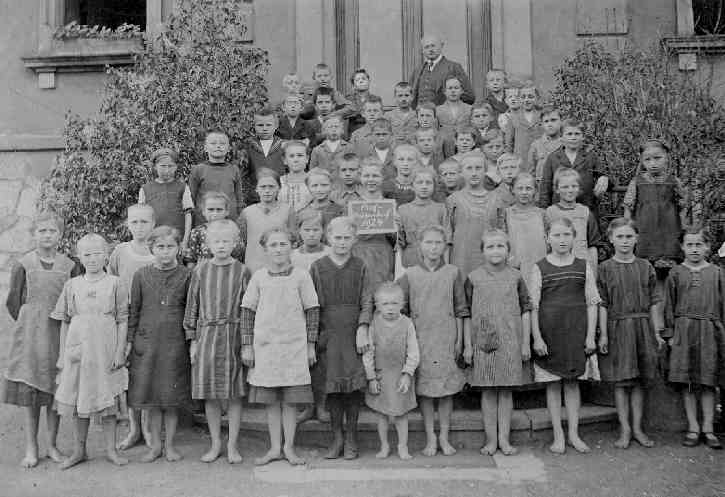
Figure 1.-Here we see the primary school at Moschendorf, a section of the town of Hof in Bavaria . Hof is located in northern Bavaria near Saxony border, on the Saale River. It must have been a sbnstantial school with several different classes. We have two portraits taken in 1924. The girls mostly wear pinafores over their dresses. The boys wear suits, including a few sailor suits. Almost all the girls are barefoot. We can not see the boys, but they are presumably barefoot also. These portraits. are a good reflection of the difficult economic conditions in post-War Germany. Most pre-War school portraits show German children wearing shoes, especially at city schools.
|
|
HBC has begun to collect information on German schools during different time periods which will include Imperial Germany, the Weimar Pepublic, NAZI Germany, East and West Germany during the Cold War, and modern unified Germany. We only have a few schools at this time, but hope to add tp our list. We hope that some of the large number of German visitors to HBC will provide us some insights into the uniforms and clothes that they wore to school so that we can add to our list. Unfortunately in only a few cases do we know the name of the school.
A
Here we see the primary school of Altenau, a village in the district of Goslar, in Lower Saxony. The school portrait we have is from 1927. It seems to be a typical small village chool. We can't tell much about the schoolfrom the details in the background. The age range of te children suggests that it was quite a small school. Most of the girls wear pinafores. We know pre-school boys also wore pinafores at the time. It was much less common for boys to wear pinafores to school. We have no indication about the season, but some children are wearing coats or heavy jackets. Almost all children are wearing boots, however in the front row a girl wears strap shoes; a girl and a boy are barefoot. The boy wears also a garment that covers only the ankles.
B
Here are some students at the Volksschule Barnsen in 1936. Barsen is a small town in lower Saxony. They look to be all boys, but there may be two girls at the back. The children are shown here with their recorders, leaning to play an instrument. This is a simple instrument that is used to teach music to young children. The fact that it was simple and inexpensive mkes it ideal for early chilhood music instruction and is still widely used. The children are with this teacher. This is not a class group. Volsschule had much larger classes. It is interesting that music was being taught. Music of course is very important in Germany, but we are not sure just to wht extent music was part of the curruiculum. Our understanding is that the curriculum was very academic with few departures from the curriculum. What we do not know here is if this was part of the standard curriculum or an after school activity. Nor do we know what the rest of the class was doing while these children were doing music. We do not know if these children were selected or chosen. They look to be about 9-10 years old. They wear short trousers and long stockings except one boy who wears knee socks.
Betzingen is a suburb of Reutlingen, about 30 miles to the east of Stuttgart in southwest Germany in Baden-Württemberg. Betzingen is the largest and oldest suburb of Reutlingen in Baden-Württemberg . It was incorporated in Reutlingen (1907). What was once a rural village became urbanized. and become very urbanized. We note the Hoffmannschule in Betzingen. We note a school class in Betizingen, Germany (1914-15). We think this is a different school.
The school is a mixed boys and girls school. The boys are wearing knee trousers with black long stockings. Most of them wear jackets but with no neckties. The children as this a 5th year class would be about 11 years old. A few girls are wearing pinafores. The name Hansens is written on the bottom. I think this may be the name of the teacher standing in the background.
A HBC reader has provided us what looks like a portrait from the Bismarck School. We know it is a German school, but we do not know where in Germany it was located. It is clearly a primary school. We also know that theportrait was taken in 1913 just before the outbreak of World War I. The image shows just how popular the sailor suit was in Germany. Note that there was no one standard style. Mothers had a wide variety of middy blouses to chhose from. Perhaps the fact that mny mothers sewed their cildren's clothes contributed to the diversity.
This was a secondary school that educated boys in academic subjects to prepare them for university entrance. One had to pass examinations to be admitted. The ages of the school were from 10 to 18. We have no specific information on the school at this time. The only information we have here is the class portrait. I'm not sure where Blackenburg is located.
Here we have a school photo taken in Blender, a municipality in the district of Verden, in Lower Saxony, Germany. The photo was taken in 1952. It looks to be a small primary school. I think this would have been East Germany at the time. The children look to be about 8-9 years old. Most of the boys wear short pants, many H-bar or suspender shorts. The girls all wear dresses. Some of the children are barefoot, but we can not tell how common this was.
Bad Kissingen is one of Gernmay's best known spa resorts, well known throughout Europe. Visitors in the 19th century every guest was celebrated with three loud trompetsounds. It is located in the Bavarian region of Lower Franconia, This is south of the Rhön Mountains on the Franconian Saale river. We see a photograph from a primary school in the town during 1932. There is no school name only the town. The school looks small for a major spa town. Perhaps there was more than one school in town. The children are well dressed. Two boys and one girl wear sailor suits. Many boys wear open-collar Schiller collasrs. In one case it looks rather like a white sailor blouse. Several boys wear H-bar shorts, although it is difficult to tell if they are wearing Lederhosen. The girls seem to all be wearing dresses. Many have their haior done in pigtails. The boys mostly wear knee socks. A few of the boys wear ankle socks or long stockings. Some of girls also wear long stockings.
The photo was taken in primary school of Bomst/Babimost on April 4, 1923. At the time the village was in eastern Germany. Thus tis was a German school. We can't read the text, but it is almost certainlt written in German. A 1871 census reported a population of about 2,300 people, almost evenly split among ethnic Germans and Poles as well as 160 Jews. The local indusries were shoe manifacturers, linen producers and hops (beer) and wine producers. We do not have a 1920s census, but it likely that the village contined to have a substsantial German and Polish population. Here the boys seem to be wearing suits wth knee pants and long pants. Many are barefoot. The girls wear dresses, many with pinafores. The teacher is rather informally dressed with a knickers suit and what looks like strap shoes.
C
D
HBC has found some information on the Deutsche Schule Bukarest from the late 1950s throught the 60s. The school was founded in 1751 and served both the German community and Romanians that wanted an academicaly rigorous education for their children. Classes were in German, but German until the 20th century was a nuvh more important language than it is today. We get to follow one class as they go through the school. So we not only to see the different styles for the various age groups, but also how school fashion was changing. The children wear light-colored shirts and Pioneer kerchiefs. Most of the boys began school wearing suspender short pants and finish school weaing long pants.
This is an interesting photo taken of the first grade class (all boys) at Diesterweg School in Werdau, Saxony (East Germany). Saxony was part of East Germany during the Communist period. The class portrait looks to have been taken in 1953. The teacher with the boys is Herr Tenzler. This would have been a Volksshule (primary school) , but we do not know if the East Germans changed the terminology. The boys are standing in front of their school. The door bears a motto promoting the Young Pioneers, the Communist Youth Group, which translates as "Young Pioneers make Men." Most of the boys are in short trousers and long stockings with German garter waists (i.e., Strapsleibchen with four hose supporters). A few boys are in long pants gathered at the ankle, which was the alternative to short trousers. There was no set uniform. The boys are just dressed like German schoolboys in most of East Germany. East Germany kept long stockings in style somewhat longer than West Germany.
This is a class photo of the Volkshule Dortmund-Kirchenlinde--a class of boys in the upper division of the
school. Many of these boys were preparing to be teachers although the school is not specifically a school for teachers. The source tells us that most of the boys in this class were 14 years old with perhaps a few a year or so younger. That is just the age that would mean that they were soldiers at the time that Hitler launched World War II (1939). So many would have died at an early age. The boys are wearing standard schoolboy clothes for the 1920s--dark suits with knee trousers, and long black stockings. Many of them wear Schiller collars with their jackets. Only the teacher wears a necktie. The boys all seem to be wearing high-top leather shoes.
E
This is a class photo taken at the Gymnasium in Esslingen am Neckar (Baden-Württemberg, Germany) in 1949. It is a Gymnasium 1st grade class, meaning the fifth year of school in the German school system. This would mean that the boys were about 10-years old and had just finished Volkshule. Gymnasium was aselective secondary school, rather like a British grammar school. Before World War II, many German children did not attend secondary school. Most working-class did not go on the secondary school. This changed after the War when the secondary system was significantky expanded. We are not entirely sure when the changes were implemented and what the status of the educational reforms were in 1949. The boys are wearing a variety of garments, formal and casual. Two boys wear very formal jackets, while five of their mates are wearing only undershirts. We commonly see German boys wearing a variety of clothes, but we have not noticed wearing singlets to school before. Perhaps it was a hiot day. Or perhaps this was a reflection of the still difficult post-War conditions. Another possibility is working-class children beginning to asttend Gymnasium.
F
This photo was taken in 1936 in Fredersdorf-Vogelsdorf, a village about 25 km east of Berlin.
The photo shows the last grade class at the village school. It was a substantial brick building. The class has 24 children, 11 girls and 13 boys. They look about 12 years old. The girls wear rather long dresses. The bots wear shirts, some with sweaters or suit jackers. All the boys wear short pants. Only two boys thst we can see wear knee socks. Two boys in front wear sandals, open-toe sandals, and one is barefoot.
G
Here we have a boys Volkschule in Gablenberg, a village near Stuttgart. Presumably there was another school for girls, unless the genders were educated in different classes in same school. Smaller villages had coed classes. We have a photograph of the 3rd grade class in 1939. The official name of the school is simply Volkschule in Gablenberg (which means public primary school). Voksuchule was a 4-year program neginning at age 6 years. We do not know if the older children not receiving secondary educated remained in the building for their classes after the 4th year. The boys would be about 8-years old in the 3rd grade. The photo for some reason appeared in the Stuttgarter Zietung (the major newspaper of the area). The boys wear a variety of sweaters and jackets.
We notice the primary school in Gleina durin 1949. Gleina is a small town in the Burgenlandkreis district of Saxony-Anhalt. We think the class is the 3rd year (about 8 year olds). At the time it was part of East Germany, but very close to the border with the West. The class is mixed. Except for one boy in long pants, all the children, both boys and girls, wear long stockings, obviously with Strapsleibchen (bodices and supporters). One of the girls in the front row wears a pinafore. Several of the boys wear suspenders with their short trousers. The boy in the front row, third from the right, wears his short trousers with a halter and cross strap over a sweater. Another boy in the second row has the same kind of shorts with a halter top. The picture was taken
outdoors apparently in front of the school doors. The teacher is standing in the back at the left in a suit and tie.
The Goldschmidt Jewish private school operated on the grounds of an estate at Berlin-Grunewald. We have little information on the school. We do not known when it was founded. We know it operated during the 1930s. Presumably the NAZIs closed it in the late-1930s or early 40s. Many Jewish children attended state schools. Germany had one of the finest state educational system in the world. Jewish children did well in the state system. After World War I when anti-Semtism grew, some schools were not safe for Jewish children to attend, even in the 1920s before the NAZIs seized power. Thus some parents preferred to send their children to private schools. One specifically Jewish private school was the Goldschmidt School. The school operated with a British curiculum which proved helpful after the NAZIs seized power because the children there could more easily adjust to foreign schools if they managed to emigrate.
H
This is a school photo taken in Haag, near Windpassing, in Bavaria. This is a little confusing because there are several Windpassings located in neigboring regions of Bavaria and Upper Austria. The photo was taken in 1950. Haag is a village about four kilometers from Hemau in the Upper Palatinate, in Bavaria. It belongs to Landkreis Regensburg. The boys here wear various shirts and jackers. Almost all are barefoot. One boys wears knee socks and shoes. The rest of the boys here are barefoot, at least the youngr boys in the front row. We are not sure about the girls who are behind the boys. This is a little surprising as by 1950 the West German economy had begun to recover and most images we have found of German schools during the 1950s, even the early-50s, show the boys wearing shoes. We see Austrian school children commonly barefott in the 50s, but this was less common in Germany. Perhaps Bavaria was a little different. We are guessing that Haag was an agricultural area were children commonly went barefoot as was the case in rural Austria.
This small German class was located at a school in amall village named Hallmann, which we can't locate anywhere in Germany. The students look to me about 6-10 yeats old. The younger children are in the front row. The boys and girls wear normal school clothes.. The boys wear sweaters, short trousers, and long stockings with supporters (Strapsleibchen). You can see the garter clasps on the leg of a boy in a rear row, sitting on the aisle. One of the interesting features of the photo is the older Wehrmacht (Heer) officer. Perhaps he had come for the day to lecture the children, but he looks more like a teacher. We have noted disabled soldiers used as teagers during the War, in part because so many teachers (who were modtly male) were conscripted for military service. But we have not noted soldiers as teachers befote the War. The source dates the picture 1938-39, so it would have been just before World War II or shortly after it had begun. The class looks rather small (only about 14 children of mixed ages), so presumably Hallmann was a rather small village.
This is a Gymnasium class in 1921. We are not entirely sure what the school waas called. While we use the name Hannover Gymnasium, we suspect there was more than one gymnsium in Hannover. The photograph was taken in Hannover which we believe means the city rather than the state in general. The picture was taken in Hanover. The photographer was located at Heinrich Strasse 15. The school was undoubtedly located in that part of the city. The boys look to be about 14-15 years old. They don't wear uniforms, although they are very similarly dressed in their school caps with black shiny visors. This was the only uniform item. The boys all wear suits as was common at the time. This was probably more widely accepted conventin than school rules. Only two of the boys wear a necktie with their suits. The boys mostly wear knee pants, but we see one boy with long pants.
Here we see a group of younger boys at the Hardenberg Gymnasium. I'm not sure where Hardenbeg is located in Gwemany. We know nothing about the school other than a gynasium was an academically selective secondary school. The image is fated 1964, although we might have guessed was taken earlier. The class was all boys. We are not sure just when Germany shifted to coeducation. The boys wear casual shirts and both long and short pants. Several boys wear halter suspenders. I don't know if they are wearing lederhosen several boys wear sandals.
Häslach is a small town in southwest Germany in Baden-Württemberg very close to the Rhine and the French border. The town during World War II was the location of a sub-camp of the NAZI Natzweiler-Struthof concentration camp. Many French people resisting the German World War II occupation arrested by the Gestapo were incarcerated here, presumably because it was so close to France. There was also an underground munitions factory. We note the Volksschule (primary school) after the War in 1954. At the time the German economic miracle was beginning to transform the country. The children all seemed smartly dressed for the school portrait. Most of the children wear long stockings which is interesting because at the time, long stockings were beginning to decline in popularity.
This is class of boys (aged about 10 to 12) from the Heinrich Heine School in Salzwedel, Germany, a town in Saxony-Anhalt at the junction of the Dumme and Jeetze rivers. The photograph was taken in October 1948 just after World War II. The class contained a number of very poor boys--their poverty made worse, of course, by the devastated condition of Germany in the postwar years. The commentator, who doesn't give his name, appears in the picture. He is the boy wearing the striped pullover in the second row just behind the boy wearing very short pants and long stockings with supporters ("Stumpfhalter" as the commentator calls them). See the enlarged detail of the second attached photo. His striped sweater was a gift from his Aunt Erna, who
had emigrated to the United States. The commentator, writing in 2004, mentions that the teacher of the school, Karl-Heinz Frank (he stands on the right), is still alive and was recently commended for his 50-year career as a teacher.
We note images from the Hermsdorf School in the 1930s. I don't think that this was the name of the school, but rather the town where the school was located. I'm not even sure that the school had a formal name other than the name of the town. It looks to be a primary school with children up to about 14 years of age. The only information we have about the school at this time is the available school photographs.
Here we see the primary school at Moschendorf, a section of the town of Hof in Bavaria . Hof is located in northern Bavaria near Saxony border, on the Saale River. The school apparently did not have a name, but rather was jusjy known as the Hof Moschendorf School. It must have been a subtantial school with several different classes. We have two portraits taken in 1924. The girls mostly wear pinafores over their dresses. The boys wear suits, including a few sailor suits. Almost all the girls are barefoot. We can not see the boys, but they are presumably barefoot also. These portraits. are a good reflection of the difficult economic conditions in post-World War I Germany. Most pre-War school portraits show German children wearing shoes, especially in city schools.
This class portrait we have been able to identify. The school was the Hoffmannschule in Betzingen, presumably a primary school. Betzingen is a suburb of Reutlingen, about 30 miles to the east of Stuttgart in southwest Germany. The boys are about 7-8 years old, meaning only a second or third years boys--although this is only a guess. The man is Rektor Willmer. Rektor here means principal or headmaster of the school. While that is only a guess, we do know that the portrait was taken in 1954. Many German schools in the 1950s were still segregated by gender in the 1950s. You can see long pants beginning to be worn by younger boys which was not very common in the 40s. Long stockings are still quite common, at least in chilly weather. Most of the boys wear long stockings with short trousers, but a few wear long trousers, and one boy is wearing shorts with knee socks. The long stockings seem to be cotton and vary in color from brown to tan to beige.
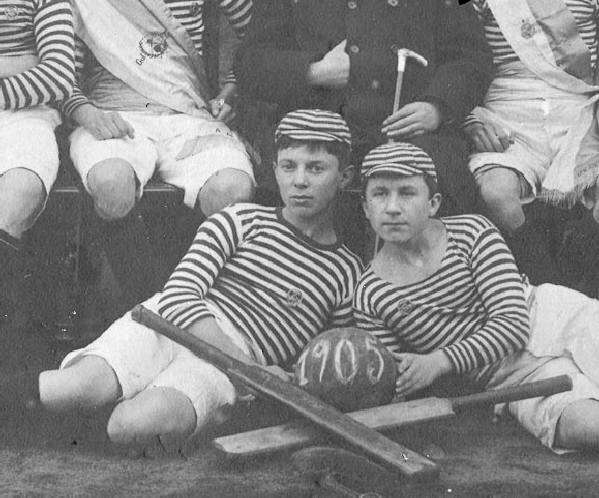
Figure 2.-Here are members of the cricket team at the Jacobson School. I don't think cricket teams were very common at German schools, but we are less sure about boarding schools.
|
|
J
Israel Jacobson founded a school which became known as the Jacobson School (1801). Jacobson was the father of reform Judaism and his philosophy was reflected in the school. The new school had 40 Jewish and 20 Christian boys who were to be educated together, a novel concept in the early 19th century. Especially novel was Christian children in a majority Jewish school. The boys were given free room and board. The idea of living and working in close association was a central concept of Rabbi Jacobson. Rabbi Jacobson's school established very high standards and acquired a reputation for quality education. Several hyndred boys from the surrounding area were schooled there durng the 19th and early 20th centuries.
The school was located at Seesen am Harz, near the Harz mountains in Lower Saxony.
The school became known as the Seesener Jacobson Gymnasium. We note a portrait if the school cricket team in 1905. I don't think cricket teams werecall that cimmon in Germany. The boys' names are listed on the back.
The Collegium Josephinum in Bonn was one of the most respected secondary schools in Germany. We have a photograph taken during 1939. Note the NAZI banner in the background. The boys are marching in the Corpus Christi procession in Bonn. the Collegium Josephinum was an academically selective secondary for boys (ages 13 to 18). The boys don't wear school uniforms, but they are dressed up for the religious feast day of Corpus Christi. They all wear suits with short trousers and mostly black long stockings. I do not know if the boys all wore long stockings to school as part of a dress code, but it was probably expected on a religious holiday. They don't wear neckties but rather open-necked shirts (Schiller collars). One boy wears tan long stockings, but the convention obviously called for black stockings. Note that one boy wears a sailor suit. Although the photo was taken in 1939 (Corpus Christi occurs in the Spring), the
clothing is quite conservative--typical, apparently, of Catholic private schools. These boys are not dressed very differently from what we might expect a decade earlier. One of the features of dress for Catholic religious holidays and ceremonies in Germany and northern Europe was that boys were often mandated to have their knees covered,
hence the long stockings (more formal than knee socks, which were also worn at the school for activities like hiking).
K
Here we see the Kafertal Primary School in 1955. It looks to be the children at recess. Kafertal is a neigborhood in Mannheim. Mannheim is a city in the southwestern Germany, the third-largest in the German state of Baden-Württemberg after Stuttgart and Karlsruhe. The city is at the center of the larger densely populated Rhine-Neckar Metropolitan Region. Mannheim was an important industrial city and thus targetted in the World War II Allied air campaign. The first major raid occurred during the battle of Britain in rtaliation for the German Blitz on British cities. The school unlike many schools in industrial cities apparently survived the War. The photograph was taken 10-years after the War.
This class portrait was taken in Kircheim, Hessen during 1949. This would have been in the Americam occupation zone at the time. It shows a first year class at the local Gymnasium (academically seledctive secondary school). The boys are wearing a variety of garments. Someone wear lederhosen, others short pants. Some children wear jackets, others wear shirts and someone only undershirts. Boys would not have dressedcthis informally before the War.
Kischken was a village in East Prussia. As a result of World War II, much of East Prussia ws tranferred to the Soviet Union and Poland. This area was transferred to Soviet--occupied Lithuania. It is now Kiškiai in Lithuania. We have found a photograph of the village school in 1933. It appears to have been a substantial brick building. East Prussia was one of the poorer regions of Germany, a largely agricultural area. There was also a substantial non-German population in rural areas. We are not sure about Kischken, but assume there were many Poles and Lithuanians. The school, however, was conducted in German.
Here we see the Kornau Grundschule (Primary School) in 1949. Kornau is a separate quarter of Oberstdorf, a Bavarian village. Oberstdorf is in Bavarian mountains, near the Austrian border. The boys wear typical clothing with lederhosen. Most are barefoot.
Kuelsheim is a village near Würzburg. We do not know much about the school, but it seems to have had a substantial school. As I understand it, these schools were normally not named, but simply referred to as the school of the village in which they were located. We do have a class portrait taken The picture was taken in school year 1948-49. The children wear a variety of clothing styles. The difficult conditions in Germany after World War II are still aparent because many children are barefoot. Two of the boys wear folk-style jackets.
L
The Lessing Gymnasium is one of the oldest and most respected secondary schools in Germany. It is the oldest surviving school in Frankfurt am Main, one of the largest German cities. (Similar schools were called grammar schools in England. I am not sure what the school was called when it was founded.) The school was founded in 1519 by the merchant dominated city council. Similar schools were being founded at this toime in other European countries, especially the northern countries of western Europe. The historians among us will recognize the date. Europe was changing rapidly in the early-16th century as the developing economy was creating more demand for young people who could write abnd do sums. And the school was founded 2 years after Martin Luther nailed his '95 Thesis' on the church door igniting the Reformstion which rapidly spread throughout Germany. This created even more emphasis on literacy and education. The school is still operating today as a gymnasium. The gymnasium program places a considerable emphasis on foreign languages. This begins with Latin and English in 5th grade, children of about 11 years of age. The students in the 7th grade the pupils choose between French or Ancient Greek. The school also offers a fine arts program, an area thst has been expanded in recent years. It has several orchestras and choirs. A nice photo of German High School students (10th grade, which is about 13-14 years old). The portrait we have is tentatively dated 1937, but we think was taken a few years earlier. The boys wear a variety of school clothes, mostly with short trousers and long stockings but a few with "Kniebundhosen"
(literally knee pants), which in German means knickers that come just to the knee--not the baggy or longer style knickers).
M
We note the Merschwitz near Meißen, in Saxony. We do not yet know much about Merschwitz. The substantial school suggests it was more of a town than a village. It appears to have been a fairly standard primary school in a substantial building. We are jmnot sure when it was built, but we would guess the 1920s. There surely was a school in town before this building was built. The images we have are from the 1930s. We have both a 2nd grade (1932) and a 5th grade (1935) class. We see both boys and girls. Villages and small towns generally had coeducatiional schools. Larger towns which had more than a single school were more likely to have single-gender schools. The classes include anout 30 children each.
N
We note teachers taking children to recess at the Neubrandenburg Schule in Germany (1955). It looks like a new building, perhaps built after the War. The school included a kindergarten. It seems to be a mixed school with both boys and girls. Many of the boys are wearing short trousers with long stockings while a few others are in long trousers. The teachers are in white aprons. I suspect that they were carers for the kindergarten and younger children. Brandenburg is in eastern Germany.
P
Here we have a school in Pechern. This was a small village near the Polish border. We do not know the name of the school. It was probably just called the Pechern School. It would have been a primary school. As Pechern was in eastern Germany, it was after World War II in the Soviet occupation zone and subsequently the Communidt German Democratic Republic (DDR). We note a class portrait in 1955. Several of the children are barefoot. That is something ehat would have been much less common in West Germany where the German Economic Miracle was transforming the country into the prosperous center of Western Europe.
The Peterwitzer School was a school in Silesia. A reader has brovided some images from the 1920s-40s. At the time Silesia was part of Germany. After World War II it was transferred to Poland and the Germans expelled. Some of the ohotographs seem to have been taken during school trips. Unfortunately we have no further details on the school.
R
The Gymnasium Rahlstedt was located in Hamburg. We so not yet know much about the school. We have a class portrait from 1931. It looks like the new first year boys at the school. They look 10-11 years old. They are informally dressed, but wearing their school caps. While German secondary schools did not have uniforms, they did have destinctive school caps. Only two boys did not have the caps. Boys at many gymnasium in Germany wore suits and ties. These boys mostly wear shirt-like sweaters. One boy wears a sailor suit. Teo boys wear wide white collars. All wear short pants, most with knee socks. Sone boys wear long stockings, some of which look home knitted. We believe this was seasonal. In colder weather probably more boys switched to long stockings.
This is an all-boys' class and presumably school at Ruckerg Primary School in 1951. It is a 2nd year class. We are unsure just where Ruckerg is located. These single gender schools were common before the War. They were mostly integrated during the 1950s. Note the lady teacher. That was another major chabnge in German schools after the War. A certain variety in the boys' clothes is observable here. One boy in the back wears a Bavarian jacket (note the different colored lapels). Several boys wear similar Bavarian jackets, but without lapels. Over boys wear jackets or sweaters. We see several halters or H-bar shorts. Nearly all the boys wear short pants. We also see knickers. The boy in the back row with the Bavarian jscket wears long pants. Most of the boys wear knee socks, but in a few cases long stockings.
S
Here we see a boys' class in 1933 Bavaria. The school was the St. Gunther Volksschule of Rinchnach, a Catholic confessional school located in the Bavarian Forest of southeast Germany. The teacher was Herr Braunfofer. This is obviously a primary class of "Buben" (= boys) about 7 or 8 years old. The details are interesting, both the class furniture and the slates the boys use. The overwealming impression, however, is the very large number of boys in the class. The boys are very informally dressed. The boys wear short trousers, mostly with long stockings. One or two boys wear sailor suits, but the others wear jackets of various kinds--none of them with dress shirts or neckties. Some boys wear dark-colored open-necked shirts.
The class portrait was taken during the school year 1928-29 at the primary school of St. Peter im Schwarzwald, a municipality in Baden-Württemberg. Schwarzwald meant Black Forest. We suspect that it was a Catholic school because the area was lagely Catholic. The name of the school does not necsarily suggest that it was Catholic as many Protesant (Luthern) schools were named after the saints. This is an interesting photograph in that the boys seem dressed differently than was commn in Gemany at the time. It was not a small village school as can be seen in the background. The substantial building is presumbly the school. The children, however, are mostly barefoot as you might expect at a small village school. All of the boys are barefoot and most of the girls. The pivture was prsumaby taken after the Wall Street stock market crash. It would seriously affect German, but the impact would take more than a few months to begin to filter trough and affect children's clothing. Also interesting is the fact that the boys are wearing long pants or longish pants. That was not very common for boys this age at the time. Again it suggess a conservative rural community, rather than a town school. Also unusual re te shirt like jackes the bys wear. Many if the girls wear pinafores.
Here is an interesting photo dated 1915 taken of the graduating class of St.
Stephan's Gymnasium (secondary school) in Augsburg, Germany. The boys would be
about 17 or 18 years old. They are obviously dressed formally for the class photograph in dark suits with white shirts (mostly with detachable starched collars), neckties, and black lace-up high-top shoes. Some of the boys already are wearing long trousers, but the majority seem to wear knee-pants suits with long black stockings. Notice the ornamental buttons at the knee of the boy who is reclining. The boys also wear caps, mostly flat caps.
We note photographs taken at the Schönemoor village school before and after World War II. Schönemoor is a German village about 15 km west of Bremen in northwestern Germany. We know very little about the village or the school. The first photograph was taken in the mid-1930s. Three boys wear their Hitler Youth uniforms. They are prominabtly placed in froint. The girls wear dresses, many with pigtails. It looks like a single class at the school. A photograph taken after the War in 1947 shows the affect of the War. Several children are barefoot, unable to obtain or afford shoes. The boys all wear short pants with either jackets or sweaters. The girls asll wear dresses. Schönemoor would have been in the British occupation zone.
Skerbersdorf is a village in Saxony located close to Silesia (one of the modt fought-over proivinces in Europe) on the Lusatian Neisse River. The area was settled by Germanic tribes and then Slavic tribes when the Germans moved west. Charlemagne in the Saxon Wars began the Christinaztion of the Saxons (8th century AD). We are not sure when the first written records of the village appdear. Developing trade routes made the area important and many battles were fought resulting in substantial destruction. The area was devestated by the Thirty Years War (17th century). Skerbersdorf is located in the southeastern portion of East Germany, very close to the post-World War II Polish frontier. We note several portaits taken in the village school duting the post-War era.
The photo was taken at the school of Stresow, a village in Saxony-Anhalt, Germany. The photograph is not dated. but it looks like the 1920s to us. Almost all of the boys are barefoot. weare not entireely sure about trends in rural village schools before World War I, but we see quite a number of barefoot children in the difficult period after World war I in the 1920s. A few boys wear sailor suits. Almost all of the boys wear short pants and are barefoot. Seasonality is probably another factor here. We are less sure about the girls, b\ut tghey probably did not have shoes as well. The classes have about 35 children making it an average sized village school. The childrten are dressed very warmly. We suspect that coal supplies to heat the classrooms and homes were limited.
W
This is a Volksschule primary school class in Weissensee (a district of Berlin) taken in 1935. We would have guessed that they were the youngest children. German children began Volkschule at age 6 years. The source referred to as the second class. If this means the the second year, then the boys would be about 7 years old. The class seems to be only boys. There is a pupil in the first row with rather longish hair. Most boys had their hair cur short for school, but we occassionally see a few boys with lionger hair. Several of the boys are wearing sailor suits. Some have white collars abd bows. They all are wearing short trousers with long stockings (with the traditional Leibchen--bodice and supporters). They look quite happy. Notice the male teacher standing at the back of the class. Most boys had male teachers even in the early primary years. This did not begin to change until World War II. He has taken pains to decorate the classroom with images the boys would enjoy. The pictures around the room appear to
involve horses and farm animals. Notice the school caps hung on hooks at the back of the room.
Unknowm Schools
Here are schools that we do not know the names.
A HBC reader has mentioned a lovely little short story by Alphonse Daudet, entitled "La Derniere Classe" ("The Last Class"). It was published as part of Daudet's Lettres de Mon Moulin ("Letters From My Mill"). The story is set in Alsace. It describes a French teacher telling his class that he was being replaced and this will be the last day that their class will be taught in the French language. An indifferent schoolboy comes to class on the last day that instruction will be given in French. It is 1870-71 and the Franco-Prussian War has ended with a overwealming German victory. German must now be used in the Alsatian schools. The schoolboy enters class a bit late (his custom!) and listens as the schoolmaster relates the sad news of the German victory to the class. The schoolmaster's praise of the French language
and literature awaken a belated patriotism and love of French in this errant but goodhearted pupil.
We do not know the name of this school. Here we see boys wearing an unusual combination of school clothes. Most boys wear various types of sailor suits. There are, however, also boys in "civilan" suits as well as one boy in a cadet uniform. We are not sure what kind of school this is, but the boys look to be in the first or seconday year of a secondary school.
This class of younger children looks to have been photographed about 1915. They wear mostly smocks and sailor suits, often with large bows.
This class of primary-age children were photographed in 1913. They wear mostly sailor suits and plain jackets, mostly without bows. Many of the girls wear pinafores.
We note a photograph of a group of German boys. Infortunately we have no provinance about the image. It is undated and there is no location indicated. We are guessing that it was just before, but more likely during the War. We are not positive that it is a school group, but that seems the most likely explanation. It looks like it could be a military school, but the boys are very young. The uniforms are quite elaborate. The the cost of such uniforms again suggest a school.
This looks to HBC to be a German class photographed in the late 1910s. The early 1920s is a possibility, but the late 1910s looks more likely. The boys wear a wide range of outfits from suits to sweaters and scarves. All of the boys, however, wear knepants and dark long stockings.
This class in about 1925 shows boys dressed in both sailor suits and regular suits in about equal proportins. Two of the boys wear sailor suits, but the boys in regular suits seem to be wearing mostly short pants, but with calf-length instead of knee socks. There may be one girl and one boys wears a velvet suit. The boys seem to vary in age from about 7 to 9 years of age.
This class in
about 1925 shows boys dressed in both sailor suits and regular suits, although
the regular suits are slightly more common. All of the boys appear to
be wearing short pants. There is one child with long hair who is almost
certainly a boy. Several boys wear smocks of many varied styles. The
boys seem to vary in age from about 9 to 11 years of age.
This class of older boys, about 11-13 years
of age, wear suits and sweaters with short pants and kneesocks. These
older boys do not wear sailor suits or smocks.
Boys at this boarding school wear sweaters, short pants, and kneesocks. There shorts are cut shorter than in the 1920s. For some reason they wear their belts over their sweaters.
We have a portrait of an uknowm German primay school taken in 1936. It is a large class and the children look quite young, probably their first or second year in school. We know it was taken in 1936 because the year is written on the back of the photo. The children wear a wide variety of clothing. At least three of the boys are wearing sailor suits. Many of the
children are wearing a badge of some kind--some of them two badges. A few of the girls wear pinafores. The portraut was taken 3 years after the NAZIs seized power. We do not notice any NAZI symbols in the classroom. Hitler's portrait is not on the wall, although only one wall is visible.
We note a German primary school class in 1948. They are a third year class and all boys. Gender separation appearently ws still quite common in 1948. A few of the boys wear lederhosen, but there may be more as many have jackets. We note that everal boys have Bavarian kackets. We are not sure where theis photograph was taken, but we suspect Bavaria.
HBC

Related Chronolgy Pages in the Boys' Historical Web Site
[Return to the Main Chronology Page]
[The 1850s]
[The 1860s]
[The 1870s]
[The 1880s]
[The 1890s]
[The 1900s]
[The 1910s]
Navigate the German school pages
[Return to the Main German individual school page]
[Return to the Main school uniform national page]
[Return to the Main German school uniform page]
[Imperial Germany]
[Weimar Republic]
[NAZI era]
[Post-war Years]
[Modern Germany]
Navigate the Relate Boys Historical Clothing Style Pages
[Return to the Main German page]
[Long pants suits]
[Short pants suits]
[Lederhosen]
[Kneesocks]
[Eton suits]
[Jacket and trousers]
[Blazer
[School sandals]
Navigate the Boys' Historical Clothing School Uniform Pages
[Main School Uniform Page]
[Australia]
[England]
[France]
[Germany]
[Italy]
[Japan]
[New Zealand]
[Scotland]
[United States]
Navigate the Boys' Historical Clothing Web Page
[About Us]
[Activities]
[Chronology]
[Clothing styles]
[Countries]
[Debate]
[Economics]
[Garment]
[Gender]
[Hair]
[History]
[Home trends]
[Literary characters]
[School types]
[Significance]
[Transport and travel
[Uniform regulations]
[Year level]
[Other topics]
[Images]
[Links]
[Registration]
[Tools]
[Return to the Historic Boys' School Home]
Created: September 4, 2001
Last updated: 7:50 PM 9/1/2018