**
Italian school uniform chronology -- 1930s cronologia italiana del uniform della scuola
Italian School Uniform: Chronology--1930s
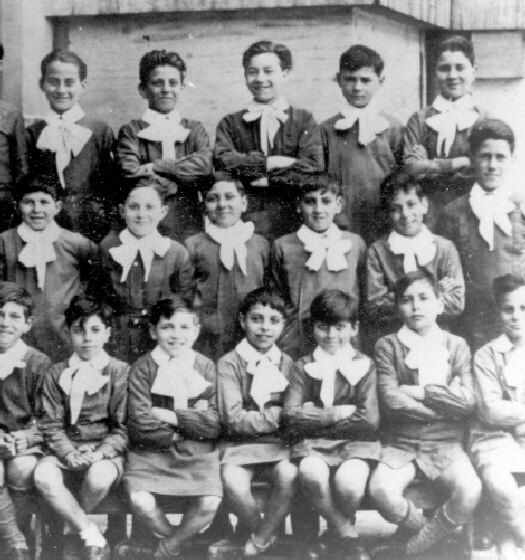
Figure 1.--The class picture here is undated, but looks to hav been taken about 1935. A HBC reader indicates that this is an origional photograph from an Italian school that Marcello Mastroianni attended. It is unmistakable which boy he is (5th from left, top row).
We note many boys along with girls wearing smocks in school during the 1930s. We are not sure precisely when smocks were introduced. They do not appear to be so universal in the early-1930s. Our Italian school archive is not as common as several other ;large countries. Many of the school portraits we have obtained rom the 1930s show the children wearing required school smocks, both boys and girls. We can not say yet that the smocks were universal. We see some schools where not all the children wore smocks. They were, however, cerainly were very widely worn. There was not, however, one standard style or color. Also we note white collars abd smock colors varoed. One class photograph was taken about 1935. All the boys wear similar looking smocks, probably light blue, with white collars and white bows. All of the boys wear white collars, but there are some differences in the collars. As all the boys wear the same smocks they are clearly required. A portrait at another school in 1937 also shows all the childtren wearing smocks. One boy notably has tucked his smock into gis waistrband, wearing it like a shirt. This was, however, not very common. There muist have been some kind of nationl requirement for so many boys to be wearing smocks. But we are not sure just what the requirment and rgultions were. Italy in the 1930s was under the control of Benito Musolini's Fascists. There were differences from school to school, but most Italian children seem to have worn school smocks. There semes to have been no requirement as to what the boys wore with their smocks, although most boys wore short pants.
Italian boys and girls have dressed very differently, but these differences have varied substantially over time. The differences were fairly standard during the first half of the 20th century until well after World War II. The boys wore long and short pants and the girls dresses and skirts. This began to change in the 1970s when we begin to see girls beginning to wear pants. Both boys and girls commonly wore smocks. We note, however, some schools where only the girls wore smocks. Here we do not yet fully understand the conventions. While both boys and girls wore somocks, there were often differences on the color or design of the smocks differentiating those for boys and girls.
Unidentified Town School (1935)
I'm not sure about the name of the school here or what kind of school it was (figure 1). The boys here almost all seem to be wearing short pants with smocks, although one boy in the fromt row wears long pants. There was clearly no rule about shoes and socks as there is clearly no uniformity. The styles range from no socks at all to ankle socks to knee socks of different
patterns. Colors of shoes and socks aren't consistent either. One boy in the front row, far left is wearing knickers with his smock, which may indicate that boys in second and back rows may have been wearing either long pants, knickers, or short pants under the smocks. There are 35 boys in the full class portrait and they are pictured with their teacher. There looks to be some difference in the age of the boys, perhaps a normal difference in a class of this size. We would guess that they are 11-12 years olds. Some of the boys at the back look like they might even be 13 years old.
Here we have a class portrait from an unidentified Italian school, presumbly a primary school. The children look to be about 10-11 years old. This would make them some of he older children at the school. They are 23 children which suggests about 160 children at the school, unless there are more than one class for each form/grade age group. The differences in the smocks here suggest that whilke the Government required snocks that it was up the individual schools as to details like color, length, design, collars, bows, and other details. Many schools like the school here decided on gender differences for the boys and girls. The girls seem to be wearing white smocks with bows. The boys wear light colored smocks without bows. We are not sure about the color of the boys;' smocks, perhaps light blue. We assume they are all the same color. All he children have large white collars, although they very in size. And they exhibit just about every cut imaginable. There seems more variery here than we see at most other schools. Almost all of the smocks, including those for boys, appear to be back buttoning. The smocks vary quite a bit in length. One boy notably has tucked his smock into his waistband, wearing it like a shirt. This was, however, not very common. They are photographed with their teacher who is wearing a heavy overcoat, so the portrait was presumably taken during the winter. As seems standard in Italy, there are no belts worn with the smocks.
Here we see an Italian school during the 1938-39 school year just before war was to break out in Europe. The photograph is from the Ozzano Monferrato School, near Turin. This is an interesting image, but we do not fully understand it. The Fascist influence can be seen in the Balial uniforms that some of the boys are wearing. I believe that the uniforms were just worn on separate occassions. We are not sure why only some of the boys war yhe uniforms. About half of the boys wear smocks, the normal school outfit. This is especially confusing because as we understood it, participation was virtually mandatory. Another curious aspect of the phitigraph is some of the boys wear smocks, but the girls do not look to be wearing them, although this is some what indistinct in the photograph.