|
Australian school uniforms, like those in other countries, have changed over time. The first school uniforms were simply copies of English school uniforms. The Australian school system was set up by English colonial administrators. They were schooled and trained in England and set up Austalian schools along the same line as English schools, complete with English school uniforms. We have collected some information about modern Australian school uniforms, but little information about earlier historical eras. We believe, however, that the further you go back the more similar Australian chool uniform is to European school uniform.
Australia's history of European settlement is quitelimited. Substantial nymbers of Europan settlers did not arrive until the mid-19th century. The state schools did not require uniforms for elementary age children. We see children in the 19th century wearing a wide variety of garments. Some children dressed up for school. We also see many children wearing pinafores. Secondary schools, which were attended by only a small number of affluent children, basically adopted the uniform of the English public (private) school. Many private schools were formed in the 19th Century. These schools, like the state schools, were set up by English educators. They adopted the ethos and educational sysyem, as well as the uniform of English preparatory and public schools.
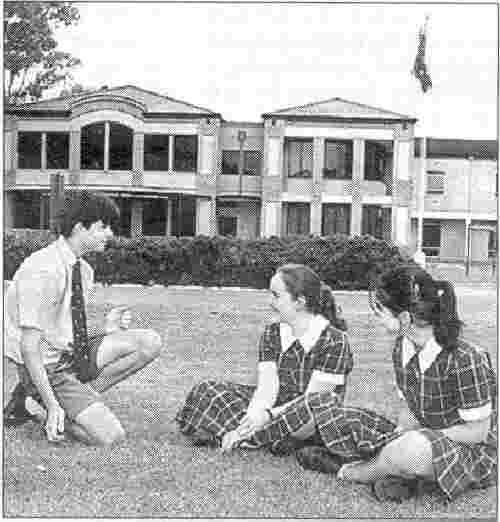
HBC has much more information about Australian school uniform in the 20th century. Australia had an extensive school system throughout the 20th century modeled on the British system. At the turn of the 20th century, nearly all Australian children, except for the Indigenous children, received at least 5 years of basic primary schooling. Each of the Australian colonies had established and consolidated public mass, compulsory public education. As the century progressed, the period of schooling steadily incensed and schooling was made available to th Indigenous children. Many teachers during the 19th century were trained in Britain. This had become less common in the 20th century, but still occurred, especially in the early part of the century. Education was impacted by the austerity of world wars and the Great Depression, but thee was a stead trend of expanding the system and increasing he level of compulsory education. The system was mostly a primary system during the first half of the century. It wasn't until after World War II that the country began to significantly expand the secondary system. We also see a move toward coeducation after the War. We also begin to see uniforms at primary schools. The principal exception was private schools where uniforms were worn. Many mothers purchased school items modeled on British schools attire. Australian children at the secondary level generally did wear uniform at the secondary schools in the 20th century. This meant the same uniform styles worn in Britain. School uniforms look very British at the beginning of the 20th century, except that many Australian children, both boys and girls, went to school barefoot. This basic trends continued until after World War II. After the War more casual uniforms gradually began to appear. Some private schools retained traditional British uniforms. Many state schools shifted to more casual styles that seem better suited ti a country with a warmer climate. Also we begin to see fewer children going to school barefoot, especially at urban schools.
Many Australian schools continue to require uniforms in the early 21st century. The styles vary widely from school to school. Australian uniform styles are increasingly casual, especially at public schools. There are also regional variations. Some schools have incorporated sun-safe styles. Some schools still have more formal uniforms with blazers and suits. Most of these scgools with formal uniformsa re private schools.

Related Chronolgy Pages in the Boys' Historical Web Site
[Main Chronology Page]
[The 1880s]
[The 1890s]
[The 1900s]
[The 1910s]
[The 1920s]
[The 1930s]
[The 1940s]
[The 1950s]
[The 1960s]
[The 1970s]
[The 1980s]
[The 1990s]
[The 2000s]
Related Style Pages in the Boys' Historical Web Site
[Main country page]
[Long pants suits]
[Short pants suits]
[Socks]
[Eton suits]
[Jacket and trousers]
[Blazer
[School sandals]
Navigate the HBC School Country Pages:
[Return to the Main Australian school page]
[Return to the Main school country page]
[Return to the Main school page]
[England]
[France]
[Germany]
[Italy]
[Japan]
[New Zealand]
[Scotland]
[United States]
Navigate the HBC School Section:
[About Us]
[Activities]
[Chronology]
[Classrooms and buildings]
[Clothing styles]
[Countries]
[Debate]
[Economics]
[Garment]
[Gender]
[Hair]
[History]
[Home trends]
[Literary characters]
[School types]
[Significance]
[Transport and travel
[Uniform regulations]
[Year level]
[Other topics]
[Images]
[Links]
[Registration]
[Search]
[Tools]
[Return to the Historic Boys' School Home]