|
We have very limited information on levels in Russian education. We notice kindegardens as part the Soviet system. We are not sure when they were introduced. The state system was divided into both primary and secondary sections. During the Tzarist era many working-class children and former serfs did nt complete primary studies. secondary education was very limited. Until the Revolution, working-class children had very limited access to education. The Sovit state significantly expanded the average Soviet citizen's access to education. Children from families of the former privlidged class were restricted in their access to higher education. Political reliability was an important factor in gaining acceptance to the university. We have little information at this time on post-Soviet Russia.
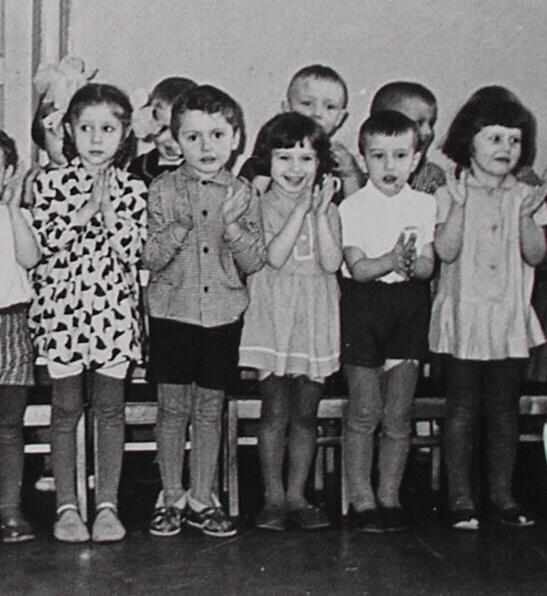
We do not know if there were kindergarten during the Tsarist era. We notice kindegardens as part the Soviet system. We are not sure when they were introduced. They were presumably at first more common in the larger cities. Kindergarden at least since World War II seems to have been very extensive. I am not sure, however, if they were compulsory or if so when they were made compulsory. Unlike primary and secondary school students, Kindergarten children did not wear uniforms. We believe that the children enter kindergarten at age 5 years. Here we see the children from a modern Russian kindergarden involved in a school pagent of some kind (figure 1). It looks to be one of the "Seasons celebration", they are traditional for kindergartens. Red apples in a basket is one of Autumn symbols (for Russia), so may be it is "Welcome, Autumn" celebration. Kindergarden children commonly wore long stockings and modern children often wear tights. Short pants and white tights are considered a dressy outfit. A reader tells us, "My friend from Russia stated that most children started school later in the Soviet Union and in Russia today. School starts at 7 rather than 5 or 6. They have older parents or elderly people who will watch children for very little money. This person is rather wealthy so the information I am giving you may only apply to wealthy people or government people but she grew up in Moscow." Hopefully our Russian readers will tell us more about kinfergarten.
The state system was divided into both primary and secondary sections. Russia had an extensive system of primary schools during the Tsarist era, but primarily in the cities. And even this developed slower than the education system in the rest of Europe, but many Russian children by the 20th century got some form of free primary education. In the countryside, the sitution was much worse. In the countryside, there were few sate schools. For the villages of peasants . the schools suchva they existed were provided by landowners, the church, mosque, or synagogue. Even so only about hald of the population was literate and here we are talkking about the yomger generation asnd nol the lederly who had less accrss to euvation than the 20th century generation. During the Tzarist era many working-class children and former serfs did not complete primary studies. Many childrten got only a few years of schooling. Education was not compulsiry. Outsude of the village school, most schools were single gender. Until the Revolution, working-class children had very limited access to education, especially in the countryside. The best measure of that was literacy. here there was no valid national data. the Tsarist Army did maintain records. Only about hjalf of the new recruits were literate (1912). Another quater were semi-literate, meaning they could read a little, bit cols notwrite. Over a quater were entire illiterate. This was far worse thn even pooer countries in Western Europe. And the situation was even worse for secondary and university level sdchooling. There were also major differences between boys and girls. This all changed dramatically after the Revolution. The Soiviet Union has few accomplishments to be proud of, but education is arguably one of them, at least comasred to Tsareist times. During Tsarist time, very few workers and even fewer peasants advanced beyound primary school. This changed with the revolution. Schools were opened in the contryside and compulsory attendance laws were enacted anbd enbforced. It should not be thought that schools in the cities and countryside were at the same standards, but differences were mirmized. Literacy becme standad throughout the country. Schools became mostly coeductionl. Most children completed primary school. Differences between boys and girls, except in muslim areas largely disappeared.
By the late-19th century of Tsarist rule, the aristocracy, upper class, and middle-class nerbefitted by high standard of education, bith thesevoibry systen and university system. These Russian schools had academic stanbdards similar to that if western Europe. Few children from wirking-class fmilies advanced beyond primary school. In the countryside, the peabtry had far dewer vopoortunities. - the villages of peasants - there was no education system except as provided by landowners, the church, mosque or synagogue.
The Soviet state significantly expanded the average Soviet citizen's access to education, especially secondary education. Children from families of the former privlidged class were restricted in their access to higher education. Political reliability was an important factor in gaining acceptance to the university. We have little information at this time on post-Soviet Russia.

Related Chronolgy Pages in the Boys' Historical Web Site
[Main Chronology Page]
[The 1900s]
[The 1910s]
[The 1920s]
[The 1930s]
[The 1940s]
[The 1950s]
[The 1960s]
[The 1970s]
Navigate the Relate Boys Historical Clothing Style Pages
[Return to the Main country page]
[Return to the Main Russian page]
[Long pants suits]
[Short pants suits]
[Lederhosen]
[Kneesocks]
[Long stockings]
[Eton suits]
[Jacket and trousers]
[Blazer
[School sandals]
Navigate the Boys' Historical Clothing School Uniform Pages
[Return to the Main Russian school uniform page]
[Return to the Main school uniform page]
[Main National School Uniform Page]
[Australia]
[England]
[France]
[Germany]
[Ireland]
[Italy]
[Japan]
[New Zealand]
[The Philippines]
[Poland]
[Scotland]
[South Africa]
[United States]
Navigate the BC School Section:
[About Us]
[Activities]
[Chronology]
[Clothing styles]
[Countries]
[Debate]
[Economics]
[Garment]
[Gender]
[Hair]
[History]
[Home trends]
[Literary characters]
[School types]
[Significance]
[Transport and travel
[Uniform regulations]
[Year level]
[Other topics]
[Images]
[Links]
[Registration]
[Tools]
[Return to the Historic Boys' School Home]