Scottish School Uniform: Chronologies--19th Century
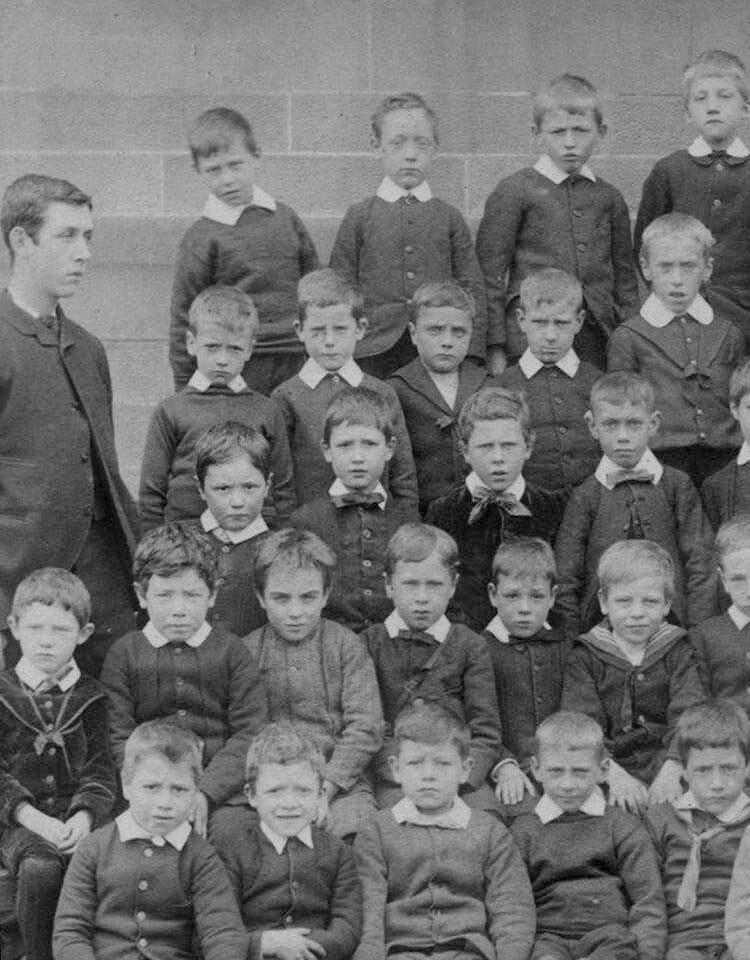
Figure 1.--Here we have a view of the younger students at a Glasgow school. The portrait is not dated, but the mount and the clothes shown suggest the late-1870s or early-80s. Most of the boys wear suit jackets with small Eton collars. We believe that by the 1890s the collars and bows tended to be larger. We also see boys wearing sailor suits and pull over swearters instead of jackets. The boys also wear Eton collars with the sweaters. No one has a large floppy bowm but there are a few small bows and bowties. One boy wears a velvet suit and one of the sailor suits seem to be done in velvet. There is a young mand and a lady at the sides. Perhaps this is two classes photographed together. Many of the boys do not sem to happy about having their photograph taken.
|
|
Some authors report that by the early 19th century, in part because of the Industrial revolution, many Scottish towns and villages were without schools. Children from wealthy families were instructed by tutors in their homes. There were some charity schools for poor children. Unlike England there was no prestigious private (called Public) schools. Some new schools were founded using the Bell and Lancaster systems. Here older children acted as ‘monitors’ to instruct the younger children. This kept the cost of running the schools low.
Most working-class children received only the most basic reading, writing
and religious instruction. As in England, few in Scotland attached any importance to educating poor children. Given the importance attached to teaching children to read in the 17th and 18th century, this prevailing early 19th century attitude is interesting. During the 19th century the Church of Scotland became almost entirely disassociated from the schools. Voluntary associations and by the late 19th century the Government became the major factors in public education. The Secretary of State for Scotland was made responsible for Scottish education in 1885, in effect becoming the equivalent of the British Minister of Education. The Education Act (Scotland) of 1872 was the counterpart of the English VEducation Act of 1870 which had placed public schools under the authority of locally elected school boards. Scotland carried out its own educational reforms in the late 19th century and by the turn of the 20th centurt every locality maintained free primary schools. Many localities also maintained free secondary schools which was not ye the case in England. Scottish schools maintained by charitable groups were never as widespread as in England. We have not yet been able to develop information on Scottish schoolwear and uniforms during the 19th century. We have little information at this time, but we do know that Scotland tended to lead England in terms of free public education. We do not believe that uniforms were worn by Scottish school children, except in the private schools.
Disappearance of Schools
Some authors report that by the late-18th and early-19th centuries, in part because of the Industria lRrevolution anf Higland Clearances , many Scottish towns and villages were without schools by the late-18th and early-19th century. We can not yet confirmn this nor do we know how widespread the disappearing schools were. We know that some parishes had schools that were functioning. An example here is the Kirkmichael School near Balybol. One of the few other schools we have information on is the school at New Lanark, the mill comminity administered by social reformer David Owen. The New Lanark school was of course an experimental school, very different than any other school in Scotland at the time.
Private Schools
Children from wealthy families were instructed by tutors in their homes. There were some charity schools for poor children. Unlike England there was no prestigious private (called Public) schools at the beginning of the 19th century. A number of these schools were founded in Scotland in the 19th century, in some cases by wealthy industrialists. These schools are much less known than the major English Public schools. Here we need to investigate thev history of some of these schools, such as Dollar, Herriot. Loretto, and others. Some were established as academies, but we are not yet sure about the history of these schools.
Bell and Lancaster System
Some new schools were founded using the Bell and Lancaster systems. Here older children acted as ‘monitors’ to instruct the younger children. This kept the cost of running the schools low. Most working-class children received only the most basic reading, writing and religious instruction.
Attitude Toward Public Education
As in England, few in Scotland attached any importance to educating poor children. Given the importance attached to teaching children to read in the 17th and 18th century, this prevailing early 19th century attitude is interesting. During the 19th century the Church of Scotland became almost entirely disassociated from the schools.
Voluntary Associations
Voluntary associations and by the late 19th century the Government became the major factors in public education. Scottish schools maintained by charitable groups were never as widespread as in England.
Educational Reforms
The Secretary of State for Scotland was made responsible for Scottish education in 1885, in effect becoming the equivalent of the British Minister of Education. The Education Act (Scotland) of 1872 was the counterpart of the English VEducation Act of 1870 which had placed public schools under the authority of locally elected school boards. Scotland carried out its own educational reforms in the late 19th century and by the turn of the 20th centurt every locality maintained free primary schools. Many localities also maintained free secondary schools which was not yet the case in England.
We have found some 19th century Scottish school images. Not very many, but we have found some. Scotland is a small country and we have difficulty finding needed images from small countries to assess fahion trends. And many of the ones we have found have no descriptive information. As far as we can tell, the images we have found date to the 1880s and 90s. Most are not dated. We can not always differentiate between these decacdes, but what we have found so far seem to come from these two decades. So we have to our best to date the images and to figure out what type of school. The school here looks to be a state primary school (figure 1). The portrait is not dated, but the mount and the clothes shown suggest the late-1870s or early-80s. Another school portrat looks like it might be a small private school, probably taken in the 1880s, although mixing boys and girls would have been unusual, especially at private schools at the time.
Schoolwear
We have not yet been able to develop information on Scottish schoolwear and uniforms during the 19th century. We have little information at this time, but we do know that Scotland tended to lead England in terms of free public education. We do not believe that uniforms were worn by Scottish school children, except in the private schools.
HBC-SU

Related Chronolgy Pages in the Boys' Historical Web Site
[Main Chronology Page]
[The 1900s]
[The 1910s]
[The 1920s]
[The 1930s]
[The 1940s]
[The 1950s]
[The 1960s]
[The 1970s]
[The 1980s]
[The 1990s]
Navigate the Relate Boys Historical Clothing Style Pages
[Main country page]
[Long pants suits]
[Short pants suits]
[Lederhosen]
[Kneesocks]
[Eton suits]
[Jacket and trousers]
[Blazer]
[School sandals]
Navigate the Boys' Historical Clothing School Uniform Pages
[Return to the Main Scottish school chronology page]
[Return to the Main National School Uniform Page]
[Australia]
[England]
[France]
[Germany]
[Ireland]
[Italy]
[Japan]
[New Zealand]
[Poland]
[United States]
Navigate the HBC School Section
[Activities]
[Chronology]
[Clothing styles]
[Countries]
[Debate]
[Economics]
[Garment]
[Gender]
[Hair]
[History]
[Home trends]
[Literary characters]
[School types]
[Significance]
[Transport and travel
[Uniform regulations]
[Year level]
[Other topics]
[Images]
[Links]
[Registration]
[Tools]
[Return to the Historic Boys' School Home]
Created: 8:18 PM 6/22/2004
Last updated: 8:06 PM 1/5/2015
