|
We see private school boys still wearing coats and ties, but this was no longer very common at public schools. Boys were dressing increasingly casually for school, especially by the end of the decade. Knickers were still quite common at the beginning of the decade, but much less so by the end. Some primary boys wore short pants, especially the younger boys. This varied a good bit regionally and by social class. Knee socks were becoming less common for boys. Overalls were still worn in fural areas. Almost all of the girls wear dresses, often will puffed sleeves. Some girls wears skirts with blouses that had puffed sleeves.. Some children still came to school barefoot.
This photograph shows Holderness boys playing ice hockey in 1930-31. The uniforms consist of rather tight jerseys, unusually short shorts, and long stockings. Modern hockey shorts are knee-length pants, rather like basketball shorts. We are not sure what the earliest uniforms were like. We have noted these short-cut shorts in the 1910s. In the case of one boy (second from the right), the shorts are not long enough to cover the tops of his long stockings. I'm not sure when the
longer-styled shorts were introduced.
This is another Glenn School, an American elemntary school. We can see a substantial brick school in the background. Perhaps some one will recognize it. So it is not the Pennsylvania Glen School we have already loaded. The photograph we have is undated, but the 1st grade and the name of the school is on a placard. First graders would be 6-year olds. The class has bnoth boys and girls, but almost all of the boys are at the back. Quite a few are wearing neckties are now ties. This suggests the 1920s or early-30s. One boy is in front and wears longish short pants with tan long stockings. We have much more in the way of girls' clothing. We see all kinds of different dresses little girls wear. Interesting we do not see any with ballopn sleeves, a very popular style for girls. We do see, however, many with short sleeves. They are mostly A-line dresses without defined waists. Several have large collars. The hemlines are about the same, above the knee. Notice how most of the girls are wearing striped or pattererned knee socks rather than long stockings. There wa a major change in American hosiery beginning about 1929. Boys began wearing knee socks rather than long stockings with knickers. We are less sure about the chrionology gfor girls, but believe that it was comparable. The knee socks and the low-cut shoes suggest the 1930s. Thus we would guess the portrait was taken around 1930. We might be able to eventually make a better estimate, but we believe that within a year or two that this us areasonably accurate date estimate. Notice how one mother was concerned about the hem lengths and the girl has bloomers rather like above-the-knee knickers. Also interesting is how many of the girls have the same bangs hair cut.
At the Western Reserve Accademy, knickers were commonly worn in the 1930s, although by the late 30s they were increasinglty being worn by the younger boys as the popularity over the decade declined. The school archivist has supplied several photographs from various years during the 1930s. The pattern as to who wore long pants and who wore knickers seems quite varied and the overall pattern is not quite clear.
A group of younger children, probably second are third graders are seen recreating a passagener ship. Almost all the boys wear short pants. Several wear sailor suits. One boy wears button-on shorts and long stockings. Unfortunately the photograph is undated, but probably was taken about 1933.
We are not positive, but we believe that the children here are from the Cliff Side School. It appears to be a small school in Elliott County. Te photograph is undated. We would guess that it was taken sometime in the 1930s. The image is notable because it shows how common it was for boys to wear overalls in rural areas. Most but not all of the boys here wear overalls. Even one of the girls look to be wearing overalls. The photograph also shows that it by the 1930s despite the Depression, coming to school barefoot was becoming much less common. Only one girl here is barefoot.
Here we have a view of a West Virginia School. We are not sure that the name of the school is the Berwind School, but it was appararmtly located in Berwind, West Virginia. We have one image taken during 1930-31 school year. By the way the children are dressed, we would guess was taken in 1931 toward the end of the school year. It appears to be a town school. The school looks to be a substantial building. Many of the boys wear overalls--more common in rural areas. Perhaps Berwind was a small town. It also may have been a coal mining town. The children of miners like farm families were more likely to wear overalls, especially during the Depression. Other boys wear both knickers and long pants. We don't note any short pants. The girls mostly wear dresses. One girl wears a skirt. Several children both boys and girls are barefoot. Many of the girls wear Mary Jane strap shoes.
The Harris Middle School was located in San Antonio, Texas. Middle schools meant different age groups from state to state. They were similat, but not identical to junior highs. I'm not sure about the age group here, but would guess about age 12. The portrait may have been taken in the 1931-32 school year, although we can not be positive. Texas at the time had segregated schools with blacks and whites in different schools. I think in some school districts Hispanic childen were segregated, but I am not sure about this. The expense of operating separate school systems probably limited this. Notice boys wearing overalls, long pants, amd knickers. The boy in the front wear kickers with ankle socks. This began to be more common as knicker declined in popularity during the late 1930s. fewer boys had knee socks. A factor here is that San Antonia is located in the south and it can be quite warm.
Here we have a class oportrait at the end of the School year (June 10, 1933). This is all we know about the class. The name and the location of the school are unknown. As many of the boys are wearing sweathers, we guess that it was a bnorthern state. We are not sure what kind of school the attended, but suspect they are the oldest students at a primary (elementary) school, meaning children about 11-12 years old. They look a year or so older so it coulf be a junior high school. It could be a junior high school. Meaning that they might be 13-14 it is difficult to tell. The boys that we can see what they are wearing knickers and knee socks. We can not see what the other boys are wearing, but presumably most are also wearing knickers. Knickers were noot iniversal in the 1920s, but were very widely worn. This began yo change in the 1930s, especially after mid-decadeas long pants became increasingly common. The girls all look to be wearing dresses. We don't see blouses and skirts. .
Here we see a 3rd grade class at the Copley School. That would mean most of the children ar 8-year olds. It was an American elementary school, meaning a public primary school. We do not know where it was located. We think it may be Ohio, but we are not sure. The photigraph we have was taken in April 1934. It was quite a large class, 49 children. The lady teacher was photographed with them. The boys based on the first row are mostly wearing knickers and knee socks. Several boys wear sweaters. Only two boys wear suits, but several wear neck ties. Only one boy wears a bow tie. As far as we can tell, all the girl wear dresses. We do not see any girls wearing blouses and skirts. The girls mostly have shortish hair. Only one has a hair bow. Some of the girls, but not the boys have bangs.
Perkins is a very old and famous instituion, located now at 175 North Beacon Street, Watertown, Mass., on the Charles River, now a part of metropolitan Boston. The school is 175 years old and was the first school
for the blind in the United States. Helen Keller is the most famous graduate. The school was incorporated in 1829 by John Fisher, the original founder, and opened to receive students in 1832. At first Fisher
used the house of his father in Boston. But, having outgrown this residence quite quickly, the school moved in 1833 to the larger home of Thomas H. Perkins, the philanthropist for whom the school has ever since
been named. Next the school occupied a converted hotel in South Boston, Perkins having sold his home and donated the proceeds to the school.
Deckard Primary School was located in Brown County, Indiana. This is located in the southern part of the state, an essentially rural area. We have a photograph from 1934-35. The teacher standing in the rear is Clotha Hillenburg. This looks like a typical small one-room rural school. As a result of the Land Ordinance of 1785 every block of public land had one section (number 16) reserved for public schools. This was used to both locate the school and sold to finance the schools. Thus there were large numbers of small rural schools in America until after World War II when they were consolidated. Most of the boys here, who are about look to be about 6-12 years old, wear overalls to school. This was quite common in rural America until after World War II. One boy in the second row on the extreme right wears short trousers with long cotton beige stockings (obviously with supporters), a short-sleeved white shirt, and a somewhat oversized sweater-vest. Long stockings were still woirn in the 1930s, esoecially in th early 30s, but becoming less common. I doubt if the long stockings are being worn for warmth. They are a very lightweight version. Long stockings were just one of the several appropriate options for young schoolboys in the 1930s. The children are standing in front of their smallish rural school building. Overalls were very common school wear in the midst of the Great Depression. Notice that boys greatly outnumber the girls. I am not sure why that was, perhaps just a statistical accident gicen the small number of children.
Here is a 9th grade portrait at New York City School PS (Public School) 165 in Manhattan during January 1934. It appears o be an all boys schoolor class. We are not sure how common tyhis was. We are not sure if it was a junior high or high school. Most of the boys wear suits, several are still wearing knicker suits, although long pants suits are more prevalent. The boys in 9th grade would be mostly 14 years old, but beginning to turn 15 years.
Here we have another Washington School, this one located in Sulphur, Oklahoma. Washinton was one of the most popular names for American grade schools. Grade, grammar, and elementary school means primary school, usually with the first six grades of education. Oklahoma was located on the Southern Plains, originally designated as Indian Territory. The area around Sulphur was been noted for its mineral springs. It is located in southern Oklahma. It was a basically rural state. Oil was discovered in the 1910s which resilted in an oil boom. Many school portraits until after World War II show the boys in rural schools wearing overalls. We note a Depression era image. Oklahoma was one of the states especially hard hit in the 1930s, both by the Depression and the Dust Bowl. Many farmers lost their land. Many of the boys wear overalls. This was sonething we did not see until the late-1900s, but then became very common as we see here. It was especially common at rural schools or at schools like this one with some farm chilftrn attending the school. One boys wears short pants overalls, something that was not very common. The girls all wear dresses. Pinafores are no longer in style.
We do not know rhe name of this primary school, but we know it was a school in the Chicago area. The photograph here shows a class of 5th graders having a dancing lesson in 1935. The knickers the boys wear and the dresses the girls wear were very common for the 1930s. The school apparently supplied sandals for the dancing.
A photograph from 1935 shows an upper Form (I'm not quite sure whether it's the Second or the Third)--boys of about 15 or 16 years of age--and maybe even 17 yearsin a few cases. Note that this slightly older age group has mostly changed to long trouser suits although one boy still wears a knicker suit. His hosiery seems to consist of patterned knee socks rather than the plain colored long stockings. Many of the boys wear vested suits, nearly all with
white shirts and ties although the middle boy in the front row is somewhat more sportily dressed with dark trousers, a contrasting lighter colored jacket, a V-necked sweater, and an open collared shirt which folds over his lapels. Some older boys still wore knickers in 1935 but most had shifted to long trousers by age 16 years.
We are not sure where the Madison School is located. We would guess it might be in Virginia as President Madison was from Virginia. It looks to be an public elementary school. We have a photograph of the school safety patrol in 1935. Notice their badges abd white shoulder belts. The older boys were chosen to help the younger children across the street at corners around the school. Note only boys were chosen. The boys wear mostly long pants, but two wore knickers with patterened knee socks. The photograph is a good indication of how knickers were declineing in popularity by the mid-1930s. More and more boys were wearing long pants.
This class portrait was a 9th grade Junior High School class photographed in January 1935. They would be mostly 14 years old, some by have turned 15 years. The school may not have a name. it seems to be schhool No. 126. These numbered schools were common in New York City, but that was not the only city with numbered schools. This portrait came out of an estate in Upstate New York. Of course that does not man the school mwas not in Ne York City. Junior highs taught grades 7th through 9th grades. This was class 9B1 meaning there was more than one class of each grade. The students all dressed for the portrait. The boys wear suits and ties. The two boys in front wear knicker suits and knee socks. We are not sure about the other boys. The girls wear white blouses with dark scarves and skirts. The scarves look like the ones worn with middy blouse gym uniorms.
Kindergardens appeared in America during the late-19th century. It was one of the reformns promoted by the Progressive Movement. Only a few schools established Kindergardens during the early-20th century.
Here we see a Kindergarden class at an unidentified Ohio primary school in 1935-36. At the time school throughout the United States primarily began with the First Grade for 6-year olds. Kindergardens were not yet very common amd may schools fid notv have them. They were optional for those that did. Also many Kindergardense half day programs or sometimes alternating days. Ohio passed the School Foundation Program Law in 1935. This provided state funding for public kindergardens. Schools were promised $22.50 for each child enrolled. In addition, the state first set training standards for kindergarten teachers at that time. The class here was very small, probably because only a few parents signed up. The First Grade class would have been much larger.
We do not yet know where the Penn School was located. It seems to have been a rural area. We have a school portrait from 1936. The boys wear overalls and knickers. One boy wears jeans with te cuffs tuned up. The girls all wear dresses. The photograph is interesting because the mid-30s were a time of change in boys' fashions. We still see farm boys wearing veralls. And many boys still wore knickes, although they were no longer universal. Note the boy wearing jeans, an up and coming style. They wre probably called "dungareees". Wearing jeans to school would pobably not have been common in city schools at the time. The cuffed jeans are probably a movie cowboy influence.
Here we know the name of the school and the date, but we do not know where the school was located, except that the school was located somewhere in the North. Southern schools understanably were not named after President Lincoln, the Union leader during the Civiln War. The name of the school does not help much because there were so many Lincoln schools all over America, except the South. This is an interesting images because it shows how common knickers still were in the 1930s, but it shows that American boys were beginning to reject them. Notice we do not see boys wearing short pants. Many American boys resusted wearing shorts. This varied from family to family. But boys were beginning to wear knickers with ankel rather than knee socks. Beginning with the 1910s when knickers were the dominant tyoe of pants worn by boys, through the early-30s. They were always worn with first long stockings and then knee socks. But by the mid-30s boys had begun wearing knickers with ankle socks which we can see here. We do not know what year class this was, but they look like 3rd graders, children about 8 years old.
This is School No. 37, but we do not know where. New York City was known for numbering its schools, but this was not exclusive to New York. It looks like a leafy part of the city. The photograph was taken at the end of th 1936-37 school year--June 1937. It looks to be a 8 year elementary school. This was class 8A. *th graders would be children 13-4 years old. But it could not hv been a class room group bcause there are some 60 children here, too many for a single class. The photographer has grouped the girls in the middle surrounded by the boys. The girls wear dresses. The boys mostly wear suits . or dress sgirts and ties. A few noys wear open collared shirts. Presumably most of the childrn drssed up for the class portrait. All of the boys except one boy wars long oabts. One boys wear a knickers suit. Knickrs were going ou of style, but we still see them into the early-40s.
We have some images from this Norfolk, Virginia primary school in 1937. Most of the boys appar to be wearing knickers and go barefoot. We assume this is probably near the end of the school year as temperatures are beginning to get warm. One boy came to school in a long pants suit and tie, but still went barefoot. I'm not sure just what is going on here, but I suspect that the boys wore shoes during the winter and their feet are still a little tender when they first began to go barefoot when the weather got warm.
We note a first grade class at Crowley School in 1937. We believe this is a school in Crowley, Lousisiana (Acadia Parish). The boys' clothes are quite varied. One boy in the front row is wearing long pants (probably dungarees) and tennis shoes (sneakers), another is wearing bib overalls, and a third (the dressiest of the three) is wearing a white shirt and tie, short trousers, and tan long stockings neatly held in place with hose supporters (he is undoubtedly wearing a garter waist). The girls seem to be bare legged with ankle socks. This photo is a good illustration of the continuing custom of sending younger boys to school in short trousers with long stockings. Notice that the stockings are knitted extra long (as advertised at the time in Sears catalogs) so that the necessary hose supporter fastenings won't show. This can be seen in 1930s catalogs.
Here we have the Reinberg School. It looks to be a standard public elementary (primary) school. Unfortunately we can not read the first name, something like Jol. We are not sure where the school was located, but we have found a Reinberg school in Chicago. And it was named after a Chicago politician. It was, however, named the Peter A. Reinberg School. Apparently there was more than one prominant Reinberg in Chicago. Heeren Photo was a Chicago studio working in school photography so there is little doubt that it was a Chicago school. It is the only Reinberg school we have been able to find. We have a class portrait of a second grade class in 1937. The children would have been 7-8 years old. The children were dressed variously. Several wear dress shirts with ties. Perhaps they were told about the portrait. Only one boy wears a suit, a fashionable Eton suit with an Eton-like collar. A few boys wear casual shits. We also note a few short-sleeve shirts which seems rather surprising for Chicago in the winter. Two boys and none of the girls wear sweaters. They are dressed in short and long pants as well as knickers. One boy wears suspenders. The girls mostly wear dresses. Several have puff sleeves. One girl wears a blouse and skirt. The boys all have short hair cuts. One girl has Shirley Temple ringlet curls. The portrait was taken just before Christmas, December 17, 1937 which is why many of the children are waring knee socks, long stockings, and boots. Knickers were beginning to gp out of style in the late-30s, but most of the 2nd greaders here seem to be wearing them.
We note some scenes from the Irwinville School, presumably in Irwinville, Georgia. We know very little about the school, but it looks to have been a primary school with a rural setting. It seems to have had a substantial building. One photograph from 1937 shows what looks like the children going back into class after a recess. The girls wear dtesses. Several of the boys wear overalls meaning that it was a rural school. We also notice what looks like a girls' gym class at the school for which the girls changed into rompers. We wonder if it may have been some kind of institutional facility.
Here we see the 4th grade class in TVA School-Village No. 1 in June 1937 at the end of the school year. With the onset of TVA, people moved into the Village No. 1 homes nd the school opened. It was a rather small class only 14 children. The 4th grade children would be 9-10 years old. It was summer time by June and very warm and the children are dressed accordingly. There was no air conditioning in schools at the time, even in the Deep South. We can see their school in the background. One girl wears short pants rather than a dress which was not very common at the time, especially for school. Many of the boys also wear shorts. It is a little difficult to tell, but we also see several of the boy wearing button-on shorts. The belted shorts were also probably button-on outfits. Many of the boys probably wore knickers during cooler school months.
We note a portrait of the 'Guards' in Brooklyn (New York) P.S. 216 during 1938. The Guards were presumably the Safety Patrol Boys. The school was coeducational, but at the time only boys were chosen for the Safety Patrol. We are not entiely sure what grades were involvd. Standad elmentary (primary} schools were grades 1-6, which would mean ags 6-12 years of age. The portrait was taken in the spring so many of the 6th frafers had begun to turn 12 yearsof age. Some of the boys look a ittle older. They were photographed on the front steps of their red brick school. Only a few boys wear suits to school, although mny boys wear ties. Based on the front row about half the boys wear knickers and the other half wear long pants. Notice that the knee socks are mostly patterned. They may have been the younger boys. Often at elmentry scools both 5th and 6th graders qualified for the Safety Patrol. P.S. 216 is now the Arturo Toscanini School with programd pre-kindergarden through 5th grade. ,
Here we see a small school on the Aleutian Islands for Aleuts. It looks like a small one room school. I'm not sure which islnd this was, but there must have been a navy facility nearby. Some of the children wear navy caps.
The Cypress Creek School was a small primary school in rural Louisiana. It was located in Winn Parish, Louisiana. We note the children gathering around a bookmobile during 1938.
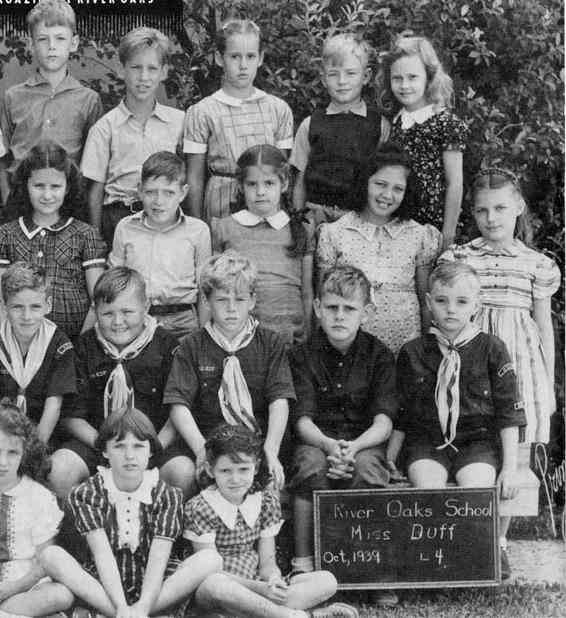
Here is a school photograph from 1939 in Houston, Texas. It must have been Scout day as most of the boys are wearing their Cub Scout uniforms. It was quite common for American schools at the time to have a Scout day each week. It is a little unusual to see American cub scouts wearing the shorts pants uniform. At the time most American Cubs wore a knickers uniform. I was not even sure that there was offical Cub shorts at the time. Two factors here is that the class is in Texas and the weather in Houston can be very hot. Another factor is that River Oaks was a planned upper class neighborhood
This photo back postcard identifies the school, only it is difficult to read. We think it is the Grant School, but it is difficult to read. Let us know if you can make out the writing any better. It is a city school. We can see their substantial brick school in the background. The group looks to be 3rd Grade class (8-year olds). Striped 'T'-shirts were popular. It looks to us as if the school was in the South because of the number of boys wearing short pants. Shorts were not as common in northern schools. This makes us doubt that that the name of the school was Grant. Because of the Civil War you don't see schools named Lincoln and Grant in the South. None of the boys were wearing knickers which were declining in popularity, but still worn in the 1930s. One boy wears long pants. Another boy wears overalls. We note boys wearing sneakers. We were a little surprised by this because when I started school in 1949, I don't recall many boys wearing sneakers to school. We wore sneakers at home for play after school. None of the girls wear sneakers to school. The girls are all wearing dresses with ankle socks.
We see the Hibbard Elementary School built in in Chicago during 1916. It seems a fairly standard American urban elementary school. As was common at the time, it was a multi-story building. The portits of different grades are undated. We innitially though the potraists were tajen in the early-40s, but the lsrge number of boys wearing knickers makes the late-1930s moke likely. Mot of th 4th graders are wearing knickers. Other portraits show most of the 5th graders and many 6th graders also wearing knickers. This ssems much more likely to be the lste-30s than early-40s, although we so see didderences from school to school.

Related Chronolgy Pages in the Boys' Historical Web Site
[Return to the Main American 1930s page]
[Return to the Main Chronology Page]
[The 1900s]
[The 1910s]
[The 1920s]
[The 1930s]
[The 1940s]
[The 1950s]
[The 1960s]
[The 1970s]
[The 1980s]
[The 1990s]
[The 2000s]
Navigate the Relate Boys Historical Clothing Style Pages
[Long pants suits]
[Short pants suits]
[Lederhosen]
[Kneesocks]
[Eton suits]
[Jacket and trousers]
[Blazer
[School sandals]
[Bloomers]
[Rompers]
Navigate the Boys' Historical Clothing School Section
[Return to the Main American 1930s school pag]
[Return to the Main U.S. individual school 20th century chronology page]
[Return to the Main National School Page]
[Australia]
[England]
[France]
[Germany]
[Ireland]
[Italy]
[Japan]
[New Zealand]
[Poland]
[Singapore]
[Scotland]
[Singapore]
[United States]
Navigate the HBC School Section
[About Us]
[Activities]
[Chronology]
[Clothing styles]
[Countries]
[Debate]
[Economics]
[Garment]
[Gender]
[Hair]
[History]
[Home trends]
[Literary characters]
[School types]
[Significance]
[Transport and travel
[Uniform regulations]
[Year level]
[Other topics]
[Images]
[Links]
[Registration]
[Tools]
[Return to the Historic Boys' School Home]