|
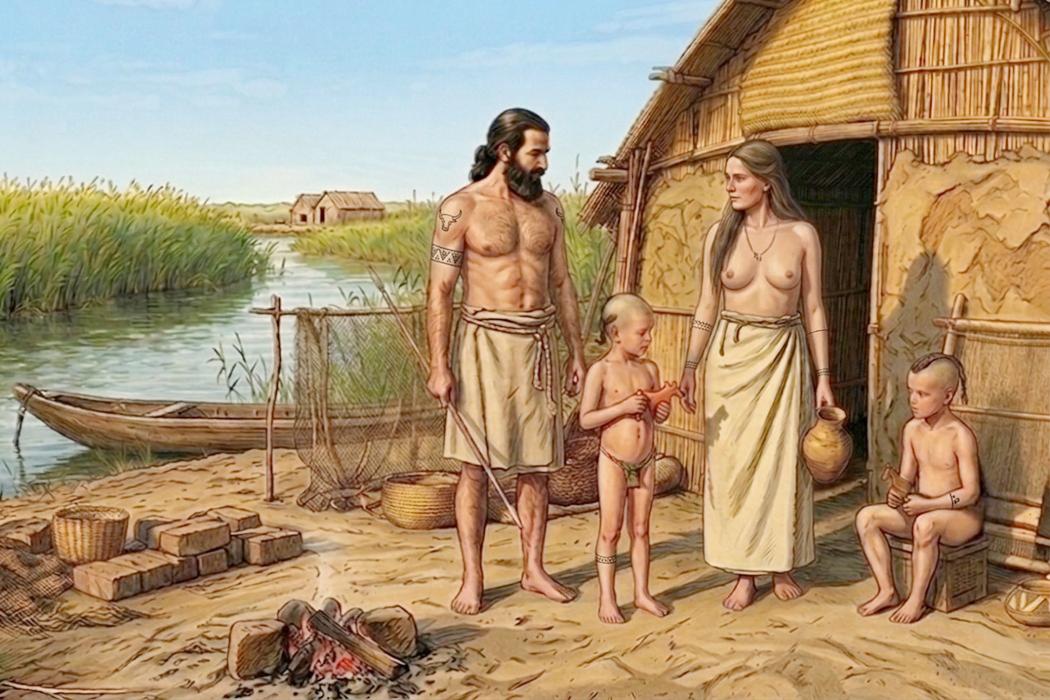
Historians believe that settlement of the Fertile Crescent created by the Tigris-Euphrates Rivers began roughly about 10,000 years ago (about 7000-8000 BC). There is archeological evidence beginning about 7000 BC, but archeologists caution that earlier habitation is likely, but has been obscured under the alluvium. 【Adams and Wright】 In addition, the climate in the area is very hot and humid meaning that most human traces would disappear because except for pottery, hudbrick, and atone tools, most of what humns produced was biodegradaeable. About this time people from the surrounding mountains and arid areas began to settle in the southern floodplain of the two rivers as they discovered the substantial harvests possible in the rich alluvial soil and plentiful water--leading to the invention of agriculture and subsequently civilization. There is little archeological evidence available, because the people of pre-history left only a limited archeological foot print. The beginning is the Ubaid period (c6500–3800 BC)--a very long perriod in historicl terms showing how cultural change was verfy skow in ancient times, especilly pre-history. It is a pre-historic period of Mesopotamia. Its name comes from Tell al-'Ubaid where the earliest large excavation of the Ubaid period began. A tell (from Arabic tall 'mound' or 'hill' is an artificial mound created by successive centuries of human habitation. Here successive villages leading to towns were built on top of the ruins of previous ones creating mounds and hills in the landscape. The Ubaid period remains primarily n what is now southern Iraq/Kuwait, was southern Mesopotamia. We see the earliest known settlements on the alluvial plain. But alreasy we see imprtant developments in wgtwas to define Mesopotami.. The art of pottery flourished, and the first mud bricks - essential for later urban settlements - began to be produced. During this period, the first water canalization systems were constructed. There islittle evidence of walled settlements meaning a relatively peaceful mperriod. We have some information on clohing, coming from clay figurines. It is thought that cloths wrapped around the body were used. Fitted clothing requirea mych higher level of weaving than was availbleat the time. No discovered figurine depicts a top covering for men or omen. Children did not wear clothing. Hairstyles are also depicted on the figurines. Adults wore their hair long. Children had their heads shaved, with a few hairlocks or braids left, a style that would prevail in Egypt as well. .
Adams, Robert McCormick Jr. and H.T. Wright. "Concluding remarks" in Elizabeth F. Henrickson anxd Ingolf Thuesen (eds.). "Upon this foundation: the ʿUbaid reconsidered" ; proceedings from the Ubaid Symposium, Elsinore, May 30th – June 1st 1988 CNI-publikations. (Copenhagen: Museum Tusculanum Press, 1989), pp. 441–56.

Navigate the Children in History Website:
[Return to the Main Mesopotamia page]
[Return to the Main Iraq history page]
[About Us]
[Introduction]
[Biographies]
[Chronology]
[Climatology]
[Clothing]
[Disease and Health]
[Economics]
[Freedom]
[Geography]
[History]
[Human Nature]
[Ideology]
[Law]
[Nationalism]
[Presidents]
[Religion]
[Royalty]
[Science]
[Social Class]
[Bibliographies]
[Contributions]
[FAQs]
[Glossaries]
[Images]
[Links]
[Registration]
[Tools]
[Children in History Home]