|
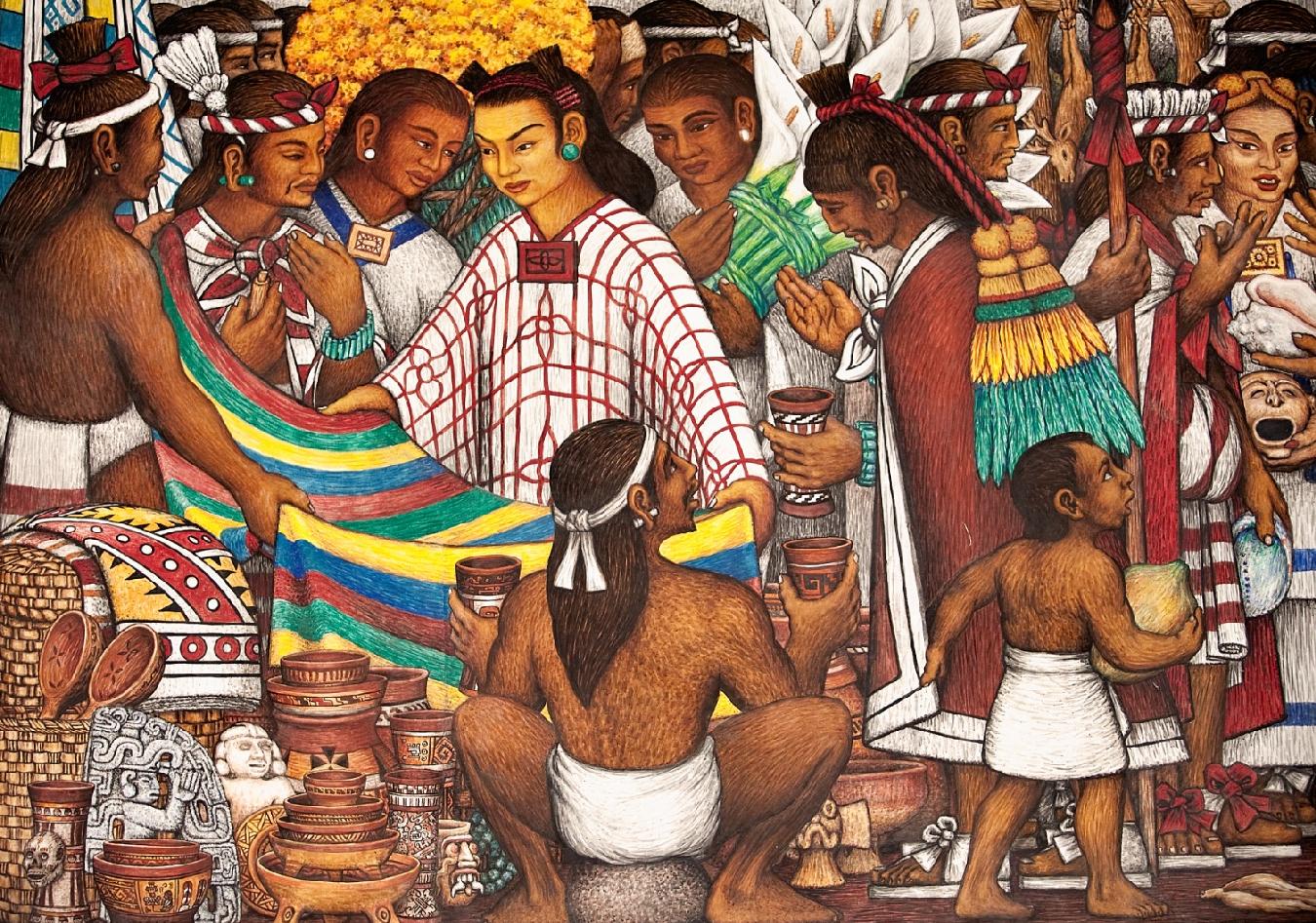
Tlaxcala is located on the cool, semiarid Mesa Central in central Mexico. There vis a mean elevation of 7,000 feet (2,100 metres). Tlaxcala City is dominated by La Malinche (Matlalcueyetl) volcano, which rises to an elevation 14,636 feet (4,461 metres). The modern Mexican state roughly approximates the same location as the pre-Colombian Amer-Indian state that refused to surrender to the Mexica. The Tlaxcalans are often referred to as the Tlaxcala Republic. The prior to Spanish arrival, the Tlaxcalans were governed by a confederation of four autonomous indigenous city-states adminisrered by a council of nobles and warriors rather than a king. This senatorial council handled state affairs, including war and commerce, forming an oligarchic or 'federal' republic structure.
The current inhabitants of the area, the Tlaxcalans, drove out the Chichimecas (about 1350 AD). The Tlaxcalans moved into the Cholula region and set up an autonomous state. Thy proceeded to war and defeat many neighboring people. The Tlaxcalans eventually encounteres the expanding Mexica (Aztec) peoples who had seized the Valley of Mexico to the west. The Náhuatl-speaking Aztecs begun spreading out from their base of power in Tenochtitlán, 75 miles northwest of what is now Tlaxcala City (1325). The Mexica subdued neighboring city-states and compelled conquerd people to pay tribute--part of which was victims for human sacrifice. The Mexica primrily controlled the area around modern Mexico City, but their influence had reached as far south as modedrn Guatemala (1440). As all of this this was unfolding, the Tlaxcalans became their traditional enemies. The Tlaxcalans were located close to Tenochtitlán and were surround by Mexica territory and the territory of people conquered by the Mexica. Interestingly, the and Mexica shared common origins, both sole the northern Náhuatl language. Both looked back to the legendary Aztlán--'Place of the Herons' as their ancestral homeland. The Tlaxcalans represented a major thorn in the side of the Mexica. lving in the hadow of the Exica fo 200 years. There was almost continuous warfare. There are historians who asre comvimced that the powerful Aztec armies cold have Empire overwhelmed Tlaxcala, but declined not to do so probably because the Tlaxcalans provided a local source gor sacrificial victims. The clashes became known as the 'Flower Wars' (Xochiyaoyotl). Meso-Americans believed that offering human sacrifice to their gods ensured the continued movement of the sun and the natural processes needed for the continution of life. Whatever the reason, allowing Tlaxcala to exist as an independent state proved a terrible mistake. They became Spanish allies who played a crucial role in the Spanish conquest of Mexico (1519-21).

Navigate the Children in History website:
[Return to the Meso-American civilzations]
[Return to the Main great native American civilizations]
[Return to the Mexican history: Native American civilizations]
[Return to the Main Native American Central American page ]
[Return to the Main Native American Caribbean-Central American page ]
[Return to the Main Native American page ]
[Return to the Main Native Caribbean history page ]
[About Us]
[Introduction]
[Biographies]
[Chronology]
[Climatology]
[Clothing]
[Disease and Health]
[Economics]
[Freedom]
[Geography]
[History]
[Human Nature]
[Law]
[Nationalism]
[Presidents]
[Religion]
[Royalty]
[Science]
[Social Class]
[Bibliographies]
[Contributions]
[FAQs]
[Glossaries]
[Images]
[Links]
[Registration]
[Tools]
[Children in History Home]