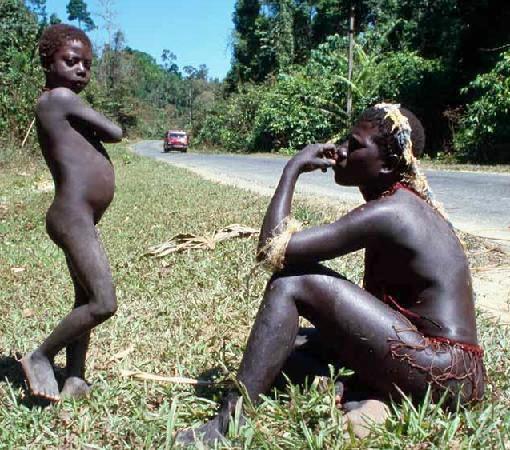
San people in southern Africa. There seems to have been an initial migrration that followed the coast of Asia and finally reached Indonesia and Australia. As this migration was a coastal one. This may have been explained by climate and resource availability. Basically only beach combing skills were necessary, although the final stage to Australia involved a sea crossing of about 150 miles. This seems to have occurred about 50,000 years ago. Virtually no physical evidence exists of this coastal migration in terms of tools and other remains. The evidence is purely genetic. And genetic evidence has been found in southern India. The Australian aborigenes are the modern descendants of these peoples. This migration constitutes about 10 percent of the modern world population. The coastal migration out of Africa was followed by a second wave of Homo sapiens. This second wave is responsible for about 90 percent of the modern world population. A range of inter-related factors appear to have driven the migration, including weather, droughts, rains, and grass graising heard animals. These early people are believed to have headed north first into the Middle East. Here they split into two groups. One moved east into India and overwealmed the first wave out of Africa that had followed the coast. Another group moved north into Central Asia, again probably following migrating heards. They did not move into Europe through Asia Minor as earlier believed. It is not clear just why. Perhaps the mega fauna of the great Eurasian plain attracted them. Some researchers speculate that the existing Neanderthal populations blocked their way east into Europre. This suggests that at the beginning of the their migration, Homo spaien may not yet have been technologically more advanced than Neanderthal. From central Asia Homo Sapiens split. Two waves moved east, one into north china and another into south china. Another wave moved west from central Asia into Europe. This is believed to have occurred about 40,000 years ago. Thus Central Asia was the nursery for modern humans. It is after this split that modern races developed as climatic adaptations. Some groups headed west into Europe. Others moved east into eastern Asia and others into south Asia. The East Asians split into China and southeast Asia. Some of the northern east Asians continud into the far north, evenually crossing the Bearing Sea land bridge and populating the Americas. [Wells]
Origins
British naturalist Charles Darwin with the publication of Origin of the Species (1859) launched a controversial debate on evolition. Religious figures challenged Darwin and he was pilloried in the press as a monkey man. Gradually the substantial body of scientitic evidence Darwin and other collected convinced the scientific community. Evolution Through much of the late-19th and early 20th century, however, remained controversial. And not only within community. some authors maintained that man evolved independently in several different locations. It is difficult to ascribe motives here, but a factor was surely that many Europeans did not want to admit that they were evolved from Africans. Anthropolgists by the mid-20th century after World War II finally conclusively proved through the discovery of the fosil remains of a number of early Homonoids that man evolved in Africa. Fundamentalists, bith Christians and Muslims continue to believe in creationism. Often they point to mistakes made by Darwin. And it is true, Darwin made some mistakes. After all he formulated his theories in the mid-19th century when many modern scientific disciplines were just developing. DNA was not even known to science. That said, there are few histories in modern science where an innovator like Darwin got so much right.
Migration Out of Africa
Anthropologists were unable to reach agreement on any accepted theory on just which homonid migrated out of Africa, just when this occurred, and what path they took. DNA work at the turn of the 21st century has combined with the earlier anthropolgical work to provide new theories that seem to provide a coherent theory as to how man peopled the globe.
Evolutionary development
Before a migration out of Africa was possible, however, humonoids needed to develop a mind capable of creating the technolgies (tools, clothing, ect.) necessary for such a migration. Here the intelectual leap early homonoid took was probably strongly related to language development.
Impetus
The impetus for the movement out of Africa is not known. It could have been climate change, over population, or other developments.
Homonoids
Next Homo erectus appears about 1.9 million years ago. And is likely that a migration out of Africa in small numbers began soon after they appeared. They appear to have migrated out of Africain larger munbers than any other archaic human. A more modern species Homo heidelbergensis which appeared about 0.7 million years ago and from which
both Homo neanderthalensis and Homo sapiens are believed to have evolved, altough the fosil record is still incomplete. The age of speciation of H. sapiens out of ancestral H. erectus (through intermediate species ending with Homo heidelbergensis began about 0.3 millio years go. The transition to Homo sapien took place before the migration out of Africa began. Sustained archaic admixture has been found in both Africa and Eurasia (about 100,000 to 30,000 years ago). It is of course H. sapiens that became the primary hominoid migrating out of Africa. The reason that you do not see archaic humans around the world is the same reason thst you do not see other species in Africa. H. sapienes was so sucessful that they out competed other Homonoid species and interbread with them, swamping them in the gene pool.
Anthropologists disagree as to the details as to pattern of the movement the genus Homo out of Africa. It appears that the first immigrants out of Africa were small numbers of H. erectus (2.0-1.8 million BP). Not only were the numbers small, but hey left very little archeological trace as to their movements. The movement of H. sapiens in larger numbers followed much mater. All of this until very recently could only be theorized. DNA has enable historians to look into pre-history to a degree unheard of only a few years ago. At first this was primarily the female line using mitochondrial DNA. Thee now are ways of looking at the male line. There are proponents of the single and multiple wave dispersal models, but the two wave model is by far the most common. Although it is likely that some small family groups ventured forth earlier and in small numbers. There appear to have been two primary waves H. sapiens. There is much more debate over the details. There is also considerable controversy over the timing of these migrations. A consensus was emerging that the H.sapiens migrations began about 65,000 BP. A recent discovery in northern Saudi Arabia at Al Wusta in the Nefud Desert is pushing back the dates of the human migration out of Africa. A finger bone found there has been identified as H. sapiens and dated to about 85,000-90,000 BP. This means that humans may have already reached the Arabian Peninsula and probably areas further afield earlier than previously believed. All of these individuals were hunter-gatherers, probably following migrating herds.
Sources
Wells, Spencer. Journey of Man: A Genetic Odessy.
CIH

Navigate the Children in History Website:
[Return to the Main Pre-history page]
[About Us]
[Introduction]
[Biographies]
[Chronology]
[Climatology]
[Clothing]
[Disease and Health]
[Economics]
[Freedom]
[Geography]
[History]
[Human Nature]
[Ideology]
[Law]
[Nationalism]
[Presidents]
[Religion]
[Royalty]
[Science]
[Social Class]
[Bibliographies]
[Contributions]
[FAQs]
[Glossaries]
[Images]
[Links]
[Registration]
[Tools]
[Children in History Home]
Created: 5:45 AM 12/17/2010
Last updated: 4:57 AM 3/29/2026