|
Anthropologists have develop a complicated story of the evolution of hominoid species in Africa. There are several different species, although because so little actual fossil evidence has been found, there is an active debate on whether some of these species are really just variations withering a smaller number of species. Some species are especially important. The most important archaic species are Homo habalis, H. ergaster, and H. erectus. These early fossil remains are extremely rare and thus it is difficult to know for sure if they are really different species. Scientists are, however, making important strides in fitting together the relationship of these different species. And constantly refined dating methods. The Homo species tend to have increased cranial capacity which generally coincides with the increasingly sophisticated tools some times found with the fossils, but mote commonly without any accompanying fossils. The whole story is more complicated than detailed here. There were many more species and there is still considerable indecision about the species listed here, primasrily because the fossil evidence is so limited.
Homo habilis means 'handy man' or tool maker. It is one of earliest species of the Homo genus and appears to have been the species that began the path that led us to he moon. The name of the species refers to the tool-making abilities and intermediate features between Australopithecus and subsequent Homo species. Habelis was not the first species to make tools. Other species and not just primates made tools. Habelis is the first species to make tools that no one can doubt were manufactured tools. The brain capacity of Habilis ranged from 500 to 900 cubic centimeters (cc). This opacity is s notable as it is a ignificant increase compared to earlier hominids, like Australopithecus. And importantly, notice as brain size increases, the advances made by archaic humans take pace over a shorter time period. Habilis is a mixture of ape-like and human-like traits, including long arms, a moderately prognathic face, and a increasingly large brain compared to Australopithecus. Habilis demonstrates the importance of tools is the making of modern man. Habilis like all the ape species in the human evolutionary line, lived in Africa.
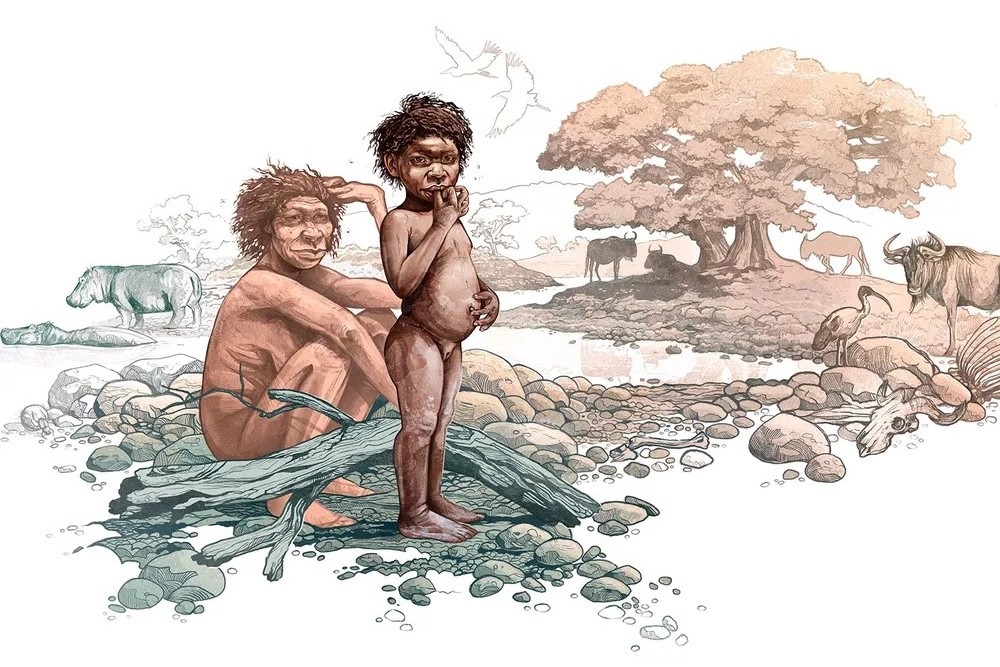
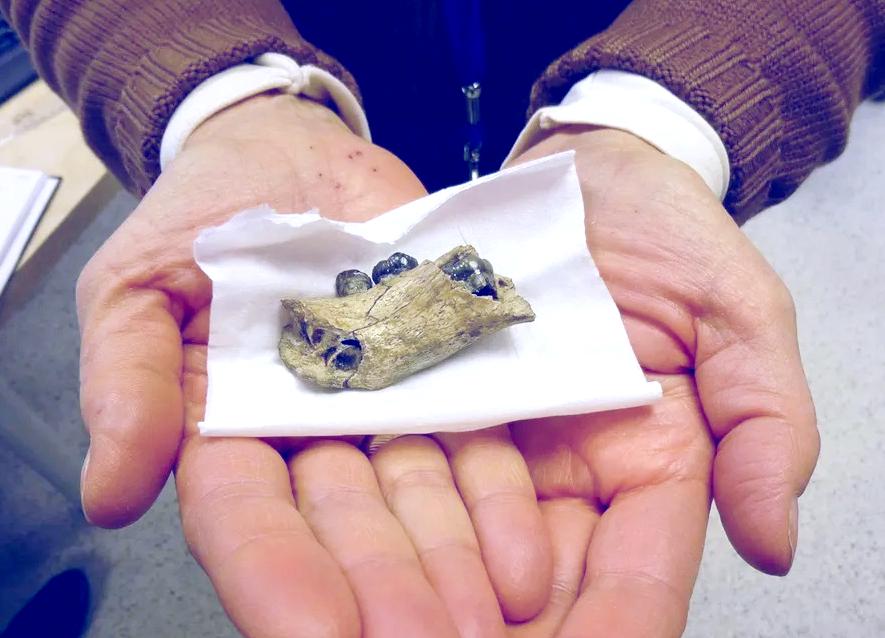
Homo erectus or upright man was probably the first hominid to develop a hunter-gatherer society--the life style practiced by humans for most of our history. And there is no doubt about Erectus status. It is unclear, however, to what extent he was a hunter as opposed to a scavenger. Hunting probably did not become primary until the neolithic era and the ability to make really sophisticated tools, especially weapons. Without weapons, hominid species would be very limited as to what they could hunt and kill. Most anthropologists identify H. erectus as the first hominid to look much like modern humans and to develop social relationships more like modern humans than the more ape-like Australopithecus species that preceded it. Here brain size was important. Erectus had a brain capacity averaging about 950 cc with some individuals as large as 1,200 cc, a unsubstantial increase over Ergaster. The human-like appearance meant specifically long legs and short arms. Those long legs meant that Erectus could travel long distances. Traces have been found in Africa dated to some about 1.9 million years BP. And this included sites in the Ethiopian Highlands. This means that Erectus was not restricted to the warm African lowlands where humans could thrive with basic technology, but could adapt to diverse climates. 【Handwerk 】 As a result, it was Erectus that spread all over the Eurasian land mass. Erectus had a larger brain reflected in more sophisticated tools. He may also have discovered the use of fire. Erectus has been described as the most successful of all hominid species, surviving for an incredible time span, approaching almost 2 million years.
Homo ergaster begins to look like modern humans. They were generally tall and slender, well adapted to the dry, hot climate of East Africa. They are believed to have been increasingly hairless. The brain capacity of Ergaster was about 850 cubic centimeters. This size is substantially larger than that of earlier archaic hominids, but still much smaller than modern humans with brains averaging some 1,350 cubic centimeters. The Ergaster case is complicated. Many believe Ergaster was really Erectus. And the fossil finds are so limited, it is difficult to make any definitive assessment. Ergaster is, however, believed to be the link between Habilis and Erectus.
Homo heidelbergensis is a relatively short lived archaic human. Despite its name, it evolved in Africa. Fossil evidence suggests that H. heidelbergensis evolved from Homo ergaster. Some researchers believe that there was a population bottleneck (around 0.9/0.8 million BP). Some believed that Ergaster is a sub species of Erectus. Heidelbergensis
migrated into Europe where the first fossil was found near near Heidelberg, Germany. Its presence in Asia, at least western Asia, is suspected, but not yet confirmed. As archaic humans like Heidelbergensis migrated north into colder climates, their bodies became more compact. This educed overall skin surface area and thus heat loss. This made them better able to conserve heat than a taller more lean body like Erectus which exposed a greater surface area proportionally to body mass. This was ideal in the hot, drier environment of East Africa. Heidelbergensis was a robust species with large brow ridges, and importantly with a brain size about 1,100–1,400 cc. While not as well known as other archaic human species, it is of some importance because it was the widely seen as the last common ancestor of Neanderthals, Denisovans, and modern humans Homo sapiens. The rise of modern humans occurred in Africa. The rise of Neanderthals occurred in western Eurasia, meaning that modern Africans unlike Europeans have no Neanderthal DNA. The rise of Denisovans appears to have occurred in eastern Eurasia. The break with these successor species seems to have occurred about 0.35 million years BP after the migration out of Africa. Heidelbergensis was in many ways a ground breaker. We see the earliest definite control of fire, not just use, but control. And we note the use of wooden spears. They were the first of the archaic humans to regularly hunt big game. And another imprint milestone, Heidelbergensis was the first of the archaic species to build any kind of primitive shelters. They fashioned primitive dwellings out of branches and rocks This leads to a difficult question to answer. Heildelberg is in southern Germany but north and west of the Alps and at the beginning of the Rhine Plain. But it is far enough north that it is hard to understand how humans, no matter how robust, could survive during the winter without some kind of protective clothing, especially because they lived during the last Global Maximum. There is a debate as to when clothing was invented. Of course biodegradable materiel like clothing does not survive hundreds of thousands of years. Anthropologists have long insisted that clothing did not appear until (170,000 to 80,000 BP). But some modern estimates are much earlier (as early as 500,000 BP). The later estimates are within the time range of Heidelbergensis
Neanderthals were a neolithic people that dominated Europe for about 400,000 years. They inhabited most of Europe and western Asia. Neanderthals had larger brains than Erectus, with significant differences in size and structure.: Neanderthals had an average cranial capacity ranging from approximately 1500 - 1600 cc. Neanderthals developed a culture similar to that of early man. They wore clothes and used fire. They were nomadic hunters. We are not sure to what extent if any that they developed agriculture. They made stone, but no metal tools. Their principal weapons were spears and clubs. Neanderthals disappeared after the arrival of modern man. It is widely believed that they perished because they could not compete with modern man, but there is little actual evidence. Neanderthals were heavily built and squat, more powerful, but apparently less intelligent than modern man. The last Neanderthal traces date back to about 40,000 BC. One enduring debate in anthropology is whether is how Neanderthals are related to modern men. We know that the two groups coexisted before Neanderthals disappeared. Some believe that modern man out-competed and displaced Neanderthals. Others believe that Neanderthals merged with and interbred with modern man. A recent study based on an assessment of sculls have found substantial differences which suggest that the two were different species rather than related sub-species.
【Harvati】 Teeth studies suggest that Neanderthal children grew faster than human children. Some anthropologists believe that Neanderthals may have been anatomically adult by about age 15, but not all anthropologists accept this theory. Preliminary DNA studies also suggest there was little or no mixing.
Homo sapiens or wise man is modern man who like most other members of the genus originated in Africa Modern man followed Erectus and also spread throughout the Eurasian land mass (Old World), eventually reaching the New World. Sapiens were characterized by large brains, bipedalism, complex culture, and of course language. Neanderthals had larger brains than modern humans on average. Neanderthal brains were, on average, slightly larger in absolute volume compared to those of modern humans. 【Merritt】 This of course challenges the prevalebt assumption that larger brain capacity size directly correlates with grater intelligence and cognitive skills. Volume is important, very important but not the only factor in determining capability. Brain organization and structure may play an even greater role in cognitive function than just And of course the Neanderthals were heavier than modern humans with larger body mass. Thus the ratio of brain size to body mass has to be considered. It is unclear to what extent other Humanoids species developed language. There must have been vocalizations of course, but at what point vocalizations became language is unclear. One notable characteristic of H. sapiens is a lack of genetic diversity, far less than most other species. It is believed that this reflects a kind of genetic bottle neck in which only a small number of humans survived. Some believe that this genetic bottle neck was caused by the eruption of the Toba mega-volcano and resulting in a mini-ice age about 75.000 years ago.
Handwerk, Brian. "Two million years ago, This Homo erectus lived the high life," Smithsonian Magazine (October 13, 2023).
Harvati, Katerina. New York University. Proceedings of the National Academy of Sciences, 2004 .
Lordkipanidze, David (Georgian National Museum) and Christoph Zollikofer (University of Zurich). Science (October 17, 2013).
Merritt, Gavin. . "Neanderthal Brain Size vs. Modern Human Brains" Biology Insights (September 21, 2026).

Navigate the Children in History Website:
[Return to the Homo genus]
[Return to the Main early Homonid species ]
[Return to the Main pre-history/Stone Age Paleolithic Era]
[Return to the Main stone age page]
[About Us]
[Introduction]
[Biographies]
[Chronology]
[Climatology]
[Clothing]
[Disease and Health]
[Economics]
[Freedom]
[Geography]
[History]
[Human Nature]
[Law]
[Nationalism]
[Presidents]
[Religion]
[Royalty]
[Science]
[Social Class]
[Bibliographies]
[Contributions]
[FAQs]
[Glossaries]
[Images]
[Links]
[Registration]
[Tools]
[Children in History Home]