
|
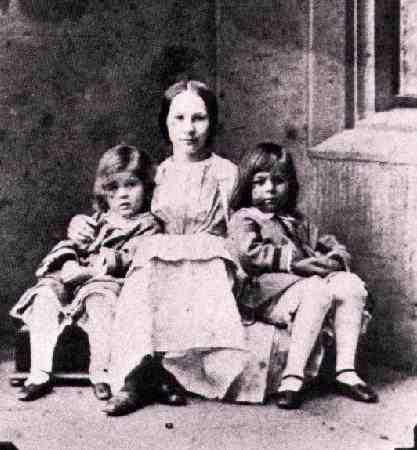
The Tennyson Boys' Clothing (1850s-60s)
Alfred Lord Tennyson is one of England's most beloved poets of all time. QueennVictorian chose him to suceed Wordsworth as the British Poet Laureate (1850). Tennyson is rightly regarded as the embodiment of the British Victorian Age. Alfred met Emily Sarah Sellwood, the love of his life in 1833. A friend, Arthur Hallam, had introduced them. Arthur himself asked Alfred's sister to be his wife. It was a great shock to the young people when Arthur died in September 1833 of an apoplexy. The year of 1833, despite his engagement to Emily was not a happy one. Alfred's brother Edward who had been disturbed for some time, was admitted to a mental asylum where he stayed until his death in 1890. It was in 1833 that Tennyson began Memoriam: A.H.H., perhaps his most famous work. He did not actually finish it until 1850. Tennyson after a prolonged engagement, finally married Emily in 1850. In the same year he was appointed Poet Laureate, suceeding William Wordsworth. The couple had two sons. The Tennysdon boys were close in age and often dressed a like. Many of the available images show the two brothers in idential outfits or outfits with only subtle differences, minor concessions to the older brother's age. The photographs suggest that the boys were very close to each other. The science of photography had by the 1830s developed to the pointthat realistic portraits were possible. It developed rapidly and was just enmerging in the 1850s as a popular family tradition. Technical improvements and falling prices for the first time provide us for the first time an extensive photographic record. Lionel and Hallam are two of the first boys where there are a series of photographic images available to chronicle their boyhood and provide details on how they were dressed. Interestingly, as the Tennyson family lived in a social swirl with many other artists and writers--they were close to Lewis Caroll, the author of Alice in Wonderland. Caroll happened to be fascinated with the developing technology of photography. Thus many of the photographic images of the boys were taken by Caroll. Others were taken by Julia Cameron. Photography appeared 1839. By the 1850s when the boys arrived, pgotograohy was well established. As a result there is an extensive phtographic record of the boys and how they were dressed. They had aind of artsy idea about how boys hould be dressed. The boys wore dresses for the fitst few years and then they began wearing tunics, often with fancy collars into their teens.
|

Dresses as Younger Boys
The fashion of outfitting boys in dresses continued at mid century as it did throughout the 19th century. This was a very common concentiom especially duing the early and mid-19th century. What varried was from family to family weas the age of beeching boys. We think that social class impacted the age. The same was true for hair length. Working-class boys seem to have been breached a little earlier than middle- and upper-class boys. The fashion of long ankle-length dresses probably worn by their father passed out of fashion during the 1830s. Boys by the 1850s were wearing much shorter dresses (figure 1). While dresses became shorter, it was not in the 1840s and the 1850s considered proper for young boys or girls to have bare legs. Thus short dresses were worn with lacey pantalettes. Generally the pantalettes of girls were fancier with more lace trim than those of boys. (This is one of the indicators that can be used to determine gender in early images.) Pantalettes were intially very modest ankle lengths. By the 1850s they had become much shorter and were often worn midway between the hem of the dress and the ankle. Girls and young boys would wear them with long white stockings, often with strap shoes. The Tennyson boys are a good example of this style (figure 1). I do not know precisely when the two boys were breeched, that is allowed to wear tunics and eventually pants. Also I do not know if was done at once, both boys allowed to wear tunics or if one boy stayed in dresses while the other wore tunics. I do not know of any images of the boys together dressed differently with one still in dresses. At any rate Hallam appears to have emerged from dresses sometime about 1859 at about 5 years of age. Presumably Lionel followed within a year in this major step of boyhood.
|

Long Hair
Mrs. Tennyson appears to have been partial to long hair. The boys' blond hair was kept in long gilden locks, not only as little boys, but also as they got older. Their hair was not curled as was to become popular in the 1880s. Rather Mrs. Tennyson lert their hair a shoulder length in
a long flowing style. I do not believe that this was a common style of the day in England. Long hair may have been more common in France. Images of French boys waring long shoulder-lenth hair with hairbows are available for the 1870s, I'm not sure, however, as to just when it became fashionable. Looking at the images of Lionel and Hallam I note that there hair is often rather unruly and not carefully combed for the photographs. Compare this to the images availavle during the 1860s-90s. These images were taken in photographic studios and the children carefully
dressed and their hair coifurred with great care. Often doting mothers carefully laid a boy's long ringlet curls on his shoulder so it would show prominently in the photograph. This does not seem to have been the case with the Tennyson boys. In part this was due to the fact that many of the photographs were taken by Lewis Carol as a hobby and not in a photographic studio. In fact there are even outdoor images (figure ?), a rarity at the time. The unruly hair may also reflect the fact that while the Tennysons were comfortable, but they were not rch and could not afford a huge staff that could constantly be caring for the boys' hair.
Mrs. Tennyson appears to have shared her husbands romantic impulses and
appears to have expressed
them in outfitting the boys. I'm unsure as to what Lionel and Hallam
themselves thought about their long hair or what they may have said to
their mother about it. English and American boys during the mid-19th
century appear to have more commonly worn short hair.
I'm not sure how their long locks would have been received at England's rather
rough Public (i.e. private) Schools wear boys who dressed differently from the
accepted styles could be teased and hazed. Lionel and Hallam given the family's
comfortable status were presumably educated at home.
While perhaps not common, Mrs. Tenyson was not the only English mother
at mid-century that insuisted on long hair for their sons--even older boys.
The Tennysons were friendly with the Brownings--two other renowned
English poets. Another good example of mid-19th century hair styles
for boys is a photograph of
Elizabeth Barrett Browings' son Pen
, also taken by Lewis Carol. Pen's mother has the boy who was
about 11
years in long, but in this case curled hair. As mentioned above, Mrs.
Tennyson kept her sons' hair long, but did not curl it.
Tunics and Pantalettes
Their mother appears to have been partial to the popular tunic style of the day. For Mrs. Tennyson it appears to have appealed because for all practical purposes, the tunic if worn with pantalettes (figure 2) looked very much like a dress. Younger boys wore their tunics with pantalettes but if the continued to wear tunics as older boys they would be worn with knickers or even long pants. Mrs. Tennyson chose to out fit her sons with pantalettes, long white stockings, and strap shoes when they first began wearing tunics. We have a photograph by Lewis Carol of Hallam in such an outfit, a tunic with lacey pantalettes (figure 1}. Presumably his brother wore a similar outfit. Tunics were common for boys ztvthe yim. Bit it was not common for boys to wear tunics into their teens.
|

Mrs. Tennyson often added a lace collar
to complete the outfit. The collar does not appear to have been the collar of a blouse, but rather a separate decoratve device sewn on to their tunics. Again this does not seem to have been a common style. Boys in the late 18th and early 19th centuries often wore large ruffled collars, usually open collars without bows. Lace collars, however, were unusual. The lace collars worn by Lionnel and Hallam predate the emergence of this fashion as part of the Little Lord Fauntleroy style of the 1880s. It presumably appears as part of the boys' clothes as lace collars had by the mid-19th century begun to be worn by women. Women's fashions more strongly affected boys' fashions at the time. Remember little boys wore dresses and Hallam, when Lewis Caroll photographed him (figure 2), had just
emerged from dresses. The lace collars the Tennyson boys wore for several years were worn without bows of any type.
Knickers and Lace Collars
A rare outdoor photograph taken in 1862 shows the boys wearing frock-like tunics with
lace collars and knicker pants (figure 2). The tunics were front buttoning and worn with large floppy hats. Earlier these tunics were often worn with pantalettes. Another good
example of the mid-19th century tunics is the photograph of Elizabeth
Barrett Browings' son Pen taken by Lewis Carol discussed above. Pen wears his tunic with knee pants and strap shoes. Pen wears below the knee pants, but unliked the Tennyson boys they were not pursd in knicker style.
The Tennyson boys, however, in the 1862 wear an interesting combination of lacey collars, tunics, with rather plain, modern-looking knickers. I'm not sure then they made the transition from pantalettes to knickers, but it appears to have been 1862 (at least for Hallam). Mrs. Tennyson may have had Lionel wear knickers with pantalettes for another yar or so. The knickers are rather
long coming well below the knee and were normally worn with heavy wollen soc ks rat her than the white stockings the boys had worn earlier. They also had colorful crimsom stockings for best. I do not know precisely when the boys finally made the transition to long trousers.
The boys appears to have worn the same grey tunics for several years. They did not seem to have had anything approaching a warbdrobe, but always wore identical-looking tunics. Large wardrobes for children are rather a modern phenomenon, but even by the standards of the day this seens rather a limited selection of clothes. I think Mrs. Tennyson must of made their clothes, however, using the same pattern over and over, probably out of her old dresses. From what
I've seen of other 1850s clothes, they look pretty boring.
The brothers in most available photographs are pictured in nearly identical clothes. As they were so close in age, the major changes from dresses to tunics, pantalettes to knickers, and eventually long pants may have been made at the same time. Many Victorian photographs show that parents may many changes in a boy's clothes as he got older. Even brothers quite close in age might have subtle differences in their clothing. This does not appear to have been the case for the Tennyson boys. In fact they appear to have worn the same grey tunics for quite a long time, only changing from pantalettes to knickers when they were about 7 or perhaps 8 years old. There is one intriguing 1864 photograph in which Lionel dutifully wears his lace collar, but his older brother Hallam does not. I'm not sure what this meant, especially as we do not know what the boys thought of their lace collars. We know that some boys did not like the idea of wearing a lace collar one little bit. I do not have any information about what they thought of their mode of dress or hair style. I think Hallam may have wrote a biography of his father which could have some information in it. Several possibilities come to mind. Did Hallam not like the collar and didn't want to wear it? Was Lionel more obedient than Hallam? Was Hallam's collar perhaps soiled or torn and needed replacement? Was it not a real issue and simply forgotten in preparing for the photograph? (This seems unlikely as so many earlier photographs shows the boys carefully done up in their lace collars.) One observer doesn't think that the boys would have objected to their tunics, lace collars, and long hair very much. They were pretty much raised at home and closeted from most outside influences. They associated only with their parents' set and the children they played were the children of their parents friends. The British practice of sending 8-year olds off to boarding school had not yet become an excepted practice and many boys were schooled at home until their early teens. Thus there mother could choose their clothes and hair style without much criticism.
|

The two attractive brothers and the way their mother dressed them did not escape notice in the family's social circles. Photographer The photographer Julia Camerson was especially struck by Lionel's curls which she thought so pretty. Another observer wrote of Lionel He seems to come out of a chapter of past history. Edith Bradley, daughter of family friends Grenville and Maria Bradley later wrote:
...straight and tall dressed always in tunics and kneepants of the same shade of grey as their mother's gown--belted on weekdays, crisomed sashed and crimsomed stockinged on Sundays, holidays, and ]everyday evenings, low stapped slippers always worn in the house, and on the broad lace collars, the long golden hair falling, Lionel's forever in his eyes ... the younger's beauty was so great that even we children were conscious of it. He looked like his mother, whereas the elder had his father's deep-set eyes and high forehead.
It is interesting to note that there plain grey tunics were adorned with a red sash and red stockings for Sunday, holidays, and evening wear. One of the subjects of interest comcerning the Fautleroy suits of the 1880s-1890s was both the color of the suits and the color
of the accesories like the sashes and stockings. The black and white
photography of the day offers few clues. We know from mailorder ads
that the suits came in dark blues, greens, and burgandies in addition to the classic black, although how common these colored suits were is not known. We also know that crimsom sashes were not common. I always thought that the stockings were black or matching colors. Mrs. Tennyson's use of crimsom stockings in the 1860s is an indicator that at least one mother was adding colored stockings to boys' outfits. Thus the possibility that this device could have been used in subsequent decades should not be discounted.
Because of Tennyson's status as Poet Laureate, he and his family were an attractive subject for the photographers of the day. Besides the prestige, the photographers would often sell the photos. The outcome is that there are several photographs from the 1850s-60s showing how the boys were dressed and how their clothes changed over time. Photography was still
developing as a commrcial enterprise and there are few such complete
records for boys over a span of years during this period.
HBC

Navigate the Boys' Historical Clothing biographies pages:
[Return to the Main Tennyson page]
[Return to the Main biographies page]
[Biographies A-F]
[Biographies G-L]
[Biographies M-R]
[Biographies S-Z]
Navigate the Boys' Historical Clothing Web Site:
[Tunics]
[Curls]
[Long stockings]
[Pinafores]
[Smocks]
[Dresses]
[Sailor hats]
[Lace collars]
[Knickers]
[Strap shoes]
[Pantalettes]
Navigate the Boys' Historical Clothing Web Site:
[Introduction]
[Activities]
[Biographies]
[Chronology]
[Cloth and textiles]
[Garments]
[Countries]
[Topics]
[Bibliographies]
[Contributions]
[FAQs]
[Glossaries]
[Images]
[Links]
[Registration]
[Tools]
[Boys' Clothing Home]
Created: 6:55 PM 4/30/2026
Last updated: 6:55 PM 4/30/2026
