|
Alfred Lord Tennyson is one of England's most beloved poets of all time. QueennVictorian chose him to suceed Wordsworth as the British Poet Laureate (1850). Tennyson is rightly regarded as the embodiment of the British Victorian Age. This is not only the case for modern readers, but it was the view of his Victorian contemporaries. Hevwas surely one of the bthree most widely known Victorians after of couse Queen Victoria and Prime-Minister Gladstone. This was an stonishing prominence for a poet. No English poet has produced acknowledged masterpieces in so many different literaray genres as Tennyson. The consumate artistic excellence of his verse, resembling in many of its qualities the stately and heroic measures of the ancient Roman poet Virgil, has securred an enduring place in literature for Tennyson. He lived in a society in transition and both his life and poetry were transformed by it. He was not just the poet lauterate ob Britain, but the poetic spokesman for Victoria's reign. He realized what was happening and his role, although he clearly idealized the countryside, desribimg a wonder thatbnever was. And poetry seems illequiped to capture a industrial and mercantile processes rising over a landed, traditional nation. His sympathies were with what he believed was the old, static rural countryside. Thus he was conflicted between what he saw as his duty to society to report and his allegiance to the perceived natural beauty. Literary experts report an astonishing lyric gift captuing the perfect sound and cadence for his thoughts. In this more than any other man he captured the the concerns and imagimnation of the Queen and her subjects. And the life span of the Queen and her poet were very close.
The renowened English poet Alfred Lord Tennyson (1809-92) was born in Somerby in Lincolnshire in northern England.
Alfred Tennyson was born in 1809. He was the third surviving child of the clergyman and rector Reverend George Clayton Tennyson and Elizabeth Fytche Tennyson. Although his father George had been an elder son, his younger brother Charles was made sole heir after a disagreement between George and his father. As a result, and George was forced to earn his living as a clergyman. He did not like his profession, but as he had 11 children, he had little choice. Alfred's father suffered from depression and was has been described as very absentminded.
We know very little nothing about his boyhood or how he was dressed as a boy. While not growing up in abject poverty, the family resources were very streatched--especially for 11 children. There would not have been enough money for fancy clothes. Certainly he was outfitted in dresses as a younger boy as was the style throughout the 19th century. As an older boy he probably wore skeleton suits and tunics, two popular styles in the
early-19th century. Alfred began to write poetry as a boy. He was enchanted by Byron and cpied his style.
'
Alfred spent four years at a boarding school where he was very unhappy. Finally his parents decided to tutor him at home. He then attended Trinity College, Cambridge. He was drawn to the literary club 'The Apostles'. Here he met Arthur Hallam and the two became close friends.
|
Tennyson's petic career began at an early age. Alfred himself started writing poetry at only 8 years of age and had written most of a blank verse play by age 14. His poetic talents were recognized while he was still at Cambridge. In 1829 he wrote the spirited blank verse poem Timbuctoo,
for which he received the Chancellor's gold medal. He published his
first book of poems in 1830, Poems, Chiefly Lyrical.
Tennyson left Cambridge without earning his degree in 1831. He and a close friend, Arthur Henry Hallam--son of an eminent historian, joined a revolutionary Spanish army fighting the reactionary regime of King Ferdinand VII. Ge was not the last idealistic young English writers, not to speak of Americans, to fight despotic regimes on the Iberian Peninsula. Tennyson published more poems in 1832, but his friendship with Hallam was to have a profound impact on his literary career. The sudden and unexpected death of his friend Arthur had a profound impact on him and he pledged himself to refrain from publising for 10 years in homage to his friend. Instead he devoted himself to
philoshopical contemplation. Literary scholars still debate
the nature of the relationship. Given the future eminance of Tennyson and the impact of Hallam on his career, the relationship is one of the
most debated in the literary world. One of Tennyson's few published works during this period was the The Two Voices, a philosophical poem on death and importality.
Tennyson in 1842 at the expiration of his 10-year period of silence published some of his best known poems, winning wide acclaim. The poems included Morte d'Arthur, Ulysses, Locksley Hall, Godiva, and the poignant lyric Break, Break, Break. These poems firmly established Tennyson's position as the foremost poet of the day and brought him in comtact with other literary luminaries such as Dickens, Carlyle, and poets Rogers and the Brownings.
|
The acclaimed poet as a result of an imprudent investment lost his
modest fortune and would have been reduced to extreme poverty had not
Arthur's father prevailed upon Prime Minister Sir Robert Peel to arrange for an annual pension in 1845. He published The Princess in 1847, a romantic treatment in musical blank verse dealing with women's rights. One of his most perplexing poems, In Memoriam, a tribute to his friend Arthur, was published in 1850. Liteary scholars continue to debate the character of this work to day.
Alfred met Emily Sarah Sellwood, the love of his life in 1833. A friend, Arthur Hallam, had introduced them. Arthur himself asked Alfred's
sister to be his wife. It was a great shock to the young people when Arthur died in September 1833 of an apoplexy. The year of 1933, despite his engagement to Emily was not a happy one. Alfred's brother Edward who had been disturbed for some time, was admitted to a mental asylum where he stayed until his death in 1890. It was in 1833 that Tennyson began Memoriam: A.H.H., perhaps his most famous work. He did not actually finish it until 1850. Tennyson after a prolonged engagement, finally married Emily in 1850. In the same year he
was appointed Poet Laureate, suceeding William Wordsworth.
Alfred and Emily at Twickenham, in Middlesex. They moved in 1853 to a country estate Farringford, near Freshwater on the Isle of Wright. He resided there for at least part of the year during the rest of his life.
The couple had two boys, Lionel and Hallam. Hallam was born in
1853 and Lionel in 1854. I have few details on his family life or on the boys. One source claims that Tennyson loved being Poet
Laureate, though he never quite got used to all the attention from complete strangers. It was, however, his home life was what was most dear to him. He was reportedly a doting father and was apt to spoil the boys more than his mother.
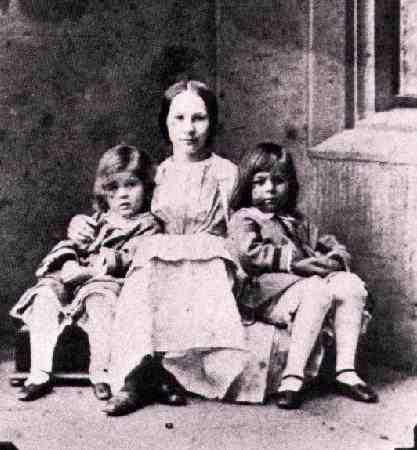
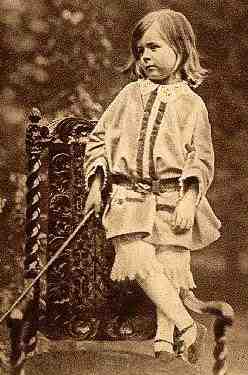
The boys were close in age and often dressed a like. Many of the available images show the two brothers in idential outfits or outfits with only subtle differences, minor concessions to the older brother's age. The photographs suggest that the boys were very close to each other. The science of photography had by the 1830s developed to the pointthat realistic portraits were possible. It developed rapidly and was just enmerging in the 1850s as a popular family tradition. Technical improvements and falling prices for the first time provide us for the first time an extensive photographic record. Lionel and Hallam are two of the first boys where there are a series of photographic images available to chronicle their boyhood and provide details on how they were dressed. Interestingly, as the Tennyson family lived in a social swirl with many other artists and writers--they were close to Lewis Caroll, the author of Alice in Wonderland. Caroll happened to be fascinated with the developing technology of photography. Thus many of the photographic images of the boys were taken by Caroll. Others were taken by Julia Cameron.
|
Tennyson's eye sight deteriorated late in life. His
eyesight became so bad that he had difficulty editing. Fortunately he had always composed his poems in his head. Emily acted as his secretary. Hallam took over this task in 1874 due to his mother's failing health. But Tennyson was feeling his age and was afraid to take on another major work that he might not live to finish. His brother Charles died in 1879 and Edward FitzGerald died in 1883, and Alfred was starting to feel increasingly isolated.
The most tragic blow came in 1886, when his son Lionel died of fever while at sea. Lionel went to India at an early age and died on the return voyage which caused his father and mother much grief.
Hallam married and had children. I have no details on the children
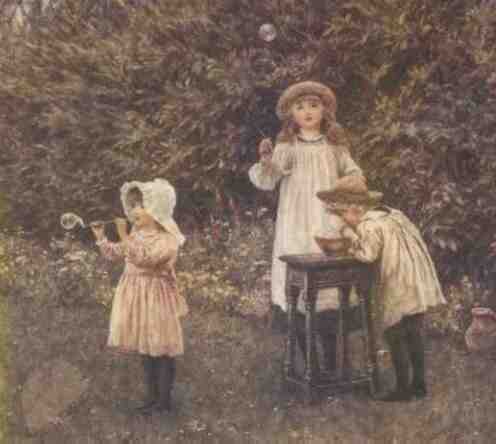
or details on their upbringing. Hallam's son Lionel was born In November 1889, followed by Alfred, Jr. in April 1891. They all appeared to have lived together with their paternal grandparents. Few details are available on the clothes they wore. I do not know if they wore tunics like their father. They do seem to have worn smocks, as the watercolor probably painted in the late 1880s by
Hellen Allingham shows. Hallam made a career out of caring for
his parents and his father's legacy. Hallam proved to be the dutiful
son.
Tennyson continued to publish for four decades, although his later works lack the force and originality of his earlier works. One of the most famous poems, The Charge of the Light Brigade, deakling with a Crimean War engagement was published in 1854. His published works during this period were the ones most successful commercially. No English poet has produced acknowledged masterpieces in so many
different literaray genres as Tennyson. The consumate artistic
excellence of his verse, resembling in many of its qualities the stately and heroic measures of the ncient Roman poet Virgil, has securred an enduring place in lit erature for Tennyson. He furnished perhaps the most notable examples in English letters of the ecletic style, made up of elements derived from many of his distinguished predecesors. Alfred, Lord Tennyson, was first and foremost a Victorian. Tennyson
like Charles Dickens, Matthew Arnold, Charles Kingsley, T.H. Huxley, and Victoria herself, is one of the people meant when we speak of " the Victorians." What made Tennyson so Victorian was his ready acceptance of the mores of his day, his willingness to conform to popular taste, to write a poetry that was easily understood and enjoyed. This was something that Robert Browning never could, or would, do, although he often said he wanted to. If we expect poets to be rebellious, like Shelley, Byron, Swinburne, or Dylan Thomas, Tennyson must disappoint us in this regard. t is important to remember, however, that his behavior involves no hypocrisy. This was a position which he readily accepted: no Poet Laureate before him had so regularly written so much occasional verse. He wrote poems on the death of Lord Nelson, on the birth of Princess Alexandra, and dedicated the complete Idylls of the King to Albert, the Prince Consort (Victoria's beloved husband) -- which lead to Swinburne's description of the Idylls as the "Morte d'Albert." But again, we should remember that Tennyson knew and liked the royal family. Prince Albert had come to visit him on the Isle of Wight just shortly after he and his family had moved in, and Queen Victoria summoned him to court several times. It was at her insistence
that he accepted his title, having declined it once when Disraeli offered it and again when Gladstone did.
Partly as a result of his position as a public and nationalist figure, Tennyson was by far the most popular poet of the Victorian era. No poet was ever so completely a national poet: Henry James said in 1875 that his verse had become "part of the civilization of his day." This probably explains why literary opinion turned so sharply against him in the earlier part of the twentieth century, as we reacted against all things Victorian.

Navigate the Boys' Historical Clothing biographies pages:
[Main biographies page]
[Biographies A-F]
[Biographies G-L]
[Biographies M-R]
[Biographies S-Z]
Navigate the Boys' Historical Clothing Web Site:
[Tunics]
[Curls]
[Long stockings]
[Pinafores]
[Smocks]
[Dresses]
[Sailor hats]
[Lace collars]
[Knickers]
[Strap shoes]
[Pantalettes]
Navigate the Boys' Historical Clothing Web Site:
[Introduction]
[Activities]
[Biographies]
[Chronology]
[Cloth and textiles]
[Garments]
[Countries]
[Topics]
[Bibliographies]
[Contributions]
[FAQs]
[Glossaries]
[Images]
[Links]
[Registration]
[Tools]
[Boys' Clothing Home]