|
The important matter to bear in mind about medieval French history is what a long period it was, the country's longest historical era--essentially a millennium. French medieval history begins with the fall of Rome and the Franks. The Franks were, however, a Germanic tribe.
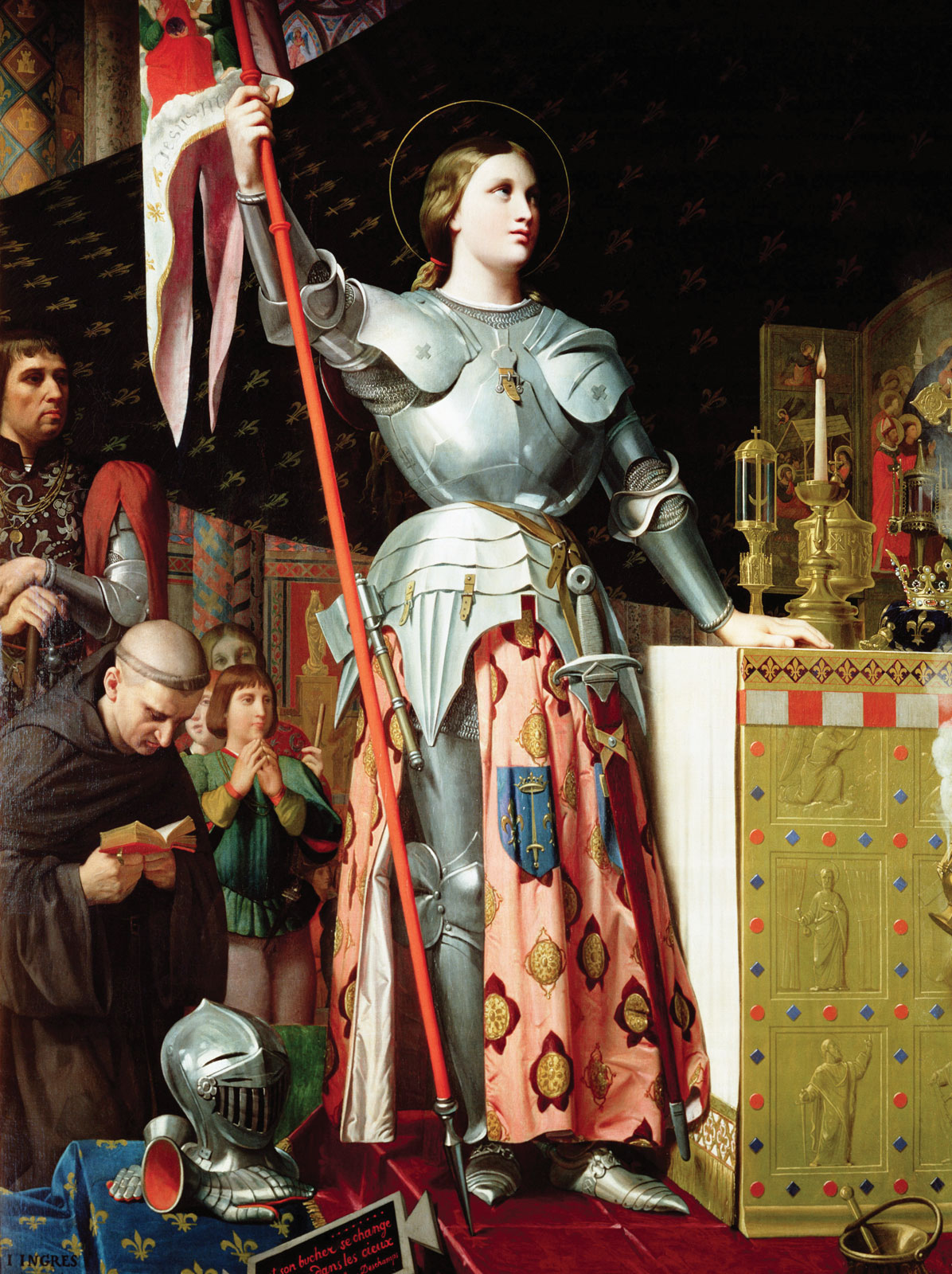
There was no unified Frankish state until Clovis. His father was Childeric I, the king of Salian Franks (481). The Salians were one of several important Frankish tribes. Clovis unified the Franks creating a kingdom encompassing a large area including what is now modern France and the Merovingian dynasty. Modern France does not emerge until the division of the Frankish Carolingian empire. The division of the Carolingian Empire provided the basis for both modern Germany and France. After the Carthaginians, the descendants of Hugh Capet for almost 1,000 years provided France with its kings as direct descendants and later branch families (Valois and Bourbon). France emerged as a recognizable modern country at about the time that the Viking raids began. The country thus was formed by the Celtic, Roman, Frankish, and Viking peoples. The French monarchy was initially very weak. The monarchy because of the resistance of the nobility to central authority. This left France open to attack from the Vikings and English. France played a major role in the Crusades which absorbed the energies of kings, counts, clergy, and commoners, reducing internecine conflict. Medieval French history swirls around conflicts with both a divided Germany (the Holy Roman Empire) and a united England. The Norman conquest of England in the 11th century initiated centuries of conflict between England and France. The proud French nobility competed with the monarchy for power. This coupled with regional power centers like Normandy and Burgundy had the potential to create a situation as in Germany that prevented the creation of a centralized French state. This was prevented by King Philip Augustus of France who defeated a coalition led by Emperor Otto of Germany and King John of England. The French victory at the Battle of Bovines (1214) defeated the Germans and the coalition fell apart. Two centuries later, France again faced dismemberment, this time it was saved by an unlikely savior, a French peasant girl--Joan of Arc. Her victory at Orleans was crucial (1429). The French went on to expel the English in the Hundred Years War (1337-1453) and to defeat their Burgundian allies. The French nobility weakened by the War finally was forced to bow to the monarchy and its claim of absolute authority. Gradually trade revived and cities and towns begin to grow. The bourgeois of the towns engaged in a resurgent trade of agriculture and artisan crafts. The French built magnificent cathedrals to glorify God. Important universities were founded at many of these cathedrals. The quickening economy was caped by the Renaissance bringing and end to the medieval era.
The important matter to bear in mind about medieval French history is what a long period it was, the country's longest historical era--essentially a millennium. France was a major playervin the Renaissance which brought an end to medieval era.
French medieval history begins with the fall of Rome and the Franks. The Franks were, however, a Germanic tribe. There was no unified Frankish state until Clovis. His father was Childeric I, the king of Salian Franks (481). The Salians were one of several important Frankish tribes. Clovis unified the Franks creating a kingdom encompassing a large area including what is now modern France and the Merovingian dynasty. Modern France does not emerge until the division of the Frankish Carolingian empire. The division of the Carolingian Empire provided the basis for both modern Germany and France. France emerged as a recognizable modern country at about the time that the Viking raids began. The country thus was formed by the Celtic, Roman, Frankish, and Viking peoples. Medieval French history swirls around conflicts with both a divided Germany (the Holy Roman Empire) and a united England. The Norman conquest of England in the 11th century initiated centuries of conflict between England and France. The proud French nobility competed with the monarchy for power. This coupled with regional power centers like Normandy and Burgundy had the potential to create a situation as in Germany that prevented the creation of a centralized French state. This was prevented by King Philip Augustus of France who defeated a coalition led by Emperor Otto of Germany and King John of England. The French victory at the Battle of Bovines (1214) defeated the Germans and the coalition fell apart. Two centuries later, France again faced dismemberment, this time it was saved by an unlikely savior, a French peasant girl--Joan of Arc. Her victory at Orleans was crucial (1429). The French went on to expel the English in the Hundred Years War (1337-1453) and to defeat their Burgundian allies. The French nobility weakened by the War finally was forced to bow to the monarchy and its claim of absolute authority.
The medieval economy of France was characterized by periods of a strong wwak abns monarchy, perhaps tyhe apogee of feudal sydevelopment, and a flourishing network of trade and commerce. The economy as did most countries relied heavily on agriculture, but France had the advange of the mot productive agriculture in Europe. Most of Europe is well-watered, except Spain, one of of France's medievl rivals. But France combined the available water with more sunny weather than Englnd or Germany. This is crucial in economies based on agriculture. This was especially impotant because wht the Europeans wanted to grow was wheat. This is a cropp develed in the sunny, but arid Mesopotamia. And no oher country in Western and Central Europe had the capacity to produce wheat that France had. This made France the poyential super power of the medieval era. This agricultural advantage would begin to echange with the a href="/eco/ce/agr-ce.html">Colombian Exchange introduced potatoes to Europe (16thcentury). The potato massively increased the agriculktural productivity of France's min rivals (englnd and Germany). The production of luxury goods such as silk, wool textiles, and silver, also played a role in the medieval French ecomomy. After the fall of Rome and early-medievl period., gradually trade began to revive, and cities and towns begin to grow. The bourgeois of the towns engaged in a resurgent trade of agriculture and artisan crafts. The rise of the medieval bourgeoisie, a new social class of merchants, artisans, bankers, and entrepreneurs, marked the beginning of the Commercial Revolution, which transformed Europe's economy from agrarian and localized into one increasingly oriented toward trade, finance, and production. France's geographic expanse, resources, climate, and strategic location also played a crucial role in its economic prosperity and influence.The quickening economy was caped by the Renaissance bringing and end to the medieval era.
After the Carthaginians, the descendants of Hugh Capet for almost 1,000 years provided France with its kings as direct descendants and later branch families (Valois and Bourbon). The French monarchy was initially very weak. The monarchy because of the resistance of the nobility to central authority. This left France open to attack from the Vikings and eventually the English. It would be France, however, that would create Europe'd mot powerfuly monarch in the person of Louis XIV--the Sun King (r. 1643-1715). This was well beyond the medieval era. But France even at that time retained pects of the Feudal sytem in both society amd most imprtntly the economy which is the main reason France, a potentially greater power than England, lost its centuries-long conflict with England.
French religious history is marked by the profound influence of Christianity, particularly Catholicism. Before the rise of Christianity, the region was influenced by Celtic polytheism and later Roman pagan beliefs. The Romans introduced their pantheon of gods and built temples, which laid the groundwork for the religious landscape of Gaul which was conqueed by Caesar (1dt cenury BC).
Christianity began to take root in the Roman Emire, including Gaul (2nd century AD). It was well estblished when Constantine enacted the Edict of Milan which granted toleration to Christianity and allowed the faith to flourish (313 AD). Despite the fall of Rome to Germanic pagan invaders, Christianity continued to grow (5th century AD). Clovis I, the Frankish king, convesion ro Christiuanity ws acruscial step in French history. His baptism solidified the church's role in legitimizing royal authority, intertwining the church with the French state and ensured the development of Christinity as the established religion. The Churchg influencing politics, education, and social customs. The French monarchy maintained close ties with the papacy, earning France the title 'eldest daughter of the Church'. The major conflict with Church was who controlled the selection of French clerics. The French built magnificent cathedrals to glorify God. Important universities were founded at many of these cathedrals. France played a major role in the Crusades which absorbed the energies of kings, counts, clergy, and commoners, reducing internecine conflict. The Reformation shook France to the core leading to Relgious Wars. The French monarchy and Catholic clerics would eventually suceed in supressing the Hugenots, but at enormous cost to the country.
The Roman manorial system of slave labor began to change after vthe collapse of the Western Empite, but moresloly than often recognized. Feudalism camne to diominare most of northern Europe (by 1000 AD). The heartland or fullest flowering of the Feudal System were the rich agricultural lands in the Seine valley of France and the Thames valley of England. (Remenber that the conquerung Normans under William the Cionqueror (1066) brought French feudalism to England.) Feudalism would ome larer to nEastern Euopoe. The slaves of Rome over time as poart of Christian influence. were replced with the serfs of medieval Western Europeo. One author describes a medieval population divided into three groups: 'those who pray' (clergy), 'those who fight' (knights, soldiers, aristocrats), and 'those who work' (peasants). 【Konieczny】 The rise of the medieval bourgeoisie, would complicate the class sysrtem and eventully lead to the decline of the Feudal System. Of course the peasants (serfs) were the vast majority of the population. till rather primitive agriculture meant that a large peaaaant population was needed to produce the food which society needed. In sharp contrast to modern agiculture, medieval farmers only produced a little more than their bsaic needs. Medieval serfs had few fights. But they did gave wone right which separated them from Roman slaves. They had aight to stAy on the land. A huge social and legal gulf separated the dufferent classes--especially the peasant. The Carolingian Empire (800–888), offered the promise of anew Rome, but in the end failed. Under feudalism, the power of the monrch declined. Western Europe wasturned into a patchwork quill of small, semi-autonomous fiefdoms of lords and clergy ruling over a populace mostly of farmers. Some were relatively prosperous and actually owned land. Most were landless, but with the right to remain on the land. 【Levine, pp. 18-21.】
Chivalry is an informal and varying code of conduct that developed in France.
The medieval era lasted about a millenium. The general asumpotion is that cultural phenomenon like chivalry existed thrroughout the medieval era. This of course was not the case, there were great differences during the medieval era.
he idea of Chivalry, for example, did not apper until more thn half of the medieval era had passed. It is stronly asociated with the edieval feudal Christian institution of knighthood. Feudal knights were members of various chivalric orders. Knights' were depicted as gentlemen whose conduct was governed by a chivalrous social codes. It became a popular literary genre in which knights were heavilily idealized (1170-1220). In reality, mediev knight could terribly brutl, especially in dealing with the peaantry or in actual military operations. We know, for example, how the Crusaders treated peoplein besieged cities which was nothing short of unchecked barbaity. The best known conte,prary ideals expressed in medieval literature were the literary cycles -- the the Matter of France recounting the Famed companions of Charlemagne and his knightly warriors, the paladins. There was also the Matter of Britain . Geoffrey of Monmouth's Historia Regum Britanniae (1130s) the first literary expression of Camelot -- King Arthur and his knights of the Round Table. (Alathough thesetales were Engkisg, the ruking dybasty was Norman.
The fashion of medievl Europe isnot well undestood in the popular mind. There were not individual national styles. In fact modern nations did not begin ti form before much oif the millennium-lomg medueval era had passed. After the collpase of the Western Roman Empire Europe (5th century AD) civilization began a societal collapse. Many modern scholars reject the term Dark Ages, but there was civilizational declines. Whole cities disappeared or declined to mere shells of their formner sizes. Trade withered. The Eastern Empire (Byzantium) survived, but controlled an increasingly small part of Easten Europe. All of thisimpacted econmics and people's life styles and fasgion were impacted by thedcline in economic ctivity. Fashion diring much of the mdievl period was very basic and slow to change and was remarkably stardardc for large areas of Europe, the impact of a very low standard of living. And most notably France was not the dashion icon it would become as Europe moved into the modern age. What fashion influence thar were imprtant came largely from Italy--for a long period the richest area of Europe. Clothes for men and women were amazingly similar. They tended to be crudely and loosely cut. What we would call a shirt eventually became known as a chemise which aking with braises was the foundational medieval garment. The chemise were grments done in natural colored linen. (Dyes were expesive and cotton did not yet exist in Europe.) The chemise was a hip-length garment for mem, somewhat longer for women. It was one with a had a rounded neck, slit in front tomakeit wasy to pull on. buttons had not yet been invented. It was dastened with a drawstring. The chemises was worn with braies -- baggy linen breeches or undergarments. They werecommonly tied at the waist with a drawstring. They could be short or knee-length. Thetwere worn in antiquity and continued to ve wirn in the medevl era. They were often paired with hose and included a gusset for strength orv ease of movement. This was a triangular or rhomboidal piece of material (usually fabric but could be metalic or leather). Braies were aldo fastened at the waist with drawstrings. Over this
was worn tunics. While the term tunic iscommonly bused--thy look mote like crobes or dresses. They were knee- or ankle-length for men and ground-length for women and elerly men. Medieval tunics had a round neckline and long sleeves cut in one with the garment. It was was loose fitted, but often girded at the waist. Tunics asthe oter garment that howed were made from dye colored linen or wool and could be decorated with embroidered bands or other features at the neck, wrists, and hem. Legs were covered with basically ill-fitting hose. Futting of coursemean more woirkmabship andthus cost. The hose was cut from cloth in two vertical sections and sewn together. They were held in plasce up by banding or garters. This was the generic European costume, including France and did not begin to change until the ecomomy began to revive (about the 11th century). There were also impoements in medieval agriculutre resulting bina tradeable surplu. Trade beganb to quicken amd cities began to grow again. A factor here was the Crusades (beginning 1095). Note that the Crusades among other factors helped open up trade routes. Inadditioin, the growth in state formation helped bring h depredations of the Norsemen under comtrol. But note all of this was more than half way throughh the medieval period. And with the quickening economy, fadhion for the first time since Rome began to flourish.
Art and the visual representations it provides plays a very imprtant role in understanding history. The Romans reached a very important levels of sophistication. Relatively little of it survived. And aftr the fall of the Western Empire and the collapse of civilization, the technical capabilities were lost for centuries. As a result, French art for much of the medieval era offers only unsophisticated glimses into culture and society. We see llustrations, often without ant attribution as to the artist. Only with the advent of the Renaisance do we begin to see refined artistic images. Here wer have two groups of artists. Ten Renaisance occurred during the late-medieval period. Contemprarty artists that painted during the period. These may not be the most refimned artists, but had the advantage of painting what they actually saw. The other group are historical artists, mostly beginning in the 19th century. They attempted to create historical scenes. This of course does not have the same historical value as contemporary artists.
Geoffrey of Monmouth. Historia Regum Britanniae (1130s).
Konieczny, Peter, "The Three Orders of Medieval Society: Those who Pray, Those who Work, Those who Fight," Medievalists.net.
Levine, David, (2001), At the Dawn of Modernity (Berkeley: University of California Press, 2001).

Navigate the Children in History Website:
[Return to the Main French history page]
[Return to the Main medieval European history page]
[Return to the Main European history page]
[About Us]
[Introduction]
[Biographies]
[Chronology]
[Climatology]
[Clothing]
[Disease and Health]
[Economics]
[Freedom]
[Geography]
[History]
[Human Nature]
[Ideology]
[Law]
[Nationalism]
[Presidents]
[Religion]
[Royalty]
[Science]
[Social Class]
[Bibliographies]
[Contributions]
[FAQs]
[Glossaries]
[Images]
[Links]
[Registration]
[Tools]
[Children in History Home]
Navigate the Boys' Historical Clothing French pages:
[Return to the Main French page]
[French choirs]
[French school uniforms]
[French school smocks]
[French royalty]
[French sailor suits]
[French scout uniforms]
[Difficult French images]
[French art]
[French Movies]
[French ethnics]