|
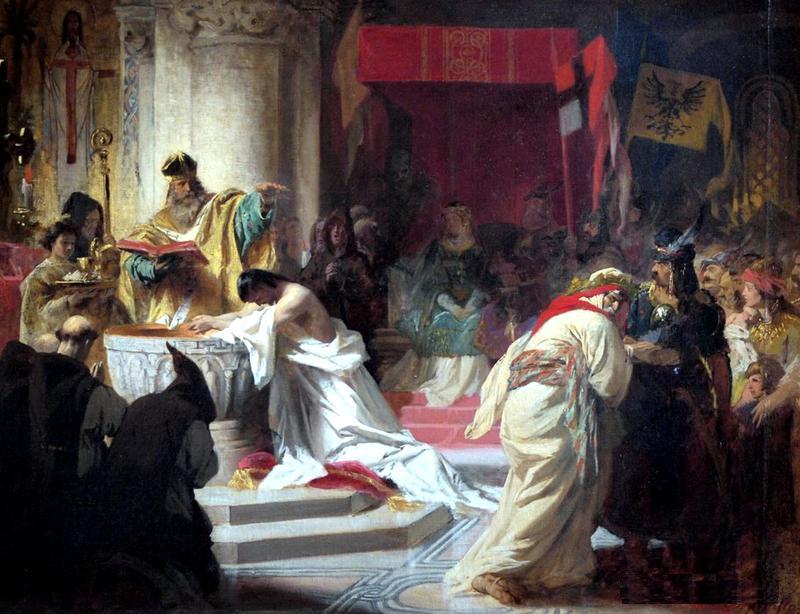
One of the most important Hungarian monarchs was King Stephen (997-1038). He was Vajk, the son of Duke Géza. His father had him baptized in his teens. He was in his early 20s when he succeeded his father (997). The Magyars did not have a tradition of hereditary monarchy. More important was seniority within the ruling family. He was thus challenged by other tribal leaders, including relatives. Stehen ruthlessy exereted his claim to leadership. Once in control he asked the Pope to raise him to royal rank. Pope Sylvester II granted his rquest. By dealing directly with the papacy, Stephen exerted Hungary's independence from both the Holy Roman Empire and the Byzabtine Empires. Stephen was crowned the first King of Hungary (1000). Thus Hungary became part of Christian Europe. He then proceeded to converting his people to Western (Latin) Christianity. He founded and financially endowed two Archbishoprics (Metropolitan Sees) and eight Bishoprics. He also founded several Benedictine monasteries. They played a major role in Christinizing the Hungarians as well as introducing viniculture. Stephen promoted the construction of Parish churches. He mandated that Sunday be a day of rest ,eaming no work. Every ten villages had to build a parish church. And To encourage attendance, he decreed that Sunday be the official market day in towns with churches. This combinedg civic commerce with religious duty. To this day Sunday is market day (piacnap/vasárnap) in Hungary. King Stephen within two decades converted pagan Hungary into a distinctively Christian coutry and pagan beliefs and customs rapidly disappeared. The Pope granted King Stephen the title Apostolic King and the right to use the Apostolic double cross. All subsequent Kings of Hungary styled themselves Apostolic until the fall of the monarchy after World War I (1918). The Hugarian nation continues to use the double cross is in Hungary's arms even to this day.

Navigate the Children in History Website:
[Return to the Main Hungarian history page]
[Return to the Main European history page]
[Introduction]
[Animals]
[Biographies]
[Chronology]
[Climatology]
[Clothing]
[Disease and Health]
[Economics]
[Geography]
[History]
[Human Nature]
[Law]
[Nationalism]
[Presidents]
[Religion]
[Royalty]
[Science]
[Social Class]
[Bibliographies]
[Contributions]
[FAQs]
[Glossaries]
[Images]
[Links]
[Registration]
[Tools]
[Children in History Home]
Navigate the Boys' Historical Clothing Belgin pages:
[Return to the Main Hungarian page]
[Hungarian choirs]
[Hungarian movies]
[Hungarain royals]
[Hungarian schools]
[Hungarian military schools]
[Hungarian youth groups]