|
The Paleolithic Era or Stone Age lasted some 3.3-2.6 million years. It was defined by the appearance of stone tools and the evolution of hunter-gatherer culture. Very little archeological evidence of this period exists beyond the stone tools. In Italy this includes both Neanderthals and subsequently modern Homo sapiens. The first humans appeared in Italy (about 850,000 BP), based on stone tool finds at Monte Poggiolo in northern Italy. 【Mutotoni, et. al.】 This would presumably be H. erectus. Next cames the Neanderthals. Altamura Man is a well preserved Neanderthal skeleton discovered in the Lamalunga Cave near Altamura, southern Italy (128,000 - 187,000 BP). Finally anatomical modern humans (H. sapies) arrived (about 43,000 BP). Modern humans created many varied cultures which settled and Sicily. The area of modern The earliest findings in Italy are the Altamura Man in Puglia and the Toirano caves in Liguria have evidence of human habitation and tool usage. Only with the Neolithic era to we have important archeological evidence. During the end of the Paleolithic era, humans began to produce the works of art and to demonstrate spiritual behavior including burials providing valuable artifacts. The Neolithic or New Stone Age as a result of remarkable advances resulted in the appearance of extensive archeological evidence, This began in Asia, Europe, and Africa (about 12,000 BC). We have what is now referred to as the 'Neolithic package' included the invention of agriculture, domestication of animals, and gradual evolution from wandering hunter-gathering to a more settled life style. All of this of course originated outside of Italy in the Near East, especially the great River Valley civilizations of Mesopotamia and Egypt. The Rock Engravings of Val Camonica north of Milan depict scenes of daily life, animals, and abstract symbols are perhaps the best evidence of Neolithic life in Italy (about 10,000 BC). 【Arcà】 They are recognized as one of the most important concentrations of prehistoric petroglyphs in the world. This population survived as nomadic hunter-gatherers. They fashioned stone tools to hunt animals and gather and process plants. Archeological evidence such as the Venus figurines and cave paintings (such as in Valcamonica area, provide important evidence as to their culture and daily life. Agriculture reached Italy as a result of the migration of Neolithic farmers from Anatolia (modern Turkey) across the Mediterranean, bringing domesticated crops and animals to southern Italy, Sicily, and Puglia (around 6000 BC). These new arrivals, often called Impressed Ware culture, introduced sheep, goats, and grains like emmer wheat and barley to existing hunter-gatherer populations. 【Radi and Pannocchia】 Agriculture gradually spread north up the peninsula (5500 BC). Evidence suggests a mix of new arrivals (carrying distinctive pottery and domesticated crops) and local Mesolithic hunter-gatherers acquiring these methods. The Neolithic Era lasted in the Near East until the transitional period of the Chalcolithic (Copper Age) (4500 BC), a little longer in Western Europe being with the development of metallurgy to the Bronze Age. From the beginning, there were destinations between northern and southern Italy. Two distinct cultures developed, the Terramaricoli people in the north (Po valley) and the Apennie in central and southern Italy. This is about the time of the appearance Ötzi, the Tyrolean Iceman (about 3200 BC). The Remedello, Rinaldone, and Gaudo cultures are late-Neolithic cultures of Italy, traces of which are primarily found in the present-day regions of Lombardy, Tuscany, Latium, and Campania. They are sometimes described as Eneolithic cultures, due to their use of primitive copper tools.
The Paleolithic Era, or Old Stone Age, is the earliest period of human prehistory, spanning from about 3.2-2.6 million years ago to roughly 10,000–12,000 years ago, defined by the development of chipped stone tools and the rise of small, nomadic hunter‑gatherer societies. It all began in Africa and before the appearance of the Homo genus. There are many Homo species, but of special importance are habilis and erectus. It was once thought thought that tool making began with handy or tool making man (Homo habilis) (2.6 million BP). They are among the earliest of the archaic humans, but masy be the most important. We now know that tool making began with earlier Hominins and even further down the primate chain. Quite a few animals use tools, but only a select few actually make tools. And only Hominins evolved with the brain power to make sophisticated tools. Before H. habilis one can reasonably debate what is and is not a manufactured tool. With H. habilis there is no longer any doubt. And over time we see increasingly sophisticated tools. This is important because actual human fossils are very rare and incomplete. Often we only have a single bone or bone fragment. Stone tools, however, do not decompose and thus are much easier to find. Humans first began migrating out of Africa around 2 million BP. This began first with Upright man H. erectus (2.0 million BP). They were followed by H. heidelbergensis (0.7 million BP), a common ancestor of Neanderthals and modern humans. Homo sapiens appeared about 315,000 BP based on a recent Moroccan find. The Ethiopian finds found earlier date to about 200,000 BP. Anatomically modern humans (Homo sapiens) began migrated out of Africa in significant waves (about 70,000–50,000 BP). The wave reaching Europe constitute the more recent individuals from that time frame.
The first humans appeared in Italy (about 850,000 BP), based on stone tool finds at Monte Poggiolo in northern Italy. 【Mutotoni, et. al.】 All we have are the stone tools. There are no fossil findings at the site. So we do not know what species was involved with any certainty. The most likely candidate is Upright Man H. erectus.
Neanderthals (H. neanderthalensis) are the closest extinct human relative to modern humans, believed to have evolved from H. heidelbergensis which had migrated out of Africa. They are the first Homimin species to establish themselves in Europe in any numbers. Neanderthals were stockier and more heavily built than modern humans and as a result better equipped at conserving body heat, very important during the ice ages. Which is why we see them in northern Europe. The Neanderthals thrived in Europe (about 400,000 BP-40,000 BP). We are sure when Neaderthals first reached Italy. Altamura Man is a well preserved Neanderthal skeleton discovered in the Lamalunga Cave near Altamura, southern Italy (128,000 - 187,000 BP). This is deep into the Neandertham period. Italian researchers have extracted DNA (dated about 90,000-100,000 BP) at Grotta del Fiume near Rome. 【UNIPI】 There is evident of Neanderthals in northern Italy (Tuscany). There are two important sites: Buca della Iena and Grotta del Capriolo (Massarosa). They have been dated to about 42,000 BP meaning, making them part of the final paase of the Neanderthal history in Europe. There is also evidence of Neanderthal sites in southern Italy. 【Oxilia, et. al.】 Modern humans interbred with Neanderthals, but did not descend from them. Thus there is a small anount of Neanderthal SNA in Europeans, but not Africans.
Anatomically modern people appear in Italy (about 43,000 BP). Evidence of several different cultures have been found. Once of the most notable were the Uluzzian people. They were contemporaneous with the last Neanderthals. 【Oxilia, et. al.】 Evidence of these people vhav been found in the Italian Peninsula and the Balkans, including Greece. Only with the Neolithic era do we have imcvreainglysinstantial archeological evidence. During the end of the Paleolithic era, humans began to produce the works of art and to demonstrate spiritual behavior including burials providing valuable artifacts. The Neolithic or New Stone Age as a result of remarkable advances resulted in the appearance of surviavle extensive archeological evidence. This began in Asia, Europe, and Africa (about 12,000 BC). We have what is now referred to as the 'Neolithic package' included the invention of agriculture, domestication of animals, and gradual evolution from wandering hunter-gathering to a more settled life style. All of this of course originated outside of Italy in the Near East, especially the great River Valley civilizations of Mesopotamia and Egypt. The Rock Engravings of Val Camonica north of Milan depict scenes of daily life, animals, and abstract symbols are perhaps the best evidence of Neolithic life in Italy (about 10,000 BC). 【Arcà】 They are recognized as one of the most important concentrations of prehistoric petroglyphs in the world. This population survived as nomadic hunter-gatherers. They fashioned stone tools to hunt animals and gather and process plants. Archeological evidence such as the Venus figurines and cave paintings (such as in Valcamonica area, provide important evidence as to their culture and daily life.
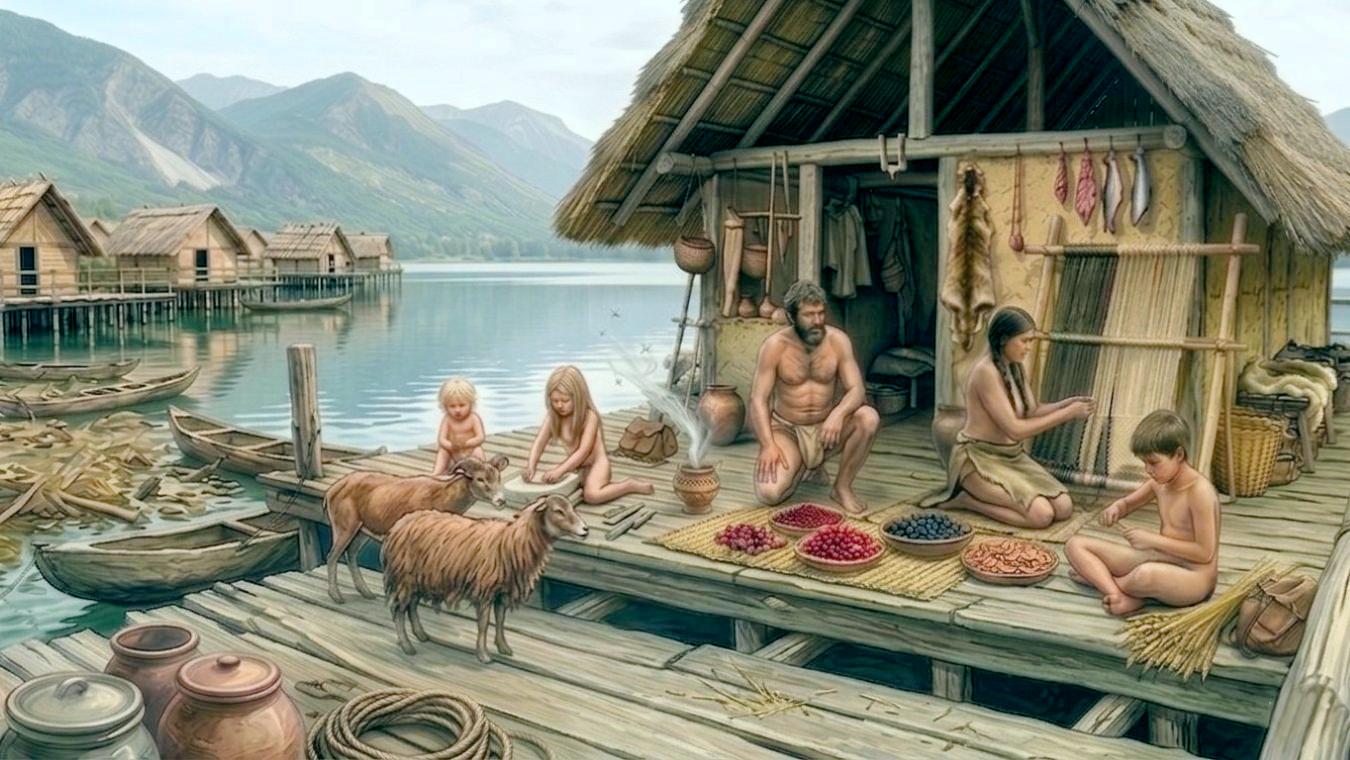
This was the dinl phase of the Neolitic era. Agriculture negan reaching Italy as a result of the migration of Neolithic farmers from Anatolia (modern Turkey) into the the wider Mediterranean area, bringing domesticated crops and animals to southern Italy, Sicily, and Puglia (around 6000 BC). These new arrivals, often called Impressed Ware culture, introduced sheep, goats, and grains like emmer wheat and barley to existing hunter-gatherer populations. 【Radi and Pannocchia】 Agriculture gradually spread north up the peninsula (5500 BC). Evidence suggests a mix of new arrivals (carrying distinctive pottery and domesticated crops) and local Mesolithic hunter-gatherers acquiring these methods. People lived by fishing, hunting, and gathering. Evolving modernity also resulted in rudimentary forms of livestock raising and the beginning of agriculture illustrated here in a lakeside piledwelling viilage (figure 1). The Neolithic Era lasted in the Near East until the transitional period of the Chalcolithic (Copper Age) (4500 BC), a little longer in Western Europe being with the development of metallurgy to the Bronze Age. From the beginning, there were destinations between northern and southern Italy. Two distinct cultures developed, the Terramaricoli people in the north (Po valley) and the Apennie in central and southern Italy. This is about the time of the appearance Ötzi, the Tyrolean Iceman (about 3200 BC). The Remedello, Rinaldone, and Gaudo cultures are late-Neolithic cultures of Italy, traces of which are primarily found in the present-day regions of Lombardy, Tuscany, Latium, and Campania. They are sometimes described as Eneolithic cultures, due to their use of primitive copper tools.
Arcà, Andrea."Chronology and interpretation of the 'Praying figures' in Valcamonica rock-art," in "Archeologia e arte rupestre: l’Europa – le Alpi – la Valcamonica, secondo convegno internazionale di archeologia rupestre,". Atti del Convegno di studi (Oottobre 2-5, 1997) Darfo Boario terme Milano, pp. 185-98)
Oxilia, Gregorio, et. al. "Direct evidence that late Neanderthal occupation precedes a technological shift in southwestern Italy," Am J Biol Anthropol (July 20, 2022) Vol. 179, No. 1, pp. 18–30.
Mutonni, G. et al., 2011. "First dated human occupation of Italy,"Earth and Planetary Science Letters, Vol. 307, Nos 3-4 2011, pp.241-52
Radi, Giovanna and Cristiana Petrinelli Pannocchia. "The beginning of the Neolithic Era in Central Italy," Quaternarty Interrnational Vol. 470 (2017)
Università di Pisa (UNIPI). "In Tuscany, two of the last Neanderthal settlements in Italy" (June 18, 2025).

Navigate the HBC Italian pages:
[Return to the Main Italian history page]
[Return to the Main ancient history page]
[Return to the Main Itlalian page]
[Return to the Main European history page]
[Italian school uniforms]
[Italian youth groups]
[Italian choirs]
[Italian movies]
[Italian royalty]
Navigate the Children in History Website:
[About Us]
[Fact Check]
[Introduction]
[Biographies]
[Chronology]
[Climatology]
[Clothing]
[Disease and Health]
[Economics]
[Freedom]
[Geography]
[History]
[Human Nature]
[Ideology]
[Law]
[Nationalism]
[Presidents]
[Religion]
[Royalty]
[Science]
[Social Class]
[Bibliographies]
[Contributions]
[FAQs]
[Glossaries]
[Images]
[Links]
[Registration]
[Tools]
[Children in History Home]