|
The family in most countries is a cornerstone of most county's society. The major exception is totalitarian countries, Communist and Fascist (both Socialist variants, where the totalitarian state aggressively intrudes on family life. The HBC family section is a valuable section. In terms of fashion, family images put boys fashion into the context of the day, showing what girls and adults were also wearing. Family images also produce insights on many other areas covered by HBC, especially the chronology, demographics, economy, ethnicity, garments, gender, and other important sections on our country pages. At this time we archived only a few Costa Rican family and information about the family is still sketchy. One issue is that peasant families in Costa Rica were not generally Amer-Indian and Mestizo families as was generally the case in Central America and they were probably small landowners, also often not the case.
The Méndez family were a peasant family photographed in front of their modest, but tidy adobe home (1933). They lived in Moravia, a canton in San José province, the province is near the Pacific Ocean but does not touch it. Moravia itself is further from the cost than most of Moravia. Much of the Canton is in the foothills of the Cordillera Central, but Morvia is located squarely in the middle of the country. We see Florentino Méndez and Elena Umaña Rodríguez with their seven children. Only the mother and the two older daughters are shod. This is rather annual. In photographs like this in other Latin American families, it is the father that was most likely to have shoes. What we do not know about the family is who owned the land. We suspect that father was a small land owner.
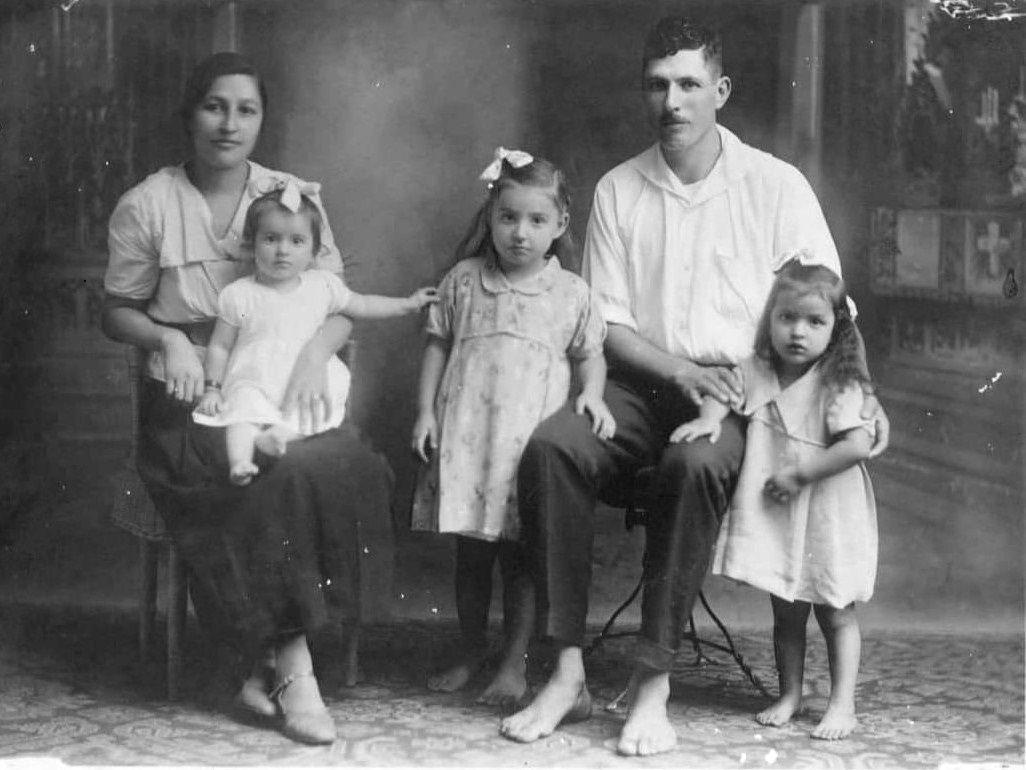
This photos were taken in the Escazú district of Costa Rica (1930s). It is a mountainous area 4 miles west of the capital, San José. Today, it is home to service and financial industries, but in the 1930s it was a rural area with many small family farms, mostly growing coffee. Unlike the rest of Central America, Costa Rican agriculture was not dominated by huge plantations and a landless pedantry. There were coffee plantations, but they did not dominate the country side like the plantations and haciendas of many Latin American countries. Here we see José and Luzmilda Flores with their three young daughters (figure 1). Many photos from that era show that in rural areas, only women owned shoes for formal occasions. We see many examples of this in the photographic record. In daily life, they too went barefoot, while men and children did not own any at all. Elsewhere in Latin America it was the father who was the most likely to ear shoes. What we do not know is how the father was employed. We think he was a small-scale farmer, who probably owned a small plot.
Here we see Juan Varela and his young family. It is what we might call a peasant family in the Costa Rican countryside (1930s) At that time, with their parents’ permission, teenagers could legally marry at age 16 years and girls at age 14 tears. Many peasants in Costa Rica at that time never wore shoes their entire lives. This was especially the case of the women. Costa Rica was south of the area to the north dominated by one of the great Amer-Indian civilization--the Maya. The regions between the southern Maya borders and Costa Rica were not empty lands. They were populated by other established and formidable indigenous groups (such as the Lenca and Chorotega) with their own fiercely defended territories and cultural identities. And the Maya never developed centralized organization that would allow them to build large armies capable of overwhelming less-civilied indigenous tribes outside of their cultural zone. In addition, the Maya agrarian economy was highly specialized
Pushing further south would have required drastic changes to their agricultural practices. After thg Spanish conquest , the peasantry in areas to the north was dominated by Amer-Indian people. The Costa Ricane peasantry was more European, primarily Spanish. Notice what might be called a cowboy hat, that is also something that you do not see commonly among the Amer-Indian peaantry in Mexico and northern Central America.

Navigate the Children in History Website:
[Return to the Main Costa Rican page]
[Return to the Main Latin American history page]
[Return to the Main Latin American page]
[About Us]
[Introduction]
[Activities]
[Biographies]
[Chronology]
[Cloth and textiles]
[Countries]
[Garments]
[Girls]
[Photography]
[Topics]
[Bibliographies]
[Contributions]
[FAQs]
[Glossaries]
[Images]
[Links]
[Registration]
[Search]
[Tools]
[Boys' Clothing Home]