|
"The Big Bang of the Indo-European languages is easily the most important event of the last five millennia in the Old World."
--Laura Spinney, Proto: How One Ancient Language Went Global
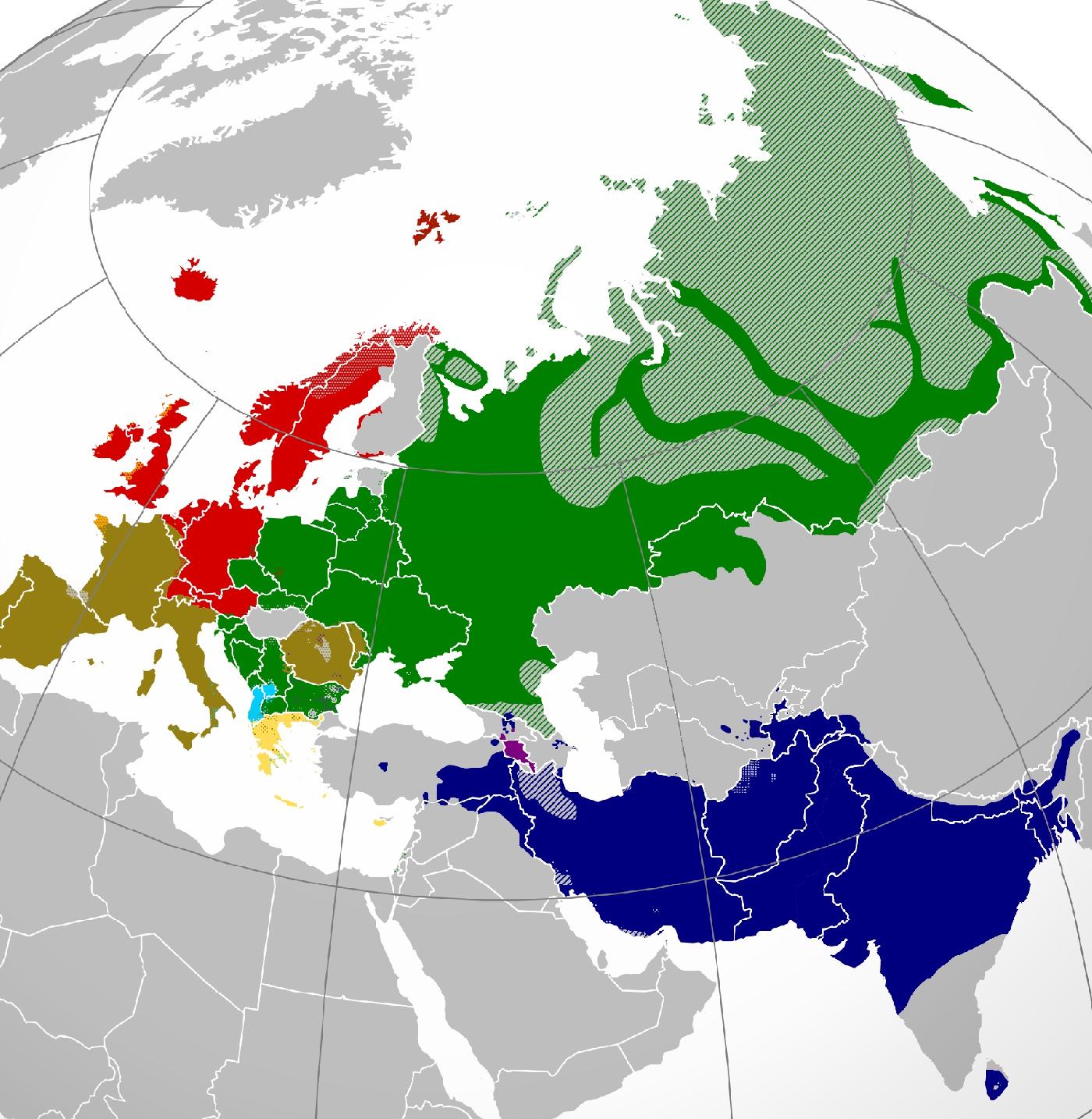
Archeological evidence reveals that The Eurasian Steppe has been inhabited since the bronze age (2000- 1500 BC). The early steppe societies are poorly known. They were pre-literate, nomadic societies. As a result they did not leave many of the artifacts that archeologists use to study early civilizations. They did work with metal and thus there are some metal artifacts, including bronze, silver and gold. Bronze axes have been found in Siberia (1500 BC). Beautiful Cimerian bronze and gold atifacts have been found north of the Black Sea (1200 BC). Some of the most beautiful gold artifact were Scythian found north of the Caspian Sea (800 BC). Hsiong-Nu bronze art have been found around Lake Baikal and China (600 BC). But these ancient peoples were relatively modern. It was linguists of ll people who began to notice undeniable similarities in widely separated modern languages. And as a result began to speculate on far earlier population with very limited physical artifacts to work with. These were languages extending thousands of miles in a diagonal band from the British Isles to South among people who seemingly had no cultural relationship. These similarities did not exist in Asian languages north of the Himalayas or of course with Amer-Indian and African languages. And slowly it became understood that there was an Indo-European language group spoken by nearly half of the world's population. The inescapable conclusion was that the was a common ancestral language and people. We now know that a small Steppe people, essentially conquered half the world. Hundreds of modern languages trace their origins to an ancient tongue spoken by a small Steppe tribe that emerged as the last ice age receded. Their language now called Proto-Indo-European began between Europe and Asia and exploded out of its Steppe cradle, fragmenting as it spread north east and south west. 【Spinney】
About 10,000 years ago just before agriculture began to shape human society, the world population was an incredibly small 5-10 million people, moistly widely separated hunter-gather bands. Linguists speculate that they spoke some 15,000 mostly long-forgotten languages. Most of these languages were spoken by very small groups of a few chundered or perhaps several thousand people. It would prove to be the period of the greatest linguistic diversity in human history despite the small population. Agriculture began to develop in Mesopotamia--(the Tigris-Euphrates). This occurred (about 8,000 BP), And soon after in Egypt (the Nile Valley), a little later in South Asia (the Indus Valley). These people were in contact with each other. The Indus Valley (Harappa) language is unknown, but Sumerian and Egyptian was very different as was Chinese and Amer-Indian languages. Linguists believe that no single language or language group at the time dominated human society. And the four great River Valley civilizations spoke four completely different languages.
Students of ancient history know that for the most part that the civilizations that mattered were the highly productive d civilizations beginning with the River Valley civilization that supported large populations and built civilization generating cities. Areas like the Eurasian Steppe with low population densities were of little importance in the wide sweep of history. This changed for brief period, just as agriculture in the great River Valley civilization was transforming human society . And in changed because of two cutting edge new technologies. First the invention of the wheel and second because of domestication of the horse. One author writes, "The domestication of the horse by the Yamnaya is circumstantial, but the circumstance in question is the conquest of much of Europe in he space of a few brief generations ... Such a feat seems miraculous. For my money, the horse is the missing piece we need to render comprehensible the unprecedented speed of the Yamnaya advance across and far beyond the steppe." 【Khan】
The wheel was invented before writing. Thus it is impossible to know who invented the wheel. It is believed that the wheel was probably not invented by any one individual, but rather.probably emerged independently across Eurasia. Historians for years credited Sumerians in Mesopotamia for inventing the wheel (c3500–4000 BC), probably not beginning with transport. Rather they may have pottery wheels and heavy-load rollers. One plausible theory is that the wheel emerged from the use of logs as rollers to move heavy objects. The logs were over time narrowed into wheels and axles.
Spoked wheels came more than a millennium after the frst wheels appeared (c2000 BC). This may have occurred in Anatolia. The wheel had both military and economic importance. The wheel led to chariots--formidable ancient weapons. It also led to wagons of great importance. It significantly increased jato human could produce, carry, and transport and thus marker.
The horse has a strange evolutionary history and one that is still being worked out. Scientists trace the origins of the horse, not to Eurasian Steppe but to the forests of North America. Here the first ancestor of the modern horse browsed leaves and fruits (about 50 million BP). There is some difference of opinion on the date. It was a rather small ancestor, only about 2 feet high. Scientists call it eohippus (dawn horse). The modern horse developed and flourished on the steppe like grasslands of North America (about 1.5 million BP). Soon after in geological time, before the evolution of modern man, these animals migrated across a Bearing Sea land bridge into Asia (0.9 million BP). Just as humans migrated east across a later the Bearing Sea land bridge during the Ice Age, horse appear to have migrated east into Asia. Native Americans came in contact with horses and many other large mammals, but did not domesticate them. Horses given the climatic conditions of Siberia and Alaska would have been unfamiliar to the original Ice Age settler of North America. The animals disappeared in the Americas (about 7,000 BC). Anthropologists today debate why this occurred. It may have been over-hunting, but climatic conditions may also have been involved. It was on the Europe am Steppe that men a horse first came in contact. The horse would have appeared first on the Asian Steppe, but spread very rapidly to the European Steppe. (We know this because of the speed with which feral horses escaping from the Spanish haciendas spread out and colonized the American prairie during the 16th century.) We know a great deal about this encounter. Early man at first hunted horses for meat. Excavating paleolithic sites in Eurasia show that horses were butchered for meat. The extent of horse bones suggest that they were an important source of meat. But something was different about the horse. The speed and spirit of the horse was unlike any other animal. They fired the imagination of the nomadic people who encountered them. 【Lobell and Powell, pp. 28-29】 This can easily be seen because no other animal appears so extensively in cave art. There were different horse species. As in the Americas, almost all of these species disappeared, especially the forest species. Climate and habitat issues may have been involved. But on the Steppe, the modern horse flourished (Equus cabulus). And this is where human migrating out of Africa uncounted them. By this time, man had already domesticated livestock (cattle and sheep). The step of domesticating horses was a natural step to a people already herding livestock. And the horse besides it innate appeal had real advantages did not develop in the Middle East. It was habituated to the Steppe, meaning it could survive by itself through winters while cattle and sheep had to be fed which meant work. As one archaeologist explains, "Horses are easier to feed through harsh winters than sheep or cattle. they are well adapted to winter on the steppe, and can break through ice and snow with their hooves to reach winter grass to feed themselves." 【Anthony】 Bone carvings suggest that the early Steppe people kept horses and cattle together, perhaps for this reason. Man began domesticating horses on the European Steppe, in the Ukraine and southern Russia (about 5,000 BC). 【Lobell and Powell, p.29.】 Other sources suggest about 6,000 BC. The horse proved useful as a pack animal, but researchers believe that from a very early point, men began riding them. There is strong evidence of riding behavior (3,500 BC). And chariots first appeared (about 2000 BC. With the invention of the chariot it became a major element in warfare. The invention of the stirrup by the Scynthians made it an even more potent military weapon, allowing warriors to effectively wield weapons from a horse. Even before the adaption of the horse for warfare. horses greatly increased the efficiency of herding.
The Yamnaya people (c3300–2600 BC) were a relatively small,
nomadic Bronze Age pastoral society also known as the pit grave culture which appeared in the Pontic-Caspian steppe (modern Ukraine). 【Morgunova and Khokhlova 】 They were nomadic herders who lived on the grasslands of the Eurasian Steppe, raising cattle, sheep, and most notably horses. As a result, they left little physical trace, No cities, no monumental architecture. They were not the first to domesticate the horse. But it was done on the steppe. It may have been done by the Botai people to the east. Nor were they the group which invented the wheel. This apparently occurred by peoples to the west. But the Yamnaya seem to be the first to successfully put the two technologies together. The Yanmaya were renowned for horse riding and wheeled vehicles. This led to migrations into Europe and Asian. Now there are other theories about Indo-Europeans such as the Anatolian agricultural and the Out of Asia hypothesis thesis. And the role of the Yamnaya is intensely debated by archeologists. But the Yamnaya thesis seems to be very likely because of the spread of patralineal social structures and the now traceable genetic imprint which DNA allows us to study. Genetic studies shoe that the Cordered Ware culture which pre-dates the Celts and Germanic share a large percentage of DNA . 【Lobell and Powell】 Countries speaking Indo-European languages (both in Europe and Asia) have populations with discernible Steppe traces. , shaping modern Eurasian genetics, languages, and social structures. And they were placed at the center of developments to the east and west. The Yamnaya is a name given to these by academic researchers. It comes from the Russian yama, meaning 'pit' because they buried high ranking individuals in 'kurgans' (earthen burial mounds) along with their tools, weapons, and wagons.
Their diet as with other Steppe people was largely pastoral (dairy products (including horse milk) and meat. There was very limed agriculture. We know little about their religion, except their burial rituals in kurgans. We have found their grave goods and use of ochre—. This suggests complex beliefs such as ancestor worship and social hierarchy,
Some anthropologists believe that the same Anatolian farmers that introduced farming to Europe are the ones who introduced Indo-European languages. 【Dutchen】There is also the Out of India hypothesis.
Anthony, David W. The Horse, the Wheel, and Language: How Bronze-Age Riders from the Eurasian Steppes Shaped the Modern World (Princeton University Press).
Dutchen, Stephanie. "A steppe forward," Harvard Medicine News (March 2, 2015).
Khan, Razib.
Lobell, Jarrett A. and Eric A. Powell. "The story of the horse: How its unique role in human culture transformed history," Archaeology (July/August 2015), pp. 28-33.
Morgunova, Nina and Olga Khokhlova(2013). "Chronology and Periodization of the Pit-Grave Culture in the Area Between the Volga and Ural Rivers Based on 14C Dating and Paleopedological Research". Radiocarbon. (2013) Vol. 55, Nos. 2–3..
Spinney, Laura. Proto: How One Ancient Language Went Global (2025).
Stoneking, Mark, Leonardo Aria, Dangnn Liu, Sandra Oliveira, Irina Pugach, and Jae Joseph Russell B. Rodriguez, "Genomic perspectives on human dispersals during the Holocene," Proceedings of the National Academy of Sciences Vol. 120, No. 4 (January 24, 2023).
TNN. Mangaluru vsarsity stdy hows sgared paternal ancestry anong Brahmins across India, The Times of India (August 18, 2025).

Navigate the Children in History Website:
[Return to the main Main Steppe Crucible page]
[Return to the main Main Mongolian history page]
[Return to the main Main Asian history page]
[Return to the main Main horse page]
[Introduction]
[Biographies]
[Chronology]
[Climatology]
[Clothing]
[Disease and Health]
[Economics]
[Geography]
[History]
[Human Nature]
[Law]
[Nationalism]
[Presidents]
[Religion]
[Royalty]
[Science]
[Social Class]
[Bibliographies]
[Contributions]
[FAQs]
[Glossaries]
[Images]
[Links]
[Registration]
[Tools]
[Children in History Home]
Navigate the Boys' Historical Clothing national pages:
[Albania]
[Austria]
[Bosnia]
[Croatia]
[Hungary]
[Romania]
[Serbia]
[Slovenia]
[Australia]
[Belgium]
[England]
[France]
[Germany]
[Ireland]
[Italy]
[Japan]
[Korea]
[Mexico]
[New Zealand]
[Scotland]
[United States]